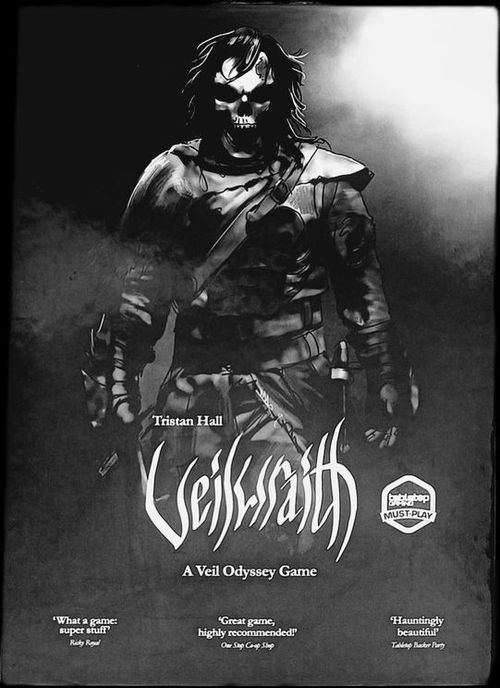
Veilwraith: A Veil Odyssey Game
Veilwraith: A Veil Odyssey Game Rulebook
Table of Contents
Table of Contents
Components
- This Rulebook
- 20 Power Tokens
- 20 Veil Crystals
- 10 Divider Cards
- 5 Silver Ribbons
- 3 Action Power Tokens
- 1 Spirit Dial
- 122 Cards:
- 40 Threats
- 34 Memory Upgrades
- 20 Basic Memories
- 12 Foes
- 5 Keys
- 5 Vignettes
- 3 Actions (2-sided)
- 1 Archfiend
- 1 Portal
- 1 Reference Card
Component Notes
Ribbons – Each time a Veilwraith loses a game, they lose a silver Ribbon, and their connection to the Vana lands weakens. If no Ribbons remain they lose the Campaign and must restart from Vignette number 1. Some game effects bestow additional Ribbons, but the maximum limit is 5 Ribbons.
Spirit Dial – This shows the Veilwraith's remaining Spirit. If the Veilwraith's Spirit ever runs out they fade from the world and lose the game. The maximum limit is 20 Spirit.
Power Tokens – These are placed on Actions to increase their effectiveness. A Power Token may be spent to increase the Power of its Action by 1.
Action Power Tokens – These determine the Power of the Veilwraith's 3 Actions. Each number on the Basic Action Power Tokens (1, 2, or 3) is a Power number and shows the current Power of the Action beneath it. The Advanced Action Power Tokens are on the reverse side (with circled numbers 2, 3, and 4) and may be upgraded to during a Campaign. Advanced Action Power Tokens may also be utilised for an easier game experience (see Game Difficulty Variants).
Actions – There are 3 Basic Actions that the Veilwraith may choose from each turn to interact with the Threats they will meet: Explore, Fight, and Influence. Throughout the Campaign when certain Vignettes are defeated, Actions may be upgraded to their advanced versions: Hunt, Assault, and Charm – simply flip the Action to its upgraded side, which has circles around the icon image.
Vignettes – Each Vignette displays the setup instructions and win requirements for the game. Some Vignettes also have their own special ability, which changes how that particular Vignette plays. Defeat all of the Vignettes in order to win the Campaign!
The Explore value on the Vignette determines how difficult it is to find the Portal through which the Veilwraith must escape.
Threats – Threats (Anima, Deja, Foes, and Keys) comprise the Threat deck. The Veilwraith must defeat, placate or avoid these Threats to escape from the Vignette successfully. When a Threat is defeated it is removed from play and placed in the Threat deck's discard pile. Threats can have certain text abilities that trigger when they come into play, when they are defeated, or that are ongoing whilst they are still in play.
Threats have a number of Threat values:
- Explore – How much Explore Power is needed to defeat the Threat.
- Fight – How much Fight Power is needed to defeat the Threat.
- Influence – How much Influence Power is needed to defeat the Threat.
Threats also have a number of Spirit values:
- Spirit Cost – How much Spirit the Veilwraith loses if the Threat remains in play at the end of the game round.
- Spirit Boost – How much Spirit the Veilwraith gains if the Threat is defeated.
- Veil Crystals – These crystal tokens may optionally be used to track: damage to Foes, number of Keys/Foes remaining in a Vignette, or other game effects.
Keys – The 5 Keys are the most sovereign memories of the world that once was. The Veilwraith must collect all 5 Keys to locate the Portal and escape the Vignette. The Keys are hidden amongst various Foes and Threats in the Threat deck. Keys also display a 'Key' symbol to quickly identify them when they emerge from the Threat deck.
Foes – Foes are the most powerful Threats in the Threat deck. The Veilwraith must defeat them all to complete the Vignette. Like Keys, Foes are found in the Threat deck. When a Foe is defeated it is removed from the game.
Archfiend – If too much time is spent in one Vignette, the Overlord is alerted and will send forth his invincible avatar (the Archfiend) to obliterate the Veilwraith. This card is added to the Threat deck when it runs out and must be reshuffled. If the Veilwraith ever draws the Archfiend they instantly lose the game – nothing can cancel this. The Archfiend has its own 'Archfiend' symbol.
Memories – These are the Veilwraith's special abilities, played to overcome Threats and Foes and discover Keys. The Veilwraith draws one Memory from their Memory deck into their hand every round during the Draw Phase, and may play as many Memories as they like during their turn. Card abilities that reference 'your deck' or 'your discard pile' are referring to the Memory deck and discard pile.
Memory Upgrades – As the Veilwraith progresses through the Campaign they can improve the abilities of their Memory deck by earning these upgraded Memories after each game.
Memories and Memory Upgrades display a 'wisp of memory' symbol to identify them more easily in case they happen to be shuffled together with Threat cards…
Memories also have a Combine value:
- Combine – How much Power the Veilwraith can gain if this Memory is Combined with another Memory.
Portal – A doorway between worlds. Once the Veilwraith has collected all 5 Keys, and after they defeat all of the Vignette's Foes, the Portal comes into play. The Veilwraith must defeat the Portal (as detailed on the current Vignette) to escape and win the game before the Archfiend discovers them. Foes and Keys may be defeated in any order, but they must all be defeated before the Portal can be defeated. The Portal has its own 'Portal' symbol.
World Terms
VEILWRAITH is a card game for 1 player (hereafter the 'Veilwraith'), which can also be played multiplayer with up to 4 Veilwraiths, where each Veilwraith must have their own copy of the game. As the eponymous Veilwraith you are a remnant of what once was – an unearthly being sent back through the Veil by an impossible twist of fate.
VANA: In the seared lands or 'Vana' that has been left behind after the end of all things, fragmented memories of trapped souls continue to try to break through the shattered Veil.
DEJA: Some spirits remain because of an intractable bond with the life they left behind, and some remain because of strong magicks, or curses, or the tragedy of their fate – these souls are the Deja. Their very presence threatens to drain your soul unless you can help them find peace.
ANIMA: Other more malicious entities patrol the Vana too, clinging to a shadowy vestige of wraithlike half-life. The twisted Anima are creatures and spirits driven by madness and evil: demons, monsters, damned souls, and puppets of the Overlord Himself.
KEYS: You must traverse the corrupted Vana, searching for and weaving together a series of disparate memories called Keys that can restore light, colour, and life to this broken, blackened world.
MEMORIES: But you are not helpless. Gifted with unusual talents you can avail yourself of powerful memories from the stories that came before; memories which are all that remain to lend hope to this ravaged land.
Game Objective
Veilwraith is played over a series of games or 'Vignettes' which together make up a Campaign. Each game, the Veilwraith selects a Vignette to play through for that game. For the first game, the Veilwraith should select Vignette number 1 Lost Ruins. Each game, the Veilwraith must collect 5 Keys and defeat all of that Vignette's Foes, all whilst evading the watchful eye of the Archfiend. Once they have collected all 5 Keys and defeated all the Vignette's Foes, only then can the Veilwraith try to reach the Portal in time to escape back beyond the Veil and win the game.
Victory: The Veilwraith wins the game and escapes immediately once they have…
- Collected all 5 Keys, and
- Revealed and defeated all of the Vignette's Foes (even if other Threats are still in play), and
- Defeated the Portal.
Defeat: The Veilwraith immediately loses the game if their connection to the world is severed. This happens if…
- They run out of Spirit, or
- They encounter the Archfiend.
If the Veilwraith loses a game they lose 1 silver Ribbon – a mysterious vestige connecting them to what remains of this broken world – and must restart the same Vignette. If the Veilwraith loses all of their Ribbons, their connection to the world is permanently destroyed: they lose the Campaign and must restart.
When a Veilwraith wins a game they move on to the next Vignette in numerical order, e.g. if a Veilwraith beats Vignette 1 'Lost Ruins', next they should play Vignette 2 'Nesting Woods'.
If the Veilwraith wins all of the Vignettes, in numerical order, before they run out of Ribbons, they win the Campaign! Next time they start a new Campaign they should increase the difficulty as follows:
a. reduce their total number of Ribbons by 1, and
b. ignore any Gain 1 Ribbon rewards when defeating Vignettes.
The ultimate challenge is to defeat all Vignettes with only 1 Ribbon!
Alternative Stand-Alone Game: The Veilwraith may choose any single Vignette to play through, but does not record Ribbons for a Campaign. This lets the Veilwraith a) play through Vignettes they might otherwise take longer to reach, and b) try to figure each Vignette out first before committing to them within a Campaign. They will need to upgrade their Memory deck first though (see Game End).
The Monochrome Rule: Unless specifically stated, effects on cards always take precedence over the rules in this rulebook.
Setup
-
Action Power Tokens and Actions: Place the Action Power Tokens Basic-side up (numbers 1, 2, and 3 going left to right) into the Play Area – the area in front of the Veilwraith – then…
- Place the Explore Action Basic side up* beneath the number '1' Action Power Token.
- Place the Fight Action Basic side up beneath the number '2' Action Power Token.
- Place the Influence Action Basic side up beneath the number '3' Action Power Token.
It helps to remember that the Actions are placed alphabetically.
* The Advanced side of an Action is labelled and has a circle around the Action icon (and better abilities), the Basic side doesn't.
Advanced Variant: The Veilwraith chooses the order of Actions beneath the Action Power Tokens.
Beginner Variant: The Veilwraith starts with 1 Action Power Token flipped to its Advanced side (with circles around the icon).
-
Spirit Dial: Set it to 20 and place it in the Play Area to show the Veilwraith's remaining Spirit.
-
Power Tokens: Gather the Power Tokens and set them to one side out of the Play Area but within reach.
-
Memory Deck: Shuffle the 20 Basic Memory deck cards – Basic Memory cards are labelled as such and each have a Combine value of 1 – and place them face-down in front of the Veilwraith. The Veilwraith begins with no Memories in their hand (until the first Draw Phase).
-
Vignette + Threat Deck Stacks: Choose a Vignette and follow its Setup instructions to assemble the Threat deck using 5 Stacks (follow steps a. to d. below).
Gameplay
Veilwraith is played over a number of rounds. Each round, Threats will emerge from the Threat deck for the Veilwraith to try to defeat. On their turn the Veilwraith can:
- Play any number of Memories from their hand to improve their situation,
- Combine pairs of Memories to add Power to Actions in order to boost them,
- Tilt one Action to add a Power Token to it in order to boost that Action,
- Use one Action to try to defeat a Threat in the Threat Area, and
- Use special Key abilities.
They are attempting to find all 5 Keys, defeat all of the Vignette's Foes, and escape through the Portal as quickly as possible to win.
Each round consists of the following five Phases, which are explained in more detail below:
- Threat – 1 Threat is drawn.
- Draw – The Veilwraith draws 1 Memory.
- Play – The Veilwraith takes their turn.
- Spirit – The Veilwraith loses Spirit from all Threats still in play.
- End – The game area is reset, ready for the next round.
1. Threat Phase
-
Any cards in play that have Start of Round: abilities (see Glossary) activate now.
-
Then the Veilwraith draws and plays 1 Threat from the Threat deck * face-up onto the table in an area in front of them – this area is called the Threat Area. The Threat Area may contain any number of Threats, and all Threats stay in play until they have been defeated or discarded by an effect.
-
Immediately activate any Played: abilities on the newly played Threat, if any.
-
Archfiend: If the Veilwraith goes to draw a Threat but the Threat deck is empty, take the set-aside Archfiend and shuffle it into the discarded Threats to form a new Threat deck to draw from.
* If the Archfiend is ever drawn, the game ends instantly in defeat.
2. Draw Phase
At the start of the Draw Phase, the Veilwraith draws 1 Memory into their hand. If the Veilwraith goes to draw a Memory but the Memory deck is empty, immediately shuffle the Memory discard pile to form a new Memory deck to draw from.
Forgetting to draw a Threat or Memory? Why not draw both at the same time and resolve the Threat first, and then your new Memory will be in hand already! Next up, the Veilwraith will endeavour to tackle any Threats in play during the Play Phase…
3. Play Phase
The Play Phase is when the Veilwraith takes their turn. In any order, the Veilwraith may do any, none, or all five of the following activities, which are described in more detail below.
- a. PLAY: Play any number of Memories from hand.
- b. COMBINE: Combine 2 Memories to add Power to an Action.
- c. TILT 1 Action (once per round): Rotate the Action by 45 degrees, and add 1 Power Token to it (Limit: 5 Power Tokens per Action).
- d. USE 1 Action (once per round): Rotate the Action a full 90 degrees sideways, Use that Action, then move it beneath the number '1' Action Power Token, pushing the other two Actions up one space if necessary.
- e. KEY Abilities: Turn or Flip a Key in the Play Area to activate one of its special abilities.
a. PLAY Memories – Play any number of Memories from hand. Memories may be played at any time, including during an Action, or outside of the Play Phase. Activate any or all (or none) of the abilities on any Memory played, then place it face-up into the Play Area to show that it has now been spent. Memories that give a bonus to an Action should be placed next to that Action in the Play Area, e.g. the Veilwraith plays Memory of Blood, which gives +2 Fight, and so places Memory of Blood next to their Fight Action.
At the end of the round, during the End Phase, all played Memories are discarded to the Memory discard pile.
b. COMBINE 2 Memories – Discard any 2 Memories to add Power equal to the lowest Combine number shown on either card to an Action that is being Used (see below). Power from Combining is spent immediately; any excess Power not spent is lost. Performing a Combine does not Tilt or Use an Action. Combine may be performed multiple times per Play Phase.
c. TILT 1 Action (Limit: once per round) – Select an Action that is not already Tilted or Used. Tilt the Action: rotate it 45 degrees, then add 1 Power Token to it from the supply (up to a maximum of 5 Power Tokens per Action).
A Tilted Action may not be Used this turn. However, in a future turn when this Action is Used, any number of Power Tokens on this Action may be spent to increase its Power.
d. USE 1 Action (Limit: once per round) – Choose a Threat in the Threat Area as the target for this Action and defeat its Threat value in one go. Select an Action that is not already Tilted or Used. Exhaust the Action – rotate it 90 degrees sideways (as opposed to Tilting it 45 degrees) to show that this Action is being Used.
Determine the Action's Power by adding together:
- The Power number on the Action Power Token above the Action,
- The Power of any Memories played next to the Action (Memories that increase an Action's Power must be played in conjunction with triggering an Action – i.e. Memories cannot normally be played in isolation to defeat a Threat),
- The Power generated by Memories that have been Combined for the Action,
- Any number of Power Tokens on the Action may be discarded back to the supply too, adding 1 Power per discarded Power Token (Power Tokens do not have to be discarded when their Action is Used, and unused Power Tokens are not discarded),
Example: The Veilwraith Uses a basic Fight Action beneath the number '2' Action Power Token (2 Power). The Fight Action has 2 Power Tokens on it, so they spend 1 Power Token (leaving the other on the Action) for a total of 3 Power, to defeat a Threat with 3 Fight.
Then perform the Action on the card…
-
Fight: If the Power of the Fight Action is equal to or greater than the Fight value of the target Threat in the Threat Area, that Threat is defeated (see below).
-
Influence: If the Power of the Influence Action is equal to or greater than the Influence value of the target Threat in the Threat Area, that Threat is defeated.
-
Explore: If the Power of the Explore Action is equal to or greater than the Explore value of the target Threat in the Threat Area (usually a Key, a Threat, a Foe, or even the Portal itself), that Threat is defeated.
If the Threat defeated is the 5th Key, and all of the Vignette's Foes have been defeated, then the set-aside Portal immediately comes into play in the Threat Area.
Draw: All Actions have an alternative Draw option too. Instead of Influencing, Fighting, or Exploring, a Veilwraith may Use any Action to Draw 1 Memory from the Memory deck. The Draw option is useful for tactically manoeuvring Actions around the Action Power Tokens.
After performing the Action, move the Used Action (keeping it Exhausted) to the position beneath the number '1' Action Power Token. This will usually push the other two unused Actions up one position: they are moved up to the positions beneath Action Power Token numbers '2' and '3', respectively.
Exception: If the Used Action was already beneath the number '1' Action Power Token it will simply remain where it is.
Defeated Keys: When a Key is defeated by an Explore Action it is removed from the Threat Area and added to the Veilwraith's Play Area. Keys in the Play Area have special abilities that may be activated at any time during the Play Phase as long as the Key is not face-down…
e. KEY Abilities – The Veilwraith may either Turn (Exhaust) or Flip a Key in their Play Area that is not already Turned or Flipped to activate one of its special abilities. Multiple Keys and Key abilities may be activated each round, but each ability can only be activated once per game.
Both of a Key's abilities might be activated during the same Play Phase resulting in three possible combinations:
- i. Turn ability only,
- ii. Flip ability only,
- iii. Turn ability first, followed by Flip ability.
Turn: Rotate the Key 90 degrees and immediately Use 1 Action that is not already Tilted or Used (rotate the selected Action 90 degrees sideways as normal). This way a Veilwraith can activate Keys to perform an extra Action (or two!) in addition to their regular Action in the same turn. Keys do not reset after Turning, so their Turn ability can only be activated once per game, though they may still be Flipped…
Flip: Flip the Key face-down to activate its Flip ability. Each Key's Flip ability can only be activated once per game. Flipped Keys may no longer be Flipped or Turned, but they stay in the Play Area to show how many Keys have been collected.
Example: A Key with the abilities 'Turn: Use 1 additional available Action' and 'Flip: Add 1 Power Token to a Fight Action' may be Turned during a Veilwraith's same Play Phase to give 1 extra Action, and then add 1 Power Token to a Fight Action.
5th Key Collected + Foes Defeated = Portal: When the Veilwraith has collected all 5 Keys into their Play Area (whether they are Flipped, Turned, or otherwise) and defeated all of the Vignette's Foes, they immediately add the set-aside Portal into the Threat Area. The Veilwraith now just needs to defeat the Vignette's Explore value to escape through the Portal and win the game!
Defeated Threats: When a Threat is defeated it is placed in the discard pile next to the Threat deck. If the defeated Threat has a Defeat: ability, it activates as soon as the Threat is defeated.
Defeated Foes: When a Foe is defeated it is removed from the game – set it to one side as a reminder. The Veilwraith must find and defeat all of the Vignette's Foes to win the game.
Threat Spirit Boost: After a Threat has been defeated, if it has a Spirit Boost value (e.g.: the Goblin King Foe has a Spirit Boost value of +1), the Veilwraith immediately regains that amount of Spirit.
Multiple Threat Values: Some Threats have multiple Threat values – e.g. a Fight value AND an Influence value – in this case the Veilwraith chooses which value to try to defeat.
Multiple Threat Values with * symbols: If there are multiple Threat values with the * symbol, ALL of these Threat values must be defeated using separate Actions to defeat the Threat. Track which values on a Threat have already been defeated by placing a Veil Crystal over the defeated value. Multiple Threat * values may be defeated in any order, and even over multiple rounds.
Example: The Goblin King requires an Influence Action of Power 6* or more and a Fight Action of Power 6* or more to be defeated.
Note that even if the Veilwraith continues to survive each round, eventually (usually after 30 rounds) the Threat deck will run out of cards. The Threat discard pile will have to be shuffled to form a new Threat deck. At this point the set-aside Archfiend is shuffled into the Threat deck, and time starts running out for the Veilwraith!
4. Spirit Phase
Add up the Spirit Cost value of every Threat in the Threat Area. The Veilwraith then loses that much Spirit. If they have no Spirit remaining they lose the game (see Game End).
5. End Phase
- a. Discard: Discard from play any Memories that have been played this round.
- b. Memory Limit: If the Veilwraith has more than 6 Memories in their hand they must choose and Play or discard any number of Memories until they have only 6 Memories in their hand. Keys do not count towards this limit because they are in play, not in hand.
- c. Actions Reset: The Veilwraith then resets their Actions – cards are reset by rotating them back to their original upright state. Note: Keys are not reset after being Turned or Flipped.
- d. End of Round: Any End of Round: abilities on cards in play activate. Then a new round begins with a new Threat Phase.
Ending the Game
Rounds continue – each round consisting of the 5 Phases listed above – until the Veilwraith succeeds in their quest by having achieved all of the following:
- Collected all 5 Keys, and
- Revealed and defeated all of the Vignette's Foes (even if other Threats are still in play), and, finally
- Defeated the Portal in the Threat Area (by defeating the Vignette's Explore value).
Otherwise the Veilwraith suffers defeat. This happens if:
- They run out of Spirit, or
- They encounter the Archfiend.
Game End
Complete each game in the Campaign by following these steps:
a. Memory Upgrades
b. Other Rewards
c. Non-Memory cards
d. Restore Spirit
e. Next Vignette
a. Memory Upgrades: As their impossible journey continues and they discover more Keys, the Veilwraith's connection to the world becomes stronger, and their Memories grow more clear and powerful. Whenever the Veilwraith defeats a Vignette they may upgrade their Memory deck as follows…
- The Veilwraith chooses a Memory in their Memory deck and returns 1 copy of that Memory to the game box, AND
- They choose 1 Memory Upgrade – e.g. Memory of Heaven – from the Memory Upgrades in the game box. The Memory Upgrade must be either the same Combine value or one higher than the Memory they just removed (e.g. a Combine 1 Memory can be upgraded to a Combine 2 Memory). They add 1 copy of that Memory Upgrade card to their Memory deck.
Boxed: If a Memory Upgrade lists a 'Boxed:' Memory, that listed Memory must already have been returned to the game box, e.g. each Memory of Locus must replace its own separate copy of Memory of Heart.
Memory Upgrades with a Combine value of 3 or higher may only be chosen after at least 1 Campaign has been completed successfully.
Memory decks cannot contain less than 20 Memories.
Chosen upgrades remain for the rest of the Campaign, so choose wisely!
If the game was a defeat:
-
The Veilwraith loses 1 Ribbon (return it to the box) and must restart the same Vignette the next time they play.
If a Veilwraith loses all 5 Ribbons, they lose the Campaign.
b. Other Rewards: Some Vignettes offer other bonuses when defeated such as Gain 1 Ribbon (to a maximum of 5 Ribbons) or Upgrade an Action or Action Power Token (simply flip the Action card or Token over to its upgraded side), and these rewards are claimed before starting the next Vignette.
c. Non-Memory cards: Remove any cards from the Memory deck that are neither Memories nor Memory Upgrades.
d. Restore Spirit: Before starting their next game the Veilwraith restores their Spirit to their maximum, usually 20.
e. Next Vignette: Finally, they set up the next Vignette and continue the Campaign.
Stand-alone game: To play any Vignette outside of a Campaign first upgrade the Memory deck a number of times equal to the number of previous Vignettes, e.g. to play Weald Heart (Vignette number 4) outside of a Campaign the Veilwraith first performs 3 Memory Upgrades. Then activate any 'Defeat:' benefits/penalties from those previous Vignettes.
The Campaign
If the Veilwraith defeats all of the Vignettes, in numerical order, before they run out of Ribbons, they win the Campaign! The next time they start a new Campaign they should increase the difficulty:
a. Reduce their total number of Ribbons by 1, and
b. Ignore Gain 1 Ribbon effects when defeating Vignettes.
The ultimate challenge is to defeat all Vignettes in order with only 1 Ribbon!
Rogue Wraith Mode: Whenever the Veilwraith wins a Campaign they make one permanent Memory Upgrade to their Basic Memory deck before starting their next Campaign and reduce their maximum Spirit by 1.
Variants
Game Difficulty Variants
Easy Dream: Start with 1 Action Power Token already flipped to its Advanced Action Power Token side.
Day Dream: Spend 1 Ribbon to entirely skip a non-final Vignette.
Veil Veteran: Start the Campaign with just 3 Ribbons instead of 5.
Nightmare: For each Memory Upgrade, either remove a Memory or add a Memory Upgrade, not both. Nightmare Memory decks cannot contain less than 19 Memories, and added Memory Upgrades must still be either the same Combine value or one higher than the last Memory removed.
Endworld: Start the Campaign with just 1 Ribbon instead of 5.
Absolute Absolution: If playing with the Absolution expansion, once Vignette 5 has been defeated, restart at Vignette 6 (instead of restarting Vignette 1) whenever a Campaign is lost – follow the Stand-alone game rules described above.
Multiplayer Game
To play Veilwraith with more than one player, each player must have their own copy of the game.
Cooperative Team Play
The Lady has sent more than one emissary back into the gloom!
Reduce the maximum Spirit of each Veilwraith to these values…
- 2 Veilwraiths: 18 Spirit
- 3 Veilwraiths: 17 Spirit
- 4 Veilwraiths: 16 Spirit
The team shares 5 Ribbons for the Campaign. Starting with Vignette 1 Lost Ruins, each Veilwraith sets up their own copy of the game as normal, with their own Threat and Memory decks and Play Areas and Threat Areas. They play through each phase at the same time, simultaneously as follows:
- Threat – Each Veilwraith draws a Threat and places it into their own Threat Area.
- Draw – Each Veilwraith draws a Memory.
- Play – Each Veilwraith takes their turn, but when Playing Memories and Using Actions they may coordinate and help each other out by targeting Threats in any Play Area.
- Spirit – Each Veilwraith loses Spirit from Threats in their own Threat Area only.
Victory – Any Veilwraith who escapes the Portal and wins is removed from the game. If all Veilwraiths win, everyone wins as a team. But if just one Veilwraith loses the game, everyone loses together. The team loses 1 Ribbon and must restart the Vignette.
Joining an existing Campaign: If a new Veilwraith joins an ongoing Campaign, to catch up they first upgrade their Memory deck a number of times equal to the number of previously defeated Vignettes, e.g. to join a Campaign at Weald Heart (Vignette 4), they perform 3 Memory Upgrades. They then activate any appropriate 'Defeat:' benefits/penalties from all previous Vignettes.
Competitive Play
The Overlord has sent his own nefarious emissaries to compete against the Lady for control of the fleeting memories from a world destroyed.
Competitive play functions the same way as Cooperative play (above), but each Vignette is played by opposing Veilwraiths and is a desperate race to the finish! The first Veilwraith to win a game is victorious.
Tie Breaker: If two or more Veilwraiths win in the same round, the tie is broken first by the most remaining Spirit, then by the most remaining Power Tokens, then by whoever is younger.
Whoever wins the most Vignettes throughout the Campaign – whether or not the Campaign is successful – is the overall Campaign Victor, with ties broken as above.
Variant Starting Abilities
Before play begins the Veilwraith may choose 1 bonus starting ability from the following:
- Shade Wraith: Start with 1 Power Token on Explore.
- Umbra Wraith: Start with 1 Power Token on Fight.
- Shadow Wraith: Start with 1 Power Token on Influence.
- Soul Wraith: Start with 1 Memory in hand but Exhaust 2 Actions.
- Spirit Wraith: Start with 1 extra Spirit but Exhaust 2 Actions.
Glossary
Another Veilwraith: In solo play read 'Another Veilwraith' as 'The Veilwraith'.
Card Abilities: Some cards have abilities that trigger when an event happens, as listed below. If no trigger is listed on a card's ability, that ability remains in effect until the card is discarded or defeated.
-
Defeat: When this card is defeated (not discarded, or otherwise removed) immediately trigger this effect.
-
Drawn: When this card is drawn from the Memory deck or from beneath another card immediately trigger this effect.
-
Ignore: Abilities that ignore a card only ignore the Spirit Cost of the card but not its abilities. A card that ignores, say, a Spirit Cost 2 card cannot ignore a Spirit Cost 1 card and vice versa.
-
Played: When this card is played from the Threat deck immediately trigger this effect.
-
Start of Round: At the start of the round, immediately trigger this effect before doing anything else.
-
End of Round: At the end of the round, immediately trigger this effect after everything else in the End phase.
-
If multiple effects resolve at the same time, the Veilwraith chooses the order in which these effects resolve.
-
If an effect can only be partially resolved, resolve as much of that effect as possible – e.g. for 'Discard 2 Power Tokens' when there is only 1 Power Token in play, discard the 1 Power Token in play.
-
If an effect cannot be resolved – e.g. 'Discard 1 Power Token' when no Power Tokens are in play – that effect is ignored.
-
If an ability is open to interpretation the Veilwraith determines how it is played, e.g. for 'Discard 1 card', the Veilwraith chooses which card to discard; as opposed to 'Discard 1 card at random', where the Veilwraith cannot choose which card to discard.
Discard: Discard is not the same as defeat, a discarded card is simply placed in its deck's discard pile, triggering no Defeat effects.
Any Threats added to a Memory deck are always discarded to that Memory deck's discard pile (until the Vignette ends).
Play Area: The area in front of the Veilwraith, including any Actions, played Memories, or collected Keys.
Remove from the game: Removed cards are set to one side, out of play. Removed Memories are restored before the next game.
Threat Area: The area containing all the Threats in play.
Rotating cards –
- Tilt: Tilt an Action by rotating it 45 degrees, usually to add a Power Token to it.
- Exhaust: Exhaust a card – usually an Action or Key – by rotating it 90 degrees sideways, usually without any benefit. Exhausting does not count as Using an Action.
- Turn: Turn a face-up Key by rotating it 90 degrees to activate its 'Turn' ability.
- Use: Use an Action by rotating it 90 degrees to activate its 'Use' ability. After performing the Action, move the Used Action (keeping it Exhausted) to the position beneath the number '1' Action Power Token.
- Reset: Actions, Keys, or other cards that are 'reset' by any effect are rotated to their original upright, face-up position.
- Flip: Flip a face-up Key or Upgraded Action face-down to activate its 'Flip' ability. Upgraded Action cards that are Flipped for their Flip abilities retain any Power Tokens on them and do not change position – they return to their upgraded side at the start of the next Vignette.
Play Phase Example: The Veilwraith already has a Healer in their Threat Area, and draws a Hobgoblin at the start of a round. The Hobgoblin's 'Harry' ability indicates that they must shuffle their Memory discard pile into their Memory deck.
The Veilwraith Uses their Influence Action (beneath the '3' Action Power Token) and plays a Memory of Redemption (adding 2 Influence) to defeat the Healer's Influence of 5. The Healer is discarded to the Threat discard pile and bestows 1 Spirit Boost for defeating it. The Used Influence Action remains Used, and moves to the space beneath the '1' Action Power Token, pushing the other Actions up one space.
The Veilwraith then Turns their Key of Light to Use 1 additional Action. Their Fight Action is now beneath the '2' Action Power Token so the Veilwraith Uses this Fight Action to defeat the Hobgoblin's Fight of 2. This pushes their Fight Action back down to beneath the '1' Action Power Token.
FAQ
The 'Thief' Threat (Absolution expansion) states that you get the card tucked under it if it is defeated or discarded, but what if it is put back on the top/bottom of the threat deck (by using Memory of Sorrow/Vision)?
You draw the card into your hand (treat as though you discarded/defeated her).
Round Summary
1. Threat –
- 'Start of Round:' abilities activate, if any.
- Threat: Draw and play 1 Threat into the Threat Area.
- 'Played:' abilities activate, if any.
2. Draw – Draw 1 Memory into hand.
3. Play – In any order…
- Play any number of Memories: Follow the instructions on any cards played.
- Combine 2 Memories: Discard 2 Memories to add Power to an Action (any unused Power from Combining is lost).
- Tilt 1 Action: Rotate it 45 degrees, add 1 Power Token to it (Limit: 5 Power Tokens per Action).
- Use 1 Action: Rotate it 90 degrees sideways, Use the Action, then move it to the number '1' Action Power Token, pushing the other two Actions up one space.
- Key Ability: Turn or Flip a Key in the Play Area to activate one of its special abilities.
4. Spirit – Add up the Spirit Cost of every Threat in the Threat Area and lose that much Spirit.
5. End –
- Discard: Discard from play any Memories that have been played this round.
- Memory Limit: Play or discard down to 6 Memories.
- Actions Reset: Rotate Actions back to their original upright state.
- 'End of Round:' abilities activate, then a new round begins with a new Threat Phase.