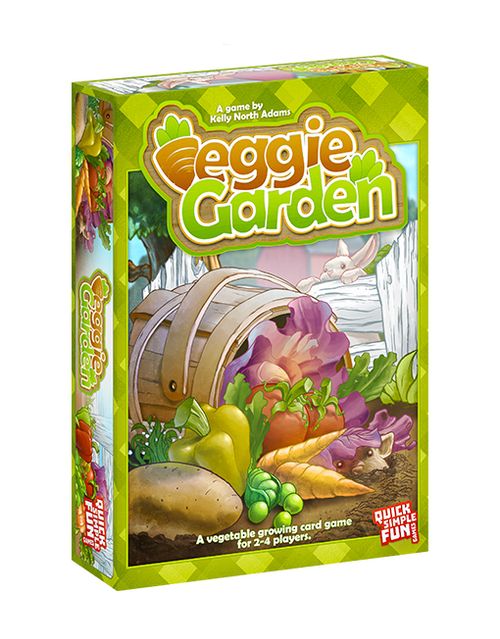
Veggie Garden
Veggie Garden Rulebook
Table of Contents
Table of Contents
Overview and Objective
In Veggie Garden, each player cultivates their vegetables to help the community garden prosper. A game plays out over 6 rounds, where each player takes turns manipulating the community garden to make it flourish. At the end of the game, each vegetable in the garden has a point value. Whoever has the most points wins.
Contents
- 1 Game Board
- 12 Numbered Fence Posts (4 of each kind), 1 Bunny Fence Post, 1 Blank Replacement Post
- 6 Vegetable Reference Tiles, 1 Bunny Token, 1 Groundhog Token
- 84 Veggie cards (6 different types, 14 of each): cabbage, carrots, peas, peppers, potato, tomato
Setup
-
Select 5 of the 6 available Veggie Reference tiles. These tiles will give a quick reference to the various actions in the game.
-
Gather the Veggie cards corresponding to the selected reference tiles and shuffle them together to form the Veggie deck. Put the remaining tiles and cards back in the box.
-
Shuffle the 12 numbered fence posts face down and place them on the fence post spots.
If you are using the Carrot Veggie cards, remove one numbered fence post at random and replace it with the Bunny post before shuffling. This will determine where the Bunny token starts.
-
Fill the garden with a 4x4 grid of randomly drawn Veggie cards as shown below.
The cards in the four center spaces are part of the Compost area. Cards in these four spaces are worth zero points at the end of the game.
Each fence post has a point value, which corresponds to a vegetable card in the outer ring.
-
Set the Veggie deck next to the board and place the top four cards face up next to it. This area is called the Harvest.
-
Finally each player draws 2 secret Veggie cards into their hand. Whoever last ate fresh vegetables goes first!
Gameplay
On each player's turn, that player selects a face up card from the Harvest, places it in front of them, and takes the action associated with it on the reference tile. Next, the player adds that card to their hand and places the top card of the veggie deck face up in the Harvest. Then, it's the next player's turn.
If there are ever 4 Veggies of the same kind in the Harvest, discard all four of those cards and replace them with new cards from the deck. If the cards ever run out from the deck, reshuffle the discarded cards and continue play.
Play continues for 6 turns until each player has 8 cards in their hand (including the 2 starting Veggie cards plus those acquired throughout the 6 turns).
Vegetables Types/Actions
Cabbage
Cabbage allows you to shift any one column or row of cards or fence posts. To do this, move all of the cards/posts left, right, up or down. This will cause one card/post to fall off the edge. Place that card/post in the new empty space on the opposite side. (The Groundhog blocks the row and column he is a part of.)
Carrots
Carrots allow you to choose any other fence post and swap it with the Bunny.
At the end of the game, the card next to the Bunny does not earn any points.
Peas
During setup, the first player chooses a space in the Compost Area and places the Groundhog token on that space. Whenever you Harvest Peas, move the Groundhog to another space in the Compost Area, and select one card adjacent to the Groundhog's new position (including diagonals). Swap the selected card with the card on the Groundhog's direct opposite side. For example, if you choose the card to the Groundhog's lower left, then you would swap it with the card to the Groundhog's upper right.
Peppers
Harvesting Peppers allows you to swap any two adjacent vegetable cards or fence posts vertically, horizontally, or diagonally. The Groundhog blocks his vegetable.
Potato
When you harvest a Potato, exchange a card from your hand with any one of the sixteen in the garden. The Groundhog blocks his vegetable.
Tomato
When you harvest a Tomato, discard a vegetable from the garden and replace it with one of the remaining 3 from Harvest. The Groundhog blocks his vegetable. Replace both cards from the deck after a Tomato action is taken.
End Game
When the last player has taken his or her last action and every player has 8 cards in their hand, the game ends. Starting with the first player, each player takes one more card from the harvest. Cards are not replenished between picks, and players do not take the associated actions.
Scoring
Everyone places their sets of vegetables face up. If you have all 5 types of vegetables, score 10 bonus points. Pick a vegetable to start with and count up all of its associated points in the garden. Each player multiplies those points by the number of vegetables they have.
In the example below, Peppers are worth 4 points each. The Pepper next to the Bunny is worth zero points.
Kelly has 3 peppers for a total of 12 points.
1 pt + 3 pts + 0 pts = 4 pts x 3 = 12 pts total
Kelly has 36 points from her vegetable cards plus 10 points for having every type of vegetable for a grand total of 46 points.
- Tomato: 8 pts
- Pepper: 12 pts
- Carrots: 4 pts
- Peas: 6 pts
- Cabbage: 6 pts
Acknowledgments
I would like to thank my husband Chad, Shaun Graham, and Jason Barnes.
Thanks also to all the persons who tested this game and took part in its evolution, and to all the gamers met at conventions. Thank you for the time you gave to me, I am truly grateful.
- Kelly North Adams