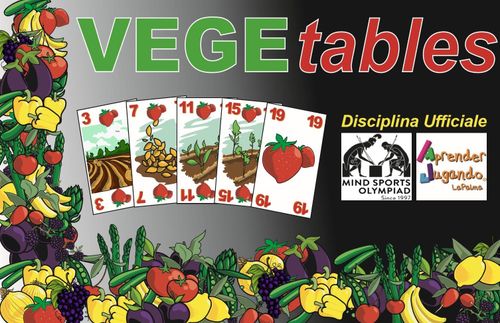
Vege Tables
Vege Tables Rulebook
Table of Contents
Table of Contents
Components
The Vege Tables deck consists of 4 suits (colored red, green, black and yellow), each numbered from 1 to 20, plus 8 Joker cards (called "Tractors"), for a total of 88 cards.
Within each numbered suit:
- Cards 1-4 are the special Plot cards (in Italian, "Terreni"). Each represents a specific vegetable/fruit family and is always kept face up in front of its owner.
- Cards 5 onward are played on top of a Plot to build up a numeric sequence in steps of 4 (5, 9, 13, 17 or similar, depending on the deal), matching the growth of the plant: Seed, Sprout, Plant, and finally the ripe Vegetable/Fruit (the closing cards, numbered 17-20, which carry a large image of the fruit or vegetable).
Physically, the deck is also organized by the color of the card backs, independent of the four front suits: red-backed cards, white-backed cards and green-backed cards. This back-color grouping is used only to deal out the game and is explained fully in each variant below.
Two extra Jokers are included in the box beyond what a 4-player game uses: one is for the 5-player game, the other is a spare in case a card is lost.
Object of the Game
The goal is to get rid of all the cards you have received (and any you collect during the game). Whoever runs out of cards first often scores more points than the others, but the winner is whoever has scored the most points, not necessarily the first to empty their hand.
Base Rules for 4 Players
Learning the 4-player rules is the essential first step to understanding quickly all the other rule sets (2 players, 3-5 players, Partnership, Expert, Tournament). Start here.
Setup
Divide the deck by the color of the card backs: red (16), white (32) and green (40). Remember that the box contains two extra Jokers: one is used for the 5-player game, the other is a spare.
The dealer distributes cards to each player as follows:
- 4 red-backed cards, dealt face up and always kept visible to everyone: these cards are called "Plots".
- 8 white-backed cards, dealt face down, which players may pick up and look at.
- 6 green-backed cards, also dealt face down, but which players may not look at until the right conditions arise. This packet of cards is called "the Pot".
The remaining 16 cards are laid out on the table, face down, in a 4x4 grid at the center of the table called "the Field".
At this point you should find yourself in a situation similar to the one shown in the rulebook's illustration, which also shows one player's cards: the four "Plots", the 8 white-backed cards ready to be picked up, and the six green-backed cards.
Everything is ready: the object of the game is to get rid of all the cards you were dealt (and those you collect during the game). Whoever finishes their cards first often scores more points than the others.
Starting the Game
The player who holds the Black "1" Plot card (the Eggplant) starts, and play proceeds clockwise. And if you're wondering whether the starting player must play the Black One, the answer is "no": this card only grants the right to start, but the player may use whichever card is most useful to their game.
On their turn, a player may play as many cards as they think appropriate. When a player wants to end their turn, it is polite to let the opponent on their left know by saying "Pass".
ATTENTION: this freedom to play as many cards as you want must be used with extreme caution, because playing at least one card or Joker (the "Tractor") is mandatory. If a player finds themselves unable to play, the consequences described in the article "What happens if you have no playable cards" apply.
The "Plot" cards (numbered 1 to 4, which each player keeps face up in front of them) have a special characteristic unlike all the other cards: only Plots can be played onto the Field, and when they enter play they are placed on the 4x4 grid of the Field in place of one of the green-backed cards.
The replaced card becomes the property of the player who played the Plot: they add it to the cards in their hand, and they may (obviously) look at it and, if they wish and conditions allow, play it immediately.
All other types of cards, instead, are placed on top of a "Plot", building up a sequence that must respect two conditions:
- the same color as the numeric series (you cannot place a green card on a black one)
- numeric progression in steps of 4 (also helped by the type of fruit/vegetable shown on the cards)
A graphic example helps a lot with understanding this (and even more so if you hover the mouse over it, in the online version).
Here is the first player's choice and its effects, as an example: the red "3" Plot (the strawberries) forces all players to place the family of red vegetables on this row. But not only that: this move also "christens" the columns of the Field: all "1" Plot cards will go to the far left, "2" between "1" and "3", and "4" at the far right.
Could the player have chosen a different row? Yes, entirely at their discretion. Could the player have chosen a different column? In theory yes — one could complicate the game by letting Plot cards be placed freely, but in practice this choice gives no real advantage and no greater strategic depth. It's best, then, to assume that each color family has its own reference row, and that within this row the cards run in order from 1 to 4.
Playing Cards
As seen in the previous section, the player who holds the Black One has the right to start. And since only "Plots" can be played onto the Field, that player will be forced to play one of the four Plot cards they hold face up in front of them.
And after that? The other cards (that are not "Plots") must be played on top of the correct Plot, forming a sequence that MUST respect: the color (you cannot place a yellow card among green cards) and the type of vegetable.
Vege Tables is a mathematical game in which players build simple numeric sequences "in steps of 4". The strategic framework is founded on blocking your opponents (you cannot play the tomato 9 on top of the Red One until the Five has been played), trying to reach the end of the round as quickly as possible by exhausting all the cards you hold.
When a player completes a cultivation by playing the sequence's closing card (these are the cards numbered 17, 18, 19 and 20, each showing a large picture of the vegetable that Plot was dedicated to), they earn 10 points — more on this and other intermediate scoring opportunities appears in the sections below.
Before moving on, a small note: if you want to involve younger players who might be intimidated by all the counting the game involves, you can help them by pointing out that, in the sequence, we start by preparing the land (the Plot), on which we sow the seed. Then the little sprout is born, the plant grows and, at the end, we've harvested our tomatoes!
Collecting the Pot
When a player, on their own turn, can show that they have fewer than six cards in hand, they collect their Pot — the packet of green-backed cards that was dealt to them at the start of the deal.
ATTENTION: before being able to collect the Pot, it is essential to have played at least one card.
Collecting the Pot is an "intermediate objective" during the game with important characteristics: it earns points (these are not what wins the game on their own, but they help), and above all it gives you important information about how your game should proceed strategically from here.
Collecting the Pot has two effects:
- the turn passes immediately to the next player, no acknowledgment is required
- as mentioned, you score some points: the player earns 10 points for every opponent who has not yet collected their own Pot, so that works out to 30 points for the first to do so, 20 for the second, and 10 for the third. The last player to collect their Pot receives no points for it. This detail is revisited in the scoring section.
One technical point that not everyone catches: the Pot can be collected once you can show that you have fewer than six cards in hand. Whatever the reason a player ends up with fewer than six cards makes no difference — as explained further in the Penalties section, the Pot must also be collected if you end up with no cards due to the First Level of Penalty.
Playing the Joker (the Tractor)
The Vege Tables deck contains 10 Jokers: the "Tractor" card, which has two possible uses. But remember that a 4-player game uses only eight of them — leave the other two in the box!
The first use: on your turn you may discard it, which lets you say "Pass" and move play to your left without playing any other cards. This is a very useful defensive move to avoid entering the First Level of Penalty, but it is also an important strategic choice if you want to delay releasing a card your opponents need.
The other use is to substitute the Joker for any numbered card from 1 to 16 (so all the final fruit/vegetable cards are excluded), but to make this move you must immediately also place the next card in that sequence. If you do not hold that card, the Joker cannot be played this way. It is possible to play several Jokers in sequence.
The card that was replaced by a Joker may be discarded at any time by whichever player holds it, but the effects of that discard become active for that player only once it is actually their turn.
Scoring
- When a player completes a sequence by playing one of the fruit/vegetable cards (17 to 20), they earn 10 points.
- If closing the sequence also completes the color family, an additional 30 points are earned.
- Points are also earned by collecting your own Pot, when, on your own turn, you show you have fewer than six cards in hand: 10 points are awarded for every player who still has to collect, so 30 points to the first, 20 to the second, and 10 to the third. The last player to collect their Pot scores no points for it.
- Finally, there are closing points: when a player exhausts all the cards they were dealt, 10 points are awarded for every sequence that is not yet closed.
Remember to claim the score update every time you earn points.
Before moving on, here is a closer look at the Scoresheet. The "Table" and "Round" boxes are only used by the organizer of tournaments — don't worry about them otherwise.
The first important row is reserved for player names: typically you write them starting from the player to your left and proceeding clockwise; the name of the player acting as Scorekeeper goes in the fourth box.
Right below is the "Pot points" row — each box is filled in when that player declares they are collecting their Pot. At the end there is a check box that tells you the maximum total possible on this row: 60.
Then comes the sequences area: every time a player completes a cultivation, a tick mark worth 10 points is recorded for them. There is also a check box here, because each round you must have sixteen tick marks recorded in total.
When the round ends, the Scorekeeper completes the sixteen tick marks and writes the partial totals.
On the second-to-last row you record the bonuses for completing families (each "+" is worth 30 points) and the penalties for passing without playing (each "-" is worth 50 points).
Everything comes together on the last row, where the totals are calculated: Pot + Sequences + Bonuses − Penalties. Much easier to do than to explain.
Penalties
As we know, when playing Vege Tables it is always mandatory, on your own turn, to play at least one card (and as long as we still hold Plots, we'll always have a move available!).
It can happen, though, that through careless play or an unlucky deal, a player finds themselves with no cards they can play. This triggers the first of the two Levels of Penalty.
The player who declares they have no available moves reveals their cards on the table: this is essential to prove to everyone that they have no playable card. Opponents are required to check carefully, because if they find a playable card (even discarding the Joker counts), the penalty is cancelled, the player is required to make that move, and play continues as before.
If, after this check, the player really has no playable cards, the Penalty is confirmed and the player pays their "Pass without playing" penalty by leaving their cards face up on the table. At this point we need to distinguish: has the player already collected their Pot?
...if the player HAS ALREADY collected their Pot
In this case you are in serious danger of reaching the Second Level of Penalty, and the trouble is that this doesn't depend on you, but on how "mean" your opponents choose to be. Because once you have no more cards in hand left to reveal, every further "Pass without playing" will cost you 50 points, subtracted from your total at the end of the round.
...if the player has NOT YET collected their Pot
In this case, though, a rule we've already seen kicks in: because by revealing their cards on the table, the player in fact now has... ZERO cards in hand. That is, fewer than six. So, if they had not already collected it, they now go to Pot and score the related points. And this automatically causes them to Pass as well.
Interesting, isn't it? Know that Vege Tables is mathematically unbeatable in the sense that the game cannot reach a deadlocked position, even if players behaved illogically.
To sum it up simply, the rule is: every time you "pass without playing" you pay 50 points, unless you have cards in hand still to reveal on the table. This means that the first time you find yourself in the "Pass without playing" situation, you will not pay the 50 points, but you must instead reveal on the table all the cards you have in hand, which from that moment on remain visible to everyone.
(The original rules text refers readers to a page of Frequently Asked Questions at this point; that FAQ page was not preserved in the archived copy of the site and is not included here.)
Base Rules for 2 Players
Introduction
Without excessively disturbing the delicate but robust balance of the 4-player rules — indeed enriching it with an expanded role for the Dealer — the rules for 3 and 5 players came together with a facility that surprised even the designer. Scaling the game down to 2 players, however, was a much bigger challenge: it was no longer a pure question of a different card distribution. Having only two opponents facing each other made it possible to create a completely different game while keeping the same core mechanics. So this section will not simply list the differences from the 4-player game as some other variant sections do — everything identical to the 4-player game will only be pointed out briefly, but this page is a little more substantial.
Setup
Divide the deck as usual, separating the cards by back color.
The red-backed cards, the "Plots", form the Field face up, laid out as four rows of colors in ascending order.
Give eleven of the white-backed cards to each player. The remaining ten are placed face up beside the Field, partially overlapping, forming the common Pot.
The dealer keeps the remaining green-backed cards close by, to be used to refill the common Pot when it runs out during the game.
So the starting position is quite different from the 3/4/5-player versions:
- The Field is not a spread of face-down green-backed cards — all the Plots are already placed on it.
- Players have 11 cards in hand (not 8).
- There is no individual Pot for each player — instead there is one common Pot that both players draw from, as explained next.
How to Play
As in all the rule sets already covered:
- on your turn you must play at least one card
- you may play as many cards as you think appropriate
- building numeric sequences in steps of 4 that respect color and vegetable type
- always with the goal of exhausting all the cards you hold
Since the Field is already fully set up, there is of course no substituting of cards: every play is placed directly onto the relevant "Plot". So far, nothing new.
Compared to the other variants, though, there is one fundamental difference. If the player does not close the round by playing all of their cards in a single move, before passing play to their opponent they must draw from the common Pot as many cards as they just played, bringing their hand back up to eleven cards.
ATTENTION: it is still mandatory in this variant to play at least one card. What's more: if you find yourself in the (unlikely, but not impossible) position of having to "pass without playing," the round is lost and your opponent scores the points as if they had closed it.
Managing the Common Pot
Managing the common Pot is certainly the most interesting strategic key of this variant.
We know that, on your turn, you may play as many cards as you think appropriate: if you play them all in one go, you win the round and score the related points; otherwise you must restore your hand to eleven cards by drawing from the common Pot as many cards as you played.
The Pot is visible to both players, and cards must be drawn in the order in which they appear (the dealer lays them slightly overlapping precisely so there is no doubt about draw order).
A small example: say a player has placed the green 6, the green 7 and the black 6. Before passing play to their opponent, they must collect the first three cards of the common Pot, which in the illustration are shown shifted slightly to the right.
When the common Pot runs out, the dealer replenishes it by turning up ten more cards from the green-backed deck.
ATTENTION: if a player places more cards than remain in the common Pot, to get back to eleven cards in hand they must:
- collect all the cards remaining in the common Pot
- have the dealer deal them, face down, as many cards as still needed to complete their hand
The dealer then continues laying out the ten cards of the common Pot, taking into account how many they have already dealt to that player. So, for example, if two cards remained in the common Pot and the player played five cards, at the end of their move they would take both remaining Pot cards and receive three more face down from the dealer, who would then continue by turning up seven cards for the new common Pot.
Base Rules for 3-5 Players
Introduction
Just as the designer's own path in developing Vege Tables started from the 4-player game and evolved into the other variants, so it's wise for you, the reader, to venture into the alternative rule sets only after you have properly understood the 4-player rules. So, in the interest of being brief and not boring anyone who has already sat through the lengthy 4-player explanation, the 3- and 5-player games are described here by highlighting only the differences from the 4-player game. As you'll see, they aren't very many — in essence you'll read about the extra options available to the Dealer during setup — but the subtle strategic implications that come from the different card distribution will give you plenty of food for thought.
Setup
Changing the number of players changes (naturally) how the cards are dealt. Here is a summary:
If you play with 4:
- 4 red-backed cards, face up, to every player
- 8 white-backed cards, in hand, to every player
- 6 green-backed cards in every player's Pot. The remaining 16 cards are used for the Field.
If you play with 3:
- 6 red-backed cards to the dealer and 5 to each of the other two players (so the Dealer plays with one extra "Plot", displayed face up along with the others)
- 10 white-backed cards, in hand, to every player. What happens to the two leftover cards is described below.
- 8 green-backed cards in every player's Pot. The remaining 16 cards are used for the Field.
If you play with 5:
- 4 red-backed cards to the dealer and 3 to each of the other four players (so the Dealer plays with one extra "Plot", displayed face up along with the others)
- 6 white-backed cards, in hand, to every player. What happens to the two leftover cards is described below.
- After adding one Joker, 5 green-backed cards in every player's Pot. The remaining 16 cards are used for the Field.
Now, the outstanding question: what about those two undealt white-backed cards — what are they for, and whose are they?
In the 3- and 5-player games, the white-backed cards left over after dealing are collected by the Dealer, who looks at them and, after carefully checking their own cards and the Plots in front of themselves and their opponents, decides who gets them.
- They may keep one for themselves.
- They may not give both to a single opponent.
As mentioned in the introduction, the Dealer takes on a much more active role in these versions, which is why it's proper not to stop at a single deal but to complete a full game so every player gets a turn at being Dealer.
You can also download scoresheets made specifically for these versions of the game from the Area Download section of the official site.
Conclusion
That's really all there is to it — but be careful, because those two cards handed out at the Dealer's discretion can really make a difference and become the key to victory.
One more tip: in the 5-player game, players receive only six white-backed cards, so an ill-considered Plot play on the very first round can lead to an opponent collecting their Pot immediately. Not only will they get their extra cards well ahead of schedule, but they'll also be awarded 40 Pot points (remember, it's 10 points for every Pot not yet collected).
Partnership Rules (2 vs 2)
Introduction
This is a "2 against 2" version of Vege Tables inspired by the way partners communicate silently in Bridge — fun, but also difficult to master. It's worth trying at least once, and you won't want to stop.
How to Play
Setup, rules and objectives are, naturally, the same as the 4-player game, so you're encouraged to be comfortable with that version before appreciating this "Partnership" variant fully.
Partners sit facing each other, so one partnership is North-South and the other East-West.
Here's the interesting part: whenever a player places one of their "Plots" onto the Field, the green-backed card that gets replaced must be handed over (without looking at it) to their partner, who, after looking at it and evaluating it, gives back one card of their own choosing from their hand in exchange. (So, if it makes sense, this can even be the same card just received from their partner, who, incidentally, doesn't know what it is.)
The move is then complete once this card exchange is finished: be careful, because the most common mistake is declaring your turn over before you've actually received the card back from your partner — and it's equally possible for the opponent to jump in with their move without waiting for the exchange to be signaled.
Remember that on your own turn you may play as many cards as you like, and so you may carry out multiple "exchanges" with your partner in a single turn.
The exchange with the partner also happens when a "Plot" belonging to the opposing partnership is "burned" using a Tractor — a rather nasty move, since it reduces the other partnership's opportunities to communicate.
Scores are calculated as in the normal game, then summed at the partnership level.
Aside from the single-player game, there are no other differences, but it's worth spending a few words on the strategic side.
Technical Notes
The structure of Vege Tables makes it rather unlikely that a bidding phase similar to Bridge's could be grafted on — there are too many unknowns to plan in advance how many points will be scored. What was needed instead was a way for partners to communicate, and the idea of exchanging cards immediately seemed like a winner, because it requires no verbal interaction and becomes an excellent measure of a player's ability to judge the strength (or weakness) of their own hand.
So where's the difficulty? In passing your partner a card that's actually useful to them. If your partner has the strawberry 3 in front of them and you're holding the 7, you've easily identified (without hesitation) which card to pass them. Likewise, if you keep the red 7 for yourself, your partner will have little reason to suspect the 3 is still out there, because they'll have every reason to believe the strawberry sequence cards are in the opponents' hands.
Try to work out whether closing the round is within your own reach, or whether it's better to set up your partner instead — perhaps by passing them a Joker. In this variant of Vege Tables, you win together, so set aside personal glory and the search for the flashy move, and make room for cooperation and understanding between partners.
It's a difficult variant, but genuinely worth trying.
Expert Rules
When Vege Tables was created, one of the designer's goals was to create something that would spark friendly competitiveness among friends, to the point of wanting to run tournaments with it. But it quickly became clear that the rules used for teaching newcomers "how to play" were not suited to a "serious" setting like a tournament, because the impact of the "luck factor" could be excessive.
To be precise: an imbalance can arise from randomly finding the Jokers in the Pot or the Field. On a good day you might find four or five of them; on a bad day, none at all. Either way, someone ends up unhappy, and a relaxed atmosphere at tournaments matters.
It wasn't too difficult to find a proper balance for how the Jokers are distributed, and players took to it right away. This was the official tournament rule set until June 2014, when it was replaced by Vege Tables 2.0 and renamed the "Expert" version.
4 Players: with a very simple change to how the cards are dealt, Vege Tables turns into something that will surprise you. The impact of the "luck factor" is drastically reduced thanks to an equal distribution of the Jokers — now let's see who uses them best!
3-5 Players: as already happened in the Base rules, the 3-5 player variants of Vege Tables introduce interesting new strategic themes in the Expert version too. Are points better, or Jokers? Can you afford to let your opponents have a Joker more than you? The answer depends on your own playing style.
2 Players: for three years (2014-2016) this variant of Vege Tables was the discipline played at the Mind Sports Olympiad. Here too, a simple adjustment to the deal turns the game into a real challenge fit for champions.
Partnership: take the "Partnership" version of Vege Tables, add an equal distribution of Jokers to cut down the "luck effect," a pinch of salt, pepper and a drizzle of extra-virgin olive oil. That's a joke, but this game is far from being one — it may well be one of the most demanding versions of all.
(The published site described the Expert distribution changes for each player count as full separate articles; the archived copy preserved only the introductory summaries quoted above for the 3-5, 2-player and Partnership Expert variants. The 4-player Base setup differences that define "Expert" play were not separately preserved in the archive beyond what is summarized here — equalizing how the Jokers are dealt out compared with the Base deal.)
Tournament Rules — Vege Tables 2.0
Introduction
The designer noticed, watching tournament games, that the dreaded "luck factor" he thought he had defeated with the equal distribution of Jokers in the Expert rules had simply shifted from the Pots to the Field: the four cards drawn when a Plot is placed can hold nasty surprises, and the two Jokers sitting in the Pot could prove entirely insufficient to fix the problems caused by an unlucky draw. This led to the idea: what if players could choose which cards to take from the Field? That, in refined form, became Vege Tables 2.0, the current tournament rule set, introducing the Silos, the common Pots, immediate access to Jokers, and a reworked Penalty system.
What Has Changed
Four main differences from the Base/Expert rules:
- The Field is replaced by a game board with Silos. Instead of the sixteen face-down green-backed cards forming a "Field" at the center of the table, there is a new game board, at the base of which the "Silos" are placed: four columns of four cards each, which players draw from when they play a "Plot". The key difference: when you play a Plot, you no longer receive a random card — you can choose which of the available cards to take, both to help your own game and to make life difficult for your opponents.
- There are no more individual Pots. Instead there are three "Common Pots": the first two are visible from the very start of the game, and the third is revealed once one of the first two is exhausted. The key difference: a player can now choose, once they drop below six cards in hand, whether to go to Pot at all, and if so, whether to draw from one or both of the visible Pots.
- Jokers are available from the very start of the game, still following the "equal distribution" principle, so every player has 2 Jokers. The key difference: instead of having to "go to Pot" to gain access to Jokers, a player can now choose when to collect and use them.
- Entering a penalty becomes riskier, but also offers a chance to turn a game around, since you can gain access to particularly valuable cards. The key difference: instead of passively suffering a 50-point cost every time you pass, a player can now choose whether to draw the cards they most need from the Pots (paying 50 points) or take them for free, letting the opponents decide which cards to hand over.
As you can see, choice is now the dominant theme, but remember the game isn't played alone — your opponents are trying to do the same, and to make things difficult for you.
There are further rules details not worth listing exhaustively here: go and read the complete rules for the finer points!
One thing is certain: the influence of the "luck factor" is reduced even further — almost all the cards are visible from the start, and the ones that aren't are certainly in an opponent's hand (or in the third Pot, in which case it's just a matter of waiting). There may be no other card game this close to being a game of "perfect information."
The Game
Aside from the Silos and the availability of Jokers, the game hasn't changed all that much.
Play proceeds clockwise. In tournament play, the right to start each round is decided by the referee according to the fairest and most useful pairing system. In casual play, for practice, the Black One rule applies, then rotates so everyone gets a chance to start (arriving first at the Silos can let a player pick up advantageous cards, leaving the tougher ones for opponents).
On your turn you may play as many cards as you think appropriate. Playing at least one card is mandatory. If you have no playable cards, you go "into penalty," with the consequences described in the Penalties section below.
Playing cards aims to build arithmetic progressions in steps of 4, as shown in the illustration.
When you play a card onto the board (a Plot or a Joker), the rules described in "Using the Silos" apply. The color of the card also sets the color for that row of the board, and all other players must conform to that placement.
The other cards ("Seed", "Sprout", "Plant" and "Vegetable/Fruit") are placed on top of the "Plot" card of the matching color, building up the sequences "in steps of 4".
If a player is left with fewer than six cards in hand, the rules described in "Using the Pots" apply.
Every player has two Jokers, given out by the dealer at the start of the game. They may be collected at any point during your own turn, before "passing." Collecting (even without using) a Joker earns a reward, described in the following sections.
When a player is left with no cards (Plots included, while Jokers are not relevant since they can be discarded at any time), the round ends and final scoring takes place.
The Silos
In the Base/Expert rules, a "Field" is formed at the center of the table, from which — when a Plot is played (or a Joker followed by its "Seeds") — a card is drawn from a chosen position. This introduces a "luck component" that the tournament rules significantly cut down, moving from "random collection" to a deliberate choice of card (obviously within the limits of availability).
Every time "Plot" cards are played onto the board — including when Plots are "burned" using Jokers — you must draw the same number of cards from the Silos.
Silo cards cannot be taken from any position: they must be taken starting from the first "free card," i.e. the one revealed at the start of the row. The player is free to choose which Silos to draw from.
Scoring
Here are all the ways to score points in a game of Vege Tables 2.0. Only the Joker rules are new — every other case is already covered by the Base/Expert rules.
- When a player collects their second Joker, they earn 10 points for every player who had already collected theirs before them (so, in a 4-player game, the reward is: zero, ten, twenty, thirty).
- Whoever plays a "Vegetable/Fruit" card (values 17 to 20), closing a sequence, earns 10 points.
- Whoever completes a "family," playing the last "Vegetable/Fruit" of one color, also earns a 30-point bonus.
- Whoever "closes" the round by exhausting their cards earns 10 points for every sequence not yet completed, and must also be awarded the Joker points, as if they had collected them.
Points scored must be recorded immediately on the scoresheet.
Using the Joker
Every player has two Jokers, which they may collect, even separately, whenever they see fit. A Joker may be collected without any obligation to play it immediately — it's entirely up to the player. Until collected, Jokers do not count as active cards.
As in the Base/Expert versions, the Joker can be used in two ways:
- Discarded: lets you pass the turn without placing any other cards — for example to delay releasing a strategic card, or to save yourself from a penalty when you have no other playable card.
- Played: in place of another card (from 1 to 16, so "Vegetable/Fruit" cards are excluded), but you are then required to immediately play the next card in that sequence as well. If you don't hold that next card, the Joker cannot be played this way.
It's possible to use several Jokers in a row, each followed by its matching numbered card.
Whoever holds the card that a "Tractor" replaced may use it as a valid discard to pass without playing any other cards.
Using the Pots
When a player, on their own turn, AFTER having played AT LEAST one card, can show they have fewer than 6 cards in hand, they may decide to "go to Pot" (so this is NOT mandatory) — that is, to replenish their hand. In this case they must collect however many cards are needed to get back to six (naturally subject to availability in the Pots).
Pot cards cannot be taken from any position — they must be collected starting from the first "free card," i.e. the one revealed at the start of the row. If more than one card is being collected, the player is free to choose whether to take them from one or both Pots.
Collecting cards from the Pots automatically passes play to the next player.
Penalties
As you know, in Vege Tables it is always mandatory, on your own turn, to play a card — or discard a Joker, or a card that was "burned" by an opponent's Joker. If a player finds they have no playable card whatsoever, the penalty is triggered.
First, the player must reveal on the table the cards in their hand, to prove that they have no playable card. From that moment, the cards of whoever has "Passed without playing" remain face up on the table, visible to everyone.
IMPORTANT NOTE: once the cards are revealed, as in the Base/Expert versions, it's up to the opponents to check that the player genuinely has no playable move, including discarding a Joker. If they find one, they must point it out and require the player to play it — in that case, the penalty is called off: the cards return to the player's hand and the game continues normally.
The player may also choose to return to having six cards in hand by drawing from the Pots, with two possible options:
- A) If they want to collect six cards of their own choosing, they pay a 50-point penalty; or
- B) they take six cards chosen two at a time by their opponents (who may not confer with each other), and pay no penalty.
IMPORTANT NOTE: collecting from the Pots always follows the priority rule given by the partial cover of the cards — in other words, you cannot take just any card from the Pot, you must start from the first "free" card.
If fewer than seven cards remain across the Pots, the player collects all available cards without paying any penalty.
If the player decides not to return to having six cards in hand, they simply remain with their cards face up on the table, waiting for their opponents to allow them to play something. Unlike the Base/Expert rules, there are no points to pay in this case.
Playing in a Tournament — Etiquette
Vege Tables 2.0 is a game that requires great concentration. It's therefore necessary to talk as little as possible, to avoid the distractions caused by unnecessary chatter.
Failure to follow these behavior rules may be pointed out by other players, or noticed independently by the referee, who may respond with sanctions ranging from a warning, to penalties applied to the game, up to deductions of Tournament Points in the more serious cases.
During play, a player's cards must remain visible to opponents, both in quantity (it is permitted, without abusing the privilege, to ask how many cards someone is holding) and in orientation (card backs visible) — so be careful not to hold them under the table.
When playing Plots onto the board, the move is: (A) play the Plot, (B) draw from the Silos. Avoid playing several Plots and then collecting a whole batch of cards from the Silos all at once — this lets your opponents clearly see what you're picking up. You'll appreciate it when your opponents extend you the same courtesy.
The same "one at a time" approach is appreciated when placing non-Plot cards too, especially when adding several cards to the same sequence. Placing two or three cards as a block doesn't make the tournament finish any faster.
When going to Pot, you must show your opponents how many cards you have and declare it out loud ("I have X cards, I'm going to Pot"). Before picking them up, show your opponents what you've chosen. The player collecting the cards is allowed to also list them out loud (for example: "I have four cards, I'm going to Pot: I'll take the red 15 and the yellow 17"). Comments from the other players are unwelcome and inappropriate ("Oh, you took the red 20, now let's see what I get").
At the end of your turn you must clearly and audibly announce your "Pass". This announcement is unnecessary (and best avoided) if you're ending your move by collecting from the Pots, since the "Pass" is automatic in that case.
It's well known that tournaments often include beginners who may be a little confused about the rules. Players are not authorized to give any kind of hint. If you notice unusual behavior from a player, you should alert the referee, who will decide freely whether to inform the beginner that their cards may offer other options. If you notice an irregular move, you must alert the referee, who will act accordingly.
Once a card has been legally placed on the board, it is absolutely forbidden to pick it back up into your hand.
Frequently Asked Questions
I played a Joker in place of the red 3 (the Strawberry Plot) — do I have to take a card from the Silos? Yes, you do.
I hold the red Three that was replaced by the Joker. Can I discard it and pass without playing anything else? Yes, you can.
I've played every card I had in hand, but I still have two Plots left, so I haven't closed the round. Can I go to Pot and take six cards of my choice? Yes. You don't pay the 50 points because you are not in penalty.
I have no playable cards, but I still have Jokers I haven't collected yet. Am I required to use one, maybe by discarding it? If the Joker is already in your hand, you're required to play it. If you haven't collected it, then you effectively don't have it, and you're not required to use it.
So can I just reveal my cards on the table? You MUST reveal your cards.
But do I also have to go to Pot? No, you're not required to. In this version of the game, "going to Pot" is ALWAYS at the player's discretion.
Okay, I want to go to Pot... there are two cards left in one Pot and four in the other... do I have to pay the 50-point penalty? Obviously not, because there's no difference between the cards you could choose yourself and the ones your opponents would give you.
Double Deck Variant
Introduction
Many card games that call for two decks are also, not coincidentally, some of the most popular — perhaps due to the (misleading) sense of added complexity that comes from having so many more cards to manage. In mid-2015 the designer was struck by sudden inspiration about the possibility of a Vege Tables version using a double deck. The more he thought about it, the more the idea seemed to hold up: what started as a project aimed at something "simple, fast and fun" was turning into something with all the makings of a proper "tournament game." After a couple of experiments, it all came together at the end of May 2017, when "Double Deck" was selected as the discipline for the Candidates' Tournament, which awards the last available spots for the Masters final.
Two notes before getting into the details of the rules:
- The next sections make heavy use of terminology that may be confusing if you aren't already a Vege Tables player. It's recommended to already be familiar with the Base/Expert rules in order to pick up Double Deck in just a few minutes.
- Unlike the other rule sets, there are no changes based on the number of players — so everything is explained more simply and consistently across player counts.
2-5 Players
Can the strategic approach of Vege Tables be turned on its head? Yes, in more than one way — and you can trust the designer on that, since he's the one who invented it.
Here's one such twist: the underlying idea is that "in the game everyone knows, there is exactly one card of each type. So if, for example, I hold the tomato 17, I can be reasonably confident that, if the sequence completes, those ten points will be mine." But — what if we double the decks in play? If you're no longer certain that your red 17 will earn you points (because an opponent might hold the other copy, and so beat you to it), what's the best thing to do? What's the best strategy?
Read the rules carefully, and you're guaranteed to have fun with this!
Partnership
Rules still being developed and playtested at the time this page was archived.