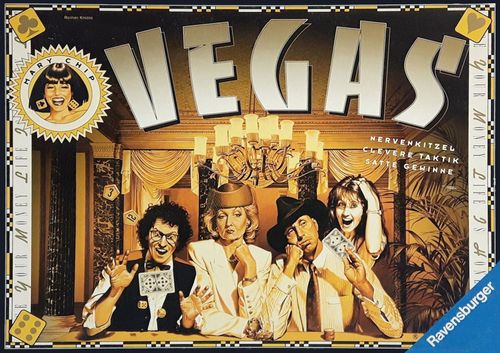
Vegas (1996)
Vegas (1996) Rulebook
Table of Contents
Table of Contents
Object of the Game
It is the coolest and cleverest player that places his bets with the most cunning and skill at the 14 playing tables, who will gain the most gold chips and win the game.
Contents
- 14 gold chips
- 1 Mary Chip figure with base
- 4 pawns in 4 colours
- 4 card sets in 4 colours (3 Front-man cards, 6 Good Luck cards, 1 Mary Chip card)
- 2 black/white 'duelling' dice (advanced game only)
- 4 x 20 counters in 4 colours
- 1 game board
- 1 gold die
Preparation
- Each player chooses a set of cards, a pawn and 20 counters all of one colour.
- The Mary Chip figure is placed on the 'Start' space of the game board.
- The 14 gold chips are placed on the respective pentagonal spaces of the board.
- The gold die is placed within easy reach.
On Your Marks
The aim of each player is to use his counters to gain the upper hand at the playing tables on the game board, and thus win valuable gold chips. Because at each playing table there is only one gold chip to be won, there will certainly be heated duels between players as they contend for the prize.
The meanest player begins the game. He places his pawn at the foot of the playing table of his choice.
Then, clockwise, the remaining players place their respective pawns at any playing table. This indicates at which playing table they want to start play. Of course, more than one player can be at the same table, going for the big win. Then the real fun begins!
Throwing the Die
The starting player throws the gold die once, and places one of his counters onto the corresponding numbered space of the playing table where he is standing. Then, clockwise, the remaining players throw the die and place their counters on their pawns' playing tables.
Placing Your Counters
As long as there is, on the playing table, a free space corresponding to the number on the die on which to place a counter, it must be placed there. Only one counter may be placed on each space on the playing table. If a player throws a number where there is no free space remaining, then he replaces an existing counter with his own on the respective space. The removed counter is handed back to the owning player. Bad luck for the player who throws a number where all corresponding places are already occupied with his own counters! Then there is no benefit.
The Good Luck Cards
The various cards can support a player in his fight to win at a playing table. Cards are always played in addition to, and always before rolling the gold die.
Each player has a set of Good Luck cards with values 1-6.
Depending on the value of the card used, the player places one counter on the respective space of the playing table where his pawn is located. Once used, the Good Luck card is discarded. Then the player rolls the die, which gives him the opportunity to play a second counter, as normal.
Example: Zilly Zocker decides to place a counter onto space 2 of the playing table. In order to do so, she uses the Good Luck 2 card and places the counter accordingly. The Good Luck 2 card is discarded. Subsequently she throws the die to place another counter.
The explanation of the remaining cards follows later.
Changing a Playing Table
If a player decides to change to another playing table then, on his turn, he simply moves his pawn to that new table (as long as this new table has not yet been scored, and still has its gold chip). Moving his pawn constitutes the player's entire turn - he may not play a card or roll the die.
Mary Chip
How does Mary Chip move? Whenever a player throws a 1, he first places his counter on the corresponding space of his playing table. Then, he advances the Mary Chip figure by one position along her track. Mary Chip is loved and hated in equal measure, for it is she who brings fortune or misery.
Scoring of a Playing Table
Case 1
As soon as Mary Chip reaches the head of a table where there is a gold chip, then that table is scored. The player with the most counters in place on the table wins the gold chip. (In the example [page 6], Pink wins the 6 gold chip).
Case 2
A playing table is also scored whenever all spaces on that table are covered by a counter. As above, the player with the most counters on that table wins the gold chip.
After scoring a table the counters from that table are returned to their owners. Once a table has been scored counters may no longer be placed on it.
Whenever a table is scored, that immediately finishes the turn of a player (even if he has not yet thrown the die). A player with his pawn at the foot of a table which has been scored must change tables.
End of the Game
Lothar Link, the cool Hilda and all the other players can only relax in their seats when Mary Chip reaches the 14th and last playing table, and the last gold chip is won. Now, all players add up the total value of their gold chips. The player with the highest total wins the game.
Any Questions?
Scoring of a Table
- What happens if two (or more) players have the same number of counters at one table when it is scored?
In this case, among those involved in the tie, the player with the counter on the lowest value space of the table wins the gold chip. In the example [page 7, right], Pink wins the 6 gold chip.
If, on larger tables (with 2 or 3 rows) this rule does not resolve the tie, then the gold chip is not won, and gets discarded. Counters are still returned in the normal manner.
In the example [page 7, left], Pink and Blue are tied with their counters on equally low-value spaces. Green has not got enough counters even to be considered. Therefore, everyone goes empty handed.
- Is a player allowed to continue his turn after scoring a table?
No.
The Cards
- What cards are there?
Each player has 10 cards: 3 Front-man cards, 6 Good Luck cards and 1 Mary Chip card.
- When are the cards played?
Cards may only be played before throwing the die. They are discarded immediately after use.
- Can more than one card be played in a turn?
Only one card may be played in a turn. Subsequently a player may (normally) throw the gold die.
- What happens when the Mary Chip card is played?
This card, as all the others, must be played before rolling the die. If the card is played, the Mary Chip figure advances by one position. This is particularly useful when the player possesses the majority of counters at a playing table, and can move Mary Chip forward to score that table. If no table is scored after playing the Mary Chip card, then the player rolls the die as normal.
- What happens when a Front-man card is played?
As with other cards, Front-man cards may only be played prior to a normal die roll. By playing a Front-man card, a player selects a playing table other than the one where his pawn stands, then rolls the die and may place a counter there in the usual manner.
Mary Chip
- How does Mary Chip advance?
There are two methods by which Mary Chip advances: by throwing a 1, or playing the Mary Chip card. If a Good Luck 6 card is played as a joker (see below) and the counter is played on a 1 value space, then Mary Chip does not move.
- What happens if Mary Chip reaches a table which has no counters placed at all?
If Mary Chip reaches a playing table which contains no counters, then the gold chip is discarded.
The Playing Tables
- What happens if Mary Chip reaches a table which has already been scored?
In this case, Mary Chip skips that table and immediately advances to the next position along the track.
- What happens if a playing table does not have a 6 value space?
A player rolling a 6 at such a table (or who plays a Good Luck 6 card) may choose on which space to place his counter at this table. This can be quite nasty, if you kick your opponent's counter out!
- What do the double-numbered spaces mean on some tables?
On such tables, these spaces can be occupied if either of the two numbers are rolled.
The Counters
- Where can counters be placed?
A player can only place counters at the table where his pawn is standing. (Exception: Front-man cards.)
- Is it possible to place more than one counter on a single space?
No.
- What happens if a player has used up all his counters?
If a player runs out of counters, he may do one of the following:
- (a) play the Mary Chip card (if it is still in his possession);
- (b) change playing tables;
- (c) pass until some counters are returned to him.
It is not advisable only to concentrate on the large playing tables at the end, because you might run out of counters.
End of a Turn
- When does a turn end?
In any case, a turn ends after a normal die roll and placement of a counter. A turn may also end when the play of a card causes a table to be scored. Then there is no normal die roll permitted.
The Advanced Game
A professional player is not removed from a playing table all that easily. First there is a dice-duel to settle the matter...
The Dice-Duel
The challenger, Harry Gambler, plays his Good Luck 2 card. He places his counter on top of his opponent's counter, which already occupies the 2 value space. This indicates which counter Harry wishes to replace (he could do the same when rolling a 2).
Now, each player takes one of the duelling dice, hides it behind his hand, and selects one of the three symbols. Simultaneously, both players reveal their die. The winner keep his counter on the table. The loser removes his counter.
Who Wins?
-
2H beats 1H
-
3H beats 2H
-
1H beats 3H
-
1H tie: both players' counters are removed, vacating the space.
-
2H tie: both players' counters are removed, vacating the space.
-
3H tie: the defender wins, keeping his counter on the space.
Harry Gambler, being the challenger, knows of course that his opponent will select 3H to save his counter in a tie. Hence Harry chooses 1H. But maybe the opponent thinks a bit further and chooses 2H. Should Harry Gambler select 3H instead...?