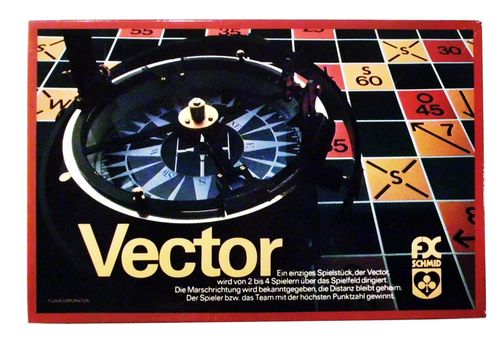
Vector
Vector Rulebook
Table of Contents
Table of Contents
Objective
Number of Players – 4
The players are in two teams – North and South versus East and West. The object of the game is to move the pawn onto squares that score points for your team or retract points from your opponents, and then to "score a goal" to end the game. Regardless of who ends the game in this way – the team with the most points wins! The game lasts for 12 rounds, or until a goal is scored.
Set Up
Each player takes a position around the board – on one of the four orthogonal points of the compass – and takes a set of 8 direction cards (showing points of the compass), and a set of four speed cards (showing the numbers 0 to 3). Place the pawn on the central square (30).
Play
North plays first on the first round. East plays first on the second round, and so on.
Direction Cards – Taking turns clockwise, each player places one of his eight direction cards face up in front of him. This card indicates the direction he chooses the pawn to move in, and may not be subsequently changed during this round.
Speed Cards – Next, the players take turns – in the same order – placing a speed card face down in front of them, next to their direction card. This card indicates, secretly, the number of squares they choose the pawn to move – in the direction they chose in the previous step – and may not be subsequently changed during this round.
Move the pawn & score – Once all cards are played, the players now take turns – in the same order – revealing the speed card in front of them, and then moving the pawn as indicated by the direction and speed cards. Points are scored immediately after each player's move, as indicated by the text on the square the pawn lands on.
Scoring
There are two different colours of scoring square, light and dark. Blank squares do nothing. The darker scoring squares add or subtract points for one player and are activated every time the pawn completes a player's movement turn on one. The lighter scoring squares may score points, or may instead affect the movement and position of the pawn, and only activate for the second player onwards, i.e. the first player ignores the light squares.
Points – If a player's move lands the pawn on a scoring square that has a single direction on it (N, S, E, W), the player indicated by the direction scores the points. If a scoring square has two directions on it (NE, SW, etc.) then the player that moved the pawn onto the square may choose one of the two players indicated by those directions to score the points – he will likely choose himself or his team mate for positive scores, and his opponents for negatives. If a scoring square has no direction on it, the player that landed the pawn on the square scores the points. Note – if the pawn is on a scoring square, and the next player has chosen a speed of 0, score the square again.
Miss a go – If a player's move lands the pawn on a square with a cross on it, and he is not the first player to move, the player indicated by the direction on the cross misses their next round. The affected player moves the pawn this round – if they have not done so already – but must sit out the next round. During the missed round he does not play direction and speed cards, and does not move the pawn. He may, however, still score points (and be forced to miss further rounds) by the actions of the other players during that round.
Push squares – If a player's move lands the pawn on a square with an arrow (→) on it, and he is not the first player to move, the player immediately moves the pawn a number of squares in a direction as indicated by the number and arrow on the square. Should that move land the pawn on an additional scoring square – score that square immediately.
Scoring a Goal
A goal is scored by moving the pawn into the goal area via any of the three squares in front of it. The pawn's movement does not have to end exactly on the goal; the move must simply have enough speed to reach the goal, and enter it via one of the three squares in front. The first player in a round cannot score a goal – the pawn counts as out of bounds instead.
When a goal is scored, the player to whom the goal belongs immediately has their score doubled – whether positive or negative – and the game ends.
Out of Bounds
Should the pawn leave the board at any point – without scoring a goal – the player that was moving the pawn misses their next round and the pawn is replaced immediately in the nearest corner square. If equidistant, the non-moving partnership chooses.
Example Round
North is playing first. North places her SE card, face up, in front of her. East plays the W card, South plays the NW card, and West places down the S card. North secretly selects a speed card, and places it, face down, in front of her. The other players do the same.
North now reveals that she has chosen a speed of 2, and the pawn is moved 2 squares to the south-east – which is a light square marked with a cross and the letter "W". As North is the first player, this square is ignored. Play passes to East, who reveals that he also chose a speed of 2. The pawn is moved west 2 squares, onto a dark square that reads "S 45". 45 points are immediately awarded to South. South reveals he chose a speed of zero, and so does not move the pawn, but does score an additional 45 points – for "landing" on the "S 45" square. West reveals a speed of 1, and moves the pawn south by one square. This places it on a light square with an arrow to the west and the number 3. West immediately moves the pawn a second time – 3 squares to the west – onto a blank square. The round ends.
(The source says East's pawn is moved "east 2 squares", though East played the W direction card; corrected to "west" here.)
The round now begins again, with East playing first.