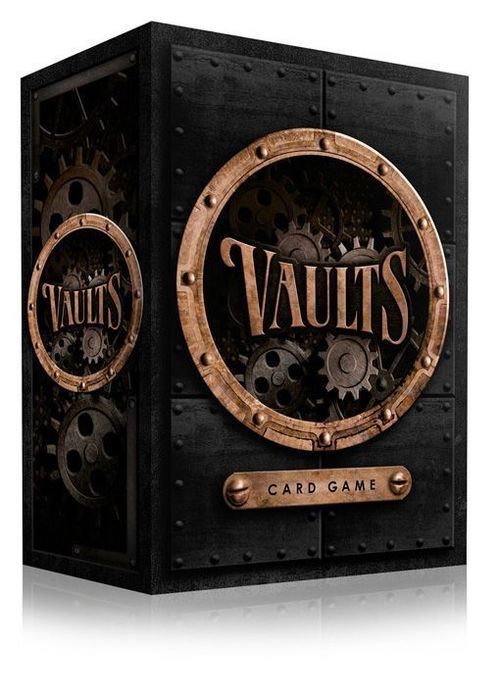
Vaults
Vaults Rulebook
Table of Contents
Table of Contents
The Goals
Your goals are simple: be the first crime lord to loot £400 or be the richest crime lord when the last card is drawn from the main deck! These goals are also variable, players are encouraged to try and experiment with different win conditions and find out which suit their play style best. Here are the recommended loot amounts by player number:
- 2 players = £400 - £800
- 3 players = £400 - £700
- 4 players = £400 - £600
If you want a quick, no holds barred two player game, set the goal at £400 or less. On the other hand, if you want a long, nail biting, vault cracking extravaganza, feel free to set the goal at £800 or more. The game ends immediately after one player hits the agreed win condition.
The Cards
Crew Bosses
Crew bosses represent the leaders of the crew. Their skills may be low, but the true value of these cards lies in their unique abilities. Abilities of the crew bosses are activated with each successful crack of the vaults.
Crew Members
Crew members represent the backbone of any crew. In addition to different skills they also have many useful abilities. Abilities of the crew members are activated when played from the hand.
Cards of crew bosses, crew members and tools contain three values that represent skills needed for cracking the vaults. First skill represents physical prowess, second represents mechanical aptitude and the third one represents the knowledge of explosives.
Tools
Tool cards contain skills as well as the ability to Overload, which increases their original skill scores.
By Overloading the tool, player can double all skill values of the card for one attempt of cracking the vault, after which the overloaded tool card is sent to the Police station.
Activation of the Overload ability must be announced by the player before attempting to crack the vault. Overloaded tool is sent to the Police station even in the event of failed crack attempt.
Tool cards cannot be played if there is no crew already in play; a minimum of one crew boss or one crew member is required.
Card anatomy (printed diagram): 1 - Tool, boss or member info; 2 - Skills; 3 - Ability.
Vaults
The back side of the Vault cards contain three numbers that represent the combination needed for cracking the vault. Cracking of the vault cannot be attempted if the combined skills of a crew do not meet the required combination criteria.
E.g. to crack a 5/2/1 vault, the crew must have at least 5 physical skill score, 2 mechanical skill score and 1 explosives skill score.
Each Vault card contains a specific reward or effect on the front side. Vaults with higher combinations contain more loot, but also carry more risk of failed crack attempt.
The printed rulebook illustrates a vault's combination (back side), a successful crack attempt (front side, e.g. "Success £30") and a failed crack attempt (front side, e.g. "Fail: Send one crew member to the police station. Gain one action.").
Disrupts
Each disrupt card has two effects. A player can use only one, chosen by their discretion, after which the disrupt card is put out of play. When players use up all disrupt cards, the entire disrupt deck is shuffled and put back into play. Disrupt cards can be played at any time and in any number (even outside the players turn or after the disrupt card of another player).
Players can gain access to disrupt cards in two ways: when it is permitted by the crew member ability or when a player chooses to send their crew boss card to the Police station by discarding it from the hand. The gained disrupt card may be played immediately, before attempting any vault cracking or the player can simply hold on to the card and play it later in the game.
Disrupt cards count into maximum hand size and can be discarded in order to respect the rule of maximum hand size (see hand size rule in Action management & Hand size section of the rules).
The Master Key
Some disrupt cards have the icon of a key that represents the ability to open any vault in the game, regardless of the combination required. The master key can be placed on any crew which initiates the crack of the vault, even if the crew is made out of a single crew member. After it is used, the master key disrupt card is put out of play, by the rules of disrupt cards usage.
Police Station
The Police station contains all cards (bosses, members and tools) that are sent to jail by the rules of the game. Cards that are in the Police station are set face-up so that they are visible to all players and are divided into two piles – one for crew members and crew bosses and another one for tools.
Cards from these piles can be taken by any player in his card draw phase.
Cards that are in the Police station can be drawn from either the character pile or the tool pile, but must be drawn in order they are placed.
Action Management & Hand Size
Each player starts his turn with three actions. All unspent actions are lost at the end of player's turn. The player gains a fresh set of three actions on their next turn.
Actions can be spent on:
- Drawing one card from the main deck
- Drawing one card from the Police station
- Playing a card from hand into play
- Cracking a vault
- Switching one boss, crew member or tool between already formed crews
- Forming a new crew by moving one boss or crew member from already formed crew
- Sending one boss card into the Police station in order to gain one disrupt card (the boss card must be played from hand)
What does not count as an action:
- Activation of crew boss ability
- Activation of crew member ability
- Activation of the Overload ability on tool cards
- Playing a disrupt card
- Discarding excess cards from hand
Maximum hand size in the game of Vaults is five. In case a player ends up with more than five cards at the end of their turn, they must discard (send to the Police station) all extra cards in their possession. This is permitted only at the end of the player's turn. If a player has exactly five cards at the beginning of their turn, they are not permitted to draw any cards that turn. There is no restriction on the maximum number of cards players can have during one turn, but must end their turn with five or less cards.
Game Setup & Play
Dealer
Dealer is determined by an agreement between the players and he/she plays last. Our recommendation is that players change dealer duty after each game in a clockwise order. If the players cannot reach agreement on first dealer duty, then the player with the most of keys on their person is set to be the dealer.
Who goes first?
The player that was dealt cards first is also playing first. Cards are dealt in a clockwise order.
Starting the game
- Determine the dealer
- Two cards of crew bosses are randomly distributed to each of the players
- Players choose one crew boss card (the rest are shuffled back into main deck) and place them face up in front of them
- All vault cards are shuffled and split into three equal piles
- Vault piles are placed in the middle of the playing space so that they are clearly visible to all players
- Each player receives four more cards from the main deck
- First player's turn
The number of public vault piles is 3 so each pile should contain 9 vault cards at the beginning of the game.
Turn
One turn equals one game round of a single player and ends when all actions are spent. Abilities and disrupt cards effects played by one player last for the duration of that players turn and do not carry over to the turn of any other player.
Game Turns
Each player turn is divided into 4 separate phases. Turn sequence must be respected at all times. Players can choose to skip a certain phase during their turn but cannot return to a previous one.
1. Draw/Bailout phase – a.k.a. Recruitment phase
At the beginning of each turn a player may draw cards from either the main deck or the Police station (if there are any cards to be drawn).
Drawing cards from the Police station cannot be combined with card draw from the main deck or vice versa; the player must choose one source of his card draw. Remember that one drawn card equals one action.
2. Play phase – a.k.a. Planning phase
Playing a card from hand is considered an action, so a player can play three cards, two cards, one card or no cards during this phase. Remember that the abilities of crew members are activated immediately after they come into play.
Also, in this phase, the player may choose to form a new crew or to transfer any crew member or tool into another crew.
3. Crack phase – a.k.a. Jobs phase
A player may crack only one vault per turn with a single crew, except in extraordinary circumstances (e.g. playing a disrupt card that allows the crew to be "reset" after cracking a vault). Players cannot play any cards from hand during the crack phase, but are allowed to move cards between crews as described in the Forming crews section of the rules.
Once a crew has skill scores that are equal or greater than the combination of a vault, the player may attempt to crack that particular vault. Doing so, they must flip the vault card over to the face side in a way that the loot or vault effects are clearly shown to the other players as well.
Note that the text on the face side of the vault must say Success in order to activate the boss ability. If the text says Fail, then no activation of boss ability is permitted. Vault effects take place immediately after revealing the face side of the cracked vault and only affect the crew that initiated the vault crack.
After cracking, the vault becomes the property of the player that cracked it and they must place it before them face-down so that the combination of that vault is clearly visible to all other players.
Every additional cracked vault will be placed on top of the first vault, making it harder for other players to attack the particular vault with big loot as it is buried under other vaults.
Also, instead of going for a public vault, the player can crack a vault that is already in possession of another player. This plays out the same way as an attempt to crack a public vault. The attacking player flips the vault card over to the face side in a way that the loot or vault effects are clearly shown to the other players. Any effects printed on the face side of the vault are repeated, any won loot now counts toward his victory condition and the cracked vault is placed on top of his private vault pile.
4. Play phase – a.k.a. Hideout phase
If a player has any unused actions, they may spend them now by playing cards from their hand (into existing crew or to form a new one) or to transfer any crew member or tool into another crew.
Forming Crews
Forming crews is the key activity in the game of Vaults. Crews are formed in the following way: boss cards are placed in the middle of players' playing positions, crew member cards are placed to the right of the boss card and tool cards are placed to the left of the boss card. It is recommended that crew member cards and tool cards overlap themselves respectively in order to save on gaming space.
One crew can contain a maximum of one crew boss, four crew members and three tools.
To form an additional crew, a player can play either a crew boss card or a crew member card from hand and place it below the existing crew. That card does not become a member of the first crew and the player must announce this action clearly to the other players. There is no restriction on the number of crews that one player can have in play during one game.
Also, for one action, a player can move one boss or crew member card from already existing crew into a new position and form a new crew in such manner. Crew bosses, crew members and tools can be switched between already formed crews for the price of one action per switch.
Crews that are formed without crew bosses do not suffer any penalty other than missing the crew boss ability when successfully cracking a vault.
Printed diagrams: a formed crew with the boss in the middle, members to the right and tools to the left; forming a new crew by moving a crew member to a new position; exchanging crew members between formed crews.
FAQ
Q: When sending cards to the Police station, do I place them on top or bottom of the pile? A: All cards that are sent to the Police station are placed on the top of their respective piles.
Q: How many cards am I allowed to draw in the Draw/Bailout phase? A: You may draw up to three cards in your Draw/bailout phase, but bear in mind you only get three actions per turn. Each drawn card equals one action!
Q: I exceeded my hand limit by two cards. If I discard two crew boss cards, do I get two disrupt cards? A: No, you may not gain any disrupt cards in such manner. Discarding the excess cards is not considered an action. To gain a disrupt card you must send the boss card to the Police station from hand, which is considered an action.
Q: I have five cards in my hand at the beginning of my turn. If I spend one action and play one card, can I use my second action to draw one card? A: Draw/Bailout phase is the only phase in which you are allowed to draw cards. By playing even one card you effectively skip the Draw/Bailout phase and as such cannot draw any cards in that turn, except in case of crew members abilities, vault effects or disrupt cards.
Q: I cracked the vault and the text says Fail. Do I get to keep the vault nevertheless? A: Yes, you get to keep all cracked vaults! Any vaults cracked by you, regardless of the outcome, are placed on top of your personal vault pile.
Q: I spent one action on cracking a vault with my first crew. For my second action I moved one crew member from the first crew to my second crew. Is my second crew able to crack another vault this turn? A: Yes, your second crew is able to crack another vault this turn; the moved crew member from the first crew is considered "refreshed" when joining another crew. Note that only the member/boss/tool card that is moved to another crew is considered "refreshed" and ready to attempt a new vault crack. It is not possible to move a card from a crew that did not initiate vault crack that turn into already "spent" crew and "refresh" the whole crew.
Q: Can I use the "Draw a card" ability to draw a card from the Police station? A: No, the "Draw a card" ability works only on the main (face down) deck and cannot be used to bailout any card from the Police station.
Q: Crew member cards that say "Send one crew member or tool to the Police station." Can this be anyone's? Or just from my own crews? A: It can be anyone's. Usually players use this as an "offensive" ability in order to remove some crew members or tools from other player's crews, but it can also backfire (see answer below).
Q: Can I choose not to activate the crew member special ability when they enter the game? A: Abilities must be activated every time; you cannot choose not to do it. If there is no valid target among opponents' cards, the ability backfires and you must use the ability on your crews. The ability cannot affect the crew member that enables it. All abilities are effectively resolved before the card actually enters the game.
Q: Can crew boss Patrica Vasser copy the boss ability of any available boss from any player? A: Mrs. Vasser can copy boss ability from any available boss from any player. Note that the boss card that Patricia is copying must actually be in game. She cannot copy abilities from bosses that are in player hands, Police station or main deck.
Q: I played a disrupt card that prevented my opponent from cracking the vault but it was done after he initiated a vault crack with his crew. Does he still lose an action from initiating the vault crack? Also, is he obliged to stay in the cracking phase and continue moving forward in the turn sequence? A: The disrupt card effectively nullified the action and it can still be used on something else. Action is considered spent only on actual flip of the vault card. He is obliged to stay in the crack phase, even though the action is not spent. Once a player declares a crack attempt he can no longer go back to previous phase.