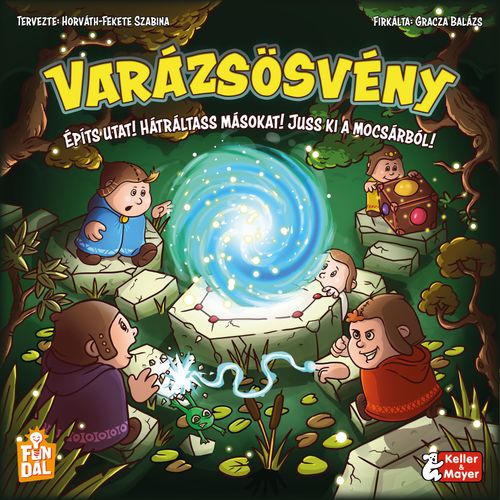
Varázsösvény: Építs utat! Hátráltass másokat! Juss ki a mocsárból!
Varázsösvény: Építs utat! Hátráltass másokat! Juss ki a mocsárból! Rulebook
Table of Contents
Table of Contents
Game Contents
- 1 Game board
- 2 Action cards
- 3 Bonus action cards
- 4 Pawns
- 5 Draw bag (for the path tiles)
- 6 Magic cards
- 7 Path tiles
- 8 Chest tiles
- 9 Starting tiles
Quantities:
- Action cards: 6 × 14 (84)
- Bonus action cards: 6
- Magic cards: 18
- Path tiles: 162
- Chest tiles: 12
- Starting tiles: 6 (one per pawn colour)
- Pawns: 6
- Game board: 1
- Draw bag: 1
Path tile counts by type:
- 12 five-way tiles
- 3 × 13 four-way tiles
- 4 × 13 three-way tiles
- 3 × 14 two-way tiles
- 9 closing tiles
- 2 × 4 teleport tiles
Chest tile counts by type:
- 1 Gate
- 3 Omni teleport tiles
- 3 Bonus tiles
- 4 Bomb tiles
- 1 "six-way" path tile
1. The Base Game – Magical Centre
Goal of the Game
Be the first to step onto the mysterious gate in the middle of the marsh, and so escape from the sinking bog.
Setup
A. Each player chooses a pawn and takes the starting tiles in the same colour. Put the path tiles into the bag and mix them well. Then draw 5 tiles and place them face up where every player can easily reach them. This is the path tile row.
B. Each player takes the action card deck in their pawn's colour, shuffles it, and draws 3 cards into their hand.
C. Shuffle the magic card deck. Each player draws two cards and chooses one of them. Put the remaining cards back into the magic card deck.
D. Shuffle 6 chest tiles (3 bonus, 2 bomb and 1 omni teleport) and place them chest-side up on the 6 "ruined" spaces around the middle of the board. (The description of the chest tiles is on page 7.)
Place the Gate chest tile face up in the middle of the board. This is the goal.
E. Using the face-down starting tiles, randomly choose the player who will pick a starting point first. That player places their starting tile in an empty corner of the board, then places their pawn on it. Then, moving to the right of that player, each of you does the same.
F. The starting player is the one who placed their pawn on the board last. Following them, the other players take turns clockwise.
Course of Play
On your turn you may perform 1 mandatory action (play one action card) and 1 optional action (play one magic card). In addition, you may pass once during the whole game in order to draw a magic card.
1 Playing an Action Card (Placing Path Tiles and/or Moving)
You can place path tiles and move by playing one of the 3 action cards in your hand. In any order you like, place path tile(s) (A) and/or move (B), then put the played action card on the discard pile.
At the end of your turn, draw from the draw pile so that you have 3 cards in your hand again (if you have more, discard the excess to the discard pile of your choice). When the draw pile runs out, shuffle the discard pile to make a new draw pile.
If you do not want to play a card from your hand (because you cannot use any of them well), you may discard as many cards as you like, then draw one replacement card for each from the draw pile. In this case you may not take any other action, and your turn ends.
A Drawing and Placing Path Tiles
The top part of the action card tells you how many path tiles you may draw. You may choose freely from the 5 face-up tiles in the path tile row, or draw from the bag. All path tiles you gain during your turn must be placed; you may not set them aside for later turns.
Example of drawing path tiles: If the number next to the path tile icon on your played card is 3, you may spend 3 points on drawing path tiles: a normal path tile costs 1 point, while a special path tile costs 2 points (see the next page for more on these).
You may decide to take path tiles worth the 3 points only from the path tile row or only from the bag, or you may mix them, taking from both places.
You may take path tiles one at a time and place them on the board right away, or first collect all the tiles you have chosen in front of you.
If the current player took a tile from the path tile row, then at the end of their turn the row is refilled to 5 tiles from the draw bag.
You may not place or alter a path tile in a way that completely blocks a player's progress or prevents anyone from reaching the goal (that is, creates dead ends in every possible direction), even if they could continue by using a teleport or by playing a magic card. In this way the starting tiles also may not be completely enclosed so that no one can step onto another tile in any direction. Your pawns may return to a starting tile as a result of a bomb chest tile (see page 7).
Rules for placing path tiles:
- Path tiles may only be placed on a space edge-adjacent to a starting tile or to a path tile already placed, regardless of who placed it earlier. Adjacent path tiles do not need to connect to each other or form one continuous road with their neighbours, so a clever placement can also hinder other players' progress.
- You may not place a path tile edge-adjacent to a face-down, standalone chest tile. A path tile placed next to a chest tile must connect to a path tile already on the board.
- A chest tile is revealed when you step onto it from a path tile along the road built to it. Path tiles may be placed edge-adjacent to revealed chest tiles.
- A closing tile can be placed not only on an empty space, but also on a path tile already placed, and on revealed chest tiles. The closing tile can't be placed on the tile in the middle of the board (depending on the variation this tile is the gate, an omni teleport or a "six-way" path tile).
Special Path Tiles
Special path tiles (marked with a star icon) cost 2 points to take from the path tile row, while if you draw them from the bag they cost 1 point, like other path tiles.
Closing tile: A closing tile holds only rubble, so it cannot be stepped on. Its special feature is that it can be placed not only on an empty space, but also on a path tile already placed, and on revealed chest tiles. A closing tile can't be placed on the tile in the middle of the board (depending on the variation this may be the gate, an omni teleport or a "six-way" path tile).
Teleport tile: You can jump from a teleport tile to another teleport tile of the same colour, or to an omni teleport tile (see page 7). Teleporting counts as a move. A closing tile can also be placed on a teleport tile, just as on any other path tile.
Example of movement: The blue player plays an action card that gives 3 movement points, but can only move one space forward, because there is no further connecting path tile to continue on. With the played action card they draw a suitable path tile, and when placing it they connect two other path tiles. Using their remaining 2 movement points, they can now move further.
B Movement
Depending on the value on the bottom part of the action card, you may move according to these rules:
- More than one player may stand on a tile.
- You may move in any direction along path tiles that connect to each other (the white stepping stones).
- You may only step onto tiles. You may not step onto the board itself (that is, empty spaces).
- Each step onto a path tile costs 1 movement point, but you do not have to use up all your movement points (see the example below).
- From a teleport tile you may jump only to a teleport tile of the same colour, which costs 1 movement point (see above).
- After revealing a chest tile you may also move across chest tiles. A bomb or bonus chest tile, once revealed, counts as a "six-way" path tile.
- If you reveal a chest tile, you may interrupt your movement: step onto it to reveal it, then place path tile(s), and if you still have movement points left, you may continue moving.
Placing path tiles and moving may be done in any order. However, if a bomb explodes (see page 7), the turn of the player who turned it face up ends immediately, and any path tiles not yet used are returned to the bag.
Both the action value and the movement value of the chosen action card can be used. However, if one of the action types shows "0", then you may use only the other action.
2 Playing a Magic Card
At any time during your turn (before, after or even during placing path tiles or moving) you may play one of your magic cards.
Played magic cards may not be used more than once: after use, return them to the box.
The explanation of the magic cards is at the end of the rules.
End of the Game
The game ends as soon as a player moves their pawn onto the gate chest tile in the middle of the board, and so escapes from the marsh. The first player who manages to step onto the gate is the winner.
Chest Tiles and Their Effects
A chest tile is revealed when a player steps onto it along a built road from a path tile. A bomb or bonus chest tile only takes effect when it is turned face up; stepping onto an already revealed chest tile does nothing. The player who reveals a chest tile may draw one magic card as a reward.
Bomb: In the base game and in variation 2/A: When such a chest tile is turned face up, all path tiles within a two-tile radius around it must be removed, and returned to the bag. Pawns standing on the removed path tiles return to the starting tile, from where they may still move 2 spaces forward, as long as there is a road built in front of them. If a player blew themselves up, their turn ends immediately, and any path tiles they had not yet used are returned to the bag.
In variation 2/B: the bomb's effect runs through a chain reaction on every tile connected to it. Every affected tile except the starting tile is removed from the board and returned to the bag. The bomb's effect does not spread further across teleport tiles.
Bonus tile: When a player steps onto a bonus tile, they may draw one bonus action card. If a player turns face up several chest tiles in the same turn, they may end up with more than 3 action cards in hand. Since at the end of the round only three of these can be kept, the rest must be discarded to the discard pile.
Omni Teleport: This is a multi-coloured teleport tile. You may move between it and any teleport tile as described on page 5. You do not have to use it when you step on it.
Gate: In the base game and in variation 2/A this is the goal. The player who first steps onto it with their pawn wins.
Variations
A. Mysterious Magic – Hidden Goal
The goal: Find and step first onto the mysterious gate hidden among the chest tiles, to escape from the sinking marsh.
Setup: Setup steps A to C and E to F are the same as in the base game. Setup step D is done differently:
- Shuffle together 2 bonus, 3 bomb and the Gate chest tiles, then place them chest-side down on the "ruined" spaces of the board.
- Place an omni teleport chest tile picture-side up in the middle of the board.
Course of play: Path tiles are placed as in the base game, with these additions:
- You may start placing path tiles next to the omni teleport tile in the middle, so that this tile can even be surrounded.
- A closing tile may not be placed on the central omni teleport.
- Since the goal is unknown, face-down chest tiles can never be completely enclosed.
All other points follow the rules of the base game.
End of the game: The game ends when a player, with their pawn, reveals the mysterious gate among the face-down chest tiles. The player who steps onto the gate is the winner.
B. Magical Chaos – Inverse Destruction
The goal: This time you must escape from the middle of the marsh first, by reaching the starting tile in one of the corners of the board (here called your "goal tile").
Setup: Setup steps A to C are the same as in the base game. The chest tiles, the starting tiles and the goal tiles (steps D, E and F) change:
- Shuffle together 2 bonus and 4 bomb chest tiles, then place them chest-side up on the "ruined" spaces of the board.
- Place the "six-way" path tile picture-side up in the middle of the board. This is the starting space from which every player begins, and to which tiles return as a result of a bomb. For this reason, like the starting tiles in the base game, it may not be enclosed (see page 4), and each path tile placed next to it must connect to it on all six sides.
- Every player places their pawn on the central "six-way" path tile. Choose the player who may first place their starting tile, which now serves as a "goal tile". The chosen player places their goal tile on an empty corner of the board, then, moving to the right of them, each further player does the same.
- The starting player is the one who placed their goal tile on the board last. Following them, the other players take turns clockwise.
Optional setup for 2–4 players: Depending on the number of players, you may place omni teleport tiles from the three on the corners of the board where no goal tile was placed. (How they work is explained on page 7.)
- With 2 players: only one omni teleport tile is placed next to a goal tile. The goal tiles may be placed in any corners relative to each other.
- With 3 players: place the goal tiles on every second corner, and place 1 omni teleport tile on each of the corners between them.
- With 4 players: leave two opposite corners free, and place 1 omni teleport tile on each of them.
Course of play: Path tiles are placed as in the base game, with these additions:
- From the starting tile (here the "six-way" path tile), a way out must be kept open in every direction.
- A closing tile may not be placed on the central starting tile (the "six-way" path tile).
- You may also place path tiles next to your goal tiles.
All other points follow the rules of the base game.
End of the game: The game ends when a player reaches their own goal tile in their colour, and so escapes from the marsh. That player is the winner.
Combining Variations
The three rule sets can be combined freely, and you may even add entirely new rule(s).
Magic Cards
The texts on the magic cards have been shortened. If questions arise about their exact use, the text of this rulebook is authoritative.
Except for FORGATA! (described below), no magic card can modify a path tile that has even a single pawn standing on it.
On your own turn you may play only one magic card.
The path tiles removed from the board by magic card effects are returned to the bag.
How to Get a Magic Card
- During setup, everyone chooses one magic card (page 3, step C).
- After turning a chest tile face up, you may draw one magic card as a reward. Stepping onto an already revealed chest tile gives nothing.
- During the game you may pass once. If you do, you may not play any action card or magic card that turn, but in exchange you may draw one more magic card.
The Magic Cards
FORGATA! (2 copies) Rotate one path tile. Rotate one path tile in any direction you like. A pawn may stand on this tile.
CSERUTO! (2 copies) Swap two path tiles. You may swap two placed path tiles with each other, rotating them as you wish. A path tile with a closing tile on it cannot be swapped.
LEVESIO! (3 copies) Take two path tiles from the board. You may return two path tiles from the board to the bag. If a closing tile is on a path tile, the closing tile and the path tile beneath it count as separate path tiles: if you want to remove both, no other tile may be removed.
ROBBALO! (2 copies) Blow up up to three connected path tiles. Take 1, 2 or 3 edge-adjacent path tiles from the board and return them to the bag. These path tiles may have a closing tile on them.
FELHUZIO! (2 copies) Draw two extra path tiles and play them. You may draw two path tiles from the path tile row or from the bag, or one from each, and you must place them during this turn. These may include special path tiles from the path tile row.
VEDA! (1 copy) For one full round, you are protected within a two-tile radius. Within a two-tile radius around your pawn, the other players may not place a path tile, and may not alter or remove the path tiles already there, until it is your turn again. If a bomb chest tile is revealed, the path tiles are removed in the same way, except the one on which the player who played this card stands. They remain there, and only the road around them ends.
CSERLA! (2 copies) Swap two chest tiles. Swap two chest tiles with each other. It does not matter whether they have been turned face up. A chest tile that has a closing tile on it cannot be swapped.
MEGNEZA! (3 copies) Look at one face-down chest tile. You may secretly look at one chest tile that is still face down. You do not have to show the others what it is.
ATHALA! (1 copy) Jump over the marsh. You may step over one adjacent path tile to which no road leads. This step does not reduce the movement points of the action card you played. You may not step over a closing tile or an empty space.