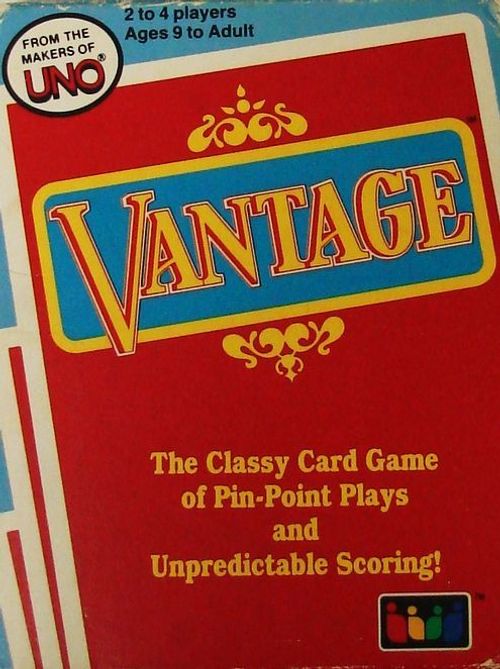
Vantage (1985)
Vantage (1985) Rulebook
Table of Contents
Table of Contents
Ages, Players, Object and Equipment
AGES: 9 to Adult
PLAYERS: 2 to 4
OBJECT OF GAME: Score the most points by matching and collecting as many key cards as possible.
EQUIPMENT: 106 cards consisting of 5 suits of cards each numbered 1-14 (suits, colored Red, Yellow, Green, Blue and Purple) 4 WILD cards and 28 Action cards including: 13 CARDS UP cards, 10 BLACK OUT cards, 3 PASS ONE cards, 2 LOSE ONE cards, 4 Quick Reference Information cards.
NOTE: Each suit contains a special "BIG" card used in SCORING.
FIRST TIME PLAYERS OF VANTAGE: We suggest playing at least the first game with the players' cards FACE UP on the table so that all the players can read the instructions together (players' cards are normally in their hands and concealed from other players).
GENERAL SUMMARY OF PLAY: Deal 4 cards to each player. Deal 4 cards on the table FACE UP. Stack all the ACTION CARDS in a pile separately. A player's turn consists of first turning over 1 ACTION CARD, following the instructions and then either MATCHING, BUILDING or DISCARDING using 1 card from his hand. His turn then ends and the player to his left goes next. Each player puts all cards collected FACE DOWN in his own pile. Each player tries to collect high scoring cards on each turn. The player with the highest scoring cards at the end of the game is the winner.
Terms Used in This Game
ROUND: Each deal of 4 cards to each player.
MATCH: Finding cards on the table that are the same as cards in your hand.
BUILD: Combining cards on the table so that they can be taken at a later turn.
DISCARD: Playing 1 card FACE UP on the table when a player cannot MATCH or BUILD. This play adds to cards already on the table.
How to Play VANTAGE
To Begin
- Select a dealer and scorekeeper by a fair method.
- Shuffle the ACTION CARDS and stack in a pile FACE DOWN.
- Shuffle all other cards and deal 4 cards to each player. Next deal 4 cards in the center of the table FACE UP. The remaining cards are kept in a pile nearby FACE DOWN until the next round.
To Play
- The player to the left of the dealer goes first. The first player turns over the top card of the ACTION CARD PILE. Follow the instructions on the ACTION CARD as follows (Note: ACTION CARDS only affect the cards in the center of the table):
- CARDS UP - All cards on the table must be turned FACE UP (if not already).
- BLACK OUT - All cards on the table must be turned FACE DOWN (see additional rules).
- PASS 1 CARD - EVERY PLAYER must pass 1 card to the player on his right (see additional rules).
- LOSE 1 CARD - Player turning over this card must put 1 card on the table FACE UP and ends his turn.
- After the first player turns over the ACTION CARD and follows its instructions, this player must then decide how to play 1 card from his hand to the cards on the table. As mentioned, the object of the game is to collect as many key cards as possible. The strategy of VANTAGE is to collect as many cards as possible on each turn with only 1 card from your hand. Remember that only 1 card can be played from your hand per turn. A player can play his card by either MATCHING, BUILDING or DISCARDING.
A. MATCHING
A player simply matches 1 card from his hand with 1 or more cards from the table.
Example #1: If player has a #8 in his hand and there is a #8 on the table, then he can collect both #8's and put both cards in a pile FACE DOWN nearby. Also, if there are two #8's on the table, then the player could collect both #8's with the #8 from his hand.
Example #2: If a player has a #8 and there is a #5 and a #3 card on the table, he can collect both the #5 and #3 cards with the #8 from his hand.
Example #3: If a player has a #8 and there is a #5, #3 and #8 on the table, then he can collect the #5, #3 and #8 with his #8. However, if a player has a #8 and there is a #5, #2 and #1 on the table, he CANNOT collect these cards with his #8.
STRATEGY HINT. Always try to collect as many cards as possible on each turn but remember to go after key scoring cards when possible (see scoring).
B. BUILDING
A player can eventually collect more cards per turn by matching cards but leaving them on the table and collecting them on a later turn.
Example #1: If a player has 2 #8's and there is a #5 and # 3 card on the table, then he can say to all other players "Building 8's." He then places one of his #8's on the #5 and #3 cards but leaves the pile FACE UP on the table. The player can take the entire pile with his other #8 card on his next turn.
STRATEGY HINT: The reason for this type of play is to enable the player to collect the extra 8 from his hand. Remember, a player can only play 1 card from his hand per turn.
Example #2: If a player has already started "Building 8's" on a previous turn, when he gets his turn and has a #8 in his hand and there is a #1 and #7 on the table, he can play his #8 card and collect the #8 build pile, the #1 card and the $7 card all together! [Sic: "$7" is printed in the original; the intended card is the #7.]
However, there are RISKS IN Building: Once a BUILD PILE has been started on the table, any other player on his turn can collect the pile if he has the proper card that the pile was called as originally. For example, a player plays a #4 card on #3 and #1 cards already on the table and says, "Building 4's." If the next player has #4 card, he can collect the BUILD PILE.
Adding to a BUILD PILE: Once a BUILD PILE has been started on the table, any other player on his turn can add to the pile. For example, a player plays a #4 card on #3 and #1 cards already on the table and says "Building 4's." If the next player has a #2 card he can add it to the BUILDING PILE and say, "Building 6's." (SEE ILLEGAL RENEGING.)
C. DISCARDING
If player cannot MATCH or BUILD then he simply plays 1 card from his hand FACE UP on the table. This adds to cards already on the table. This card is discarded FACE DOWN during a BLACK OUT (see additional rules).
-
SPECIAL CARDS: WILD CARDS can be played as a card of any number 1-14 and any of the five suit colors. "BIG" CARDS in each suit have regular numerical value during play, however, they are valuable in scoring (SEE SCORING).
-
IN SUMMARY, a player's turn consists of first turning over 1 ACTION CARD, following the instructions and then either MATCHING, BUILDING or DISCARDING using 1 card from his hand. His turn then ends and the player to his left goes next. Each player puts all cards collected FACE DOWN in his own pile.
-
After all 4 cards in each player's hand are played, the player to the left of the first dealer deals the next Round, 4 cards to each player. Play proceeds until all the cards have been dealt and the last Round played.
NOTE: For the Final Round deal as many cards as possible to each player evenly - any left-over cards are placed FACE UP on the table (SEE ADDITIONAL RULES).
- At the end of the last Round if there are any cards left on the table, the last player to collect any cards off the table gets the final cards on the table as a BONUS.
Scoring
After all cards have been played, each player looks at his pile of collected cards. Score cards as follows:
| Award | Points |
|---|---|
| Player with the most cards collected | 10 points |
| Player with the most PURPLE cards collected | 8 points |
| Player with the most RED cards collected | 6 points |
| Each "BIG" suit card collected (PURPLE #2, RED #10, YELLOW #6, GEEEN #7, BLUE #12) [Sic: "GEEEN" is printed in the original; the intended suit is Green.] | 4 points |
| Each #1 card | 2 points |
| Each WILD card | 2 points |
WINNER: Player with the highest score is the winner!
Additional Rules
- Extra cards in the final Rounds will occur as follows:
- 2 Player Game consists of 9 Rounds with the 9th Round being short and only 1 card dealt to each player.
- 3 Player Game consists of 6 Rounds with the 6th Round being short with only 3 cards dealt to each player and 1 extra card FACE UP on the table.
- 4 Player Game consists of 5 Rounds with 2 extra cards FACE UP on table at the 5th Round.
- BLACK OUT RULES: When the BLACK OUT Action Card is turned up, all cards on the table are turned FACE DOWN. Players should try to remember the cards in order to make matches. ALL BUILDING PILES ARE NEVER TURNED OVER.
-
When there is a BLACK OUT and a player wants to MATCH or BUILD, the player must show the card he wants to play and turns over the card(s) he thinks makes the match. If he is correct, he collects the card(s) as in normal play. However, if he guesses incorrectly, any cards turned up on the table are turned back over and the player's card must be played (discarded) on the table FACE DOWN.
-
A BLACK OUT continues until a CARDS UP card is turned up and all cards on the table are turned up immediately.
NOTE: When a PASS 1 card or LOSE 1 card is turned up-cards on the table whether Facing Up or Down are NOT changed.
- When DISCARDING during a BLACK OUT, a player must DISCARD the card FACE DOWN (only this player will know what this card is until a CARDS UP card is turned over).
-
ILLEGAL RENEGING: When calling a BUILD PILE, the player calling the BUILD PILE must always have the correct card being called in his hand. The reason for this rule is so other players can try to keep track of cards already played. When a player calls "Building 8's" for example, then all other players know that at least one of his cards has to be a #8 card. If a player is suspected of reneging, he must be challenged immediately - before the next player plays. The player challenged must show only the card relevant to the play to the challenger to confirm the correctness of play. If the play was legal, the challenger does not get any penalty. But if the play was not legal, then the challenged player gets a 10 POINT penalty at the end of the game.
-
VANTAGE can be played as a basic Casino game without the ACTION Cards for a simpler variation of play.
-
Always remember to turn over an ACTION Card before playing a card from your hand.
-
After a PASS ONE Card is turned up as an Action Card and all players pass 1 card to the right, the player who turned up the card still gets to play a card as a regular turn.
Also, when players pass 1 card and a player has no card to pass, he cannot pass a card. Similarly, if a player passes his only card and he does not receive a card (player to his left has no card to pass) and it is his turn, his turn is over.
-
After a LOSE ONE card is turned up as an Action Card, the player who turned up the card MUST discard 1 card as his turn. He has no other play.
-
When the Action Card Pile is completed, always reshuffle and restack the pile FACE DOWN.
-
A more challenging game will result by simply removing 1 or 2 CARDS UP cards from the Action Card pile.