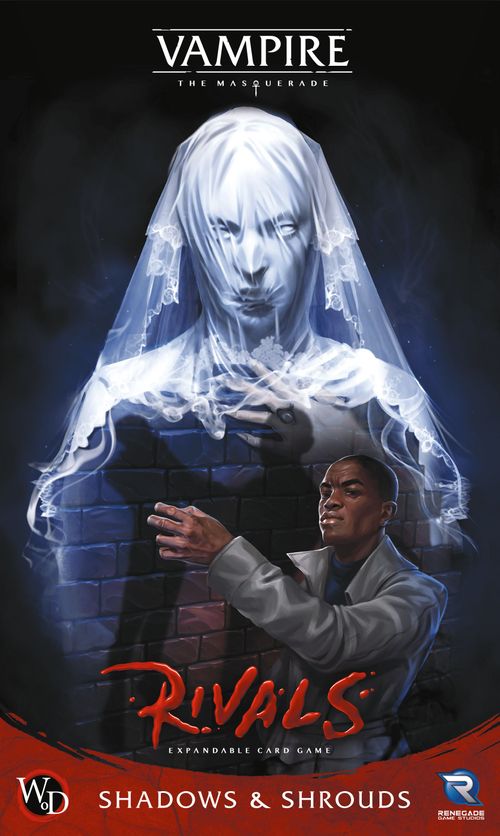
Vampire: The Masquerade – Rivals: Shadows & Shrouds
Vampire: The Masquerade – Rivals: Shadows & Shrouds Rulebook
Table of Contents
Table of Contents
Contents
- 2 Pre-Constructed 49-Card Player Decks
- 4 Fear Tokens
- 4 '-1 BP' Tokens
- 30-Card Crypt Pack (for customizing decks — don't open until you've played a game or two)
- 4 Card Dividers
- 6 Wraith Tokens
New Concepts and Keywords
Updated Burned Pile Rules for Core and All Expansions: Keep your burned cards in your own personal burned pile, so that your cards don't get mixed in with other players' cards. All burned and discarded cards are public knowledge. The Core Rulebook says to move a burned card away from the play area, but burned City Deck cards should be kept nearby from now on, as they are used for several different effects in this expansion. Players may wish to separate burned Events and burned Mortals into 2 piles, so each is more easily accessed.
Updated Torpor Rules for Core and All Expansions: Vampires in torpor cannot be targeted or affected by cards/effects unless the text specifically mentions torpor. Effects that target a character in torpor may target any player's character in torpor. For clarity, cards will no longer say "if this character is in torpor." Instead, "torpor abilities," which say "Torpor –," only work if that vampire is in torpor. These abilities resolve during your Torpor and Mending Step (Step 1 of the End Phase), just prior to any Mending.
Agenda on Vampires, Spending Agenda: Some vampires are so confident that they are willing to spend an incredible amount of resources to achieve their goals. There are several cards in this set that can cause Agenda to be placed on a vampire. Your vampires may spend Agenda on their own card or on your Agenda card. A vampire may never spend Agenda found on another vampire. An Agenda token placed on a vampire from any source may be spent by that vampire (if able). If a foe defeats a vampire with Agenda on them, that foe earns that Agenda and places it on their own Agenda card. Agenda on a vampire is not on your Agenda card, so it is not counted in your coterie's Agenda total (and does not count towards winning the game). Cards that count Agenda like Shades, Lost Glory, and Rain on Your Parade don't see Agenda on vampires.
Diablerie: The act of consuming a defeated vampire to destroy them completely and gain some of their essence. You must have permission to commit diablerie via specific cards. The Lasombra Title Court of Blood and the Haven The Big House both allow a player to perform authorized diablerie. There is no way to commit unauthorized diablerie at this time. (See page 4.)
Oblivion Rituals: These are Ongoing cards that take time and Mortal blood to perform. Rituals debuted in the Blood & Alchemy expansion, using Blood from vampires to enable them. Oblivion Rituals require Mortals in the City Deck burned pile to generate their power. (See page 7.)
Reach: Vampires with the keyword Reach may attack characters in The Streets from the comfort of their Havens. Exhausted vampires in your Haven are still members of the attacking party. City Deck Mortals are not characters, and thus cannot be attacked in this way.
Wraiths: These ghostly entities can be created through various card abilities, then they attach to and grant a vampire a random special ability via a wraith token. When a wraith is created, remove a Mortal from the City Deck burned pile, flip it face down, and attach it to the vampire who is to receive it. Draw 1 random wraith token, look at it, then place it face down on the attachment. Spring a spooky surprise on your unwary foes! (See page 5.)
Clan Lasombra
The Lasombra are a clan of ruthless overachievers. They sire those who are used to winning and want to keep on doing so for a few more centuries. As vampires hungry for triumph, they prove their worth by making a show of their victories. When a Lasombra vampire earns agenda, they often attach it to themselves and then score it later. When many successes come quickly, as often happens with the Lasombra, this can leave agenda on their vampires. Those tempted to steal it away should be aware that the Lasombra are no pushovers. They enjoy being better than their so-called peers, and often use their dominating personalities and air of supremacy to intimidate the other clans.
Clan Hecata
(Pronounced he-CAH-ta) This relatively new clan mostly comprises the remnants of several near-defunct clans and bloodlines. They value family highly, and some compare them to closely-knit mob organizations. The Hecata use Oblivion in more subtle ways than the Lasombra. One of the biggest differences is their use of "Ceremonies" (which we call Rituals in Rivals). These use much the same rules as the Rituals in the Blood & Alchemy expansion. The big difference here is that Oblivion Rituals gain their charges from Mortals in the City Deck burned pile. The City Deck burned pile is also where the Hecata find restless spirits who might be ripe for turning into wraiths (see page 5). Wraiths attach to a vampire and provide all sorts of surprises from beyond.
As a clan obsessed with death, the Hecata are not above sending their own vampires into torpor. The player calling you Rival earns no Agenda from your self-sacrificing ways, but when a vampire in your coterie enters torpor by your own hand, you must convert 1 into and place it on that vampire as usual. Reducing your own character to 0 is "defeating" them.
New Rules
Diablerie
To drink the blood and consume the very essence of an immobilized vampire, bringing about their Final Death, is called diablerie. Unauthorized diablerie is unthinkable to vampires claiming any shred of civility. To perform diablerie in Rivals, you must have permission (a card) to do so. The Lasombra Title Court of Blood and the Haven The Big House both allow a player to perform diablerie. Diablerie is an after-effect of defeating a vampire. You may activate these cards after damage is taken, but before a vampire would enter torpor. The card you use will list other effects/costs/etc.
When you commit diablerie on a vampire you just defeated, attach the victim to the vampire who defeated them so that the victim's left-most column of attributes and Disciplines is visible. The diablerist gains the attributes of the consumed vampire where they are higher than their own as well as all of their Disciplines, and a bonus of +1 BP (this effect does not mend them). This counts against the 3-card attachment limit. For example, a vampire with 1 [attribute icon] and 1 [attribute icon] commits diablerie on a vampire with 1 [attribute icon] and 2 [attribute icon]. The Diablerist's new attributes are 1 [attribute icon] and 2 [attribute icon].
Additional Rules on Diablerie:
- Performing diablerie against a vampire is not defeating them a second time.
- If the victim is burned, they cannot be consumed through diablerie.
- Burn all attachments (including Titles and tokens) on the victim before attaching it.
- When your vampire is consumed, you do not place Blood on them, as they are not being placed into torpor.
- When a diablerist is defeated, burn all vampires they had attached, then proceed as normal. There are no penalties for performing an authorized diablerie.
The printed example beside these rules reads: Markus would gain 1 [attribute icon], 3 Disciplines, and 2 [attribute icon] while this diablerized vampire (Annika) is attached. Markus gains no [attribute icon] or [attribute icon], as his are already equal to or greater than the consumed vampire's attributes.
Wraiths
A wraith is a ghost, the soul of a mortal who has died without fulfilling some goal. Those able to commune with the dead can coax such an entity into doing their bidding. In Rivals, wraiths attach themselves to vampires and provide them with some spooky surprises when the time is right.
There are 6 different wraith tokens in this expansion. At the beginning of the game, place them nearby in a random, face-down stack and then shuffle them. To create a wraith, you need a card ability that allows it (the Haven Mission Cemetery, the Ritual Summon Spirit, or the Hecata vampire Zahara). You also need at least 1 Mortal in the City Deck burned pile. If there are no burned Mortals available when a wraith is to be created, no wraith is created and the effect is lost.
When a card ability tells you to create a wraith, remove 1 Mortal from the City Deck burned pile and attach it to the recipient face down. Draw the top wraith token from the stack, look at it, and then attach it to the face-down card you attached to your vampire. This burned Mortal card/wraith token combo counts as 1 attachment against the 3-attachment limit. A vampire may attach more than 1 wraith (up to the 3-attachment limit).
The wraith token remains face down until you choose to flip it face up, which may be done at any time for any reason (or no reason). All wraith abilities are Relentless, which means they may be flipped/exhausted during any player's turn. When you wish to activate a wraith token, flip it face up if it isn't already (not the face-down Mortal). Flipping the wraith token face up for the first time generates the effect listed on the token. Once face up, the token remains face up. If it is face up, you may exhaust the token to activate it and generate the effect. The vampire then has that ability during the current action/event. At the end of that action/event, the ability turns off. It is readied at the start of your turn like every other card you control, but the token is never flipped back face down.
A player may flip a wraith token face up and then exhaust the token to double the benefit during the same action/event. For example, if a vampire makes a Social attack, they could flip a +1 wraith token face up and then immediately exhaust the token to add an additional +1 to the attack. The +1 wraith could be flipped and exhausted during an attack to prevent 2 damage or to soak up 2 Aggravated S.A.D. damage during the Antagonist Step of your End Phase.
Some abilities require an attached wraith to be exhausted as a cost. This does not generate the effect on the wraith token, as this exhaust is paying the cost of a different ability: Paying the cost of one ability never pays the cost of another ability. You may exhaust an attached wraith even if the token is face down. While exhausted, a wraith token may still be flipped face up to generate the listed effect once.
You may remove a wraith from a vampire in your coterie during your turn to make room for other attachments, but doing so removes it from the game (both Mortal and token). When a vampire goes into torpor, any wraiths attached to them are also removed from the game. In either case, the Mortal card is not returned to the City Deck burned pile, and the token does not go back on the wraith stack. If there are no wraith tokens in the general supply, no additional wraiths may be created. In a tournament setting, each player may bring their own set of 6 wraith tokens. When your personal supply of wraith tokens is depleted, you may not create additional wraiths.
Oblivion Rituals
A Ritual is an Ongoing Action that costs 2 actions to play, but only 1 vampire is required to exhaust when you play it. However, you may exhaust ONE additional vampire with Oblivion in the same party to reduce the action cost of that Oblivion Ritual by 1. You cannot combine an action and an unhosted action to perform a Ritual. When playing an Oblivion Ritual, place it face up near your Haven, and then count the number of Mortals in the City Deck burned pile. You may place up to that many Blood tokens of your color from the general supply on that Ritual as you play it. For example, if you play an Oblivion Ritual when there are 4 Mortals in the burned pile, you may place up to 4 Blood tokens of your color from the general supply on the Ritual. The phrase "burned Mortals" seen on cards refers only to burned Mortals currently in the City Deck burned pile.
Blood tokens of your color are a finite resource. Therefore, you may not want to commit too much Blood because you have a limit of 32 Blood/Prestige between all of your vampires and cards: That is the total Blood/Prestige found on the 20 tokens of your color and you cannot borrow tokens from other players. If you're playing a Ritual-heavy deck, playing 4 Rituals with 5 Blood each might severely restrict your ability to recruit or mend vampires.
The ability to add Blood tokens to an Oblivion Ritual is preceded by a [Oblivion icon], so if you want to add those tokens, the acting vampire must have the Oblivion Discipline. An Oblivion Ritual may be played even if there are no burned Mortals. The Hecata vampire Annika may move Blood from vampires you have in torpor onto a Ritual as it is being played. This allows her to trigger both levels of the Rites of Blood Agenda card (from Blood & Alchemy), which counts the Blood you add to a Ritual as it enters play. The more Blood you have on the Ritual, the more "uses" you will get out of it. If additional Mortals become burned, that does not add more Blood to any Rituals already in play. There is no limit to the amount of Blood an Oblivion Ritual may have on it (Blood Sorcery Rituals have an initial limit of 3 Blood, but Oblivion Rituals do not). When the last Blood on a Ritual is removed, resolve the effect and burn that Ritual.
Specific Card Clarifications
Annika, Markus Kumnyama, Prizefighter: These triggered effects use the word "as" instead of "when." That means it resolves at the same time as the action in question (regardless of the effects of that action). If Markus exhausts to attack a vampire (an attack action) with Prizefighter as his Agenda, place 2 Agenda tokens on him immediately before continuing with the rest of the action. The ability on Prizefighter is not limited to your Leader. Attacking a claimant to the Prince title is not performing an action, but it is an attack against a character.
Arms of Ahriman: If the acting vampire has the Oblivion Discipline, they may pay 1 Agenda to remove the Superficial tag from this Action as they play it. This is not an Attack card, so standard Reactions may not be used by the target. The target still reduces the damage with their [attribute icon].
The Big House Haven: Vampires in your hand or in torpor are not in your coterie, so their [attribute icon] is not increased. Only your Leader may perform diablerie with this Haven.
Bind the Spirit: During an attack, the last chance to move a wraith is Step 9 of the Attack Sequence. You cannot move a wraith after damage has been applied. When moving a wraith, the attached face-down card goes with it. You may use this Ritual to attach a wraith to a character outside of your own coterie.
Early Grave: This card creates a recruit action, but you pay no Prestige to place the chosen Hecata vampire from your hand into torpor. The rules of uniqueness still apply, so you cannot recruit a vampire with the same name as one currently in a coterie. If you recruit a vampire with the same name as one in torpor, that foe's vampire is burned, even if yours is being recruited into torpor. The vampire you choose will enter torpor with 0 Blood, which does not cause any ill effects.
Eternal Life Mortuary Haven: The text on this Haven specifically allows you to reduce the Blood of a vampire in your coterie to 0. Normal Blood payments do not allow you to spend a vampire's last Blood. Note that you must spend exactly 2 Blood, so if a vampire has only 1 Blood you cannot remove 2 Blood from them.
Flesh of Marble: This card allows a player to react to Aggravated damage, not an attack, so it may be played after the normal reaction window. You may even play this card after playing a Reaction during the normal Attack Sequence. It may also be played during your End Phase to turn S.A.D. damage into damage. When Aggravated damage is turned into damage, the vampire's attribute reduces it as usual. If a vampire without Fortitude plays this card, they get only 1 [attribute icon] and the damage remains Aggravated.
Mental Block: The detached card goes into its owner's discard pile. The Ongoing ability that denies the use of a card does not require Auspex, but you won't be able to use the exhaust ability without Auspex in your coterie.
Mission Cemetery Haven: You may choose any Mortal in the City Deck burned pile.
Necromancy: The burned Mortal this card requires does not have to come from this card's discard effect. The loss of 2 Blood can cause a vampire's Blood to go to 0 (from 1 or 2), as it is a side effect and not a cost. A vampire does not need to be at 2+ Blood to lose 2 Blood.
Prowess From Pain: The attack value of this card depends on the difference between the acting vampire's [BP icon] and their current [Blood icon]. If you have a 6 BP vampire who is currently at 1 Blood, this card would deal 5 damage (6 BP minus 1 Blood) +1 from the card's inherent damage in the [damage icon]. If the vampire is at maximum Blood, this Attack card would provide only the 1 inherent damage.
Sixth Tradition: Destruction: For example, if 9 Influence was for YES, and YES beat NO, this would deal 2 Aggravated damage to the target (1 + 1 for every 5 Influence in favor). If the NOs win, no damage is dealt. The target is chosen as the card is being played, not at the end of the Influence Conflict.
Spectral Possession: The vampire you choose does not have to be exhausted, but if they are, they ready. The owner of the vampire does not lose the game for lack of vampires if this is their only vampire. You must perform this additional free action immediately. The stolen vampire is treated as a member of your coterie during this action, and any costs for this free action may be paid by that vampire (using the vampire's Blood, Agenda on it, attachments, etc.). You may not detach any cards from the vampire unless that is a cost or a side effect of performing the action. You may play an Attack card and use any activated abilities as usual and you may use the vampire to attack a member of their owner's coterie. When the free action has been completed, the borrowed character remains in The Streets and returns to its owner's coterie.
Summon Spirit: This Ritual requires the removal of 2 Blood to activate the effect. If there is only 1 Blood on the card, the cost to activate it may not be paid.
The Tenderloin Haven: This Haven allows you to reduce your next recruit's Prestige cost by spending Agenda. "Different sources" include only cards you control such as your Agenda card and your vampires. You may remove a maximum of 1 Agenda from each different source you control. You do not have to remove 1 Agenda from every source you control. When the vampire enters play, add Blood of your color from the general supply to them until they have Blood equal to their printed BP.
Sample Cards
Annika (Hecata Vampire, 6 BP) — As you play a Ritual, you may move 1 [Blood icon] from any number of your characters in torpor to that Ritual.
Markus Kumnyama (Lasombra Vampire, 6 BP) — Reach (May attack characters in The Streets from your Haven.) As this character performs an Action, place 1 Agenda from the general supply on them.
Most Impressive (Agenda) — At the start of your turn, if your Influence in The Streets is higher than each individual foe's Influence in The Streets, gain 1 Agenda. If you reach 13 Agenda, you win!