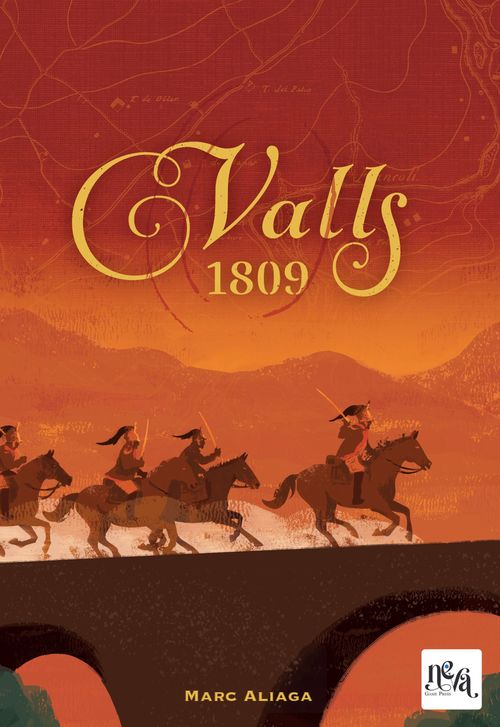
Valls 1809: Battle of the Goi Bridge
Valls 1809: Battle of the Goi Bridge Rulebook
Table of Contents
Table of Contents
- Introduction
- Victory Conditions
- Game Components
- Setup
- Key Concepts
- Sequence of Play
- Activation Options
- Cohesion Check
- Tactical Cards Rules
- Solo Mode
- Design Notes
- Bibliography
- Transcription Notes
Introduction
Valls 1809 is a wargame set during the Peninsular War. This conflict, also known as the Battle of the Goi Bridge, saw French Marshal Laurent Gouvion Saint-Cyr commanding his forces against the Spanish army led by General Theodor von Reding.
The French player must achieve a decisive victory before nightfall, as time is a crucial factor for the Napoleonic side. The Spanish player, on the other hand, must hold their ground and survive until darkness provides them cover.
This is a fast-paced game where a series of small decisions can lead to a major turning point in the battle. Every choice you make, positive or negative, will shape the final outcome.
Victory Conditions
Victory is determined by three main factors: French Morale, River Crossings, and Unit Elimination.
French Morale
French morale is tracked on a dedicated marker on the game board. This marker begins at a high value and moves closer to 0 as the battle progresses.
The French morale marker decreases by one space in the following situations:
- When a French unit spends cohesion points to activate.
- When a French unit loses cohesion as a result of combat.
If both of these events occur during the same turn, the marker moves two spaces toward 0. Additionally, the marker can be affected by specific event cards or when a player draws extra tactical cards, as explained later in the rules.
Historical Note: If French morale reaches 0, it signifies that night has fallen. The Spanish army successfully withdrew in an organized manner, and the Spanish player wins the game.
River Crossing
The French must cross the Francolí River within a specific timeframe to secure a victory.
- By the time the French morale marker reaches the 20-value space, at least 2 French units must have crossed the river.
- By the time the French morale marker reaches the 10-value space, at least 4 French units must have crossed the river.
If the French player fails to meet these conditions at the end of their turn, the game ends immediately, and the Spanish player wins.
An important note: Units that have been eliminated but previously crossed the river still count toward the total.
Unit Elimination
The game can end at any point if one side suffers catastrophic losses. The opposing player wins immediately if:
- Both of an opponent's leaders are eliminated.
- Three or more of an opponent's units are eliminated.
This provides an alternative path to victory for both sides, regardless of the morale track.
Game Components
Valls 1809 contains the following game components:
- 1 Mounted Map.
- 39 Cards.
- 65 Wooden pieces.
- 2 6-sided dice.
- 2 Player Aid Sheets.
- 1 Rulebook.
Mounted Map
The central part of the game board is a detailed map of the Battle of Valls. This area is where all the action takes place. Troop locations are represented by square-shaped unit tokens on the map: blue for the Imperial (French) forces and tan for the Spanish forces.
In addition to the battlefield itself, it contains several key elements essential for gameplay:
- Imperial Army Morale Track: This track is used to monitor the morale of the Imperial (French) army throughout the game. The track runs from 30 down to 0 and is divided into three key sections.
- Combat Modifiers: This section lists the modifiers that affect combat for both sides, detailing how different units or circumstances alter the combat outcomes.
- Combat Results: This area provides a quick reference for the results of combat, allowing players to quickly determine the consequences of their engagements.
- Imperial Dragoons Cohesion Track: This specific track is used to monitor the cohesion of the Imperial Dragoons unit, which is a crucial element for their performance and staying power in the battle.
This layout ensures that all critical game information is present and easy to reference on a single game board.
Cards
The game features two types of cards: Cohesion Cards and Tactical Cards. Below, we'll explore their unique functions and features.
Cohesion Cards
Each unit under a player's command has its own dedicated Cohesion Card. These cards serve two primary functions:
- Cohesion Tracking: They are used to track a unit's current cohesion level throughout the game.
- Combat Priority: They display the combat priority for that specific unit, which is crucial for resolving engagements.
Tactical Cards
The game includes a set of 30 Tactical Cards (15 for each side). These cards represent key historical decisions made by the commanding generals, Reding and Saint-Cyr. They introduce unique modifiers and effects that add variety and historical flavor to the gameplay.
Important Rule: If the text on a Tactical Card conflicts with a general rule in this rulebook, the card's text takes precedence.
Each Tactical Card features a representative image, a name, a description of its effect, and a letter code (A, C, or G) indicating when it can be played.
Types of Tactical Cards:
- Marked as A (Activation Cards): These cards either replace or modify the standard activation rules. If you play the action on the card, it counts as your unit's activation for that turn. Unless specified otherwise, general cohesion and morale rules still apply.
- Marked as C (Combat Cards): These cards provide combat modifiers for either offense or defense. They are played just before you roll the dice to resolve a combat engagement.
- The rest (General Use Cards): These cards can be played at any time during your turn. You have the flexibility to play a General Use card either before or after activating a unit.
Wooden Pieces
The game uses wooden pieces of various shapes and colors to represent the forces on the battlefield. Generally, red pieces represent the Spanish army, while blue pieces represent the French or Imperial forces.
The full list of pieces includes:
- 20 red rectangular blocks: Spanish infantry battalions.
- 22 blue rectangular blocks: French infantry battalions.
- 2 large red cylinders: Spanish divisional leaders (Generals Conde and Castro).
- 2 large blue cylinders: French divisional leaders (Generals Pino and Souham).
- 4 red cubes: Spanish unit cohesion markers.
- 6 blue cubes: Imperial unit cohesion markers.
- 1 black cube: Imperial army morale marker.
- 6 red discs: Spanish artillery units.
- 2 white discs: Cavalry units (French Dragoons and Italian cavalry under Mazzuchelli).
Setup
In Valls 1809, two divisions from each side face off. The French divisions are led by Generals Souham and Pino, while the Spanish are commanded by Generals Castro and García Conde. Each division is composed of 2 to 3 regiments or brigades, which are referred to as units. Each unit is, in turn, made up of battalions, represented by rectangular wooden blocks (blue for the French and red for the Spanish).
A. Placing the Units
First, place all the battalion blocks onto the map.
- Position the 20 Spanish battalions (red blocks) and the 22 French battalions (blue blocks) into the rectangular spaces on the map that match their colors (ochre for Spanish, blue for French).
- Next, place the six Spanish artillery units onto the circular spaces marked with the artillery symbol.
- Finally, place the two French cavalry units (white discs). One goes in the starting position for the Dragoons, and the other is placed next to the Mazzuchelli unit.
B. Setting up the Tracks
The game uses several tracks to manage cohesion and morale.
- Cohesion: The cohesion tracks for individual units are located on each player's board. Place a colored cube on the starting value for each unit's cohesion track (either 12 or 14, depending on the unit).
- Note: The Dragoons' cohesion track is on the main game board and goes from 7 down to 1, reflecting their unique rules. Place the white cube on the '7' space of this track.
- Morale: Place the black cube on the 'I' (Initial) space of the French Morale Track on the map.
C. Placing the Leaders
After placing all the units, position the four divisional leaders (the large red and blue cylinders).
Each leader must be placed in a square on the map that shows their coat of arms, next to a unit from their command. The cohesion cards indicate which division each unit belongs to.
The French player places their two leaders first, followed by the Spanish player.
Each leader has at least two different starting positions. The player decides which one to use:
| French Army | Units |
|---|---|
| Souham | Vergés - Bessières - Bessières (Light Brigade) |
| Pino | Fontane - Mazzuchelli |
| Spanish Army | Units |
|---|---|
| García Conde | Grenadiers and Miquelets - Swiss Regiment |
| Castro | Cazadores de Antequera - Hussars of Granada |
D. Tactical Cards
To prepare for the game, create a Spanish Tactical Card Deck by taking all Spanish Tactical Cards (1-15) and shuffling them to form a pile. Do the same with the French Tactical Card Deck (16-30). Leave both decks near the map for easy access.
To begin the game, each player is dealt 3 tactical cards from their respective deck. The remaining cards form a reserve deck, which is accessible to players throughout the game.
Additional tactical cards can be obtained during the game, as explained in section 9.2. Acquiring New Cards.
Key Concepts
- Unit: A unit represents a regiment in the Spanish army or a brigade in the French army. Each unit is represented in two ways:
- On the map, showing its position and the number of battalions (blocks) it contains.
- On a cohesion card, which tracks its remaining cohesion points, lists modifiers for cohesion checks, and shows its combat priorities.
- Cohesion: This is a numerical value on each unit's card that represents several factors, including morale, fatigue, and supplies. It shows a unit's ability to withstand combat and continue fighting.
- Cohesion Check: Whenever a unit's cohesion marker lands on a colored space of its cohesion card, a cohesion check must be performed to see if the unit can maintain its fighting strength.
- Morale: Represented by a marker on a track, morale reflects the French army's overall ability to perform actions. It also symbolizes the passage of time during the battle. As French morale drops, the battle nears its end.
Sequence of Play
The game follows a simple, two-phase turn sequence:
1. Activation Phase
The French player takes the first turn. After that, players alternate turns, activating one unit at a time. Each activation has a cost:
- Cohesion: The activated unit loses 1 cohesion point.
- French Morale: The French morale marker on the board is reduced by 1 point (only during the French activation).
2. End of Game Check Phase
After each player has activated a unit, check for the end-of-game conditions as described in section 2. Victory Conditions.
During this phase, players can also acquire new tactical cards. This is only possible at two key moments: when the French Morale marker reaches the 20-value space, and again, when it reaches the 10-value space. For more details, see Section 9.2, Acquiring New Cards.
If the game hasn't ended, start a new Activation Phase.
Activation Options
Each turn, a player can choose from a list of available actions.
Common Activations (Both Sides)
Both players can choose one of these two actions per turn:
- Combat: Activate a unit to attack an enemy unit.
- Move a Leader: Move a single divisional leader.
Spanish-Specific Activations
The Spanish player has one additional option:
- Activate an Artillery Piece: Fire one of the two available artillery batteries.
French-Specific Activations
The French player also has two additional options:
- Move a Unit: Activate an entire unit to move.
- Move the Dragoons: Activate the Dragoon cavalry to move.
Reminder: A player may use a maximum of one tactical card per activation or combat, regardless of the card's type. Once a card is used, it is discarded from the game and cannot be used again (9.1. Using Tactical Cards).
7.1. Combat
A unit may only attack specific enemy units. The cohesion card for each unit lists its valid targets, numbered in order of priority. You must attack a target with the lowest possible priority number if one is available.
- Example: The Fontane Brigade must first attack the Hussars of Granada or the Swiss Regiment (both Priority 1). Only after these two units are eliminated can the Fontane Brigade attack the Cazadores de Antequera.
If a priority number has an asterisk (*), it means you cannot attack that target if one of your own units is positioned between the attacking unit and the target.
General Rule: Combat is typically reciprocal. If Unit A can attack Unit B, Unit B can also attack Unit A.
Resolving an Attack
- Declare: The attacking player declares the attacking unit and its target.
- Roll and Modify: Roll one six-sided die (1D6). Apply any relevant modifiers to the result for both the attacker and the defender.
Common Modifiers
- +1 to the die roll if a leader is present with the unit involved in combat.
- +1 for the attacker if the defending unit is on the riverbank.
Attacker Modifiers
- French:
- +1 if the attacking unit is Bessières's Light Brigade and it has already crossed the river.
- +1 if the attacking unit is Mazzuchelli's and it has crossed the river and the Italian cavalry disc is still in play.
- Spanish:
- +1 if the Spanish player chooses to spend an artillery disc associated with the attacking unit.
Defender Modifiers
- Spanish:
- +1 if the Spanish player chooses to spend an artillery disc associated with the defending unit.
Optional Rule: You may play a "C" (Combat) Tactical Card to support an attack or defense.
- Apply Results: Consult the Combat Table using the final modified die roll.
Combat Table
| Modified Die Roll | 0- | 1 | 2 | 3 | 4 | 5 | 6 | 7 | 8+ |
|---|---|---|---|---|---|---|---|---|---|
| Result | 2CA | 1BA 1CA | 1CA | 1CA 1CD | 1CA 1CD | 1CD | 1CD 1BD | 2CD | 2CD 1BD |
- #: Number of hits taken.
- A: Attacker.
- B: Battalion (block).
- C: Cohesion.
- D: Defender.
Applying Results
The results of combat can cause a unit to lose cohesion points or lose an entire battalion block.
- Cohesion Loss: Reduce the cohesion of the unit involved in the combat by the amount indicated.
- Battalion Loss: Place the lost battalion block on its unit's cohesion card. If there is no open space, the battalion is permanently removed from the game.
7.2. Moving and Eliminating Leaders
A divisional leader (Pino, Souham, Conde, or Castro) can be moved from one unit to another within their division. This costs 1 cohesion point from the unit the leader is leaving. If the leader is French, the French Morale marker also decreases by 1 point.
Leader Elimination: A leader is eliminated if they are present with a unit when that unit is eliminated. If a side loses both of its leaders, the opposing side wins the game immediately.
7.3. Exclusive Spanish Artillery
The Spanish player can activate their artillery. Each activation costs one artillery disc, which is removed from the game to represent expended ammunition.
Artillery can be used in two ways:
- Combat Support:
- Artillery can provide +1 to the die roll for a Spanish unit's attack or defense.
- Artillery Batteries are divided into two groups: Group 1 supports Castro's units, and Group 2 supports García Conde's units.
- Independent Fire:
- As a Spanish activation, you may spend an artillery disc to fire at any enemy unit. This activation does not cost a cohesion point.
- Roll the die and apply the result from the Combat Table with no modifiers.
- If a result calls for a cohesion loss to the attacker, apply it to the unit where the Spanish leader is currently located.
- If a result calls for a battalion loss to Mazzuchelli's unit, the Italian cavalry disc is removed first if it is still in play.
- If the Dragoons unit suffers a battalion loss, the corresponding cavalry disc is immediately removed from the game. It does not count as a unit for the victory conditions.
7.4. Exclusive French Movements
Only French units can be activated to move. The unit's divisional leader must be present for the movement to occur.
- Moving a unit costs 1 cohesion point from that unit and also reduces the French Morale marker by 1 point.
- If a divisional leader has been eliminated, the units of that division can still move without a leader, but they must spend double the cohesion and morale points.
Moving the Dragoons
The Dragoons have their own cohesion track and can cross the Goi Bridge with one move to control it.
- Activating the Dragoons costs 1 cohesion point for them, and the French Morale marker is reduced by 1 point.
- They do not need a leader to move.
- The Dragoons' presence on the other side of the river gives the French player a +1 bonus on the die roll during any Spanish unit's cohesion check. Using this ability costs the Dragoons 1 cohesion point.
- The Dragoons can only be attacked after they have crossed the river.
- If the Dragoons are eliminated, the French Morale marker is reduced by 1 point.
Mazzuchelli's Italian Cavalry
If a combat result requires Mazzuchelli's unit to lose a battalion block, the Italian cavalry disc is removed first if it is still in play. The Spanish army can also use their artillery's Independent Fire action to specifically target this unit.
Bessières' Light Brigade
This unit gets a +1 die roll modifier on attacks, but only after it has crossed the river.
Cohesion Check
A cohesion check is triggered when a unit's cohesion marker reaches a value of 6 or lower. This can happen due to activation costs or combat losses.
To perform a check, roll a single six-sided die (1D6).
- Failure: If the modified die roll is greater than the unit's current cohesion value, the unit is immediately eliminated.
- Success: If the modified die roll is less than or equal to the unit's current cohesion value, the unit survives and remains in play.
Important: If a unit's leader is with them when they are eliminated, the leader is also removed from the game.
Special Rule: A roll of 1 on a cohesion check is always a success, regardless of modifiers.
Cohesion Check Modifiers
Several factors can modify a cohesion check die roll:
- Disbanded Battalions: For every battalion block placed on a unit's cohesion card, you receive a +1 modifier to its cohesion check. Each card shows the maximum bonus that can be gained this way.
- French Dragoons: If the French Dragoons have crossed the river and are active, the French player can choose to use them to influence a Spanish cohesion check. If they do, the Spanish player receives a +1 to their die roll, and the Dragoons lose 1 cohesion point. Once the Dragoons' cohesion reaches 1 or below, they can no longer be used for this purpose.
Dragoons and Cohesion Checks
The Dragoons perform a cohesion check if their cohesion value is 5 or lower. When their cohesion marker drops to 1 or below, they are no longer effective and cannot be used. Note that the Dragoons are not considered a unit for the game's victory conditions.
Simultaneous Checks
If both players are required to perform cohesion checks at the same time, the French player goes first. If the French player loses their third unit as a result of their check, the game ends immediately, and the Spanish player wins. The Spanish player does not need to perform their cohesion check in this case.
Tactical Cards Rules
At the start of the game, each player begins with three tactical cards. These cards can be played to trigger unique events. Players also have the opportunity to acquire more cards throughout the game.
Using Tactical Cards
A player may use a maximum of one tactical card per activation or combat, regardless of the card's type. Once a card is used, it is discarded from the game and cannot be used again.
Acquiring New Cards
Players can acquire up to three new tactical cards during the game, with one card available during each of the following phases:
- While the French Morale marker is between spaces 30-20.
- While the French Morale marker is between spaces 19-10.
- While the French Morale marker is between spaces 9-1.
Each player may acquire a maximum of one card per phase, for a total of up to three new cards per game. The specific costs for each side are as follows:
- Spanish Player: To acquire a card, the Spanish player must move the French Morale marker +1 space (back towards the starting value of 30).
- French Player: To acquire a card, the French player must move the French Morale marker -1 space (closer to the Spanish victory condition of 0).
In both cases, the player draws the top three cards from their deck, chooses one to add to their hand, and discards the other two.
Solo Mode
This section outlines the rules for playing the game in a solo mode. All standard rules apply, with the following exceptions.
Each leader cylinder has a special side for solo play with numbers printed on it in addition to the emblem.
10.1 Playing as the Spanish Army
Setup:
To determine the starting positions for the French leaders, roll a die and consult the following table:
| Souham | Pino |
|---|---|
| 1-2: Vergés | 1-2-3: Fontane |
| 3-4-5: Bessières | 4-5-6: Mazzuchelli |
| 6: Bessières (Light) |
Activations:
To determine which French leader activates, roll a die:
- 1-3: Souham activates.
- 4-6: Pino activates.
The numbers for each leader are printed on their cylinder.
If the activated leader's unit can move, it will do so. If the unit has already crossed the river, it will instead perform a combat action, attacking a valid target based on its priority list.
Leader Movement:
If the activated unit's cohesion is 7 or lower, the leader will change units.
- Pino: Moves to the unit that has no leader.
- Souham: Moves to the unit with the highest cohesion.
If two units have the same cohesion, roll a die to determine where Souham moves:
- 1-3: Moves to the first unit.
- 4-6: Moves to the second unit.
Exceptions:
- If French Morale is reduced to 11 or fewer points, the French AI is obligated to move and activate the Dragoons unit after each Spanish Cohesion Check is resolved. The rule that requires the French army to have a specific number of units across the river at certain morale levels is ignored in solo mode.
- If you are using Tactical Cards, draw a new card for the AI every time the French morale marker reaches 25, 15, and 7. Play the card as soon as its effect can be applied. If the card's effect cannot be used immediately, a new card is drawn from the top of the deck to replace it.
10.2 Playing as the French Army
Setup:
The Spanish leaders are placed at the head of their divisions, with Castro commanding the Hussars of Granada and García Conde with the Swiss Regiment.
Activations:
To determine which Spanish leader activates, roll a die:
- 1-3: García Conde activates.
- 4-6: Castro activates.
The numbers for each leader are printed on their cylinder.
The Spanish AI will always use its activations for combat, following the attack priorities listed on its units' cards.
Leader Movement:
If the activated unit's cohesion is 7 or lower, the leader will change units.
Exceptions:
- The three artillery units associated with Castro will be used against Mazzuchelli's cavalry.
- The three artillery units associated with García Conde will be used against the Dragoons or Bessières' Light Brigade. These units will be used as soon as possible.
- If all artillery has been used and the French cavalry or Bessières' Light Brigade have been eliminated, the remaining artillery activations will be used to grant a +1 attack modifier in subsequent combats.
Design Notes
WIP
Bibliography
WIP
Transcription Notes
Typos in the source are corrected here: "Frech" to "French" (Setup B), "Exlusive" to "Exclusive" (7.4), "Bessieres" accents restored. The source's Acknowledgements and Credits sections, and a spreadsheet-export caption under the Combat Table, are omitted as non-rules text.