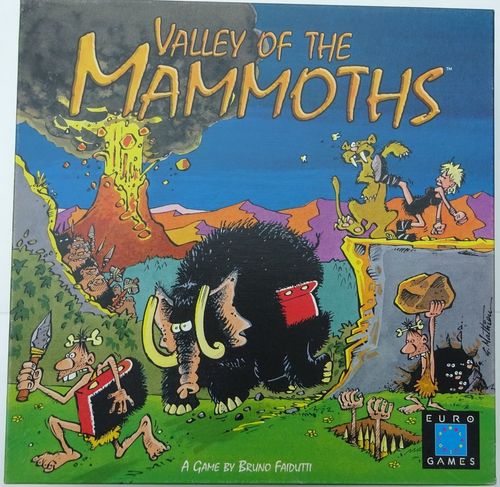
Valley of the Mammoths
Valley of the Mammoths Rulebook
Table of Contents
Table of Contents
Components
Game Board:
- Made of two interchangeable halves
Cards:
-
40 Fate Cards (Green)
-
15 Summer Event Cards (Yellow)
-
15 Winter Event Cards (Blue)
-
2 Dice
-
1 Cloth Sack for the Animal Tokens
Pawns, Markers and Tokens:
- 54 Animal Tokens printed with letters on the back to indicate where the animal arrives
- 8 Wolf tokens with blank backs
- 6 Sets of Tribe Tokens; 10 Warriors & 6 Females per player
- 1 Neutral Female Token
- 1 Neutral Warrior Token
- 1 Wooden Season Marker
- 9 Crop Markers; printed with 2 ears of wheat on the front, and 1 ear of wheat on the back
- 9 Wildfire/Flood Markers
- 2 Fence Markers
- 5 Camp Markers per player, printed with a Village on one side and a Cave on the other
- 6 Fire Markers
- 42 Food Markers, in various denominations
Setup
Four game boards to choose from.
- The players set up the game board by placing the two halves side by side. It is therefore possible to create 4 different game boards as shown above.
- One player is designated to run the food bank. Another is in charge of the appearance of animals, and a third handles the drawing of event cards.
- All of the Animal Tokens, with the exception of the 8 wolves which do not have letters on the back, are placed together in the sack.
- The Winter and Summer Event Cards are shuffled separately and placed face down on the appropriate spaces on the game board.
- Each player takes all of the Tribe Tokens of their color - this consists of: 10 Warriors, 6 Females and 5 Camps, as well as a total of 12 points of Food Markers (food points). For the first game between beginners you may start with 15 food points each.
NOTE: There is no difference between the fat and skinny cave people; they are different just for fun.
- The First Player is determined in a random fashion agreed upon by the players.
- Starting with the First Player and proceeding clockwise around the table, each player, in turn, places their tokens (1 Camp, 2 Females & 5 Warriors) on any open space on the board. When placed in a plains or a forest region the Camp is a Village; in a mountain region it is a Cave. At the beginning of the game it is forbidden to place your Camp on a space adjacent to the Camp of another player, unless the two camps are separated by a river. A player who sets up their Camp in a plains space may, if they wish, immediately spend 1 point of food in order to plant a crop there (place a Crop marker, face up, so 2 ears of wheat are visible).
- 5 Fate Cards (only 4 cards for a 5 or 6 player game) are dealt, face down, to each player. The remaining Fate cards are placed, face down, in the appropriate space on the game board. The players may now look at their Fate cards.
- The wooden Season Marker is placed on the 2nd turn of summer.
- The game is now ready to begin.
Game Turns
A year in the Valley of the Mammoth is divided into two seasons: summer and winter. These seasons are then divided into three separate turns (as seen on the turn wheel on the game board). Each turn is divided into phases that are always played in the same order. The phases in bold occur on all of the turns, the others occur only on certain turns.
The game progresses with three turns of summer followed by three turns of winter, then three turns of summer, and so on until someone wins the game (see phase 10 below).
NOTE: since the game starts with the turn marker on the second turn of summer, there are only two turns of summer for the first year.
The Phases of a Turn
- Events (except for the first two turns of the game)
- Arrival of New Animals
- Movement of Animals
- Movement of Tribes & Setup of Camps
- Combat
- Survival
- Births (at the end of the season)
- Planting Crops (at the end of winter)
- Draw New Fate Cards (at the end of the season)
- End of the Turn
1) Events
(For the first two summer turns of the game, no event cards are drawn)
All wildfire and flood markers are removed before drawing a new event card.
Draw an event card from the pile corresponding to the current season. Reveal the card to all players and immediately resolve the actions dictated by the card, then place the card in a discard pile next to the draw pile. When the pile of event cards is depleted, the discards are shuffled to form a new draw pile.
Regions
Some events require the selection of a region. A region is defined as a contiguous group of spaces of the same type: plains, forest or mountains (volcanoes count as mountains when determining regions). Regions are usually made up of several adjacent spaces; however some regions consist only of a single space. A region is divided by a river, i.e. two adjacent mountain spaces with a river running between them are part of separate mountain regions.
On the game board there are 6 Plains regions, 6 Forest regions, and 6 Mountain regions. Each region is marked with a number from 1-6. A roll of the die therefore indicates the number of the corresponding region.
Lasting Effects
Certain events (skin & bones, drought, etc.) have a lasting effect which can continue until the end of the season. Unless otherwise indicated by the card, you should leave these cards face-up on the game board, in order to remind players to take this card's effects into account.
NOTE: The text printed in italics on the event cards only applies when using the advanced rules for Fire.
2) Arrival of New Animals
Draw from the sack the following numbers of Animal Tokens:
| 4-6 players | 2 or 3 players | |
|---|---|---|
| First Turn Only | 6 | 5 |
| Summer Turns | 4 | 3 |
| Winter Turns | 2 | 1 |
NOTE: If, following the elimination of one or more of the players, only three or fewer players remain, the number of animals to be drawn must be reduced accordingly.
Each token is placed on the game board in the space specified by the letter on the back of the Animal Token. The brown capital letters indicate that the animal appears on a mountain space. The green lowercase letters indicate that the animal appears on a plains or forest space. As you can see all of these spaces are at the edge of the game board.
3) Movement of Animals
Animals located on the same space as humans do not move.
Roll the die and refer to the "Die Compass" on the game board in order to determine the direction of movement of all of the animals.
All of the animals that can move will always move their maximum movement in the direction indicated. Animals that start their movement with an immediate obstacle in the direction indicated by the Die Compass, will, if possible, move in the opposite direction. These obstacles include mountains and rivers for some animals; the lake, the edge of the game board, a wildfire space or a flooded space for all animals.
Once an animal has moved at least one space, it will stop moving if it encounters an obstacle. It will NOT turn around and complete its movement in the opposite direction. If an animal moves into a space where humans are located, the animal will stop moving. If an animal moves into a space where other animals of the same species have ended their movements, the newly arrived animals will stop moving and form a herd or pack with the other animals. These herds and packs will move and fight together for the rest of the game.
NOTE: In rare instances, when creating a herd or pack of animals, the movement of animals can lead to different results depending on the order in which the animals are moved. Players should always choose the order of movement which leads to the creation of a herd or pack over the order which would not.
Whenever a large animal (see below) moves through or ends its move on cultivated plain space, the crops are trampled & damaged. The Crop Marker is flipped so that only one ear of wheat is showing. If a damaged crop is trampled again, it is destroyed.
No animal can land in a space that is consumed by wildfire or flooded. Nor can any animal move into the lake, or off the edge of the board.
| Number of spaces | Travel in a mountain | Cross rivers | Trample crops | |
|---|---|---|---|---|
| Wolves | 3 | yes | no | no |
| Sabretooth Tigers | 3 | yes | no | no |
| Bears | 2 | yes | yes | no |
| Bison | 2 | no | no | yes |
| Woolly Rhino | 1 | no | no | yes |
4) Movement of Tribes & Setup of Camps
Movement of Tokens
After the first turn, the First Player is the player who has the largest number of camps on the board (in case of a tie the most warrior and female tokens on the board is first, in case of another tie, the player with the most food goes first. If there is still a tie, then the tied players each roll a die and the highest roll wins). On the first turn of the game the First Player is the player who placed their camp first.
Starting with the First Player and following clockwise around the board, each player, in turn, moves all of the Tribe Tokens that they wish to move. Players must complete all of their moves before the next player can start their movement.
Tribe tokens located on a space occupied by either animals or an opponent's tribe may not move unless they outnumber the animal or enemy tokens. If the tribe wishing to move does outnumber the other tokens in the space, they may move out of the space, but they must leave in the occupied space at least as many tribe tokens as there are animal or enemy tokens.
Each tribe token may move 1 or 2 spaces. A tribe token must stop if it lands on a mountain space. A tribe token may not cross the lake or a river. Tribe tokens landing on a space occupied by animals or members of another tribe must stop. If the newly arrived tribe are numerous enough, they may continue their movement as long as they leave in the occupied space at least as many tribe tokens as there are enemy or animal tokens.
Setup of Camps
If 1 warrior and 1 female of the same tribe find themselves alone in a free space without opponents or animals they may, instead of moving, set up a Camp. A camp marker is immediately placed in this space. If the space is a plain or a forest, place the camp marker Village side up, in the mountains place the camp marker Cave side up. If there are any opponent or animal tokens in the space, the camp cannot be set up.
You cannot have more than one camp per space. You must always keep at least one female in a camp, if you do not the camp is considered abandoned, removed from the game board, and the camp marker is returned to the owner's pool of tokens.
5) Combat
There is combat on all of the spaces where tokens from different tribes encounter each other, or encounter animals, except in the specific case where a lone female encounters warriors from another tribe (see below).
First, all of the combats of the First Player are resolved, then continuing clockwise, all of the combats of each player in turn. Each player decides the order in which their combats are to be resolved.
Each combatant rolls a die and adds any bonuses to the resulting number (see table). The player who has the lowest score loses one token (of their choice) that participated in the combat. In the case of a tie, the die is rolled again. The combat continues, die roll after die roll, until the elimination of one of the combatants.
Combat Bonuses
| Humans — Die Result | Animals — Die Result |
|---|---|
| +1 per warrior (above 1)* +1 in a friendly village +1 in a friendly cave | +1 per animal (above 1) in the herd/pack* |
* 1 lone warrior or 1 lone animal has a +1 combat bonus
Combat Between Tribes
Only warriors may take part in combat against other warriors; the women just run around screaming and watch helplessly (remember those old B-Movies). The females are won by the victor of the combat. If the victor is from an opponent's tribe, the new owner replaces the female tokens with female tokens of his own color, if he has any available. If the new owner does not have any female tokens, the newly taken females are killed.
Females that find themselves alone on the same space as a warrior (or warriors) from another tribe are captured without combat, and their tokens are switched as above. Females can be captured in this manner even if they are alone in their own camp.
If tokens from three or more tribes are in the same space, all of the players involved roll a die. Everyone except the player (or players) who attained the highest result loses a tribe token.
If a space contains tokens of animals and opposing tribes, combat between the tribes is resolved before the animals are confronted.
Taking Camps & Females
The player who conquers an opponent's camp takes 25 % (rounded down) of the food reserves from the conquered player, or 50 % (rounded down) if it was this opponent's last remaining camp. After pillaging the food reserves, the victor may EITHER:
Replace the camp and the females with tokens of his own color, OR; burn the camp and massacre the females.
Females & Combat
While a female will never fight a warrior, they will fight another female. If a female tribe token ever finds itself on a space with an opponent's female token they must fight. Fighting females do not receive any of the warrior combat bonuses, but they can receive the camp bonus and any bonuses given by fate cards that do not specifically reserved for warriors.
Combat Against Animals
The player chooses an opponent to roll the die for the animals. Animals of the same species in the same space are considered a herd or pack (see table above) and must be fought together, while individual animals and animals of different species must be fought in succession.
All of the tokens in the tribe (warriors and females) may participate in combat. However, the females do not provide any bonus for the die roll. A player who loses a tribe token while fighting an animal may choose to eliminate either a female or a warrior.
Killed animals are returned to the bag. The victor receives food points as shown on this table for each animal killed.
| Animal | Food |
|---|---|
| Mammoth | 6 points |
| Woolly Rhino | 5 points |
| Bison | 4 points |
| Bear | 3 points |
| Sabretooth Tiger | 2 points |
| Wolf | 1 points |
6) Survival
Each player calculates the number of food points they gain this turn, and subtracts the number of food points they consume this turn. Depending on whether the result is positive or negative the player will do the following:
- Positive - This number of tokens is taken from the food bank, and added to the player's food stock. OR;
- Negative - This player must pay this number of food points from their food stock to the food bank. If this player does not have enough food in their stock to feed the entire tribe, the player must choose which tribe tokens to eliminate.
Certain spaces on the game board produce food when they are occupied by tribe tokens. One space yields the same quantity of food regardless of how many tokens occupy the space.
Gaining Food Points
Fishing (all year long) 1 food point for each occupied space on the shore of a lake or bordering a river.
Foraging (in summer) 1 food point for each occupied forest space. Thus, a forest space on the border of a river yields 2 food points, 1 each from both fishing and foraging.
Harvesting (Only at the last turn of summer) 8 food points for each crop space that is both occupied and undamaged; 4 food points for each occupied, but damaged crop space. All of the Crop markers are removed from the game board after the harvest.
Consuming Food Points
Females and Warriors in a tribe consume 1 food point each. Tribe tokens that the player cannot feed, or does not wish to feed, are eliminated.
7) Births
(at the end of each season)
There is 1 birth in each camp where 1 female token is located and 2 births in each camp where 2 or more female tokens are located. Roll the die to determine the sex of each new token:
- 1 - 2: it is a female token.
- 3 - 4 - 5: it is a warrior token.
- 6: twins! (roll the die 2 more times (once for each twin), but now 6's produce warriors).
Place a new tribe token for each new birth. These new tokens are immediately considered adults, and are ready for normal movement, combat etc.
A tribe may never have more than 10 warriors and 6 females on the board. Even if all of a player's tokens of one sex are already on the game board the player must still roll the die to determine the sex of any new births. However, if the die roll results in the sex for which the player no longer has tokens, that player does not get to have that birth.
8) Planting Crops
(only at the end of winter*)
A tribe may plant crops on a plains space that contains a village they control. Planting costs 1 food point per crop to start the new plants (you are replanting your grain to grow more). The Crop Marker with the 2 ears of wheat is placed on the planted space. A player can only place 1 Crop Marker per space.
The back side of the Crop Marker (showing 1 ear of wheat) is used indicate damage that the crop received by being trampled by a large animal, or damaged by an event.
Exception: During the Set Up of a new game (before the first turn begins), players that have placed their starting village in a plains space may plant crops, even though the game starts in mid summer.
9) Draw New Fate Cards
(at the end of each season)
At the end of each season, players having fewer than 5 fate cards in their hand (4 fate cards for a 5 or 6 player game) receive only 1 new fate card, regardless of the number of cards that they have already played. If the fate card pile becomes depleted, the discards are re-shuffled to form a new pile.
Using Fate Cards
Players can use their Fate cards whenever they wish (subject to the restrictions on the card) during the course of the game. Each Fate card may be used only once (unless it was part of the discard pile and re-shuffled into the draw pile) and must be discarded after usage. A player who plays a Fate card does not receive a new one until the end of each season (phase 9, above), when eligible players receive 1 (and only 1) new fate card.
NOTE: The text printed in italics on the fate cards only applies when using the advanced rules for Fire.
10) End of the Turn & Victory
At the end of a turn, the season marker is moved one space clockwise on the season wheel and a new turn begins.
If, at the end of a turn, a player controls 4 or more camps, that player must notify the other players. If at the end of the following turn, the player still controls 4 or more camps (not necessarily the same ones) that player wins the game.
If, at the end of the turn, there are only animals left on the game board, the humans become extinct. In this case all of the players lose the game - such is life!
Resurrection
A player who is eliminated before the end of the first year may rejoin the game with a new tribe. However, this resurrected player receives only 3 warriors, 1 female, 8 points of food and 3 fate cards.
At the beginning of the second turn, after the drawing of event cards and the appearance of animals, the resurrected player places the new tribe tokens on a free space of the player's choice at the edge of the game board. Play then continues normally for the rest of the turn. Each player may only use this "second chance" resurrection once during per game.
Advanced Rules: Fire
If players wish a more intense and more complex game, they may adopt the following rules:
Goal of the Game
In order to win, it's not enough to have 4 camps at the end of 2 consecutive turns, you must also have fire!
Movement of Tokens & Capturing Fire
When a tribe token (or tokens) finds itself on a volcano space without opponents or animals, it may, instead of moving, capture fire.
A tribe token, even if it moves, may take fire from a space adjacent to a space consumed by wildfire or from a space where there is a flow of lava from a volcanic eruption. That token can capture the fire before or after its movement, as long as there are no opponents or animals tokens on the same space at the time the fire is captured.
Combat
A tribe that has fire benefits from a bonus of +1 in combats against animals. A player that conquers a camp belonging to a tribe that has fire, captures the fire from the vanquished tribe without depriving that tribe of fire, unless this was the vanquished tribe's last camp (see below).
Survival
In winter, survival demands 1.5 food points per token (total rounded down) for all of the players that do not possess fire.
Possession of Fire
The possession of fire is indicated by placing a Fire Marker in one of your camps. If this camp is conquered or abandoned, the tribe does not lose the fire, the fire marker is just moved to another camp belonging to that tribe. However, a tribe which loses its last camp loses the fire as well.
Event & Fate Cards
All text in italic on the cards now applies.
Author's Notes
This is the second edition of Valley of the Mammoths. The first edition of this game (only available in French) was originally published in 1989 by the now defunct Ludodélire, and was titled "La Valée des Mammouths". This version game must therefore give thanks to the whole team at Ludodélire: Gérard Mathieu, Eric "Droopy" Taillez, Lionel Perron & Myriam Lemaire. I also thank all of the play-testers for the first edition as well as the second edition too numerous to list here.