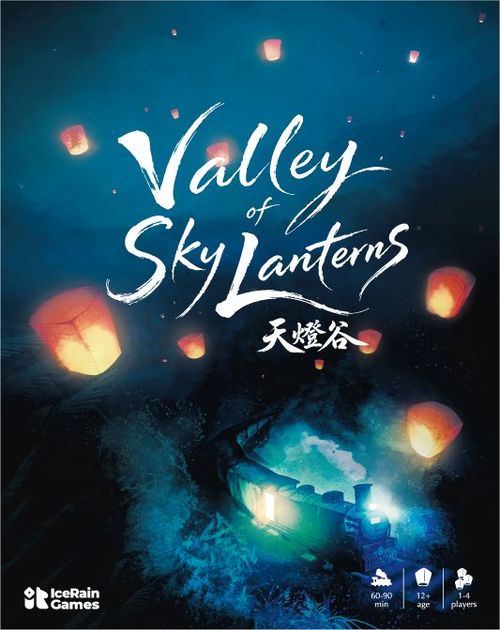
Valley of Sky Lanterns
Valley of Sky Lanterns Rulebook
Table of Contents
Table of Contents
Components
- Main Board x 1
- Player Boards x 4
- Starting Cards x 12
- Teapot Cards x 66
- Solo Mode Cards x 6
- Sky Lantern Project Cards x 4
- Railway Project Cards x 4
- Reference Cards x 4
- Era Cards x 3
- Train Markers x 4 (1 in each color)
- Score Markers x 8 (2 in each color)
- Resource Markers x 16 (4 in each color)
- Round Marker x 1
- Upgrade Tiles x 16
- Camphor Tokens x 15
- Coins x 30 ($1 x 15, $2 x 10, $5 x 5)
- Dice x 18 (5 Red, 5 Blue, 5 Green, 3 Black)
- Bag x 1
3-4 Players Setup
- In a 2–4 player game, remove the 6 Solo Mode Cards from the game and return them to the game box.
- In a 3-player game, remove 1 die of each color and 4 Upgrade Tiles with four dots from the game.
- Flip the Main Board to the 3–4 player side and place it in the center of the table.
- Randomly flip the 3 Era Cards to either side. Arrange them from bottom to top in ascending order of the year, and place them to the right of the Main Board.
- Place the Round Marker on the starting space of the Main Board.
- Shuffle all Teapot Cards and place them face down to form a deck.
- Place all Coins and Camphor next to the Main Board to form the general supply.
- Place all dice into the bag.
- Give each player one Player Board, flipped to the P-00 side.
- Each player chooses a color and takes the Train Marker and Resource Markers of that color, placing them on their respective starting spaces on their personal Player Board.
- Each Player also takes 2 Score Markers of their chosen color, place one on the "0" space at the bottom right of the Main Board, and keep the other next to their Player Board for later use.
- Shuffle and deal 3 Starting Cards to each player along with 1 Player Reference Card, and 1 Camphor.
- Shuffle and deal 4 Upgrade Tiles to each player. Place them face down randomly on the corresponding spaces on the left side of their Player Board.
- Shuffle and deal 1 Sky Lantern Project Card and 1 Railway Project Card, and place them on the upper right and bottom left corners of their Player Board, respectively.
- The player who has most recently seen a sky lantern becomes the first player and takes the First Player Marker.
- Clockwise from the first player, take starting Coins based on player count:
- 4-Player: $5 / $6 / $7 / $8, respectively.
- 3-Player: $5 / $6 / $7, respectively.
- In a 3-player game, remove any unused cards from the game.
For your first game, we recommend flipping your Player Boards and Project Cards to the side with the icon.
Basic Concepts
Gaining Resources
Each resource icon represents gaining one corresponding resource: Coal, Indigo, Tea, Dyeing yam, Camphor, $1.
Basic Resources (Coal, Indigo, Tea, Dyeing yam) — When gained, advance the corresponding Resource Marker on your Player Board's resource track 1 space to the right. Any resources gained beyond the track's maximum limit are lost.
Special Resources (Camphor, Coins) — When gained, take them from the general supply and place them next to your Player Board as your reserve.
Coins come in denominations of $1, $2, and $5. Each coin icon represents a value of $1.
Pay / Converting Resources
Some actions require you to pay the resources shown to the left of the arrow to gain the rewards and effects shown on the right. To pay basic resources, move the corresponding Resource Marker on your resource track to the left, whereas to pay special resources, return them from your personal reserve to the general supply.
You cannot perform the conversion if you do not have enough resources.
Usually, an action allows only 1 conversion. However, if it's indicated with "x2 ~ x4", you may perform the conversion up to 2 ~ 4 times.
If the Camphor or Coin supply runs out, take the required tokens directly from the Player Board of the player who currently has the most Camphor or Coins. The player who was forced to give away their tokens receives 1 VP as compensation for each token taken this way. If multiple players tie for having the most tokens, the active player chooses which tied player to take them from.
Gaining Victory Points
Gain Victory Points (VP) equal to the indicated number. For each VP gained, move your Score Marker 1 space clockwise along the Victory Point track.
If your total VP exceeds 40, immediately place your second Score Marker on the "+40" space. Move your first Score Marker to the "0" space and continue tracking your VP from there. Follow this same procedure for every additional 40 VP gained, advancing the second marker to the "+80" or "+120" space accordingly.
Gameplay
The game is played over 6 rounds. Each round consists of 3 consecutive phases: Event Phase, Upkeep Phase, Player Action Phase.
Event Phase (Skipped in Round 1)
Advance the Round Marker 1 space upward. All players receive the corresponding round bonus:
- In Rounds 2, 4, and 6: Check the number of your sky lanterns that match the color show on the active Era Card of the current round, and gain the respective rewards.
- In Rounds 3 and 5: Collect all of your income.
Example: In the event phase of round 2, each blue sky lantern rewards 2 VP and 1 Teapot card. If a player has launched 3 blue sky lanterns (see Sky Lantern Development), they will receive 6 VP and draw 3 cards.
Income — Whenever you gain income by completing Project Card requirements, Upgrades, or Railway Developments, you immediately receive the corresponding resources, VP, or other rewards shown on the income icon. Furthermore, you will receive these rewards again during the Income Event at the start of Rounds 3 and 5.
Upkeep Phase
- Return 2 dice on the Main Board to the bag (Skipped in Round 1). During the Upkeep Phase of Rounds 3 and 5, players must also return all dice from Player Boards to the bag.
- Randomly draw 10 dice from the bag (draw 8 dice in a 3-player game) and roll them.
- Sort the rolled dice by color and allocate them on the dice space in ascending value from bottom to top.
Example: A total of 4 Red, 1 Green, 3 Blue, and 2 Black dice are drawn. They are placed on the Main Board in ascending value from bottom to top.
Player Action Phase
Starting with the first player, players take turns in clockwise order to perform one Player Action Turn. This phase is repeated until each player has taken exactly two turns.
The player who claims the First Player Marker during this phase will become the first player for the next round.
Player Action Phase
On your player turn, you must perform the following three main steps in order: Contract, Take a Die and Place a Die.
Step 1: Contract (Optional)
You may choose whether or not to resolve exactly one contract action. There are three types of contracts available:
Hand Contract — Play a card from your hand, resolve the contract action shown in the center of the card, and discard it. (If it is a Starting Card, remove it from the game instead).
Example: Gain 2 Camphor and perform 1 Sky Lantern Development (see Sky Lantern Development) and discard this card.
Era Contract — Resolve one of the contract actions shown on the bottom right of the current Era Card (located to the right of the Round Marker).
Example: Pay 2 Coal to Draw 1 card (up to 2 times).
Exclusive Contract — Certain unique Player Boards feature contract actions that are exclusive to you (see Unique Player Boards).
Example: Pay 1 Coal to Gain 2 Indigo, 2 Tea or 2 Dyeing yam (up to 4 times).
Step 2: Take a Die
You must take one die from the Main Board and gain the resource or resolve the effect associated with its corresponding space. You may take the die, but you forfeit some or all of the space's reward.
Each die space on the Main Board provides a specific reward. Examples:
- Take: Pay 1 Dyeing yam to Gain 3 VP
- Take: Gain 3 Tea.
- Take: Advance your Train by 1 step and Gain 1 Indigo.
- Take: Take the First Player Marker and gain $1. Additionally, the player on your right also gains $1.
Train Advance — Move your Train Marker 1 space to the right on the track. If the space contains a reward, gain it immediately. If there are any cards in that Railway Development Zone (see Railway Development), you also gain the rewards directly below it. If an action allows you to move multiple spaces, you gain all rewards along the movement.
Example: If your train advances by 1 space, you immediately gain 1 Tea.
Upgrades — When your Train Marker is on the rightmost space and advances by 1 more step, it loops back to the leftmost space. In addition to gaining that leftmost space's reward, you trigger an Upgrade:
- Choose one face-down Upgrade Tile from your Player Board.
- Flip it face up and place it onto the matching dice space on the Main Board (covering the original reward), permanently replacing the reward of that die space.
- Immediately gain the income reward newly revealed on your Player Board.
Note: You may not peek at the face-down side of the Upgrade Tiles during the game, but you may check the income options beneath them anytime.
Example: After your train loops back to the leftmost space, you gain 4 VP. If you choose to unlock the second Upgrade Tile, you flip it face up and place it on the Main Board to cover the original red die space with four dots. You immediately gain 2 Indigo as your income. (You will receive the 2 Indigo again during each Income Event.)
Teapot Card Draw — Draw the top card from the Teapot deck and add it to your hand. If the deck is empty when you need to draw, shuffle the discard pile to form a new draw deck.
Teapot Cards
Teapot cards can be used in one of three ways when taking a corresponding action: as a Sky Lantern Development, as a Contract, or as a Railway Development.
Sky Lantern — This card provides 1 yellow sky lantern. The total number of your lanterns of the 3 colors will determine the rewards you receive during the Lantern Event and VP for Final Scoring.
Sky Lantern Reward — If played as a sky lantern, you gain this reward each time you place a die of a matching value into the Core Slot below it (see Place a Die).
Development Cost — The coin amount indicates the respective development fees. For example, using this card for Sky Lantern Development costs $2, while using it for Railway Development costs $4.
Contract — When played as a contract, resolve the effect and discard this card.
Railway Reward — If played as Railway, you gain the indicated resources or VP whenever your Train Marker reaches or passes this space from above (see Train Advance).
Sky Lantern Development — Select a card from your hand, pay its cost, and add it to one of the Sky Lantern Development zones at the top of your Player Board. Tuck the card under the top edge of your Player Board so that only the upper portion is visible. If there is already a card tucked in that zone, tuck the new card directly under the previous one, forming a new row.
Whenever you place a die that meets the value requirements into either of the two Core Slots corresponding to that development zone, you will trigger and receive the rewards. (see Place a die)
Example: A card can be tucked into the first row on the left, the first row in the middle, or the third row on the right.
Railway Development — Select a card from your hand, pay its cost, and add it to one of the Railway Development Zones at the bottom of your Player Board. Tuck the card under the bottom edge of your Player Board so that only the lower portion is visible. If there is already a card tucked in that zone, tuck the new card directly underneath the previous one, forming a new row.
Whenever your Train Marker reaches or passes the space above this zone, you receive the indicated resources or VP directly below your train.
Example: A card can be tucked into the first row on the left, the first row in the middle, or the third row on the right.
Project Cards
Whenever you complete a Sky Lantern Development or Railway Development action, check if you have triggered the corresponding rewards on your Project Cards.
The reward is only triggered by the first three rows of your Sky Lantern and Railway Development. When you tuck cards into the 4th row and beyond, you won't gain any rewards from your Project Card for doing so.
The rewards are triggered in two ways:
- Triggered each time a card is tucked into that row (up to a maximum of 3 times per row)
- Triggered when all 3 zones in that row have cards tucked into them.
Example: Once you have tucked 3 cards into the 1st row, you gain $1 and 2 VP income immediately. When you fill the 2nd row with 3 cards, you gain 1 sky lantern of each color. Each time you tuck a card into the 3rd row, you immediately gain VP equal to your current number of Railway Developments (the number of cards you tucked in your Railway Development Zone).
Example: Tucking the second card into the left Railway Development Zone triggers the Project Card reward and immediately advances your train by 1 space and gains 2 VP. Immediately trigger the Railway Rewards of the card you just tucked. If the card on the right is tucked into the third row, you immediately gain 2 Tea.
Step 3: Place a Die
Place the die chosen from Step 2 into any empty die slot on your Player Board. You must choose one of the following two types of slots:
- Core Slots — The Sky Lantern Development zones on your Player Board correspond to 6 Core Slots. The die values across all Core Slots must be equal or increasing from left to right. After placing a die, check the tucked Sky Lantern Development cards above that slot from top to bottom if any. If the die value matches the requirements, gain the rewards. Then, you may pay the slot's specified resource equal to the total number of dice currently in all Core Slots (including this one) to gain the bottom rewards.
- Compensation Slots — The three slots on the right side of the player board are Compensation Slots. You may place a die of any value here to gain the slot's rewards. This costs no resources, but triggers no Sky Lantern rewards.
Example slot rewards: Gain $3; Gain 2VP and you may resolve 1 Contract action; Advance your train 2 spaces; Pay 1/2/3/4 resources if this is the 1st/2nd/3rd/4th die in the Core Slots.
Example: Since dice must equal or increase from left to right, a die can only be placed in one of the four Core Slots to the left of an existing die. When placed in the slot indicated by the arrow, you first check the Sky Lantern rewards above it: a matching value allows you to advance your train by 1 space. Then, since this is the second die in the Core Slots, you must pay 2 Dyeing Yams to gain 1 Coal and perform 1 Railway Development action.
Free Actions
You may spend resources to perform any number of free actions.
- Camphor Trade — Before performing "Place a Die", you may pay one or more Camphor. Each Camphor paid allows you to change the value of your chosen die by +1 or -1.
- Coal Trade — You may at any time convert 1 Coal into either 1 Dyeing yam, 1 Indigo, or 1 Tea.
Final Scoring Phase
The game ends after the Player Action Phase of Round 6, followed by the final scoring. Scoring consists of three categories:
- Sky Lantern Scoring — Players total their red, yellow, and blue lanterns separately. For each color, the players with the 1st, 2nd, and 3rd most lanterns score 12, 8, and 4 VP, respectively. You must have at least 1 lantern of that color to qualify for ranking. Tied players combine and equally share the VP for their current and subsequent ranks. The next player takes the following vacant rank.
- Railway Scoring — Gain VP based on the total number of cards tucked in your Railway Development Zones. Having 4, 5, 6, 7, or 8 cards scores 1, 3, 6, 10, or 15 VP, respectively.
- Resource Scoring — Every 2 leftover Camphor scores 1 VP, every 3 Coins scores 1 VP, and each set of 4 different basic resources scores 1 VP. Before the game ends, you may use free actions to convert Coal into other basic resources to optimize your scoring.
The player with the most VP wins. If there is a tie, the tied player whose turn order is closest to the current First Player Marker owner wins.
Example: Using Player A as an example, they score 12 VP for 1st place in yellow lanterns, 8 VP for tied 1st place in red lanterns, 6 VP for tied 2nd place in blue lanterns, and 1 VP for their 4 Railway Developments.
Example: The remaining 5 Coal, 4 Indigo, 5 Tea, and 6 Dyeing Yams score a total of 4 VP.
Variants
If you are already familiar with the game, you may add any or all of these variant rules to increase the strategic depth and variety.
- Starting Card Drafting — During setup, after being dealt 3 Starting Cards, all players simultaneously choose 1 card and pass the remaining cards to the player on their left. From the 2 cards received, players choose 1 card and pass the last card to their left. Players begin the game with these 3 starting cards.
- Upgrade Tile Setup — During setup, after being randomly dealt 4 Upgrade Tiles, flip them face up. Players may freely arrange the positions of these 4 tiles on their player board before the game begins.
- Teapot Market — During setup, reveal 3 cards from the Teapot deck to form a market row. During the game, whenever a player draws cards from the deck, they may instead choose to take them from the market or the top of the deck into their hand. At the end of each player's action turn, refill the market back to 3 cards from the deck.
- Unique Player Boards — During setup, players may choose to flip their Player Board to the back side to play. See Unique Player Boards for details.
- Unique Project Cards — During setup, players may choose to flip their Sky Lantern Project Card and Railway Project Card to the back side to play.
Unique Player Boards
Each unique Player Board has distinct features. Their Core Slots, Exclusive Contracts, railway rewards, and the income unlocked by Upgrade Tiles will vary.
P-01 — You have 2 extra Core Slots that span over two adjacent Sky Lantern Development Zones. When a die is placed in either of these extra Core Slots, you may gain the matching rewards from both zones. However, you only have 1 Compensation Slot.
Exclusive Contract: Spend 2 Camphor to gain $3 (up to 2 times).
P-02 — Three of your Core Slots cost Coins instead of basic resources, and they grant more powerful effects.
Exclusive Contract: Pay 1 Indigo, 1 Tea, and 1 Dyeing Yam to gain $2.
P-03 — Your free action Coal Trade is changed to: pay 2 Coal to gain $2.
Exclusive Contract: Pay 1 Coal to gain 2 Indigo, 2 Tea, or 2 Dyeing Yams (up to 4 times).
P-04 — Your railway track is different. When your Train Marker advances, it must follow this new path. As usual, you gain the reward on the space your marker reaches and passes, as well as all the rewards directly below it. Your train's starting position is also different from other Player Boards.
Advance 1st Space: +3 VP, 1 Coal, $2 Advance 2nd Space: +3 VP, 1 Camphor Advance 3rd Space: +1 Camphor
Two Player Game
- During setup, flip the Main Board to the 1-2 player side.
- Remove the 7 Upgrade Tiles with 4 dots and 3 dots from the game. After dealing 4 tiles to each player, flip the remaining 1 tile face up and place it directly onto its corresponding space on the Main Board.
- Remove 2 black, 1 red, 1 blue, and 1 green dice from the game. Place 1 red, 1 blue, and 1 green die in the middle of the influence tracks of the matching colors.
- In a 2-player game, the contract action provides a new option: spend 2 Indigo, 2 Tea, or 2 Dyeing Yams to advance the die on the blue, green, or red influence track 1 space, respectively. This can be executed up to 2 times. You immediately gain all the rewards the die passes through.
Example: The player on the right executes the contract on the influence track, spending 4 Indigo to move the blue die 2 spaces to the left, gaining 1 VP and performing 1 Sky Lantern Development.
- During the Income Event, you gain all the income rewards on your side separated by the 3 dice.
Example: During the Income Event, the player on the left gains 2 VP and $1, and the player on the right gains 3 VP and $2.
During the Scoring Phase, the player with the most lanterns of each color gains 5 VP each. Choose the effect of any red, green, or blue dice space on the Main Board. Your opponent gains the First Player Marker and $1.
Solo Game
In a solo game, setup is the same as a 2-player game. Set up one player board for yourself and one for the virtual opponent, then play according to your chosen scenario.
- Take out the Solo Mode cards to form the action deck. When it is the virtual opponent's turn to act, reveal one card from the top of the action deck, and resolve it from top to bottom based on these conditions:
- White background: choose the die that matches the indicated dice value.
- Red, green, or blue background: choose the largest or smallest die according to the arrow direction.
- If no dice meet the conditions, or if multiple dice meet the same conditions, choose the die using the right to left, top to bottom rule.
Example: When drawing the right card, take a die according to the following priority: 1. Take a die with a dice value of 4. 2. Take the largest green die. 3. Take a die from right to left, top to bottom.
- The virtual opponent never triggers any action slot effects, regardless of which die they choose.
- During the upkeep phase of the third and fifth rounds, reshuffle the revealed Solo Game cards back into the deck.
- The player is always the First Player.
- After the income event, for each red, green, or blue die chosen by the virtual opponent, push back the corresponding color influence track 1 space, but do not gain any effects.
- After the income event, randomly choose one of the virtual opponent's four upgrade tiles and flip it face up onto the field.
- During the scoring phase, the virtual opponent is considered to have 4 lanterns of each of the three colors.
Example: Over these two rounds, the virtual opponent chooses 1 blue, 1 green, and 2 red dice. After the income event, move their blue, green, and red dice back by 1, 1, and 2 spaces, respectively.
Challenge Mode — You may adjust the starting setup to increase the scenario difficulty.
Scenario I: The Dead Mine
During the Xianfeng era of the Qing Dynasty, Hu Jie, a Quanzhou immigrant, arrived in the Wanggu area to reclaim land and mine coal. However, a catastrophic flood submerged the mine, causing countless casualties. In this scenario, the player will fight against the ghosts of the mine.
-
Game Setup: Set the ghost's Coal to 0 and Indigo to 1. Place the action deck face down.
Challenge Mode: Set the starting Indigo amount to 2.
-
Die Action: Each time the ghost takes an action, reveal one card from the action deck to choose a die according to the rules, and execute the following action based on the die value of the chosen die:
- The ghost gains 1 Indigo, but the player may gain $1.
- The player chooses to either pay 2 Camphor, or let the ghost gain 2 Indigo.
- The ghost gains 1 Coal.
- The ghost gains 2 Coal, but the player may draw one card.
- The player chooses to either pay 2 Coal, or let the ghost gain 2 Coal.
- The ghost gains 6 VP.
-
If the ghost's Coal has reached its maximum capacity of 10, it gains an equal amount of Indigo instead. If its Indigo has reached its maximum capacity of 10, it gains an equal amount of Coal instead. If both have reached their maximum limits, the player loses the game.
-
During the income event and the scoring phase, the ghost gains bonus VP equal to its Coal multiplied by its Indigo.
Scenario II: The Burning Hut
During the Daoguang era of the Qing Dynasty, Han Chinese settlers ventured deep into the mountains to reclaim land, occasionally clashing with the Indigenous people who had hunted there for generations. In an era of poor communication, the Han settlers released sky lanterns as signals to report peace to one another. In this scenario, the player will fight against the coming Raiders.
-
Game Setup: Set the starting amount of each basic resource for The Raiders to 1. Place the action deck face up (the player can see the top card of the deck).
Challenge Mode: Set the starting amount of all basic resources to 2.
-
Die Action: Each time The Raiders take an action, play the top card from the action deck to choose a die according to the rules, and execute the following action based on the die value of the chosen die:
- The Raiders plunder 1 Indigo.
- The Raiders plunder 2 Tea, and blockade Tea.
- The Raiders plunder 3 Dyeing Yams, and blockade Dyeing Yams.
- The player draws 1 card, and is plundered of resources equal to the contract requirements of that card.
- The Raiders plunder $2.
- The Raiders plunder the player's most plentiful basic resource, equal to half of what the player currently possesses (rounded up).
Plunder — The player pays the specified resources, and The Raiders gain an equal amount of those resources. If the player does not have enough, pay all available resources, and The Raiders gain the amount actually paid.
Blockade — You may still gain that resource as usual, but you cannot pay it (though it can be substituted by Coal, or be plundered). Mark that resource track with an unused Resource Marker. Once a Sky Lantern Development is completed, lift all blockades.
- If any basic resource of The Raiders reaches its maximum capacity of 10, the player loses the game.
- During the income event and the scoring phase, the Raiders gain bonus VP equal to the sum of all basic resources and special resources.
Pingxi - The Valley of Sky Lanterns
Located in the mountainous region of northeastern Taiwan, Pingxi is famous today for its sky lanterns, attracting countless travelers each year to pray for blessings.
However, over a century ago, this tranquil valley experienced a dramatic transformation due to the discovery of coal, and it once became an essential coal production center in Taiwan. During the Qing Dynasty, Pingxi had only scattered settlements, where residents lived along the mountains, making a living by cultivating tea and natural dyes.
From the late 19th century to the early 20th century, with the development of coal resources, a large number of miners and merchants flooded into the valley. Mines, settlements, and markets sprouted rapidly, bringing prosperity to these once-remote mountain villages. To transport coal to ports and cities, the Pingxi Railway Line officially opened to traffic in 1921. Steam trains laden with coal traveled through the mountains and forests, not only connecting settlements like Pingxi, Shifen, and Jingtong, but also tightly linking this mountain town with the outside world. The railway brought supplies, people, and business opportunities, reshaping the daily lives of the residents.
While the mining industry flourished, Pingxi still preserved its tradition of releasing sky lanterns. Legend has it that early residents used sky lanterns to signal peace, and as time evolved, the practice gradually became a symbol of blessings and hope. Whenever night falls, lanterns slowly rise into the sky, reflecting off the trains passing through the valley, carrying people's aspirations for safety, abundance, and the future.
In the late 20th century, the coal industry declined and mines closed one after another, leaving the past prosperity behind. However, the Pingxi Railway Line still traverses the valley, where mining relics preserve the memories of that era, and the sky lanterns continue to illuminate the night sky, allowing this mountain town to carry on its story in a different form.
Icon Reference
- Gain 1 Indigo
- Gain 1 Tea
- Gain 1 Dyeing Yam
- Gain 1 Coal
- Gain $1
- Gain 1 Camphor
- Gain 1 VP
- Advance your train by 1 space
- Gain 1 sky lantern of each color
- Draw 1 card from the Teapot deck
- Perform 1 Sky Lantern Development
- Perform 1 Railway Development
- Gain VP equal to your current number of Railway Developments
- Gain VP equal to your current number of yellow sky lanterns
- Immediately gain all railway rewards on this card
- Gain the First player Marker
- The player to your right gains the following rewards
- Perform 1 Contract Action
- 2 Indigo or 2 Tea or 2 Dyeing Yams
- An amount equal to the number of dice in the Core Slots (including this die)
- Increase or decrease the die value by 1
- 1 Indigo, 1 Tea, and 1 Dyeing Yam
- Resolve the effect of any dice space on the Main Board except for black slots
- Spend the resource on the left to execute the effect on the right for up to 2 times