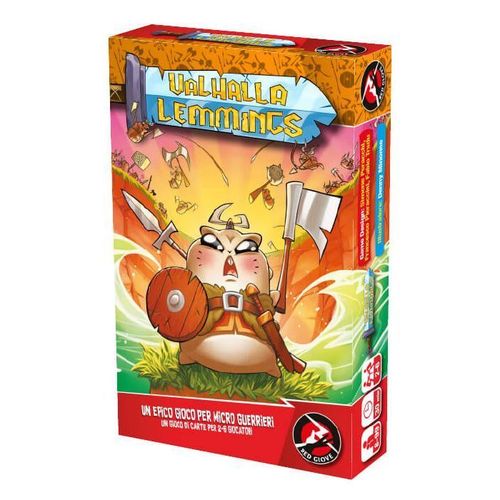
Valhalla Lemmings
Valhalla Lemmings Rulebook
Table of Contents
Table of Contents
Components
- 44 Legend cards
- 60 Village cards, divided into 6 sets of 10 cards each (distinguishable by the coloured stripe)
- 5 Neutral Village cards (they do not have the colour on the back)
- 1 First Player card
Object of the Game
Each player represents the Chief of a Valhalla Lemmings Clan who has promised all of his warriors that they will fall gloriously in battle.
Players challenge one another in battles. At the end of each battle, the strongest armies return victorious to the village (their cards return to the player's hand) together with a Lemmings Legend, while the weaker armies reach Valhalla (they are discarded).
The goal of the game is to get rid of all Village cards from your hand.
The game ends when one or more players have no Village cards left in hand at the end of a turn.
Games for two or more players: the rules below describe games of 3 or more players. If you wish to play with two, the rules for the two-player game are described at the end of the rulebook.
Setup
Each player starts the game with a set of Village cards (their own Clan) in hand, made up as follows:
- 5 cards of value 1
- 2 cards of value 2
- 2 cards of value 3
- 1 card of value 5
(The cards of the same set share the same background colour.)
If you are playing a three-player game, each player adds to their hand one more card of value 5, taken from any unused set of cards.
Note: A Clan must be kept secret from the other players. Keep your Village cards face down throughout the game. You may look at them whenever you like, but you must not show them to the other players.
The remaining Village cards (those not assigned to any player) are shuffled and form a face-down discard pile placed in the centre of the table.
Note: If you are playing with 6 players, there will be no remaining cards. In this case, take the 5 Neutral Village cards, shuffle them and use them as the discard pile. Conversely, if you are playing with fewer than 6 players, you may return these cards to the box: they will not be used.
Take the Legend deck, shuffle it and place it in the centre of the table, face down. Each player draws one card from the Legend deck and places it face up in front of them, without activating its effect. That is the first card of your Saga: it will never be activated during the game, but it may be activated by later Legend cards added to your Saga.
The player who most resembles a Lemming (or one chosen at random) takes the First Player card and begins the game.
How to Play
The game is played in turns, in which all players play together and simultaneously. Each turn is divided into 4 phases:
- The Legends Arrive
- Preparing for Battle
- Charge!
- End of Turn
If, at the end of the 4th phase, a player has zero Lemmings cards in hand, the game ends and that player is the winner.
1. The Legends Arrive
The first player draws and reveals from the Legend deck a number of cards according to the number of players:
- 3 players: 1 card
- 4-5 players: 2 cards
- 6 players: 3 cards
The revealed cards are placed in the centre of the table, face up, so that all players can see them during the turn. These Legend cards provide important aids for getting rid of your Lemmings more quickly, and may be taken by the winners of this turn's battle.
Example: There are 5 players in this game: Federico, Simona, Maddalena, Nicola and Mariano. Federico, the first player, draws 2 Legend cards, reveals them and places them in the centre of the table, visible to all players. During this turn, the winning players may take the Lemming Hood or Lemmingetorige.
Card text printed in the diagrams for these two cards: Lemming Hood, "Pass Village cards with a maximum total value of 4 to the player with the fewest Village cards in hand, excluding you." Lemmingetorige, "Discard Village cards with a total value equal to the number of players in the game."
2. Preparing for Battle
Each player must secretly choose from their hand between one and three Lemmings cards, representing the number of Lemmings they send into battle against the other players. It is mandatory to choose at least one card in this phase.
Players may place their cards on the table, and may take them back into hand or change them until all players agree. At that point, move on to the next phase.
Note: For the effects of Legend cards, the cards played this turn are not considered part of the player's hand.
Example: Federico (yellow) wants to win the battle in order to gain Lemming Hood, so he plays three very high-value cards (total value 8). Simona (orange) is not interested in this turn's Legends, but she knows that someone will certainly want them. She therefore tries to get rid of 2 strong cards (total value 5).
3. Charge!
All players reveal the Village cards they have decided to use in this war. Each player then declares their battle strength, which is the sum of the values shown on the Village cards they chose in the previous phase.
The player with the highest battle strength chooses one of the available Legend cards, activates its effect, and places it to the right of the Legend already in front of them, in their Saga. Finally, they take back into hand the Lemmings cards they just played (they have won; unfortunately their Lemmings cannot go to Valhalla).
In case of a tie in battle strength, priority goes to the holder of the First Player card, or else to the player closest in clockwise order to the first player.
If a Legend card activates at the next battle, place it in your Saga: you will activate it on the next turn. Once you have activated it, turn it upside down, so that you can recognise which ones have already been activated.
Among the remaining players, the one with the highest strength is selected in turn, until all the Legend cards available this turn have been assigned.
Players who have taken no Legend card discard all the Village cards used in this battle.
Discarded Village cards are placed on top of the central discard pile. If it becomes necessary to draw Village cards at random because of a Legend effect, they must be drawn from this pile, after shuffling it.
4. End of Turn
After all players have discarded the cards they played or taken back into hand the cards of the winning Clans, the First Player card passes to the next player in clockwise order, who becomes the new first player for the next turn.
Example: The battle is over and the winners are checked. The player with the highest strength value is Federico, with a total of 8. Federico chooses Lemming Hood. He passes one card of value 2 and two cards of value 1 (for a total of 4) to Mariano, who is the player with the fewest Village cards in hand. The second-strongest player is... Simona! Simona has the same value as Maddalena, but she plays immediately after Federico, who is the first player, so she is the second winner. Too bad! She wanted to get rid of her cards, but instead she wins the battle and activates the effect of Lemmingetorige by discarding the card of value 5 she has just played: Lemmingetorige does not specify "from your hand", so she may also discard the card she has just played (see below).
Before moving on to a new turn, Mariano, Maddalena and Nicola discard the cards they have played.
End of the Game
When a player, at the end of a turn (after applying the effects of the Legend cards and taking back into hand the cards of the winning Clans), has no Village cards left in hand, the game ends and that player is the winner.
If more than one player reaches this condition at the end of the turn, the player with more Legend cards in their Saga wins. If there is still a tie, victory is shared.
General Rules for Legend Cards
Simultaneous Effects
If several effects must be applied at the same time, follow turn order. This case is very rare, but it can happen with cards whose effect is postponed to the next battle.
From Your Hand / From the Player's Hand
Many Legend cards refer to a player's hand. In that case, the cards you must choose, pass or discard are always those in the player's hand: cards played during the turn are not part of the player's hand.
Example: A card that says "The player may discard 2 Village cards" allows the player to discard the 2 cards either from their hand or from those played during the turn. A card that says "The player may discard 2 Village cards from their hand" allows the player to discard 2 cards only from their own hand.
Partial Effects
All effects of Legend cards must be read as "up to". If, for example, a card says "Pass two cards to a player", it must be read as "Pass up to two cards to a player"; or if it says "Discard two cards from your hand", it must be read as "Discard up to two cards from your hand".
Details of Some Legend Cards
Lemmerlino "Double the cards (not the value) you will lose in the next war."
This card only has an effect if the player loses the next battle. In that case, they may discard from their hand a number of cards equal to the number they lost (and of the same type).
Example: Federico loses the clash with a Village card of value 3. He may discard from his hand another card of value 3. Had he lost the clash with two Village cards, one of value 1 and one of value 2, he could have discarded from his hand one additional card of value 1 and one additional card of value 2.
Lemsferatu "Reactivate a Legend in your Saga."
This Legend allows you to take a Legend from your own Saga and reactivate its effect. If it is a Legend card with an effect at the next battle, the effect is applied at the next battle, as usual.
Scudo di Lemmhilde (Lemmhilde's Shield) "Cancel the next negative effect of a Legend card directed at you."
This is the only Legend that activates in response to the activation of another opposing Legend card. The player cannot choose which card to cancel: it always cancels the first Legend with a negative effect played against them. To show that this Legend has been used, turn it upside down after using it.
Two-Player Mode
To play Valhalla Lemmings one against one, some aspects of the game must be changed to adapt it to this kind of contest. The rules for two players are given below.
Setup
Remove from the Legend deck all copies of: Lem Tzu, Lemmingetorige, Lemmattila, Lemmodino. Return these cards to the game box: you will not need them in a two-player game.
Prepare 4 sets of Village cards as indicated for a game of 4 or more players. Give one to each player. The remaining two are placed in a pile next to each player, representing their Lemmings Reserves.
Turn
In this game the turn proceeds differently from what is described for a game of 3 or more players.
At the start of each turn, draw 3 Legends from the deck, reveal them and place them in the centre of the table, well spaced apart from each other.
Then the players decide which Village cards to stake on the Legend card on the left, and place them face down above/below it (above for the first player, below for the second). As usual, they may choose up to 3 Village cards from their hand.
They then perform the same action for the second and third Legend cards (from left to right).
It is possible to stake 0 Village cards on a Legend card, but only if you have 2 cards or fewer in hand at the time of the stake.
When the players have chosen the cards for all the Legends on the table, all Village cards are revealed and the winners of the wars are determined in succession, with the same rules as the game of 3 or more players.
Battle
Each Legend on the table, with the cards staked on it, represents a separate battle. It follows the normal rules for determining the winner, with these exceptions:
- In case of a tie, nobody gets the Legend, but both players discard the cards staked on it. Place that Legend at the bottom of the deck.
- After the outcome of the war has been determined, the winner takes back into hand the Village cards, while the opponent discards them. The effect of the Legend applies after the winner has taken back into hand the Village cards played.
- Cards staked on battles after the current battle are considered to be "in the hand" of their player.
After resolving the first battle, the outcome of the second is determined in the same way, then the third.
Note: The effect of a Legend may affect the Lemmings cards used in the stakes of later wars!
Example: If with the Legend card Lemminathor you discard all your cards of value 1, you will also discard those you had staked on later wars, thereby changing the stake you had prepared on them!
At the end of the third battle, the turn ends. Players draw 5 Lemmings cards from their Reserves (if still available).
After the draw, a new turn begins, which proceeds in the same way.
End of the Game
If, at the end of any battle (after resolving the effects of the Legend won), a player has played all their Village cards, has no Lemmings cards staked on other battles, and has no cards left in their Reserves, that player is the winner. If both players reach the victory conditions at the same moment, the one with the greater number of Legend cards in their Saga wins. If this is also a tie, you have both lost (serves you right)!