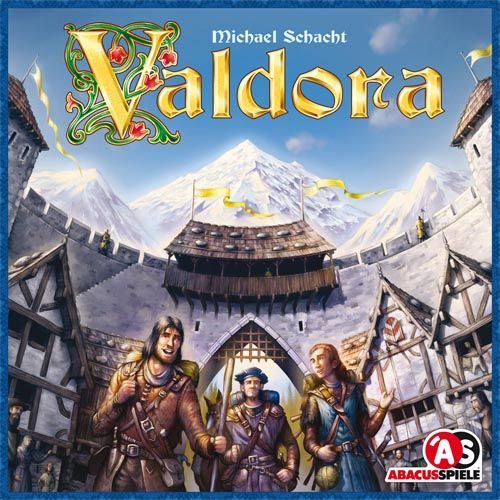
Valdora
Valdora Rulebook
Table of Contents
Table of Contents
Game Components and Setup
5 pawns in the player colors Each player takes a pawn and places it on the city with a harbor in the middle of the board.
5 start cards equipment (1 in each player color) 5 start cards adventurer (1 in each player color) 10 player aids (2 cards in 4 languages in each player color)
Each player receives both start cards in their pawn's color as well as a player aid. Return any unused player aids, start cards and pawns to the box.
Each player places their equipment start card to the left of their adventurer. This gold pan allows players to load gold. Gold lets players buy additional equipment items as well as complete contracts.
The adventurer start card shows an adventurer without provisions on one side and one with provisions on the other side. Players begin the game without provisions.
Each player should place their adventurer card in front of themselves such that the side without provisions is face-up. 3 commissions and 6 silver coins are shown along the bottom edge of the card. These serve as a reminder that players may not have more than 3 incomplete commissions and 6 silver coins at any time during the game.
Note: Player colors are of no significance to the rest of the game components (gemstones, commissions, craftsmen, workshops)!
30 silver coins
The players agree on a start player.
The start player receives 1 coin from the bank. In clockwise order, each other player receives one coin more than the previous player – that is, 2, 3, etc. Place the remaining coins next to the gameboard as a bank.
Each player must keep their coins visible, so that the other players can see how much money they have.
1 gameboard Place the gameboard in the middle of the play area. The board shows Valdora, with roads running between the following spaces:
- 2 cities with equipment catalogs (A, B)
- 2 cities with commission books (C, D)
- 1 city with a harbor (1 ship)
- 13 road spaces (symbol: gemstone)
- 3 silver mines (symbol: money bag)
- 2 harbor spaces (1 or 2 ships)
- 7 patron houses (colored crests, a - g)
Discard space for the gemstones discarded by the players over the course of the game.
1 bag 78 gemstones
- 13 rubies (red)
- 13 sapphires (blue)
- 15 amethysts (violet)
- 15 emeralds (green)
- 22 gold (yellow)
Note: Whenever the rules refer to gemstones, both gold as well as gemstones are meant.
Put all gemstones into the bag and make sure they are well-mixed. Then, place 6 randomly-drawn gemstones onto each road space.
7 workshop tiles (one workshop in each craftsman color) 13 bonus tiles (10 victory points)
Place the workshop tiles and the bonus tiles, face-up, in the middle of the play area as a supply.
If a player completes a commission while owning the appropriate workshop, he receives bonus points.
36 equipment cards (2 identical sets of 18 double-sided cards each) Equipment cards may be recognized by the rucksack in the background as well as the gold colored band. The band serves as a reminder that equipment cards may only be purchased with gold. Players may only load gemstones if they own the appropriate equipment.
Card elements: Border (to differentiate the two piles), Gemstone color that may be loaded, Gold colored band (equipment costs 1 gold), Equipment item, Cost to load a gemstone.
- The cards with tools (4 different types: shovel, pick, hammer and chisel) on them let players load one gemstone of the color shown.
- The cards with the horse and cart on them let players load one gemstone of any color, provided they pay the number of coins shown on the card.
54 commission cards (2 identical sets of 27 double-sided cards each) Commission cards may be recognized by the parchment in the background as well as the silver colored band. The band serves as a reminder that commission cards may only be purchased with coins. Players may only complete a commission if they own a commission card.
Card elements: Border (to differentiate the two piles), Requested item, Silver colored band (commission costs 1 coin), Crest of the patron, Victory points for completing the commission.
Each commission card shows what a player must do to complete the commission as well as how many victory points they will receive for it:
- The picture on the parchment indicates what the patron would like to have: a specific gemstone, a specific combination of three gemstones or a silver coin.
- The patron's crest is shown on the bottom half of the card. This crest also indicates the patron's house on the gameboard.
First, sort the cards out according to their type (equipment or commission) and border color. This results in 4 piles: 2 identical piles of equipment cards and 2 identical piles of commission cards.
4 books
Prepare the books and place them onto the four outer cities on the gameboard: Thoroughly shuffle each pile of cards separately. Have another player cut each pile and then place them onto the wooden book frames.
Note: The equipment and commission cards are double-sided and represent pages in a book. If you make sure to turn all of the cards the same way around – so that the colored band runs from the top right to bottom left – and then place the pile on the right side of the book frame, flipping the cards over later will look like turning pages in a book.
The two books with equipment cards are the equipment catalogs (A and B in the figure) and the two books with commissions are the commission books (C and D).
Note: The illustration for each city shows either a rucksack or a parchment. Place the equipment catalogs onto the cities with rucksacks and the commission books onto the cities with parchments.
1 craftsman board 39 craftsman tiles (9 silver-grey, 9 yellow, 5 white, 4 violet, 4 red, 4 blue, 4 green) Sort the craftsman tiles according to color and pile them around the craftsman board. Place each pile next to the side of the board with the matching color illustration.
With 3 players: Remove one violet, red, blue and green craftsman tile from the game before playing.
Whenever a player completes a commission he may hire a craftsman. With the help of craftsmen, players can open workshops.
1 summary card Place the summary card next to the gameboard. The summary card provides a scoring summary on its front side. On the back side, it shows how often the various commissions and equipment occur in each commission book and equipment catalog.
Gameplay
The start player begins the game. The other players follow in clockwise order. When it is your turn, you carry out your turn completely; it is then your left-hand neighbor's turn.
On your turn, you must first move your pawn. Then, you carry out one action.
A game turn in detail:
1) Movement
You must move your pawn in the direction of your choice along the road. You may move as many spaces as you wish, but may move no farther than the next city.
Exception: If you have provisions (see "Take provisions" action below), then you may move through one city. Once through the city you may again move as many spaces as you wish but no farther than the next city. Finally, turn your adventurer card over to the side without provisions.
You may not end your pawn's movement on the same space it was on at the start of your turn.
Encounters
If you end your turn on the same space that one or more pawns belonging to other players are standing on, then you must pay each of those players 1 coin. If you don't have enough coins then you may not move to that space.
You may have no more than 6 coins! If you have to pay a coin to a player who already has six then the coin goes to the bank.
Exception: You do not have to pay any coins if you encounter other players on a silver mine space. This means you can move to these spaces even if you don't have any coins!
2) Action
Next, carry out one of the following actions: a) Purchase equipment or commissions b) Load gemstones c) Complete commissions d) Replenish silver e) Take provisions
The action you carry out depends on the space your pawn is standing on. Even if the space makes multiple actions possible, you may only carry out one action.
a) Purchase equipment or commissions (city spaces with books)
The 4 city spaces with books let you purchase either equipment items or commissions, depending on whether the city contains an equipment catalog or a commission book.
You may use your action to purchase as many equipment items or commissions as you wish, provided you can pay for them. However, you may only ever buy the topmost visible card. If you don't want to buy that card, you may turn the page (see "Turning pages" below) to get at the card beneath it. Should two cards be visible after turning pages, then you can choose between them. You are not forced to buy a card if you do not want to.
Each equipment card you buy costs 1 gold. Place the gold in the discard space for gemstones in the middle of the gameboard. Equipment cards are always placed in front of you, to the left of your adventurer card.
You may only own one of each equipment item.
Note: Since you may only own one of each equipment card, you will never have more than seven equipment cards. To transport three gemstones of the same type, then, you would need the equipment card for that gemstone, the cart and the horse! You can never transport more than three gemstones of the same type.
Each commission card you buy costs 1 coin. Put the coin in the bank. Newly-purchased commission cards are always placed in front of you, to the right of your adventurer card. They remain there until you can complete them.
You may own no more than 3 incomplete commissions.
If you already have 3 incomplete commissions and you want to buy another, you must first return one of the ones you already own. To accomplish this, place the card onto the commission book for the city you are in. You may decide whether to return the card to the right or left side of the book. You do not receive a refund for the commission. Afterwards, you can buy a new commission.
Turning pages
If you don't want to buy the topmost card, you can "turn a page" to get at the card beneath it. To accomplish this, take the topmost card on one side of the book and turn it over, moving it to the other side of the book in the process.
Turning the first page of each turn is free. For each additional page you wish to turn, you must pay 1 coin to the bank.
You may turn pages forwards, backwards and back and forth, as long as you can pay for them. You may turn pages and buy in any order you wish. Before touching a card, you must first specify if you want to buy it or turn it.
Example: Andreas buys a card, turns a page for free, then pays 1 coin to turn another page and buys a second card. He then turns another two pages and pays another 2 coins. He doesn't find another card he wants to buy and decides to end his turn. In total, he paid 3 coins to turn pages.
Turning a page counts as the "Purchase equipment or commissions"-action, even if you choose not to buy anything.
b) Load gemstones (road or harbor spaces)
When you load a gemstone, place it onto the rucksack of the appropriate equipment card. Each equipment card can hold only one gemstone!
On a road space, you may load all of the gemstones located there that you have the matching empty equipment for.
Example: Andreas moves to a road space on which there are 2 gold, 1 ruby, 2 sapphires and 1 emerald. As he has empty equipment cards for ruby and sapphire, he may load one of the corresponding gemstones onto each of them. He decides to load the emerald onto his cart, paying 2 coins. Since he already has a gold on his gold pan, he may not load any more gold.
On a harbor space or the city with the harbor, you may load as many gemstones as there are ships in the harbor (1 or 2). You may only take the gemstones from the discard space in the middle of the gameboard. Here also you may only load those gemstones that you have the matching empty equipment for.
Note: At the start of the game, the discard space is empty. It will only start to fill up once players start buying equipment and completing commissions. Prior to that point, players cannot load gemstones on the harbor spaces.
You may choose to unload a gemstone that you had previously loaded onto a horse or cart, in order to reload a different gemstone. Place the unloaded gemstone onto the discard space in the middle of the gameboard. To load the new gemstone, you must again pay the cost in coins shown on the card.
c) Complete commissions (patrons' houses)
If your pawn is standing at a patron's house for which you have one or more incomplete commissions, then you may complete these commissions. For each commission you want to complete, you must pay the gemstones or coins indicated on the commission card. Place the gemstones onto the discard space and the coins into the bank. Place your completed commissions under your adventurer card.
Additionally, you must hire a craftsman.
Hiring a craftsman
Whenever you complete a commission, you also immediately receive a craftsman tile in the same color as the commission's patron from the craftsman board. Place it in front of yourself so that it is clearly visible.
Note: Over the course of the game, it will regularly happen that the tiles in the appropriate color are all gone. In that case, instead take a tile in the next color, in clockwise direction, of which there is at least one left.
Example: Andreas completes 2 red commissions at the same time. There aren't any red craftsmen left next to the craftsman board, but there are still one blue and one green tile left. Since the red tiles are all gone, Andreas instead takes a tile from the next pile in clockwise order – that is, the blue tile. Since the blue pile has now also run out, he receives a green tile for the second red commission.
Opening a workshop
Each workshop tile indicates, in the upper left-hand corner, how many craftsman tiles of the workshop's color are required to be able to open that workshop. The first player to have hired enough craftsmen immediately claims the workshop from the supply and places it in front of himself. He will keep the workshop, as well as the craftsman tiles, until the end of the game.
You may own more than one workshop.
Bonus tiles
Once you have opened a workshop, you receive 1 bonus tile each time you complete a new commission whose crest is the same color as the workshop.
Note: To receive a bonus tile, the color of your workshop must match the commission's crest color. The craftsman tile color you receive for the commission is irrelevant.
If the supply of bonus tiles has run out, then you don't get a bonus tile.
Example: At the start of Bernd's turn, there are 1 violet, 0 red and 1 blue craftsman tiles next to the craftsman board. Bernd already has a violet and a blue craftsman tile. He has 2 incomplete violet commissions in front of him and is carrying 2 amethysts: 1 on the hammer and 1 on the cart. The violet and blue workshops are still in the supply.
Bernd moves to the house of the patron with the violet crest. He delivers the first amethyst and receives the last violet craftsman tile for it. Since he is the first player to have 2 violet craftsmen, he receives the violet workshop. He then delivers the second amethyst. Since he now has the violet workshop, he receives a bonus tile. As the supply of violet craftsmen has run out and the red pile is also empty, he receives the last blue craftsman instead. Bernd is again the first player to have two craftsmen of that color and receives the blue workshop as well.
d) Replenish silver (silver mines)
Silver mines are denoted by the money bag symbol on the space. If you move your pawn to a silver mine, replenish your coin supply to 6 coins.
e) Take provisions (any city space)
You can take provisions on a city space. To take provisions, turn your adventurer card over so that the side with provisions is face-up.
Remember: If you have provisions, you may move through a city without having to stop in it. Your provisions are then used up.
Game End
The game ends when only craftsman tiles in one color remain next to the craftsman board. The current round is played to the end, such that each player has the same number of turns. Scoring is then carried out.
Scoring
Each player returns their incomplete commissions to the box.
Now, each player counts up their points:
- Each completed commission is worth the points printed on it.
- Each color a player has at least one craftsman in is worth 10 points.
- Each workshop is worth the points printed on it.
- Each bonus tile is worth 10 points.
- Each gemstone on a player's equipment cards is worth 1 point.
The player with the most points is the winner. In the event of a tie, then the tied player with the most coins is the winner. If there is still a tie, then the tied players share the victory!
Easily Forgotten Rules
- You may move as far as you want between two cities. However, moving beyond a city is only allowed if you have and use up provisions.
- Note: Don't forget to load gold before buying new equipment!
- Turning the first page of a turn is always free.
- You may only own one of each type of equipment.
- You may only deliver a gemstone or coin to a patron if you also have the corresponding incomplete commission!
- When you deliver gemstones, place them onto the discard space in the middle of the gameboard.
- All of your equipment items, incomplete commissions, coins and tiles (craftsman, workshop and bonus) should always be clearly visible to all players. Only completed commissions are "hidden" beneath your adventurer card.
- In rare instances, a book in a city may be empty. In that case, your pawn may still not move beyond the city. Although you can't purchase a card, you could still take provisions, for example.
- You can only carry out one action per turn! Even if you only turned a page without buying a card, you may not subsequently take provisions, as you have already carried an action out.
- It may occur in the final round of the game that there aren't any craftsman tiles left next to the craftsman board. In that case, players may still complete commissions but won't receive craftsman tiles any more.
Tips for the First Game
- If you want to buy cards you should make sure you have enough coins. That will let you turn pages to search for the cards you want.
- You need three gemstones for the white commissions. To complete these commissions, you will first need additional equipment items. Carts and horses are useful for these commissions, provided you have enough coins.
- There are more commissions than craftsmen in each color. Therefore, if you want a craftsman tile of a specific color, you need to make sure to complete a commission before the pile runs out.
- The final few craftsman tiles often run out very fast, making the end of the game seem to come surprisingly quickly.
- Keeping an eye on the craftsman board as well as your opponents' commissions makes it easier to tell which workshops you can still try to get. Sometimes you can also snatch the necessary commissions or gemstones out from under your opponent's nose.
- It is important to use your turns as effectively as possible. If you only load one gemstone with each action, for example, you will soon fall behind.
- After the game, the four card piles will fit neatly into the four vertical slots in the middle of the box insert. Should a player have returned commissions over the course of the game, it's worth checking while putting the game away that the piles are correctly sorted.