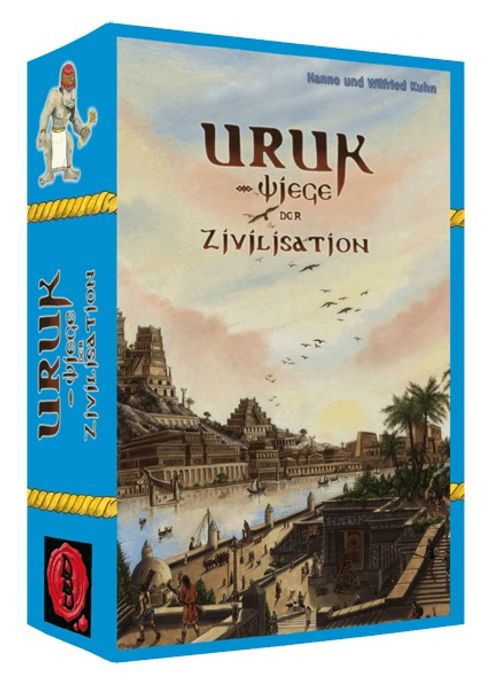
Uruk: Wiege der Zivilisation
Uruk: Wiege der Zivilisation Rulebook
Table of Contents
Table of Contents
Game Components
-
92 invention cards (23 cards each of colours red, pink, yellow and blue)
- Level 1 inventions: 1 card of each colour
- Level 2 inventions: 3 cards each of each colour
- Level 3 inventions: 4 cards each of each colour
- Level 4 inventions: 5 cards each of each colour
Note: for the specific classification of the invention cards look at the leaflet.
-
7 god cards and 3 disaster cards
-
4 epoch cards
-
4 cards which summarize shortly the rules (summaries)
-
48 resources (12 each of colours red, pink, yellow and blue)
-
24 settlement stones (1 stone = village, 2 stones stacked = city)
-
1 rule booklet and 1 leaflet
Topic and Object of the Game
10.000 years of civilizational development go by quickly in one game. Each player takes charge of one tribe, makes inventions, builds villages and cities, enjoys the favours of the gods and tries to withstand disasters. A playful ride through the ages. He, whose civilisation comes out developed best, and who finally gains the most victory points wins the game.
Preparation
- Sort out the level 1 and level 2 invention cards, the epoch cards and the summaries.
- The most inventive player appoints the player who goes first. This player receives the summary with the DDD logo. The other players each get one of the other summaries. Leftovers are put in the box.
- Each player draws blind one level 1 invention and puts it face up on the table in front of him. This is the first invention of his tribe. The remaining level 1 inventions are put back in the box.
- Shuffle the level 3 and level 4 inventions, the gods and the disasters and put them in the middle of the table as a supplementary pile.
- Shuffle now the level 2 inventions and give each player 5 of these as hand cards. Put the remaining level 2 inventions on top of the supplementary pile.
- Take the top three cards of the supplementary pile and lay them face up in the middle of the table. That are the common display. Leave some space for the god/disaster cards.
- In a game with two players draw 10 cards, in a game with three players draw 5 cards and in a game with four players draw 1 card and put these on the discard pile.
- Above these piles lay down the epoch-cards from I to IV. On card I put down 3, 5 or 7 settlement stones (depending on the number of players), on card II 6 settlement stones, on card III 4 settlement stones and on card IV 3 settlement stones.
- Each player places one settlement stone above his level 1 invention; his first village. The rest of the settlement stones will not be used and is put back in the box.
- Finally put the resources on the table, reachable for everyone. This is the common pool. Each player takes 3 resources in the colour of his level 1 invention and puts them on the 3 cube drawings on his invention.
Game Play
The player with the DDD logo on the summary card is the starting player. The play continues in a clockwise direction. When it is your turn, you can do three of the following actions (there is no order and no limit to each action, except three in total):
- take a card
- make an invention
- take resource/s
- exchange cards in your hand (of inventions lying already in any personal display) for resources of the same colour
- set one settlement stone
- carry out a card action
Note: the functions of invention cards lying in your personal display can be used. These functions are explained in the leaflet.
Take a Card
The player can either take one card from the common display or one of the supplementary pile and add it to his hand cards. If it is a god or a disaster card, see "God and Disaster Cards" below. The player then draws another card from the supplementary pile until he finally gets an invention. If he draws another god or disaster card see "God and Disaster Cards" also.
Note: Gaps in the common display will only be filled at the end of the turn from the supplementary pile. If god or disaster cards are drawn at this time, see "God and Disaster Cards".
Make an Invention
See also the function of: Axt (axe), Segelschiff (sailing ship), Stadtmauer (city wall), Statuette (statue) and Wasseruhr (water clock).
In the beginning of the game each player has a level 1 invention in his personal display. There is space for a maximum of 5 inventions in the personal display, which must each be different. New invented inventions can substitute old inventions or be put next to them.
To make an invention, you need to have the same number of invention cards of this invention, as the level of the invention, you want to make. You put one card of them in your display and discard the others.
Example: André has 3 cards of the level 3 invention "Flaschenzug (block and tackle)" among his hand cards. He takes one of them, adds it to his personal display and puts the other two on the discard pile.
If one or several cards are missing for your invention, you can substitute each missing card with a Colour Couple. These are any 2 cards matching the same colour). Other attributes are ignored. They need NOT be from the same colour as the invention you are going to make.
But before "inventing" you have to check the level-rule: If you want to invent something, the level of your new invention may not be higher than the level of the highest invention on your display plus one, even if you substitute the new for the old invention.
Example: Marco has three level 2 inventions and the level 1 invention "Lehmhaus (mud hut)" in his personal display. In his hand cards he has the level 4 invention "Zahnrad (cogwheel)". But he cannot invent the level 4 "Zahnrad (cogwheel)" until he has invented a level 3 invention.
Note: A substituted invention is immediately taken back to hand and can be used to build a colour couple or can be reinvented according to the rules.
Example: Regula substitutes her level 1 invention "Lehmhaus (mud hut)" by the pink level 3 invention "Flaschenzug (block and tackle)". She plays the invention "Flaschenzug (block and tackle)" and takes the level 1 invention "Lehmhaus (mud hut)" back on her hand. She needs 2 other invention cards "Flaschenzug (block and tackle)" to do this. Since she doesn't have them, she creates one colour couple out of two yellow cards ("Axt (axe)" and "Leier (lyre)") and another one out of the red cards ("Stadtmauer (city wall)" and the substituted red "Lehmhaus (mud hut)"). Then she puts these four cards on the discard pile.
Take Resource/s
See also the function of: Astronomie (astronomy), Brennofen (kiln), Domestizierung (domestication), Flaschenzug (block and tackle), Kanalisation (sewerage), Lehmhaus (mud hut), Netz (net), Rollenprinzip (roll with trees), Straße (street), Tongefäß (earthenware), Tonrohr (earthenware pipe), Wasserrad (water heel), Zikkurat (ziggurat), Zisterne (cistern).
The player takes one resource which he can produce due to one of his inventions in his personal display. He takes it from the common pool and puts it in front of him. This is his personal pool, which remains visible for everybody. Some inventions offer the possibility to take more than one resource.
Example: Marco has the level 2 invention "Domestizierung (domestication)" and adds one pink resource to his personal stock.
Note: If there are no more resources of your chosen colour in the common pool, you may take 1 resource of this colour from the player or players, which have the most of these resources in their personal pool. If you are the one who has the most, you don't get any resource. The player from whom you have taken 1 resource may take a resource of another colour out of the common pool.
Exchange Cards in Your Hand for Resources of the Same Colour
The player on turn can discard any number of hand cards of already outlying inventions in any players personal display. For each card so discarded, he receives a resource in the colour of the discarded card.
Example: Marco has 1 card "Wasserrad (water wheel)" and 1 card "Flaschenzug (block and tackle)" in his hand. The "Flaschenzug (block and tackle)" is in his personal display, André has the "Wasserrad (water wheel)" in his personal display. So Marco throws away both hand cards and takes a blue and a pink resource out of the common pool.
Set One Settlement Stone
See also the function of: "Gewölbe (vault)", "Münzwesen (coinage)" and "Schöpfbaum (draw well)".
To found a village or a city, the player takes one settlement stone of the epoch card, by paying the resources shown on the card. A settlement stone on the epoch card I can only be used as a village, a settlement stone on the epoch cards II – IV can be used as village or city. The settlement stone is immediately placed above one of his own inventions. The first settlement above an invention is always a village and when you build a second settlement stone on that invention, this is then a city. If a player substitutes an invention with another invention card, the settlement stones remain and are now assigned to the new invention.
Note: Above one invention may only be one village (1 stone) or city (2 stones). If a player has no invention without stones above it, he can't build a village. If he hasn't a village, he can't found a city.
A settlement stone taken from epoch card I costs as many resources of the same colour as the invention is the level of the invention he wants to place it.
Example: Regula wants to found a village at the "Wasserrad (water wheel)". The "Wasserrad (water wheel)" is a blue level 2 invention. So she has to pay two blue resources.
A settlement stone of epoch card II to IV costs as many resources as shown on the epoch-card he has taken it from.
Example: Marco wants to found a village at the "Wasserrad (water wheel)". There are no settlement stones left on epoch card I, so he takes one of epoch card II. He has to pay two resources of one colour and two of another colour, i.e.: two red ones and two yellow ones.
The settlement stones must always be taken off the epoch card with the lowest number, i.e.: villages from I to IV and cities from II to IV.
Example: André has an invention with a village and one without a settlement. There are still settlement stones lying on each epoch card. If he wants to found a village he has to take it from epoch card I; to found a city he must use the stones of epoch card II.
If the last settlement stone of epoch card IV is taken, consult "End of Game".
Carry Out a Card Action
See also the function of: "Aquädukt (aqueduct)" and "Zahnrad (cog wheel)".
A player carries out a card function which requires an action. Only "Aquädukt (aqueduct)" and "Zahnrad (cog wheel)" have card actions, which are not covered with the other actions! Most other card functions are part of an action or another action already covered (i.e.: take resource/s).
End of Turn
At the end of your turn you fill the gaps of the common display. Only when they are filled your turn is over.
End of Game
If the last settlement stone of epoch card IV is taken, you finish the round (so that all players have the same number of turns). After that each player has another turn (beginning with the player with the DDD-logo), but in this last round you discard all gods and disasters without consequences.
Note: As soon as the last settlement stone is taken the settlement stones in the common pool (see gods and disasters below) are immediately put on epoch card IV and can be bought again.
Scoring
See also the function of: "Leier (lyre)" and "Waage (scales)".
At the end of the game each player gets victory points for:
- for each invention lying in his personal display at this moment:
- without any settlement: 1 victory point
- with a village: victory points due to the level of the invention
- with a city: victory points twice the level
- resources in his personal pool: 4 resources are 1 victory point.
- the functions of the inventions "Waage (scales)" and "Leier (lyre)".
Add all the victory points. The player who has the most wins the game. If two players have the same amount of victory points the player who has the most cities wins the game. If it is then still a draw, both win!
Peculiarities
The Card Functions
You can use each card function just once during your turn, but you can play the different card functions in any order you like.
Shuffling Cards
If the supplementary pile is depleted the first time, you reverse the discard pile. Remove the top 15 cards and put them back in the box. Shuffle the remaining pile and place it on the table as a new supplementary pile. If you deplete the supplementary pile again, you do not put cards in the box.
God and Disaster Cards
See also the function of: "Leuchtturm (lighthouse)".
If you draw a god or a disaster from the supplementary pile, place it next to the common display. If there is already a god or disaster, this card will be activated at the end of the turn. In this case place the newly drawn god or disaster face down in front of the player, who has drawn it. The player then completes his turn. If during this time further gods or disasters are drawn, then they are just discarded and the player draws cards until he has his regular number of drawn cards. A player who has drawn a god or disaster always redraws, until he draws an invention.
A god or a disaster is resolved between turns.
Note: Filling the gaps of the common display is still part of the turn of the player.
You resolve the god and disaster cards top to bottom. First you always remove one settlement stone from the epoch card with the lowest number and place it in the common pool. Then each player discards hand cards until there are only eight left. (He can choose which ones he discards.) Then follow the instructions on the cards, i.e.: bidding with resources or cards, or receiving benefits for all players, etc.
If you have won the bidding, you pay the used resources/cards to the common pool or discard pile. If you have lost, you can keep your used resources/cards.
After resolving the positive or negative event of the activated god or disaster you discard the card and the one used as marker.
Note: The god or disaster card used as a marker must not be fulfilled. It is just a marker.
The Gods: Enlil, Nergal and Ninurta
These gods favour only the player who offers the most in card value: Starting off from the player who has activated this god and then clockwise the players play any amount of cards and name a bid. The bid consists of the sum of the levels of the played cards, adding bonus points from the invention "Leuchtturm (lighthouse)".
The next player must outbid this offer or pass. If he has passed once he cannot take part in this bidding any more. Played cards may not be taken back to hand during this bidding. When all players have passed, the player who has offered the most, wins.
Example: Regula has activated the god Enlil and offers the invention "Axt (axe)" (level 2) and "Astronomie (astronomy)" (level 4). She has the invention "Leuchtturm (lighthouse)" with a village in her personal display and so gets another 3 points. So she offers 9 points altogether.
André offers the inventions "Aquädukt (aqueduct)" (level 4), 2x "Domestizierung (domestication)" (level 2) and the "Leuchtturm (lighthouse)" (level 2). But he may not add bonus points for the "Leuchtturm (lighthouse)" because it is not in his personal display. So he has 10 points altogether. Hence he has out bidden Regula's offer. She passes and takes her cards back to hand. André has won the bidding and discards his four offered cards. Now he has gained the favour of Enlil.
Enlil — Favour: The player takes one invention from his hand and puts it in his personal display due to the level rule. He does not need to discard any other cards, i.e. identical cards or colour couples. Another invention in the personal display may be replaced by it.
Nergal — Favour: The winner may take 3 resources of the same colour out of the common pool.
Ninurta — Favour: The player keeps the card face up. At the end of the game he gets victory points, one for each city he possesses at the end of the game.
The Gods Gibil, Marduk and Nannar
These 3 gods favour the player with the fewest settlement stones. The other players are less favoured. If more than one player has the fewest settlement stones, all players are favoured less.
Gibil — Favour: The player who has the fewest settlement stones takes 3 resources of the same colour out of the common pool. After that the other players take clockwise 1 resource, starting off from the player, who has activated the card.
Marduk — Favour: The player with the fewest settlement stones pays for his next settlement stone half price (round up). The others may take 1 resource (see Gibil). The winner keeps this card as a memory. When using it no other discounts like "Gewölbe (vault)" or "Münzwesen (coinage)" are possible.
Nannar — Favour: The player with the fewest settlement stones pays for his next settlement just half price (round up). The other players may draw a card from the supplementary pile. The winner keeps this card as a memory. When using it no other discounts like "Gewölbe (vault)" or "Münzwesen (coinage)" are possible.
One God for All: Ischtar
Ischtar — Favour: Beginning with the player who has activated this card in clockwise order, each player may draw a card from the supplementary pile or take one resource from the common pool.
Disaster Cards: Dürre (Draught), Erdbeben (Earthquake) and Vulkanausbruch (Volcanic Eruption)
After each player had enough time to have a close look at the personal pool of the other players, everyone hides his resources in his hand. Then each player secretly takes as many resources as he wants to offer to avert the disaster in the other hand. Afterwards all players open their hands at the same time. Everyone names his amount and adds, if possible, the bonus of the invention "Leuchtturm (lighthouse)". The player or players with the highest offer do not suffer from this disaster, whereas all the others have to cope with it and suffer from losses.
Note: If all players offer the same amount, everyone suffers.
Dürre (Draught) — Loss: Each concerned player loses one settlement stone. He must choose one to be put in the common pool.
Erdbeben (Earthquake) — Loss: Each concerned player discards one invention with no settlement stone above it. If a player has only inventions with a village or a city in his display, he has to discard 3 hand cards instead, he chooses which. If he has less than 3 cards, he has to discard all hand cards.
Vulkanausbruch (Volcanic Eruption) — Loss: Each concerned player loses two actions in his next turn. To mark this, these players move a settlement stone onto an invention. In his next turn the player has to move it up and can only carry out one action.