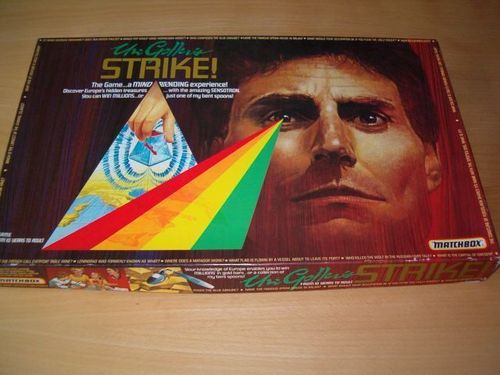
Uri Geller's Strike!
Uri Geller's Strike! Rulebook
Table of Contents
Table of Contents
Rules of the Game
Strike! is played by 2 to 4 people (or teams). The questions are divided into two groups so that children and adults can play either among themselves or against one another. Level 2 questions are for adults and level 1 questions are for children.
Only children may move from level 2 to level 1 to improve their chances of winning. (See the paragraph on movement on the map.)
The player travels the map of Europe in search of hidden mineral wealth, treasures or sunken wrecks, in order to win gold ingots or twisted spoons.
Contents
- 1 map
- 2 dice (1 of each)
- 12 black pawns (pions noirs)
- 72 gold ingots (lingots d'or)
- 12 twisted spoons (cuillères tordues)
- 4 SENSOTRONs
- 3 booklets: gold ingot distribution, questions level 1, questions level 2
Note printed with the contents: the Strike! map is not meant to represent Europe and North Africa at a strictly exact scale.
Set-Up
Before starting, and before each game, gently shake the map so that the mineral wealth, treasures and wrecks are distributed beneath the board.
The three booklets (gold ingot distribution, questions levels 1 and 2), the twisted spoons, the gold ingots and the black pawns must be gathered at the start of the game. The players choose one of their number to distribute the gold ingots, twisted spoons and black pawns.
Then each player (or team) takes a SENSOTRON of a colour and places it on the square of the matching colour.
Roll the die. The player (or team) that rolls the highest number begins. Play proceeds clockwise.
Movement on the Map
Players roll the die in turn, each one advancing as many squares as the points they rolled.
Only horizontal and vertical movements are allowed. You may not go back the way you came. The only diagonal movement permitted is the one from the starting point.
As you advance across the map and approach a mineral wealth, a treasure or a wreck, the arrow of the SENSOTRON acts like a compass and indicates the direction to follow in order to discover the hidden minerals, treasures or wrecks.
On each turn, you are on a square belonging to a question grid. You then roll a special die to choose the number of the question that your left-hand neighbour will ask you.
If you answer this question correctly, you continue to play. You may give up to three successive correct answers before passing your turn. After your 3rd correct answer, roll the die, advance, and answer a question only if you are on a treasure square.
Twelve locations on the map hide minerals, treasures or wrecks. If you arrive on one of these locations, the arrow of the SENSOTRON will point downward. In this case, you must answer a question according to the normal procedure.
- If you give a correct answer, consult the booklet "Trésors, Epaves et Minéraux" (Treasures, Wrecks and Minerals) to see whether your find is worth 1, 2 or 3 gold ingots. The gold ingots are then handed to you.
- If you give a wrong answer, you receive a twisted spoon.
Whether the answer is right or wrong, the player must place a black pawn on the square concerned. If the player forgets to do so, they are penalised: they give back a gold ingot or, failing that, a twisted spoon. (If the player has neither a gold ingot nor a twisted spoon, there is no penalty.)
If the game is played with level 2 questions, only children may move from level 2 to level 1, and only when their SENSOTRON is on a treasure square. For a correct answer the reward is doubled; for a wrong answer, a twisted spoon is distributed.
Airports
When you arrive on a square showing an airport, you have the choice between answering a question or placing yourself directly on another airport, provided that the latter is not already occupied by another SENSOTRON or a black pawn.
After changing airport, you answer a question according to the normal procedure.
End of the Game
The game ends when the 12 locations have been discovered and marked with a black pawn.
The Winner
The winner is the player (or team) who has obtained the greatest number of gold ingots. If two players (or teams) have the same number of gold ingots, the winner is the one with the greatest number of gold ingots and twisted spoons. The second place goes to the one who has obtained the greatest number of gold ingots after the winner.
Translator's note: the printed tie-break is terse and reads literally as "the greatest number of gold ingots and twisted spoons"; it is transcribed as printed.
Summary
a) Simple square, answer a question
- Correct answer: Roll the die again and answer another question. If you answer correctly 3 times in a row, you are entitled to answer one additional question only if, after your last move, you are on a treasure square.
- Wrong answer: Stay where you are and pass the turn to the player on your left.
b) Treasure square, answer a question
- Correct answer: Receive the number of gold ingots due to you. Place a black pawn on the treasure square. Roll the die again and answer a question.
- Wrong answer: Receive a twisted spoon. Place a black pawn on the treasure square. Stay where you are and pass the turn to the next player.
c) Airport square, answer a question
- Correct answer: You may decide to fly to a free airport (one not marked with a SENSOTRON or a black pawn) and answer a question, as in a). This move counts as one of your 3 authorised moves.
- Wrong answer: As in a).
d) Airport and treasure square, answer a question
- Correct answer: Receive the number of gold ingots due to you. Place a black pawn on the treasure square. Continue as in b).
- Wrong answer: Receive a twisted spoon. Continue as in b).
Figure 1
Fig. 1. Example: you are on D1 and, after rolling a 5, you want to go to D2.
The figure shows two grids of columns D and E and rows 1 to 4, with direction arrows printed on the squares. The left grid is headed "Correct movement" (BON DÉPLACEMENT) and the right grid "Wrong movement" (MAUVAIS DÉPLACEMENT).
Translator's note: the arrow placements are not reproduced in text. Consult the scanned figure for the exact arrows.