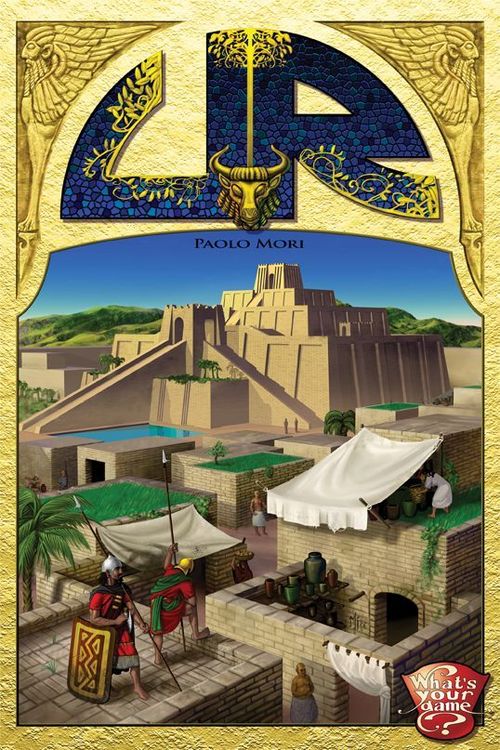
Ur
Ur Rulebook
Table of Contents
Table of Contents
Contents
- 40 double-sided Civilization tiles (4 of each kind)
- 5 Ziggurat tiles
- 4 coloured sets of 20 tokens
- This set of rules
- 1 first player token
Setup
-
Shuffle the Civilization tiles and place them on the table in a 6 x 6 square grid. Please make sure that no "adjacent" tiles are showing the same upper face (two tiles are considered adjacent when they touch by any side while on the grid). Each player selects a colour and takes all the tokens of that colour, together with one of the four Civilization tiles left over from the grid set up. In a 3 players game, the extra tile still available after this distribution should be put next to the grid. This tile will be "exchangeable" during the game.
-
Randomly assign the first player token. Starting with the first player and proceeding clockwise, each player places one of his coloured tokens on any "free" Civilization tile (a tile is called free when no player has placed a token on it yet). After all players have placed their first token, two more placement rounds occur, with slightly different rules: a token may be placed on any tile holding at least a token of the same colour, or it can be placed on any adjacent free tile.
-
The final setup step follows: every player is allowed to exchange the Civilization tile he holds in his hand with a free tile taken from the board. This exchange is not mandatory: the player can choose to pass and keep the Civilization tile he already holds.
Game Turn
The game proceeds clockwise from the first player. At his turn, each player will do the following:
- He will carry out one, both or none of the actions illustrated in the Civilization tile he holds. Instead, he can build Ziggurats.
- He will exchange his Civilization tile with a free one from the board.
Token on tile ceiling
During the game, a Civilization tile on the board cannot hold more than five tokens! It should also be clear at this point that all tokens on a tile would belong to the same player.
Carrying out actions
The Civilization tiles perform two roles in this game: they function as elements of the gameboard (they are placeholders for the players' tokens), and they are also the tools by which players carry out "actions" for their civilizations.
Each tile holds two different actions, one illustrated on the upper face, the other on the back face (the back face action also appears, as a small icon, on the upper face of the tile, at the bottom).
At the beginning of his turn, the player will choose to carry out one, both or none of the actions illustrated in the Civilization tile he holds (but he cannot carry out the same action twice). The effects of all the different Civilization actions are described at the end of this set of rules.
If the player declines to carry out one of the two actions illustrated in his Civilization tile, he gains the right to place one additional token on any of the tiles he "owns" (tiles are owned by a player when he has placed at least one of his tokens on them).
If the player declines to carry out both actions illustrated on his Civilization tile, he gains the right to either place two tokens on tiles he owns, or to place one token on any free tile on the board.
Ziggurat
At the start of his turn, if a player has five tokens on one or more Civilization tiles, he can choose to spend his turn to build Ziggurats. No more than two Ziggurats can be built in one turn. If the player chooses to build Ziggurats, he will not be able to carry out the actions on his tile. In order to build a Ziggurat, a player carries out the following actions:
- He takes back his tokens from the Civilization tile where he wants to build a Ziggurat.
- He places a Ziggurat tile on the Civilization tile.
- He places one of his tokens on the Ziggurat tile, to mark his possession.
Civilization tiles covered by a Ziggurat are considered unmovable until the end of the game. They cannot hold any other token, of any colour, and they are not effected by all further actions during the remaining of the game.
Civilization tile exchange
After completing his actions, the active player must exchange the Civilization tile he holds in his hand, by choosing a free tile from the board with a different pair of illustrations from the old one. It is up to the player to choose with face of the tile to show up. However, the illustration of the tile the player just picked up must remain always visible to all the players, as it tells them what actions will be played in the next turn.
Note: If a player at the start of his turn does not have any tokens on the gameboard, he will only have the option of placing 3 tokens on any free tile, and then exchange the Civilization tile he holds, before his turn ends.
Game ending
The game ends:
- Immediately, when a player at the end of his turn is unable to exchange his Civilization tile, because there are no more free tiles on the board, or because the free tiles left are identical to the one he already holds.
- When a player builds the fifth and last Ziggurat, the game continues until the end of the turn of the last player (the one on the right of the player holding the first player token).
Winner
At the end of the game, players calculate their victory point. Victory points are earned by owning Civilization tiles on the board (the tokens instead do not hold any value and they are discarded). Each player removes from the board the tiles he owns and places them in front of him (please note that the tiles should not be flipped: the illustration on the upper face is what counts). He then builds "sets" with the tiles. No more than 5 tiles can make a set, and their illustrations must be different from each other. The player can also use the Civilization tile he was holding in his hands at the end of the game, freely choosing its upper face. The Ziggurat tile is considered an extra: it can be attached anywhere, allowing therefore 6-tiles-long sets.
Collected sets give victory point according to the following table:
| Number of tiles | 1 | 2 | 3 | 4 | 5 | 6 |
|---|---|---|---|---|---|---|
| Victory points | 1 | 3 | 6 | 10 | 15 | 21 |
The player with most points is the winner of the game.
Example
A player at the end of the game owns 9 tiles on the board: 3 Agriculture, 2 Commerce, 2 War, 1 Politics and 1 Cultural Development. He has also built one Ziggurat, and has one War/Politics tile in his hand. With these tiles he can build one 5-tiles set (one of each type), one 4-tiles set (Agriculture, Commerce, War, and the Politics from the tile in his hand), one 1-tile set (just Agriculture). He can add his Ziqurrat to the first set, so to have a 6-tiles set.
His victory points are 21+10+1=32.
Strategic Hints
In the first turns, the combined actions associated with Agriculture and Commerce tiles allow a civilization to grow significantly.
When choosing the tile for your next actions, first consider what your civilization needs, then what other actions the players may have in their hand!
Ziggurat are also fundamental, but you shouldn't be building them too early. A premature construction project can stop the development of a civilization. (Tiles with Ziggurats do not contribute to development).
Actions
Agriculture
Remove one token from all the tiles you own that are not adjacent orthogonally to your Agriculture tiles. Place up to two tokens on every Agriculture tile you own.
Commerce
Place, on every Commerce tile you own, one extra token for each side that is either touching orthogonally a tile owned by another player or the outer border of the grid.
Culture
Place, on every non-free tile adjacent orthogonally to your Culture tiles, an additional token of the tile's owner colour. Thus other players may also benefit from this action.
Politics
Redistribute your tokens as you like among the tiles you own.
War
After selecting one of your tiles as the attacker, and one that is free or owned by another player as the attacked, a war works as follows:
- Remove all tokens from the attacked tile.
- Remove the same number of tokens from the attacking tile.
- If the attacking tile illustration is different from the one on the attacked tile or if it doesn't show the war action (the red tile), remove an additional token from the attacking tile.
- Move as many tokens as you like (at least 1) from the attacking tile to the attacked one.
Please note that all four phases of a war must be carried out. This means that the attacked tile must be owned in the end by at least one token of the attacking player.
There is no limit to the number of attacks you can carry out with a single war action.