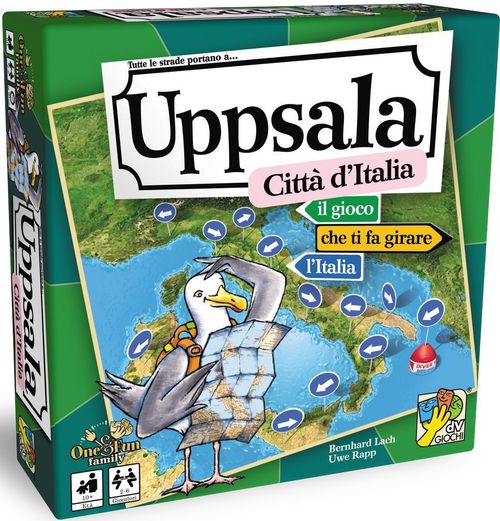
Uppsala: Città d'Italia
Uppsala: Città d'Italia Rulebook
Table of Contents
Table of Contents
Overview
For 2 to 6 players, ages 10 and up.
Components
- 200 place cards (170 cities, 20 attractions and 10 mountains)
- 2 "Intermezzo" (intermission) cards
- 1 direction card
- 35 wooden chips
- 1 notepad
- 1 pencil
- These rules
Objective
Place the places on the table in a north-south or west-east direction, according to their geographical position. Whoever guesses correctly more often, and more often spots other players' mistakes, receives chips as a reward. The player with the most chips at the end of the game is the winner!
Setup
Separate the Intermezzo cards from the place cards. Shuffle the place cards well, then sort them so that the place names face up; the coordinates and other information must be on the back. Make 3 stacks of 15 cards each. Set the remaining cards aside for now.
Create the draw deck as follows: place one intermission card on the first stack, followed by the second stack, then the second intermission card, and finally the third stack (see illustration).
Each player takes 4 chips and keeps them in front of them. The other chips are used later in the game.
Place the direction card in the middle of the table. Take the first of the remaining cards and place it on the direction card: this is the starting card.
Playing the Game
The youngest player begins, and play continues clockwise. The active player takes the top card of the draw deck and reads the name of the place aloud.
Attention: no player may look at the coordinates on the back of the card!
The active player then decides whether to place the card in the west-east direction or in the north-south direction. Since only the starting card is on the table at the beginning of the game, the first player has 4 possibilities for placing their card. They may place it above the starting card (north), below it (south), to the left (west) or to the right (east). The next player takes the next card from the deck and decides whether to place it up, down, left or right, or between two cards already played.
Attention: a place card can only be placed in the west-east direction or the north-south direction relative to the starting card. During the game the cards form a cross. Cards may not be placed in any other way.
Example: Perugia must be placed. The illustration shows five of the ten correct placement possibilities.
Now the opinions of the other players are asked. Starting with the player to the left of the active player and continuing clockwise, each player is asked whether the card just played is in the right place or the wrong place. If all players believe it is in the right place, the turn ends and the next player takes their turn. If, however, a player believes the card is in the wrong place (too far west or east if it is in the west-east direction; or too far north or south if it is in the north-south direction), they say "dubito!" (I doubt it!) and the game is interrupted. The player who doubted the card then turns it over, and also turns over one neighbouring card of their choice.
Right or Wrong?
The card just played is checked against the other card that was turned over. The other cards are not taken into consideration. On the back of each card are the geographical coordinates (latitude and longitude) of the respective places. If a card in the west-east direction has been doubted, the coordinates are read along the arrow for west-east. If instead a card in the north-south direction has been doubted, the coordinates are read along the arrow for north-south.
The card just played is in the right place if, in the direction of the arrows, the numbers are in ascending order.
It may happen that two cards with the same latitude or longitude are turned over. In this case both cards are placed correctly.
- If a doubted card was wrong, the challenger receives a chip from the player who played the card, and that card is removed from the game.
- If a doubted card was right, the player who played the card receives a chip from the challenger. The cards remain in play and are turned face down again so that only the place name can be read.
If the player who loses the challenge has no chips left, the winner receives one taken from the box. If there are not enough chips in the box, 5 chips are replaced by a place card that has been removed from the game. In the final scoring this card is worth 5 chips.
Illustration captions: "These cards are placed incorrectly because the numbers are not in ascending order." / "These cards are placed correctly because in the direction shown the numbers are in ascending order."
Intermediate Evaluation
Play continues until the first Intermezzo card appears. At this point an intermediate evaluation takes place, in which all players estimate how many cards have been placed incorrectly. Each player secretly writes their number on a sheet of the notepad. Then all cards played are turned over and checked.
Important: the check is always made starting from the starting card. Proceed from the centre towards the ends of the cross and check that each card is right (see above).
The incorrect cards are set aside and counted. The players who guessed the exact number of incorrect cards receive two chips from the box.
If no player guessed the exact number, the players who came closest receive one chip.
The Game Continues
The cards already played are removed from the table. A new starting card is drawn from the stack of cards that was set aside at the beginning of the game, and the game continues as described above.
End of the Game
Once all cards (3 × 15) have been played, a final intermediate evaluation is made. The game is then over. The player with the most chips wins!
Tip: for an easier game, or when playing with children, players may exclude the places they consider most difficult.
Game Variant: Population, Area and Altitude
The cards also carry data on population, area and height. You can play with these too!
Instead of arranging the cards according to their geographical position, line up the places according to their number of inhabitants, their extent or their height above sea level. In this case, instead of forming a cross, arrange the cards in a single column. The least populous, smallest or lowest places go at the bottom, and the most populous, largest or highest places go at the top.
This variant does not need the direction card. The distribution of points and the possibility of doubting the position of a card remain the same as described above.
Card Data Note
The data on the cards come from various sources on the Internet and official websites. Some sources may give different figures. In most cases the average of the data was used. For some places of interest, the coordinates refer to the place itself, not to the coordinates of the chief town marked on the map.