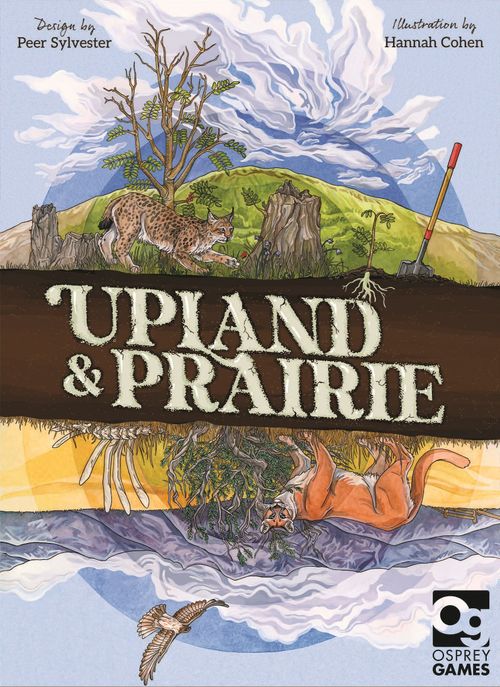
Upland & Prairie
Upland & Prairie Rulebook
Table of Contents
Table of Contents
Introduction
Each game of Upland & Prairie represents animals returning and spreading across a landscape: either the rugged Scottish Uplands or the vast Montanan Prairie.
On a turn, players draw three animal discs – keeping one secret, placing one on the shared map, and returning one to the bag. As the game progresses and the ecology improves, each space can support more animals.
Your objective is to either guide a species to connect key habitats or to collect diverse sets of animals before the bag runs dry.
Settings
Upland & Prairie can be played on either the Upland side or the Prairie side, each of which have slightly different rules. The two settings use opposite sides of the map tiles, rewilding tracker, and animal discs.
The maps share the features below, although they'll look different in each setting.
- Impassable edge
- Impassable space
- Paired goal
- Triple goal
[Diagram: the Upland and Prairie versions of each feature – impassable edge, impassable space, paired goal and triple goal – shown on the map tiles.]
Components
- 8 Player screens
- 6 Map tiles
- 1 Three-player map tile
- 1 Rewilding tracker
- 69 Animal discs
- 5 Rewilding discs
- 1 Bag
- 1 Rulebook
[Diagram: the components above, shown on the Upland side and the Prairie side.]
Setup
- Create the map in the centre of the table by choosing a side to use and then following the steps below according to the number of players:
For 2 or 4 players
First return the three-player tile to the box.
It's important that the tiles with the paired goals go in the positions shown. The other tiles can be freely substituted for each other.
[Diagram: map layout for 2 or 4 players, shown for both Upland and Prairie.]
For 3 players
First place the three-player tile in the middle of the table.
It's important that the tiles with the paired goals go in the positions shown. The other tiles can be freely substituted for each other.
[Diagram: map layout for 3 players, shown for both Upland and Prairie.]
If you'd like instructions on how to create a wider variety of maps, turn to page 13 (see "Create Your Own Landscape" below).
Setup continues:
-
Give each player a screen of their choice.
-
Add all the animal discs to the bag. Each player draws 2 animal discs at random, and hides them behind their screen.
-
Place the rewilding tracker, with the corresponding side facing up, near the map. Then take the 5 rewilding discs and:
- Upland: Add 4 rewilding discs to the bag, and place 1 on the first space of the rewilding tracker. Mix the bag.
- Prairie: Add 1 rewilding disc to the bag, place 1 on the first space of the rewilding tracker, and return the other 3 to the box. Mix the bag.
-
The last player to have seen a house cat begins the game.
Example: three-player setup on Upland. [Diagram: an example three-player setup on Upland, showing the map, the screens, the drawn discs and the bag.]
How to Play
Beginning with the starting player, players take turns going clockwise round the table.
On your turn, randomly draw 3 animal discs from the bag in secret. Place 1 back in the bag, 1 on the map, and 1 behind your screen. Then, pass the bag.
Only the animal placed on the map should be visible to all players.
At the start of the game, each space on the map can house only 1 animal disc – adding any more would make the space overcrowded. This number will increase as rewilding occurs (see next page).
Animal discs can never be placed in impassable spaces or goal spaces.
[Diagram: four examples – "Placed correctly!" (animal disc on an ordinary space), "Overcrowded space." (a second disc on a space that already holds one), "Impassable space." and "Goal space." (both marked as not allowed).]
FAQ
A space can even contain multiples of the same animal, as long as the rewilding tracker (see opposite) indicates that there is room for them.
Rewilding
Rewilding is the process of restoring ecosystems by allowing native species to return and thrive in their natural habitats.
In Upland & Prairie, rewilding is represented by a tracker, which allows more animals to be in each space as the biodiversity of the landscape gradually recovers.
The rewilding tracker has two sides, and it works differently depending on which you are playing with.
Upland
If you draw a rewilding disc, immediately place it on the rewilding tracker, and draw a replacement disc.
The progress of discs on this tracker indicates how many animals may be placed in each space:
- 1-2 discs = 1 animal per space
- 3-4 discs = 2 animals per space
- 5 discs = 3 animals per space
[Diagram: example Upland tracker with discs placed, showing "2 animals in each space."]
Prairie
If you draw a rewilding disc, immediately return it to the bag, move the disc on the rewilding tracker up by 1, and draw a replacement disc.
The progress of the disc on this tracker indicates how many animals may be placed in each space:
- 1st slot = 1 animal per space
- 2nd slot = 2 animals per space
- 3rd slot = 3 animals per space
[Diagram: example Prairie tracker with the disc on the 2nd slot, showing "2 animals in each space."]
If you draw a rewilding disc as one of the last 3 discs in the bag, treat it instead as an animal disc of any chosen type.
Game End
The game can end in one of two ways: a completed path, or an empty bag.
Completed path
The game ends immediately when one animal has an unbroken path touching the 2 paired goals A, or touching all 3 triple goals B.
[Diagram A: a completed path touching the 2 paired goals. Diagram B: a completed path touching all 3 triple goals. Both are marked with a tick.]
Paths can be broken by empty spaces C, impassable spaces, impassable edges D, and goal spaces E themselves.
[Diagram C: a path broken by an empty space. Diagram D: a path broken by an impassable edge. Diagram E: a path broken by a goal space. Each is marked with a cross.]
Winning
Players now reveal the animal discs behind their screens. The winner is the player with the most animal discs matching the animal of the completed path.
If there is a tie, the winner is the player whose turn would come next in the turn order. See the example below.
[Example diagram, headed "Player 1's turn.": a map with a completed path, a bag, and the revealed discs behind screens 1, 2 and 3; labelled "Player 3 wins!"]
Empty bag
If there are fewer than 3 animal discs in the bag at the start of a player's turn, the game ends immediately.
Winning
Players now reveal the animal discs behind their screens. The winner is the player with the most sets of all 3 animal discs.
If there is a tie, the winner is the player with the most animals of a single type.
4-Player Team Game
When playing Upland & Prairie with 4 players, you play in pairs. Follow the setup and rules for a 2-player game, with the following changes:
Setup
- Give each of the 4 players a separate screen. The 2 players on each team should be sitting diagonally opposite each other, and shouldn't be able to see behind each other's screen.
- Each player randomly draws 2 animal discs and hides them behind their screen.
Turn order
Players take turns drawing 3 discs as usual. Pass the bag clockwise, so that the teams alternate turns in this pattern: A.i → B.i → A.ii → B.ii.
[Diagram: four seats around the map – 1st A.i, 2nd B.i, 3rd A.ii, 4th B.ii.]
Rewilding
Drawing a rewilding disc has an additional effect in the team game: all players must secretly choose 1 animal disc from behind their screen and give it to their teammate, simultaneously.
Players can freely discuss their wants and plans at any time. However, these discussions must be public.
Game end
Before revealing animal discs at the end, each player swaps 1 final animal disc with their teammate.
Then determine an individual winner as normal. The team with the individual winner wins the game.
Create Your Own Landscape
Create the map in the centre of the table by choosing a side to use and then placing the corresponding tiles according to these rules:
For 2 or 4 players
a. Return the 3-player tile to the box.
b. Place 1 tile with a paired goal and 1 tile without a paired goal so that they share a complete edge.
c. Then, place the remaining tiles so that:
- Each tile is touching at least 2 others.
- No gaps are created inside the map.
- There are at least 2 other tiles between the ones with paired goals.
For 3 players
a. Place the 3-player tile in the centre of the play area.
b. Place the 2 tiles with paired goals so that the tiles touch opposite edges of the 3-player tile.
c. Place all the remaining tiles so that:
- Each tile is touching the 3-player tile.
- No gaps are created inside the map.
[Diagram: the 2 or 4 player and 3 player landscape examples, showing the placements a, b and c.]
Background
Rewilding means restoring nature to a point where it can sustain itself again. It isn't about completely removing people. Indeed, abandoning land is rarely the solution, as it often leads to low biodiversity and polluted environments. Rewilding instead suggests that we help nature by setting the right conditions, such as: reintroducing lost species, allowing forests to regenerate naturally, and removing dams so rivers can flow freely. Beyond these actions, the goal is to step back and let nature manage itself.
While the mechanics of Upland & Prairie only lightly touch on the topic of rewilding, the game's direction is inspired by key ideas of the process. Reintroducing species benefits from careful planning and those species, once released, can shape the environment in self-sustaining (if not always predictable!) ways. Their spread can then increase biodiversity, expanding what the land can support. As with the balance behind your screens, healthy natural environments are rarely static – instead, they are constantly shifting and self-correcting.
The theme of Upland & Prairie was inspired by a whole host of rewilding projects in a variety of places: Carrifran Wildwood; Talla & Gameshope; Kingsdale Head; and Knepp in the UK; the American Prairie Nature Reserve in Montana; the Oder Delta in Germany and Poland; and the Iberian highlands of Spain.
If you'd like to learn more about rewilding then you may enjoy Wilder by Millie Kerr for an American take, or Cornerstones by Benedict Macdonald for a UK focus. The Book of Wilding by Isabella Tree provides more of a practical guide, and builds on her breakthrough book and film Wilding: The Return of Nature to a British Farm. Feral by George Monbiot is perhaps the best-known recent book, and Rewilding by Paul Jepson & Cain Blythe can also provide a more academically focused background to rewilding.
We hope Upland & Prairie inspires you to find out more.