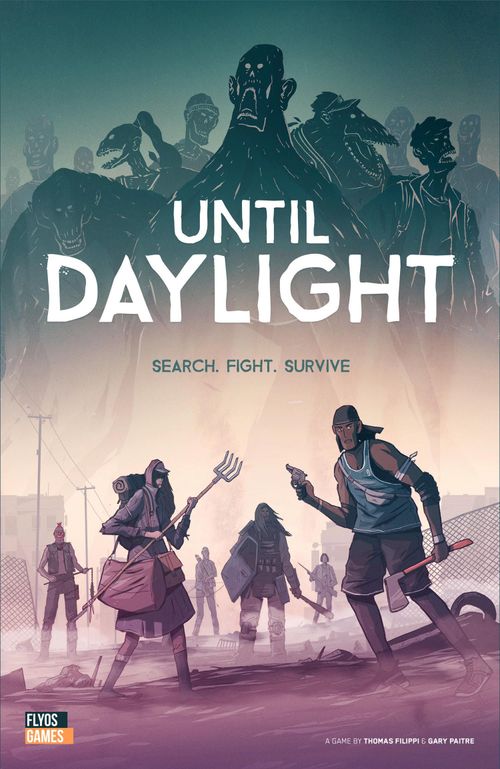
Until Daylight
Until Daylight Rulebook
Table of Contents
Table of Contents
- Search. Fight. Survive.
- What's in the Box?
- Game Setup
- Goal & How to Play
- Search Phase (This Phase Is Timed)
- Combat Phase (This Phase Is Not Timed)
- 1) The Release of the Hordes Cards
- Manage the Number of Hordes
- The Different Types of Hordes
- 2) The Character's Attack
- To Attack Enemies
- The 6-Dice Rule
- Resolution of Damage During the Characters' Attacks
- The Importance of the Distribution of Damage to Your Enemies
- At the End of an Attack, the Player Attacking
- Taming the Horde
- 3) The Enemies' Attack
- Last Round & End of the Game
- Icons Index
Search. Fight. Survive.
Until Daylight is a cooperative survival card game for 3 to 6 players.
Your goal: survive 10 waves of enemies and save at least 1 survivor.
During the game you can find and exchange objects, weapons and ammunition with other characters, build traps or barricades to protect yourself and ensure your survival as a group. Your reflexes, your sense of strategy and your ability to survive will be tested.
Every character you may embody is unique, has its advantage and drawback that will enhance the game with strong and intense moments. "Search, fight, survive" will quickly become your motto.
Your first games should be difficult, and you will probably die. Don't worry, this is normal, surviving the apocalypse is anything but easy. Every attempt will teach you a little more about mechanics and strategic priorities. In case of massive frustration, do not hesitate to refer to Billy's tricks.
Until Daylight is a game where every action counts and where time will be very cruel. In some phases, you will only have a few seconds to react before the horde falls on you.
The game is cooperative and will give you the opportunity to help your comrades in danger and allow you to request their support at the appropriate times.
To enjoy the best gaming experience, it is advisable to download the free Until Daylight app on your smartphone (www.untildaylight.com for more information). If you have stayed at Stone Age or if your phone is in repair, you can use the sandtimer provided in the box, but keep in mind that it will not provide you the most optimal gaming experience.
What's in the Box?
- 6 unique Character cards
- 18 Character's Objective cards
- 29 Secondary Objective cards
- 185 Rubble cards
- 95 Hordes cards
- 1 Die of Fate
- 6 Combat dice
- 12 Barricade tokens
- 6 Trap tokens
- 1 Sandtimer and a round tracker card
- 1 Leader token
- 1 Rulebook + 6 Craft & Play Guides + 1 First Time Play Sheet
Game Setup
1. Setting Up Elements
- Separate the character cards, characters' objectives and basic weapons from the other cards.
- Mix the hordes cards and have them on the side (let some space next to the hordes pile for the discard pile).
- Mix the rubble cards and dispose them in two equal piles at the centre of the table (let some space next to the rubble cards piles for the discard pile).
- Place traps and barricades near the hordes cards.
- Place the secondary objective cards at the centre of the table.
- Place the leader token next to the hordes cards.
Each character is unique and has:
- An Advantage.
- A Drawback.
- A different number of health points.
- The possibility to store 10 rubble cards (except the Haggler).
- A Basic weapon (the name of the character is written on the card).
Then proceed to:
- Mix the remaining Basic weapons cards with the rubble cards.
- Open the Until Daylight app on a smartphone, select the number of players and prepare to launch the first round. If you do not use the application, place the hourglass at the centre of the table. (You can use the round tracker card to help you follow the current round number)
- Start the first round with the app or by turning the sandtimer. The player who plays first is responsible of the sandtimer.
2. Choose a Character and Objectives
Each player rolls the 6 combat dice. Whoever obtains the highest number of head damage symbols wins (in case of equality, count the amount of body shots). Then the next player, in a clockwise manner, will play second and so forth.
The first player chooses a character, puts his damage wheel on NONE, puts his experience wheel on 0, takes his character's objective cards, picks 2 random secondary objective cards in the secondary objectives pile (keeps one and discards the other) and takes his basic weapon.
Goal & How to Play
To win a game of Until Daylight, all characters must survive one night (10 rounds) and save at least 1 survivor in total, during which they will be besieged by hordes of enemies.
You win the game if the following 3 conditions are met:
- All characters survived the 10 rounds.
- All enemies revealed in the game are eliminated.
- The group saved at least one survivor.
The game is immediately lost if:
- A character dies.
- No survivor is saved.
Experience Points and Group Leader Token
Until Daylight is a cooperative game. However, players may disagree on which strategy to adopt. In these circumstances, the group leader decides what action will be carried out for the party. The player with the most experience points (star icon) is the group leader.
Identify the leader by giving him the leader token.
To become the group leader, it is necessary to have more experience points than the current group leader. An equal amount of experience points does not allow you to become the leader.
You must have at least one more experience point than the current leader to become the new leader.
A player can earn experience points by:
- Finding Symbol items in the rubble cards.
- Stealing some specific rubble cards from other players.
- Eliminating some enemies in combat.
- Saving a survivor
- Achieving the character's objectives or secondary objective.
The scoring of experience points is done as soon as a player wins or loses an experience point and must be updated on the experience wheel of the character.
SYMBOL rubble cards give 1 experience point each. Although they increase the total of experience points while you have it, they each count as an inventory slot and can be exchanged, discarded or stolen (by pickpocket cards).
As the leader, a character's Advantage is doubled as long as he remains the leader.
Example: In the 5th round, the Psycho picks up a symbol card that gives him an additional experience point. He now has more experience points than the current group leader.
The Psycho immediately becomes the new group leader. He then takes the leader token and his character's advantage is doubled. The Psycho now has 2 extra dice when using a melee weapon, as long as he remains the leader.
Leader's responsibilities:
- The group leader rolls the combat dice for the enemies.
- At the beginning of the game, there is no group leader.
- If there is no group leader at the beginning of the first horde wave, it is the player who first chose his character who temporarily rolls the combat dice of the hordes.
Billy's Trick: A good leader will guide the group's overall strategy and lead you to victory. The group leader cannot impose an action on a player solely for his benefit. The leader can't stop a player from doing an action. Players are free. If Gary decides to steal Thomas' Sheriff's star to exceed the amount of experience points of the group leader, he won't be able to stop him. The group leader must convince other players of the benefits of his decisions. In case of a dispute, he's the one to look upon. The group leader is not the one who eats first, he's the one who makes sure everyone has something to eat.
Objectives
At the beginning of the game, players take their character's objective cards and choose one extra secondary objective (pick two, discard one). During the game, players will have the opportunity to achieve their objectives. When a player thinks an objective has been achieved, the player immediately announces it to other players. If the objective is indeed fulfilled, the player places his objective card face up near his character's card. The objective is then considered to be achieved. The player wins the amount of experience points indicated on the objective card achieved and update the experience wheel on his character's card.
Until Daylight Game Mechanisms
Until Daylight is played in 10 rounds. Each round is divided into 2 phases:
- A Search phase.
- A Combat phase.
Search Phase (This Phase Is Timed)
To begin the search phase, start the round in the app (a little music tells you that the round has started) or turn the sandtimer. The first character begins and may achieve one of the following actions:
-
Draw a rubble card, say out loud what was found and put the card in his inventory. (Each player can keep up to 10 rubble cards (face up) next to his character).
IMPORTANT: A player who would have more rubble cards than the maximum authorized must immediately discard the extra cards and can't do anything until this is done (he can't say "Next" either).
Throwing away rubble cards does not count as an action.
The red rubble cards (or events) have to be played immediately and completed before being able to say "Next".
-
Build a trap or barricade (if the player has the necessary rubble cards for the craft).
-
Give one of his rubble cards to another player.
-
Take one of the rubble cards from another player, with his explicit agreement. (Exchanges between players are always from one person to another, so it is not possible to take a card from a player and give it to another with a single action.)
-
Use a rubble card requiring an action, which triggers the effect of the card. (Example: consuming food)
-
Do nothing.
Once his action is done, the active player says "Next" to the next player who can also perform an action (draw a card etc.). The next player does the same, and so on, until the application music emits a gong or the sandtimer is empty. The last player who is caught playing while the search phase ends will receive the next horde wave.
Accumulate Ammunitions
Every player can keep up to 10 rubble cards (except the Haggler). A player can stock similar ammunition cards on the same inventory space.
Example: you can store gun ammo in the same place and count them as 1 slot in your inventory. However, stockpiling gun ammo and arrows would occupy 2 slots.
When a player gives some rubble card ammo, he may give the amount of ammunition cards he wishes, as long as they are of the same nature and are in the same slot.
When the application music emits a gong (or the sandtimer is empty), the search phase is over. If the active player had already picked up a rubble card, he keeps it. If he hadn't picked his rubble card when hearing the gong (or the sandtimer is empty) he can't draw a new card, life is unfair. The player interrupted at the end of the search phase will receive the next horde wave, the combat phase begins immediately.
Combat Phase (This Phase Is Not Timed)
The combat phase is divided into three successive parts:
- The release of the hordes cards
- The characters' attack
- The enemies' attack
1) The Release of the Hordes Cards
The leader adds the number of players in the party to the current game round number. If there isn't a leader yet, the first player who chose a character will temporarily assume the leader's duty. Then, the active player (the one receiving the hordes cards) rolls the die of fate and adds the effect. (The die of fate can add or withdraw one infected, add or withdraw a rubble card and add or withdraw one health point to the active player.)
The hordes cards are then disposed from left to right in an orderly manner and partially on top of one another.
Example: during round 3, the leader adds 6 (6 (number of players) + 3 (round number)), which means there will be 9 hordes cards during this phase. The die of fate effect then adds another infected to the horde. Therefore, the group picks the 10 cards and positions them in the active player's area.
Manage the Number of Hordes
In order to gain space in your combat zone, do not hesitate to organize the hordes cards by placing them one over the others. You will notice that the cards' info is visible on the right. You can combine your hordes cards as long as you don't alter their release order.
During the combat phase (you are not timed by the application or the hourglass), do not hesitate to communicate with other players to organize your actions and the group's strategy. I advise you to evaluate the situation once you know how many enemies you will face.
The Different Types of Hordes
There are 3 types of hordes cards: Raiders, Infected and Survivors.
Raiders are uninfected humans. They attack first during the enemies' combat phase and attack with 2 combat dice. 2 body damage or 1 head damage is needed to eliminate a raider. You must discard a card from your inventory (of your choice) for each damage that a raider causes you. You draw a rubble card when you eliminate a raider.
Infected are divided into three categories. All infected are attacking at the same time.
- Wanderers: 2 body damage or 1 head damage is needed to eliminate a wanderer. They attack with 1 combat die each.
- Brutes: 1 head damage is needed to eliminate a Brute. They attack with 2 combat dice each. You draw a rubble card when you eliminate a Brute.
- Monsters: 2 head damage are needed to eliminate a Monster. They attack with 3 combat dice each. You draw 2 rubble cards and win 1 experience point when you eliminate a Monster (you keep the Monster card near your character's card when you eliminate it).
Survivors. Mixed with the rest of the raiders and infected, survivors are harmless and not infected. They don't attack but can be eliminated by infected, or even players (a survivor who takes 1 damage point of any kind is eliminated). To win, your group will have to save at least one survivor throughout the game.
To rescue a survivor, players must eliminate all enemies in the same combat area and wait the end of the combat phase. A rescued survivor in a player's combat area is collected by that player. The saved survivor is now safe, and placed next to the objective section of the character. The survivor is now worth one experience point.
A player can attack a survivor (not yet saved). A player can sacrifice (discard) a saved survivor to absorb one additional damage. A survivor is extremely vulnerable since he is attacked first by the infected. He takes damage before barricades, special capacities, rubble cards or characters. When the hordes are in place, the characters may attack.
2) The Character's Attack
Starting with the first active player (whoever received the hordes wave) then clockwise, each player can perform one action:
- Attack enemies once with a melee or distance weapon. A player can throw a maximum of 6 dice during an attack (depending on the weapon or the amount of ammunition used). It is not possible to attack with a melee weapon in another player's area if your own area is occupied by 1 or more enemies.
- Build a trap or barricade (if the player has the necessary rubble cards for the craft).
- Give a rubble card to another player.
- Take another player's rubble card with his explicit agreement. Exchanges between players are always from one person to another, so it is not possible to take a card from a player and give it to another one with only one action.
- Use a rubble card requiring an action, which triggers the effect of the card. (Example: consuming food). Use one or more rubble cards that do not require any action. You can use all energy shots, vitality!, focus and lucky cards that you have, but only during your turn.
- Do nothing.
To Attack Enemies
During his turn, a player may decide to attack enemies (hordes) present on the table. For a clean play, players are advised to place the rubble cards used during each attack before them. These cards will be discarded at the end of the attack.
The player shall proceed as follows:
- Declare the rubble cards that will be used that will improve the effectiveness of the attack (focus, vitality!, bloodlust, etc.)
- Choose a weapon and ammunition amongst his inventory, then count the number of combat dice that will be used (6 combat dice maximum).
- Roll the combat dice and resolve the damages.
- Play additional rubble cards to modify the result of the fighting action (such as energy shot or lucky).
The 6-Dice Rule
Even if a player can afford it, they cannot launch an attack with more than 6 combat dice per attack.
Example: 7 gun ammo will only give you 6 attack dice.
All the rubble cards used are discarded at the end of the attack.
When the attack is over, if some damage has not been assigned to an enemy, it is discarded and cannot be used for another attack. An attacker can launch another attack if he has a rubble card that allows him to. In this case, the player launches a new attack using new rubble cards and follows the same procedure.
Resolution of Damage During the Characters' Attacks
Once the combat dice have been thrown, the player counts the damage caused to enemies.
- X (miss) = Failed attack. If you get an X while you attack enemies in another player's area with a distance weapon, the other player takes 1 collateral damage. (There is no collateral damage with melee weapons)
- Body = Causes 1 body damage. (you need 2 to cause 1 full damage)
- Head = Causes 1 head damage (cause a full damage)
1 head damage or 2 body damage eliminate a wanderer or a raider.
1 head damage is needed to eliminate a Brute.
2 head damage are needed to eliminate a Monster.
The player distributes damages to the enemies he attacks in the order of their appearance, starting with the first one on the left. If the first enemy is not eliminated by the damage caused by the character's attack, the attack will not go through and no damage can be spread over to the following enemies.
Example:
The player has 4 enemies in his area: 1 Raider (2 body or 1 head to be eliminated), 2 Wanderers (2 body or 1 head to be eliminated) and 1 Monster (2 head damages to be eliminated).
The player has a gun and 6 gun ammo.
After deciding to play all the ammunition cards available (to be as effective as possible) the player rolls 6 dice and gets: 1 X, 2 head damages and 3 damages to the body.
The player decides on the distribution of damage by respecting the order of enemies. All damage of an attack must be assigned even if they do not cause the elimination of their target.
Resolution:
With 2 body damage, the attacking player eliminates the first enemy: the raider.
With 1 head damage, the player eliminates the Wanderer who was right after the Raider. With the second head damage, the player eliminates the second Wanderer.
The remaining body damage is attributed to the Monster that does not suffer enough damage to be eliminated.
The Importance of the Distribution of Damage to Your Enemies
When players roll the combat dice and distribute damage to the enemies, they should respect the infected order in the horde. The attacker must eliminate the first enemy with the combat dice before moving on to the next enemy. If the damage eliminates the first enemy, the attacker distributes the remaining damage to the next enemy, and so forth until there are no more dice or enemies available. The attack stops when there is no more damage to spread on enemies.
Example of attack:
The attacking player has 10 enemies in his combat area: 1 Raider (2 body or 1 head to be eliminated), 1 Brute (1 head to be eliminated), 2 Wanderers (2 body or 1 head to be eliminated), 1 Monster (2 head to be eliminated), 2 Raiders (2 body or 1 head to be eliminated), 1 Wanderer (2 body or 1 head to be eliminated), 1 Monster (2 head to be eliminated) and 1 Brute (1 head to be eliminated).
The character has a gun card and 5 GUN AMMO.
Deciding to play all the ammunition available, the player rolls 5 combat dice and gets 5 body damage. The player distributes the damages, starting with the first enemy.
Resolution:
2 body damage go to the first enemy, the Raider, who is eliminated. The next enemy is a Brute (1 head to be eliminated). Unfortunately, with the remaining damages, the player can only assign 3 body damage and not a single head damage to the Brute that is not eliminated. The attack stops immediately.
At the End of an Attack, the Player Attacking
- Discards the Rubble cards used during the attack (except weapons marked as not discarded when used).
- Discards Wanderers, Brutes, Raiders eliminated during the attack.
- Places next to the character card the eliminated Monsters during the attack. These hordes cards give 1 experience point each.
- Counts his experience points and updates the experience wheel to see if he becomes the new leader. To do so, the player must have more experience points than the current group leader. If that is the case, the player takes the group leader token and his Advantage is doubled.
At the end of each attack, the remaining damage to the enemies is reset. It is not possible to combine damage on a single hordes card with multiple attacks.
Example: the attacking player just carried out an attack in its own area and eliminated all the enemies before him. The attacking player still has 2 body damage not assigned and wants to launch another attack in a different combat area, which is not possible. A player can only attack one area at a time.
At the end of each attack, the combat dice are reset to 0.
Taming the Horde
Infected (not raiders or survivors) are sensitive to noise and the characters' presence.
A character using a firearm or attacking with a melee weapon in another player's area will attract a number of infected in his own area.
Once the attack(s) has been resolved, the player who attacked in another player's area with a firearm or a melee will attract the same number of eliminated infected (the first of the pile) to his own area.
Example: 3 characters playing. It's the second player's turn and has no infected in his zone. The player decides to attack with a gun in the first player's zone, containing 6 infected.
Player 2 launches the attack, solves damages and eliminates 2 infected.
At the end of the attack, 2 of the 4 remaining infected in player 1's area move to player 2's area.
Reminder: it is not possible to attack with a melee weapon in another player's area if you have enemies in your own area.
3) The Enemies' Attack
Once all the players have played their attack turn, the enemies attack.
Starting with the first active player (the one who received the hordes wave and played the first attack), the enemies present on the table attack clockwise. Raiders attack first, infected second. The group leader rolls the combat dice for the enemies.
Damage Order
Damages are taken in this specific order:
- Survivor
- Barricades
- Protection Rubble cards
- Characters
Traps
During the game, players can build traps to eliminate enemies who sweep in their area. The effects of traps are resolved immediately, before the enemies attack. A trap causes 1 head damage to the first enemy in the character's area. A trap eliminates the first enemy (raider or infected) who attacks. The trap token is then moved back into the traps pile near the hordes pile.
Example: round 4, release of the hordes. 5 enemies are in the active player's area who has one trap set up. The first enemy is a Brute. When the horde is about to attack, the Brute is immediately eliminated by the trap. If the enemy had been a Monster, the trap would have caused it only 1 head damage, which would be insufficient to eliminate it. The trap is discarded nonetheless.
Barricades
During the game, players will be able to build barricades to protect themselves from the enemies' attacks. When an enemy attacks, the barricade will take the first damage (after the survivors), protecting players for a moment. The effects of the barricades are resolved first in the allocation of damage during the attack of enemies.
A barricade is destroyed if it receives: 2 body damage or 1 head damage.
The barricade token is then moved back into the barricades pile, near the hordes pile.
Example: Attack of enemies. The active player has two barricades in his area.
The enemies who attack are in order: 1 Monster (3 combat dice) and 1 Brute (2 combat dice). The leader draws 5 combat dice, he gets: 1 X and 4 body damage.
The first 2 body damage destroy the first barricade. The other 2 body damage destroy the second barricade. Both barricades are discarded.
Rules of Protection Token
During the game, the players can build traps or barricades to protect themselves from enemies. A player can only build and have at the same time a total of 2 tokens (traps or barricades).
Begin the Enemies' Attack
The group leader studies the composition of enemies and rolls 6 combat dice at a time. The 6-dice rule also applies here.
Raiders perform their attack first. Raiders don't attack survivors, which they consider useless. However, survivors are not immune to raiders collateral damages. The leader rolls 2 combat dice for each raider attacking.
- X = failed attack to the player. 1 collateral damage, which eliminates a Survivor.
- 2 body damage cause 1 damage to the player attacked, which also discards a rubble card from his inventory.
- 1 head damage causes 1 damage to the player attacked, which also discards a rubble card from his inventory.
Example of a Raider's attack: a character has 4 Raiders in front of him (2 combat dice per raider).
The leader rolls the first 6 combat dice and gets 3 X and 3 body damage.
The player attacked takes 1 point of damage and discards one of the rubble cards in its inventory, the two survivors in the player's zone are eliminated.
The group leader launches the second Raider's attack: 2 combat dice for the last Raider.
The player gets: 1 head damage and 1 body damage. The player attacked takes another point of damage and once again throws away one of his inventory's rubble cards.
The Infected Are Attacking Next
The infected are attacking the survivors before the players. The infected are attacking in order and by waves of 6 combat dice. The damage resolution is immediate.
- X = failed attack.
- 2 body damage = cause 1 damage.
- 1 head damage = causes 1 damage.
Example of an infected attack: a player has 6 Wanderers (1 combat die per Wanderer), 2 Survivors, 1 Monster (3 combat dice by Monster) and 2 Brutes (2 combat dice per Brute) in his zone. 6 + 3 + 4 = 13 combat dice.
The group leader rolls the first attack of the infected (6 combat dice). The leader gets: 2 X, 2 head damage and 2 body damage. The breakdown of damage is thus: the 2 head damages eliminate both survivors (their cards are therefore discarded in the hordes discard pile). The remaining 2 body damage hit the player, resulting in the loss of 1 health point.
The group leader rolls the second attack of the infected: 6 combat dice. The leader gets 2 X and 4 body damage. The player attacked takes 2 damage points.
The group leader rolls the third and last attack of the infected: 1 combat die. He gets 1 X. No additional damage.
End of the Round
When all enemies present on the table have launched their attack, it is the end of the round. If any survivor is still alive and alone in a combat zone (no enemy left), the survivor is saved by the player.
Then, a new round may begin. Enemies still present on the table remain where they are and will cumulate with the next hordes wave.
The player starting this new round is the one who plays right after the last active player (whoever next to the player that received the hordes wave).
Last Round & End of the Game
In Until Daylight, the first 9 rounds are held in the order set out in these rules. However, the last round is different from the previous ones: it's the end. The final fight.
In the 10th round, players start with their search phase and draw the hordes cards when the application music emits a gong (or the hourglass is empty).
Once the enemies are in place, the final fight begins. Players and enemies will launch their attacks until one of the two camps loses the fight.
During the final round:
- Complete one search phase.
- Draw the horde cards.
- Players attack enemies
- Enemies attack players
Both parties keep on fighting until the game ends. (No more search phases)
During the final battle, the players win if these 3 conditions are met:
- All Players are alive.
- The group saved at least one survivor.
- All the enemies revealed have been eliminated.
Icons Index
Combat Dice
- Head: 1 head damage, considered a full damage.
- Body: 1 body damage (need 2 to do a full damage).
- X (miss): Attack failed. 1 Collateral damage if used in another player area with a distance weapon. Eliminate 1 survivor if drawn by a raider.
Die of Fate
- Remove 1 enemy in the upcoming horde wave.
- Add 1 enemy in the upcoming horde wave.
- Choose and discard 1 of your rubble cards.
- Draw 1 additional rubble card.
- The active player can heal one damage.
- The active player takes 1 damage.
Rubble Cards
- Combine two cards to craft a specific item or attack.
- Supply characters with health regeneration.
- Item not discarded when used.
- Convert one body damage into one head damage.
- Experience point(s).
- No action required to use this card during your turn.
- Bad luck event: has to be played immediately.
- Noise attracts infected in a specific area.
- Number of combat dice available. (Similar ammunition can be combined).
- Number of headshots required to be eliminated.
- Amount of Rubble cards to draw or to discard.