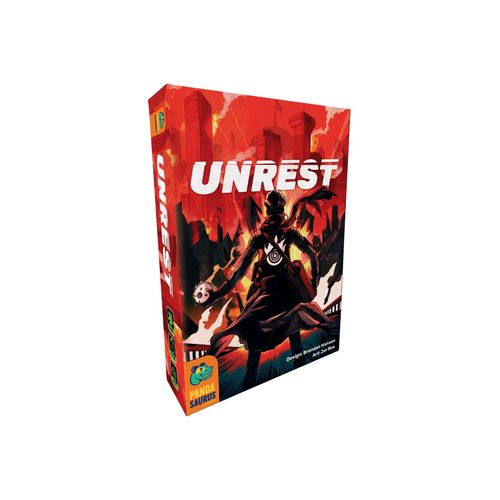
Unrest
Unrest Rulebook
Table of Contents
Table of Contents
Setup
- Choose which player will be the Rebellion and which will be the Empire. (For example, the player who most recently broke a rule plays as the Rebellion.)
- Place the 5 District tokens (Ministry of Plenty, Ministry of Peace, The Capitol, Police Headquarters, and the Ministry of Truth) randomly between the two players in a row, face up.
- Shuffle the Rebel deck and place it face down in front of the Rebellion. The Rebellion draws 5 cards from this deck for their starting hand. The Rebellion should not reveal these cards to the Empire.
- Place the 4 Empire Power tokens (Blockade, Reroute, Destroy, and Surveil) face up in front of the Empire.
- Give the Area of Interest token to the Rebellion.
- Place the Revolution Mission card face up next to the District tokens. Shuffle the rest of the Mission cards and randomly deal three of them, face up, beneath the Revolution Mission. Return the rest to the box.
- During the game, destroyed cards and liberated Districts will be placed to the side of the play area. These cards will not be accessed for the remainder of the game, but both sides can see revealed cards and the Rebellion can look at any hidden cards.
Key Terms
Throughout the game, Rebel cards will be in one of two positions, hidden or revealed. The Empire can target both hidden and revealed cards, but until the hidden card is revealed, they are only guessing what it might be.
- Hidden (face down): When a card is hidden, the Rebellion can peek at the card at any time, but the Empire cannot look at any Rebel card that is not revealed.
- Revealed (face up): When a card is revealed, it is turned to its face up position, allowing both players to easily see it.
- Destroy: Remove a Rebel card and place it to the side of the play area. Keep its position (revealed or hidden) the same.
Components
- 5 District tokens
- 24 Rebel cards
- 11 Mission cards
- 4 Empire Power tokens
- 1 Area of Interest token
- 2 Reference cards
Objective
If the Rebels build stacks of cards that complete Missions in 3 or more Districts, they claim victory and the Empire is destroyed. If the Empire prevents this, maintaining control of 3 or more Districts until the game ends, the Empire's reign continues and victory is theirs.
Gameplay
Each round, take the following steps:
-
The Rebellion chooses which Districts to target. The Rebellion selects two adjacent Districts and marks them with the Area of Interest token. Place the token in between the two Districts.
-
The Rebellion plans their operation. The Rebellion selects three cards from their hand and places them behind the Area of Interest token. They must place two cards hidden (face down) and one revealed (face up). Misdirection cards must always be placed hidden.
Example: The Rebellion has marked the leftmost two Districts and placed three cards, which comprise their current plans. Two cards are hidden and one is revealed.
-
The Empire defends the Districts. The Empire will now take two actions. First, they select one of their face up Empire Power tokens and take its action (see "Empire Powers" below for a description of each action). Flip the token to show that it has been used. Then, the Empire repeats these steps with a different face up Power token.
-
The Rebellion executes their operation. The Rebellion must now decide where to place any of the remaining cards behind the Area of Interest token (they could place all cards in one District, or split the cards between two Districts). Keep the position of all cards the same (hidden cards remain hidden, revealed cards remain revealed). The Rebellion may not place any cards in a District with a Blockade (see "Empire Powers" below).
-
The End of the Round. After the Rebellion has placed their cards, take the following steps to end the round:
- The Rebellion checks to see if any Districts have been liberated. See "Missions + Liberating Districts" below for more details.
- If all of the Empire Power tokens are face down, flip them all to their face up side. If only two are face down, leave them face down, as the Empire will only have access to the two face up tokens in the next round.
The Final Encounter: If there are not 3 cards remaining in the Rebel deck, the Rebellion draws the last remaining card. This means that the next round is the Final Encounter, the last round of the game.
During The Final Encounter, the Rebellion does not place the Area of Interest token. They play their three cards as usual but, after the Empire takes their actions, the Rebellion may move the remaining cards to any unliberated District(s).
Game End
If the Rebellion liberates 3 Districts at any time during the game, the game immediately ends and the Rebellion wins. Otherwise, rounds continue until all cards in the Rebel deck have been played. Finish The Final Encounter round. If the Empire still has control of at least 3 Districts, they win the game.
Missions + Liberating Districts
In order to liberate a District, the Rebellion must build a stack of cards in that District that meets all of the conditions shown on one of the four Mission cards on the table (including the Revolution). Cards added to a District will remain in that District for the remainder of the game. On subsequent turns, the Rebellion may add cards to the stacks that are already in each unliberated District, so it is possible (and often necessary) to spend several turns to complete a Mission in a District.
For example, to complete the Civil Disobedience Mission (the total Upheaval value is 8 or more and there are no Disruption cards), the value of Upheaval cards in a District must total 8 or more and no Disruption cards may be present in the same stack.
Liberating a District using a Mission card does not prevent the Rebellion from using the same Mission card to liberate other Districts, as long as all the conditions are met in each District. It is also possible to liberate more than one District in a single round.
When a District is liberated, take the following actions:
- The Rebellion immediately reveals enough cards to prove to the Empire that the Mission card's conditions have been met (they do not have to reveal more cards than necessary).
- Flip the liberated District's token.
- Take the District token and all the cards stacked below it and place them to the side of the play area so that all players can see any revealed cards in that stack (the Rebellion can still look at the hidden cards as well). No additional cards may be added to a liberated District for the remainder of the game.
- The Districts that were previously adjacent to the liberated District are now themselves adjacent.
Rebellion Cards
The Rebel deck includes cards valued 2-6 in four different suits (Intelligence, Upheaval, Disruption, and Supplies) as well as four Misdirection cards.
The numbered Rebel cards can be used in various ways to complete Mission cards. Misdirection cards don't have values or suits and cannot aid in completing Mission cards, but may be used by the Rebellion to trick the Empire into wasting actions on those cards. Misdirection cards must be played in a hidden position (face down) by the Rebellion.
Throughout the game, any cards revealed by the Rebellion or "surveilled" by the Empire (see Empire Powers below) will stay revealed for the remainder of the game.
If the Empire destroys a card, place it to the side of the table and keep its position (revealed or hidden) the same. Make sure that both players can see all revealed cards.
Misdirection cards are slightly different. If a Misdirection card is destroyed, the Rebellion reveals it immediately. If a Misdirection card is surveilled, destroy it after revealing it.
Empire Power Tokens
On the Empire's turn, they must take two of the actions below to affect the three cards played by the Rebellion this round. The Empire may choose to take both actions on one card, or one action each on two cards. The Empire cannot target cards that are already stacked in a District.
After taking the action, flip over the corresponding Power token to show that the action has been used. The Empire must take all four actions (over the course of two rounds) before they can flip their Power tokens back to the unused side and gain access to them again.
- Surveil: Reveal a hidden Rebel card of your choice.
- Destroy: Select a Rebel card of your choice and place it to the side of the play area. Keep its position (revealed or hidden) the same, unless it is a Misdirection card. Misdirection cards are revealed when destroyed.
- Reroute: Place a Rebel card of your choice into any District. Keep its position (revealed or hidden) the same. You cannot place a card in a liberated District.
- Blockade: Choose one District to Blockade. No cards may be placed into that District by the Rebellion this round. Place your Blockade token on top of the District for the remainder of the round.
Play Sample
- The Rebellion places the Area of Interest token between the two rightmost Districts. They then choose 3 cards from their hand of 5. They play two cards hidden—the 5 of Disruption and the 2 of Intelligence, and one card revealed—the 3 of Supplies.
- The Empire then decides to Surveil. They reveal the Intelligence card. They use their second action to Reroute the 3 of Supplies to the leftmost District.
- The Rebellion places the 2 of Intelligence and the 5 of Disruption in the rightmost District. Because there was already a 3 of Intelligence hidden in that District, they complete the Espionage Mission and liberate that District.
- They then remove the liberated District and all cards beneath it to the side of the play area. All cards maintain their position (hidden / revealed) and are kept with the liberated District. The Rebellion draws 3 cards from their deck for the next round.
- The Empire has access to their Destroy and Blockade actions in the next round.
Mission Card Reference
- Revolution: The stack of cards must have a total sum of 21 or more.
- Political Surge: The stack must include 3 or more revealed cards of any one suit. Example: The stack contains three face up Intelligence cards (2 of Intelligence, 3 of Intelligence, and 4 of Intelligence).
- Fortified Organizers: The stack must include a higher total sum of Disruption cards than Supplies cards and the total sum of Supplies cards must be more than 3. Example: The stack contains 6 of Disruption and 3 of Supplies or 4 of Disruption, 5 of Disruption and 5 of Supplies.
- Coup: The stack must include at least one card of each suit (Intelligence, Disruption, Upheaval, and Supplies).
- Coordinated Plot: The stack must contain three or more cards of one value. Example: The stack contains 5 of Intelligence, 5 of Supplies, and 5 of Upheaval.
- Sleeper Cell: The stack must contain a run of four or more consecutive value cards (they do not have to be the same suit). Note: 6's and 2's are not considered consecutive. Example: the stack contains 3 and 4 of Supplies, 5 of Intelligence, and 6 of Upheaval.
- Espionage: The total Intel value is 4 or more and the total Disruption value is 4 or more.
- Energized Press: The total Intel value is more than the total Upheaval value and the Upheaval value is 3 or more.
- Civil Disobedience: The total Upheaval value is 8 or more and there are no Disruption cards.
The Capitol Variant
The Capitol variant is more challenging for the Empire player. To play this variant, add the following rules (we don't recommend playing your first game with this variant):
- Place the Capitol District in the center, with two Districts on each side.
- If the Rebellion liberates the Capitol District, they win the game immediately.
- The Revolution Mission in the Capitol requires a total sum of 25 or more (instead of 21 or more).