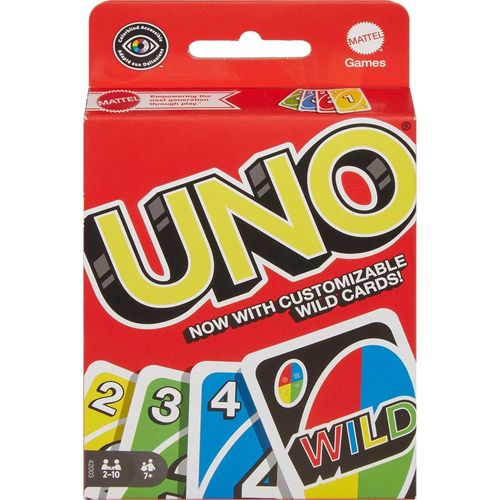
UNO
UNO Rulebook
Table of Contents
Table of Contents
Object of the Game
Be the first player to score 500 points, earned by being the first to get rid of all the cards in your hand in each round and collecting points for the cards your opponents are left holding.
The Deck (108 cards)
- Number cards: in four colors (red, yellow, green, blue). Each color has one 0 and two each of 1–9 (76 cards total).
- Action cards: in each color, two Skip, two Reverse, and two Draw Two (24 cards).
- Wild cards: four Wild and four Wild Draw Four (8 cards).
Setup
Each player draws a card; the player with the highest number is the dealer (count action/wild cards as zero for this). The dealer shuffles and deals 7 cards to each player.
Place the rest of the deck face down as the Draw Pile. Turn the top card over to start the Discard Pile.
- If the first turned card is a Wild Draw Four, return it to the deck and pick another. Other action cards flipped as the first card take effect (see "Starter Card" below).
Play begins with the player to the dealer's left and normally proceeds clockwise.
Playing
On your turn you must play one card from your hand that matches the top card of the Discard Pile in one of these ways:
- By color, or
- By number, or
- By symbol (Skip on Skip, etc.), or
- Play any Wild or Wild Draw Four (which may be played on anything).
If you have no playable card, you draw one card from the Draw Pile. If the drawn card can be played, you may play it immediately; otherwise your turn ends and play passes on. (You may also choose to draw even when you have a playable card, but then you may only play the drawn card, not another from your hand.)
Action Cards
- Skip: the next player in turn is skipped (loses their turn). If turned up as the starter card, the first player is skipped.
- Reverse: reverses the direction of play (clockwise ↔ counter-clockwise). If turned up as the starter card, the dealer plays first and play proceeds to the dealer's right. In a two-player game, Reverse acts as a Skip.
- Draw Two: the next player must draw 2 cards and forfeit their turn. If turned up as the starter card, the first player draws two and is skipped.
- Wild: play it on any card; the player who plays it chooses which color continues play (it may be a color already in play). If turned up as the starter card, the player to the dealer's left chooses the color and plays.
- Wild Draw Four: play it on any card; you choose the color to continue and the next player must draw 4 cards and forfeit their turn. Restriction: you may only play this card when you have no other card in your hand matching the color of the current top card (you may still hold matching numbers or Wilds). See Challenge below.
The "UNO" Call
When you play your second-to-last card — leaving you with just one card — you must call out "UNO!" If you fail to say "UNO" and are caught by another player before the next player begins their turn, you must draw two cards as a penalty. (If you are not caught before the next player takes their turn, no penalty applies.)
Challenging a Wild Draw Four
A player targeted by a Wild Draw Four may challenge it, believing it was played illegally (i.e., the player had a matching-color card):
- The challenged player secretly shows their hand to the challenger.
- If guilty (they did have a matching-color card), the challenged player draws the 4 cards instead.
- If innocent (the play was legal), the challenger must draw the original 4 cards plus 2 more (6 total).
Going Out and Scoring
The round ends the moment a player plays their last card. That player scores points based on the cards still held by all opponents:
| Card | Points |
|---|---|
| Number cards (0–9) | Face value |
| Draw Two, Reverse, Skip | 20 each |
| Wild, Wild Draw Four | 50 each |
- Special rule: if the last card played to go out is a Draw Two or Wild Draw Four, the next player must still draw those cards; those cards are counted toward the winner's score.
- You may not go out on a Wild Draw Four unless it is your only legal play (per the restriction above).
Add up the values of all opponents' cards and give the total to the winner of the round. Deal a new round. The first player to reach 500 points wins the game.
Two Alternative Scoring Methods
Some play instead by keeping score of the points each player is left holding at the end of a round (adding to that player's total), with the first player to reach 500 being the loser. Either way, one round ends when a single player has emptied their hand.