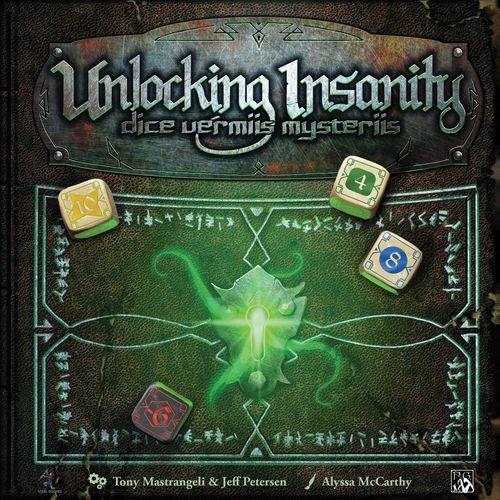
Unlocking Insanity: Dice Vermiis Mysteriis
Unlocking Insanity: Dice Vermiis Mysteriis Rulebook
Table of Contents
Table of Contents
Gameplay Overview
In Unlocking Insanity: Dice Vermiis Mysteriis, each player is trying to place dice results as efficiently as possible. Every turn, you must place a positive die result (your mastery of the indoctrination training) and also negative dice results (your growing madness). The game ends after someone fills up all of their positive or negative spaces. Your positive scores (from each positive row) are subtracted from your negative scores (from your negative brain spaces) and the player with the highest overall score wins.
Components
- 5 "positive" six-sided dice in 5 colors with sides: 4, 6, 6, 8, 8, 10
- 5 "negative" six-sided dice in 5 colors with sides: -2, -4, -4, -6, -6, -8
- 1 pad of brain sheets
- 5 pencils
- 25 Regular Insanity cards (5 per insanity color)
- 5 First to Insanity cards (1 per insanity color)
- 1 Rulebook
- 1 Bag
Setup
Each player takes a brain sheet and a pencil. The 5 positive dice are placed in front of the first player, who will be the first Active Player. The first Active Player is the last person to have joined the Cult of Cthulhu (or else chosen randomly). The 5 negative dice are placed in the bag (to be drawn randomly). Place the cards in the center of the table, sorted by type.
Gameplay
The game takes place over a series of rounds. Starting with the first Active Player and continuing clockwise, each player takes a turn in the following manner. The player with the dice is considered to be the Active Player.
- The Active Player checks their brain sheet to see if any of the colored areas on their brain sheet has a larger negative value (i.e. in the shapes inside the brain) than the matching color's positive value (i.e. in the cloudy spaces outside of the brain). If so, they go insane in that color (see Insanity below). Example on the brain sheet: at the start of Caleb's turn, he has a total value of 16 in the Yellow Area outside the brain. Inside the yellow area in his brain he has a total value of -18. Since the negative value is greater than his positive value, he goes insane in yellow.
- The Active Player chooses two of the positive dice and rolls them. NOTE: The Active Player must roll at least 1 die that will produce a result they are able to use.
- All players then select one of the two results to record in a positive space on their brain sheet. The result of the chosen die must be placed in a space matching the die's color (i.e. results from a purple die are marked in a positive space that correlates to that purple die, as indicated by the lines pointing to the different brain areas). If a player cannot use either positive result, then they may write nothing, or optionally place a "2" result in any available positive space.
- Next, the Active Player randomly draws a negative die from the bag and rolls it. All players must record this result in the matching negative brain space and an adjacent brain space. The adjacent brain space need not be the same color. Adjacent brain spaces are connected by hashed lines.
- If a player cannot place either negative die result in a brain space (because all spaces of those colors are filled), they must cross out an empty positive space of the matching color. If those are all filled, with numbers or by being crossed out, then cross out a positive space of an adjacent color. If they are still unable to cross out a space, continue through to all 5 colors until an empty positive space is able to be crossed off. If all positive spaces are full, then nothing happens. NOTE: If a player can't place both of the negative results, they still only cross off one positive space.
- The negative die used is set aside and the rest of the dice (all positive and remaining negative) are passed clockwise to the next player, who becomes the new Active Player.
NOTE: If there is only 1 negative die remaining to be passed, then all 5 negative dice are passed to the next Active Player.
Insanity
At the start of the Active Player's turn, if any of the colored areas on their brain sheet has a larger negative total value than its matching color's positive total value (i.e. -8 > 4), they go insane in that color (see the example on page 4).
When going insane in a color, take an Insanity card of the matching color. If you are the first player in the game to go insane in that color, also take the First to Insanity card of the matching color.
- The First to Insanity ability grants an immediate bonus of rolling one negative die of the insane player's choice. All other players must place the result in a brain space of the matching color. NOTE: Only one space is filled, and not an adjacent space as occurs in a normal turn. If all negative spaces of the matching color are full on a player's brain sheet, then nothing happens for that player. NOTE: The die used for the First to Insanity immediate bonus can come from either the available negative dice or the ones set aside. It should be returned to the same place after the roll is recorded.
- The "once per game" bonus can be used whenever the player desires, even on another player's turn.
While insane in a color, that player suffers the penalty listed on the card.
Losing Insanity
At the start of an insane Active Player's turn, if the positive total value in a colored area in which they are insane is now larger than the negative total value (i.e. 6 > -2), they are no longer insane in that color. They return their Insanity card to the center of the table and no longer suffer the penalty.
Target Bonuses
Every color has a target bonus for positive results (in the dark space at the end of each positive row). If the results for a positive row total exactly that number, then that player scores double for that row.
NOTE: Negatives are not considered when totaling for the bonus.
NOTE: If a player hits the 2x bonus target during the game, they gain the 2x bonus immediately, which may affect their insanity status during the check at the start of their next Active Player turn. To gain the 2x bonus, the entire row of positive spaces must be full, whether it be with numbers or X's from crossing some out.
Example: On Emily's brain sheet, the purple section has a target number of 24. The row starts with an 8, so if the results of a 4, 6, and a 10 are added to the row (top), her total score for the row would be 28. However, if she instead recorded results of a 4, 6, and 6, her total score for the row would be a 24, matching the target number, which doubles the row score to 48.
End of Game
The game ends at the end of any player's turn when any player has filled up all of their positive spaces (most likely) or negative spaces on their brain sheet. At that point, all players total their scores for each section by:
- Adding up the total positive score for each color and recording them in the boxes at the bottom of the sheet.
- Adding up the total negative score for each color and recording them in the boxes at the bottom of the sheet.
- Sum the totals in the boxes at the bottom of the sheet.
The player with the highest total score is the winner. In case of a tie, the player with the most total positive spaces filled (with numbers) is the winner. If players are still tied, the player with the overall highest positive score (ignoring negatives) is the winner. If still tied, the tied players share the victory and must work together to mock the losing players.