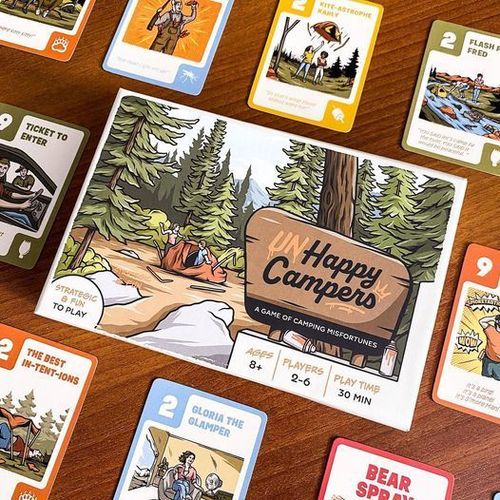
Unhappy Campers
Unhappy Campers Rulebook
Table of Contents
Table of Contents
Components
The rulebook's page 3 is headed "Contents" and lists the components; they are transcribed here.
- Playing Cards (100):
- 12 Numbered Cards (2 - 13)
- 24 Cards in each color
- 4 Colors
- 4 Wild Cards
- Campfire Cards (25):
- Used for tracking player's extra points
- Action Cards (26):
- 7 Different Actions
- Used for causing chaos or gaining an advantage
- Campsite Cards (15):
- 2 Points (x5)
- 3 Points (x5)
- 4 Points (x5)
How to Play
The objective of the game is to build as many campsites and earn as many points as you can before they are all taken.
Campsites are cominations of cards built by using sets, runs, or a specific combination of cards.
A set is at least three of the same numbered card of any color.
A run is at least four cards of any color in a numbered sequence.
Note: The lowest card in a run is 2 and the highest is 13.
To win the game, you must be the camper who has earned the most points by the end of the final round. We recommend playing 5 rounds, but your group can decide to play more or less. During each round, a player's main objectives are as follows:
Round Objectives
- Collect the right cards to claim a campsite.
- Complete your campsite by playing additional cards.
- Go out by getting rid of the remaining cards in your hand to end the round.
Player Turns
-
At the beginning of each turn, the player must first draw 1 or 2 cards (their choice) from the deck OR draw 1 card from top of the discard pile, but not both.
-
Next, the player can:
- Claim a campsite(s)
- Play one action card
- Squat on other campsites
- Swap for wildcards
The player can do as many moves as they want before discarding, but can only play 1 action card per turn.
-
Lastly, the player must discard any 1 card from their hand to end their turn.
Note: Action cards and other cards played during your turn do not count as a discard, though you may discard an unwanted action card.
Setup
Decide on how many rounds you want to play (we suggest 5 rounds). At the beginning of the game, shuffle the deck of playing cards and actions cards, keeping the campsite cards separate. Place the remaining playing cards (face down) in the center of the table and place 1 card (face up) next to the deck. This is the discard pile.
Choose the happiest camper as the camp host (dealer). Have them deal 7 playing cards (face down) to each player. Players can immediately look at their own hands. Randomly choose 1 campsite card per player, plus an additional campsite card, and set them standing up (using the plastic holders) at the center of the table. This is the campground - now the race is on to find the best spot!
Building Campsites
There are 15 campsite card combinations that can be built throughout the game. The top right number shows the point value for that campsite. The more difficult the combination, the more points that card earns.
The "PRIMITIVE" description explains the minimum combination a player needs to claim that primitive campsite (only 1 point).
The "COMPLETE" description explains the minimum combination to complete that campsite (full points if you go out).
The rulebook's example campsite card shows: Primitive "4 CARDS OF THE SAME COLOR", Complete "7 CARDS OF THE SAME COLOR", worth 3 points.
Claiming Campsites
A player's first objective each round is to claim a campsite. During their turn, a player can claim a campsite only when they have met the correct primitive campsite requirements described at the upper left side of each campsite card. They do this by laying those cards face up in front of them, grabbing that campsite card, and placing it in front of their played cards. Players can try to build more than 1 campsite each round if they want to earn more points.
Note: Campsites are first-come, first serve. If a player wants a certain card, they must claim it first or attack and steal it from a player later!
The rulebook's examples show these campsite cards:
- Worth 2 points: Primitive "1 SET OF 3 OR 1 RUN OF 4"; Complete "1 SET OF 3 AND 1 RUN OF 4".
- Worth 2 points: Primitive "2 SETS OF 3"; Complete "3 SETS OF 2".
- Worth 3 points: Primitive "1 RUN OF 4"; Complete "2 RUNS OF 4".
Once a player has claimed a primitive campsite, their goal is now to build the complete campsite. To do this, the player continues to add additional cards to their primitive campsite until it meets the requirements of the complete campsite. After a player builds a complete campsite, they can then try to go out (run out of cards to end the round), OR they can continue trying to build additional primitive or complete campsites. A player cannot go out without first building at least 1 complete campsite.
Note: Separate sets, runs, and combos must be laid out separately on the table.
The rulebook's examples: a primitive campsite of "1 Set of 3 or 1 Run of 4" (for example 5-5-5), and a complete campsite of "1 Set of 3 and 1 Run of 4" (for example 5-5-5 plus 4-5-6-7).
Squatting
Once a primitive or complete campsite has been played on the table, other players can squat if their card(s) fit in natural sequence by placing their card(s) on that campsite. For example:
If other players decide to squat on your campsite during their turn, you'll receive a fine. For each squatter that an opponent plays on your campsite, you must pick up 1 card from the top of the deck. You can squat on your own campsite without receiving a fine.
Squatting is useful for getting rid of excess cards and preventing other players from going out and ending the round. But be careful! It can also help your opponents complete a campsite.
The rulebook's example shows a squatter card callout reading "+1 cards per squatter".
Ending Rounds & Scoring
After a player has completed a campsite, they can end the round by going out (getting rid of all the cards in their hand). Once a player goes out, the round ends immediately. Players do not need a final discard to end the round.
Once the round has ended, the player who goes out keeps their completed campsite card(s) and earns the full points (2, 3, or 4 points). Any additional primitive campsites played are awarded a separate campfire point card.
All the players who did not go out receive one campfire point card (worth 1 point) for each complete or primitive campsite built. They must return all their campsite card(s) back to the campground.
The rulebook's example shows a 3-point campsite card with a "+3 points" callout.
Starting New Rounds
After each round ends, gather all the playing cards and reshuffle the deck. Place the unclaimed campsite cards at the bottom of the campsite card pile and then draw new ones, making sure you again have 1 campsite card per player, plus 1 additional campsite card. The camp host (dealer) switches to the next player on the left. Have the new host set up the next round by dealing out 7 cards to each player and placing the deck at the center once again with 1 card face up for the discard pile.
Special Moves
Once a player has played a primitive campsite, they can freely move, swap, or split their cards for strategic purposes. For example, a player might want to split a run of 10 into a run of 6 and a run of 4, so that they can claim or build an additional primitive campsite. Or a player may simply want to swap out a blue card for a yellow one. Keep in mind, a set/run/combo can only be applied towards one campsite card.
Wilds & Swaps
There are 4 wild cards in the deck noted by a "W" in the top left corner of the card. These cards can be assigned any color or number 2-13 that the player would like. They can be used to complete any campsite combination or to squat on any campsite.
During their turn, a player can gain a wild card by swapping a card in their hand for a wild card that has been played in a player's campsite (or their own) if it fits in that sequence. For example, if your opponent has a wild within the run below, you can swap it with your 7 and take that wild card.
Action Cards
Action cards are used to sabotage other players or gain an advantage in the game. Once a player uses an action card, they are placed in the discard pile, however, it does not count as the player's discard. (You may discard an action card unplayed) Only 1 action card can be played each turn, so use them wisely!
-
Bear Attack (8):
Use this card to steal any camper card from the outside edge of a full or primitive campsite. If that player's campsite then falls below the minimum requirements for their primitive campsite, that player must return their campsite card back to the campground (middle of table), unless they can replace the card with one from their own hand. If a player's campsite is destroyed, they must pick up their leftover cards, and can try again for a campsite on their next turn.
The card text reads: "Steal any card from the outside edge of a campsite." The rulebook notes: You can only steal cards on outside edge.
-
Bear Spray (4):
Deny any action card or squat from another player. This card can be played at any moment, so be alert for those bears!
-
S'mores (4):
Have s'more cards! Starting with the player who played the action card, all players grab 2 cards from the top of the deck, going clockwise.
-
Roasted (4):
Skip any player for their next turn.
-
Go Fishing (2):
Ask a player for one specific or non-specific card (e.g. "Got a blue card?") If that player has the requested card, they must hand it over. If that player doesn't have the requested card, they can tell you to "Take a hike!"
-
Lost Camper (2):
Have all players hand 1 card of their choice over to the player on their left.
-
Trash Panda (2):
Grab any one of the last 5 discarded cards.
Campsite Cards Note
The rulebook does not print the requirements of all 15 campsite cards in its text. Each campsite card shows its own primitive and complete requirements on its face, and the point value in the top right. The examples in the rulebook are the ones given under Building Campsites and Claiming Campsites above.