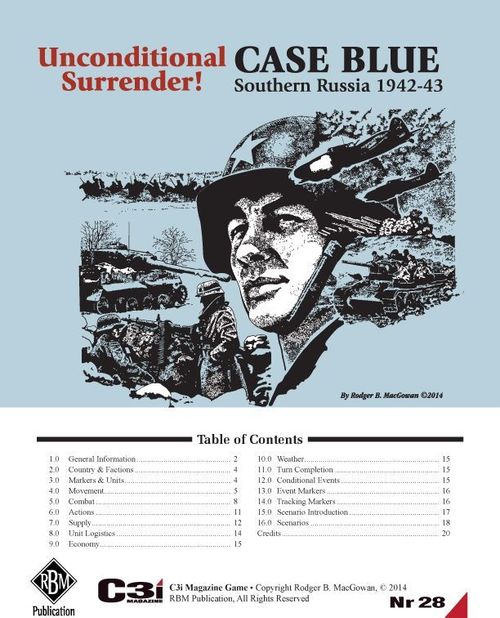
Unconditional Surrender! Case Blue
Unconditional Surrender! Case Blue Rulebook
Table of Contents
Table of Contents
- 1.0 General Information
- 2.0 Country & Factions
- 3.0 Markers & Units
- 4.0 Movement
- 5.0 Combat
- 6.0 Actions
- 7.0 Supply
- 8.0 Unit Logistics
- 9.0 Economy
- 10.0 Weather
- 11.0 Turn Completion
- 12.0 Conditional Events
- 13.0 Event Markers
- 14.0 Tracking Markers
- 15.0 Scenario Introduction
- 16.0 Scenarios
- Sequence of Play Flowchart
1.0 General Information
1.1 Introduction
Unconditional Surrender! Case Blue (referred to as USCB) is a two player game covering the World War II military campaigns fought in southern Russia during 1942-1943. One side controls the Axis forces, while the other side controls the forces of the Soviet Union.
USCB is derived from the game Unconditional Surrender! World War 2 in Europe (referred to as USE), published by GMT Games. That game covers the entire war in the European Theater using the mechanics found in USCB with addition of other elements, such as naval units, strategic warfare, diplomacy, etc. If you enjoy USCB, check out USE.
1.1.1 Objective
Have fun playing. After that, achieve the victory conditions as set forth in the scenario.
1.1.2 Writing Style
Some words are italics to emphasize their importance. Rules marked Important or Exception are ones to pay significant attention to. A rules number cross-reference or an acronym for a group of words appears in parentheses, such as (1.2) or (EZOC). Important notes appear in a blue-shaded box.
Game Designer comments appear in italics, usually in a tan-shaded box.
A rules exception is usually enclosed in brackets. [Exception: …]
Examples appear in a lavender-shaded box.
Examples and comments may help in understanding a rule.
Nouns are generally written in the singular form. A phrase such as "a unit" does not limit the rule to one unit. When a numerical limit is imposed, a number will be used, e.g. "one country."
1.1.3 Learning the Game
Rules are grouped around a common procedure or concept, e.g. Movement. If you prefer to read the rules while having components on the map, set up the Case Blue scenario (16.1).
1.1.4 Components
- One Rulebook
- One 8.5”x11” map
- 80 counters
- One 8.5”x11” Faction Card (single-sided)
- One 8.5”x11” Player Aid Sheet (double-sided)
- Die: One six-sided die is required to play. It is not provided.
Rulebook: The rules in this book apply while playing unless noted otherwise within scenario instructions. If a rules disagreement arises that cannot be resolved through discussion, roll a die. High roller wins. It's a game, folks.
Flowcharts: Flowcharts follow the Sequence of Play and Operations Phase to help you while playing the game.
Faction Card: The Faction Card contains boxes for the Axis and Soviet factions. It also contains the Turn Track, Production Table, and Weather Table.
Player Aid Sheet: The Player Aid Sheet contains many tables used in the game and a Map Terrain Key.
1.1.5 Scale
USCB is not a detailed case study of WW2 warfare. It simulates relative force projection rather than actual quantities of men and equipment.
Turn: Each turn represents one calendar month.
Unit: A ground unit is represented at the army level, but may consist of forces ranging from a brigade to a full army. An air unit is represented as a group, fleet, or other designation.
Map: The map covers a portion of southern Russia. A hex represents about 30-40 miles (50-65 kilometers).
1.1.6 Dice & DRM
The game uses a six-sided die to resolve some mechanics. The result of a die roll may be modified by a Die Roll Modifier (DRM). You add or subtract the DRM to arrive at the final result.
1.2 Sequence of Play
The Sequence of Play list is found on the cover of this Rulebook for easy reference.
A game turn follows a specific Sequence of Play, made up of Phases and possibly Sub-Phases. The faction performing its part in the Sequence of Play is referred to as the phasing faction. The other factions are referred to as the non-phasing factions.
In USCB, a non-phasing faction will have opportunities to interact while the phasing faction is playing.
Important: Each faction completes one Phase in the faction order listed before the next faction completes that same Phase. Faction order is Axis and Soviet.
Example: In the No Supply Phase, the Axis faction reduces all its unsupplied units first, followed by the Soviet faction. The Axis faction then starts the Replacements Phase.
[Exceptions:
- Only the Axis faction performs the Weather Phase.
- Only the Soviet faction performs the Upgrade Phase.]
The Operations Phase has two Sub-Phases: Actions and Supply Check. In faction order, one faction completes both Sub-Phases before the next faction starts its Operations Phase.
1.2.1 Operations
USCB does not use a "Move everyone; fight everyone" system. Instead, a faction activates one unit to move and/or fight (possibly multiple times within a single activation). When the faction completes that unit's activation, it then activates another unit.
The Operations Phase is when air and ground units move, fight, and check if they can trace a supply line.
Actions Sub-Phase: The phasing faction may perform Actions (6.0) with its units. When all Actions are done, remove any Assault or Partisans markers in a hex. See the marker's rule to determine where it goes.
Supply Check Sub-Phase: After completing its Actions Sub-Phase, the phasing faction checks if its units in a hex can trace a Supply Line (7.4).
1.3 Map
The following are key elements and rules related to the map.
1.3.1 City, Factory
See the Terrain Key on the map to identify which symbol represents a city or factory. Both types are considered a city. The distinctions are important for different game mechanics.
1.3.2 Faded Dot Hex
Some hexes are faded in color and have a dot in the middle of them, e.g. hex 2864.
These hexes are prohibited hexes for ground movement. They are allowed for air movement.
Some areas had too little infrastructure to support a large number of ground forces. By prohibiting ground movement in them, the quantity of units and their operations fall more within historical limits. This is more important in USE, which covers all of Europe.
1.3.3 Other Hex/Hexside Definitions
Land Hex: A hex that has land terrain in it, either fully or partially.
Example: Hexes 3154 and 3254 are land hexes.
Water Hex/Hexside: A hex or hexside that has only water in it.
Examples: Hex 3451 is a water hex; 3552 is not. Hexside 3255/3355 is a water hexside; 3355/3356 is not.
1.3.4 Transport Line
A "Transport Line" refers to either a rail (dashed) or road (solid) line running through a hex on the map. Rules-wise there is no difference between them. They are for historical reference.
A Transport Line provides a benefit in ground movement (4.1.3.4) and may be required to trace a supply line (7.4).
1.4 Range
Some activities require counting out a range of hexes.
When counting out a range of hexes from a counter, do not include that counter's hex.
Example: A 5-hex range from an air unit in hex 3055 goes out to and includes hex 3060. Even though it is not counted, the counter's location is part of that range.
Example continued: Hex 3055 is within the range.
A Faded Dot hex can be counted as part of a range of hexes.
1.5 Sorties
The effectiveness of an air unit is tracked using Sorties markers, valued at 1 through 6. A unit with no Sorties is fully effective. A unit with 6 Sorties cannot be activated.
As an air unit conducts actions or is involved in combat, it will add Sorties to its total. When an air unit receives replacements (8.1), it reduces Sorties from its total.
When a unit adds or reduces its Sorties, put the respective Sorties marker equal to the total on the unit (or under the unit, whichever you prefer – just be consistent).
Example: A unit with 2 Sorties suffers a combat result that adds two Sorties. Replace the 2 Sorties marker with a 4 Sorties marker.
The highest Sorties value a unit can be marked with is 6, even if it suffers a total greater than 6.
1.6 Turn Counting
When you are instructed to put a counter a certain number of turns later on a Track, do not count the current turn.
Example: It is the Nov-42 turn. To put a USSR Heavy Arty marker two turns later on the Turn Track, place it in the Jan-43 box.
1.7 Zone of Control
A ground unit exerts a Zone of Control (ZOC) into each of the six adjacent hexes around its current location. More than one ZOC from different units can be exerted into the same hex.
[Exceptions:
-
A ZOC is not exerted into or across a ground movement Prohibited hex or hexside. (Player Aid Sheet: Movement table)
Example: A ground unit in Rostov (hex 3255) does not exert a ZOC into hex 3355, which has a water hexside between them.
-
No enemy ZOC is exerted into a hex with a No EZOC marker.]
1.7.1 Enemy Zone of Control
A ZOC exerted by an enemy unit is referred to as an Enemy Zone of Control (EZOC).
An EZOC may affect movement, supply, and retreats in combat. The effects are found below and within their respective rule.
1.7.1.1 EZOC Effects Summary
Air Movement Prohibitions (4.1.2.1)
An air unit cannot end its movement in a hex containing an EZOC unless the hex contains a friendly: city or unit.
Ground Movement Prohibitions (4.1.3.2)
A ground unit cannot enter a hex containing a friendly ground unit and an EZOC.
Ground Movement Restrictions (4.1.3.1)
Examples for these restrictions appear in rule 4.1.3.1.
- A unit cannot move directly between hexes which contain an EZOC exerted by the same enemy unit.
- At the start of its activation, a unit in an EZOC can move into a hex containing an EZOC exerted by a different unit, provided that move does not violate the same unit EZOC rule above.
- At the start of its activation, a unit in an EZOC can move into a hex containing no EZOC and then later move into a hex containing an EZOC exerted by any unit (even the enemy unit that exerted the original EZOC).
Very Important: At any point during its activation (except at the start of its activation as per above), if a ground unit is in a hex containing an EZOC, it must do one of the following.
- End its activation.
- If it has not performed a Mobile attack in this activation, it can designate an Assault (5.3.3) against an adjacent enemy ground unit. If it designates an Assault, the unit's activation ends.
- It can initiate a Mobile attack (5.3.2) against an adjacent enemy ground unit. It can do this even if it had resolved another Mobile attack in the same activation (even against the same enemy unit). Remember to pay all the movement costs for each attack.
No EZOC Marker (14.5)
No EZOC is exerted into a hex containing a No EZOC marker.
Retreat Prohibitions (5.3.5.1)
A unit cannot retreat into a hex containing an EZOC unless it contains a friendly city and the unit is also putting a one hex gap between it and the attacker.
Supply Line Prohibitions (7.4.1)
A Supply Line trace cannot enter an EZOC unless it contains a friendly: city or ground unit.
2.0 Country & Factions
2.1 Country
The only country represented on the map is the Union of Soviet Socialist Republic (USSR). It may also be referred to as Russia.
2.2 Factions
There are two factions in the game: Axis and Soviet. The Axis faction consists of Germany, Hungary, Italy, and Romania. The Soviet faction consists of the USSR.
Players separately control these factions in the game.
Friendly / Enemy: A unit, marker, or city that belongs to, or is under the control of, one faction is "friendly" to all units and markers of that faction. If it belongs to a different faction, it is "enemy" to that faction. Therefore, Axis and Soviet factions are enemy to each other.
2.2.1 City Control
A city is under the control of one faction at a time (i.e. it is friendly to the Axis or Soviet faction). The control of a city immediately changes if an enemy ground unit moves into the hex.
If a city hex does not have an Axis Control marker in it, it is Soviet controlled. When a city's control changes, either place or remove the Axis Control marker in the hex.
3.0 Markers & Units
A counter is either a unit or a marker. They are different from each other so rules are specific to each type. Markers track economic, military, or political conditions. Units represent military forces.
If a counter specifically belongs to a country or faction, its faction or country name abbreviation is on the bottom of the counter.
3.1 Markers
There are two kinds of markers, Event (13) and Tracking (14). A list of each marker is found in its respective rules section.
A marker may have one or more of the following reminder symbols on them.
- A small die symbol indicates to roll a die after using the marker and put the marker that many turns later on the Turn Track.
- A "#T" symbol indicates that after using it, the marker is put the listed number of turns later on the Turn Track.
3.2 Units
Unlike some other wargames, USCB does not use combat factors to rate the fighting effectiveness of different units and nationalities. Instead, those qualities are reflected in various die roll modifiers. Also, there is no movement factor number on the counters as there are only two values to remember, eight and ten: Eight for Leg ground units and ten for every other kind of unit.
There are two kinds of units: Air and Ground. Within each kind there are different types or other distinctions. The distinction between the different types of units (e.g. leg or mobile ground units) is based on the predominant equipment and tactics used. It is not the only type of equipment in that unit.
The center of a unit's counter contains a NATO military symbol or an image. The symbol or image indicates the unit's type, as does the text on the reverse side.
An historical ID appears along one side of a unit's counter (left for air, right for ground). Unless specifically required (e.g. to identify a Shock unit), the ID has no impact on play.
A unit with a star symbol is considered an Elite unit and receives the Elite unit combat DRM on a Combat DRM list (Player Aid Sheet).
Example: In ground combat, a USSR Shock ground unit receives the +1 Elite unit DRM.
3.2.1 Air Units
There are two types of air units: Fighter and Bomber.
Bomber units only appear in USE.
A fighter can attack an air unit or provide air support to a ground combat.
Unlike a ground unit, an air unit does not have strength sides.
3.2.2 Ground Units
A ground unit has two different sides to indicate the strength of the unit. A full strength side has no stripe across the bottom of the counter; a reduced strength side has a stripe at the bottom across its nationality name.
A reduced strength unit represents forces of significantly lower quality and/or quantity.
3.2.2.1 Ground Unit Types
Ground units are broken down into two groups: Leg and Mobile. Within each group there are different types which are identified by the NATO military symbol on the counter.
Leg: Infantry
Mobile: Motorized, Tank
3.2.3 Naval Units
There are no naval units in USCB. There are in USE.
3.3 Stacking Limits
Stacking refers to having more than one counter in a hex. Stacking has to do with assigned areas of operation, not manpower. A reduced ground unit may have fewer soldiers than a full strength unit, but two reduced units cannot occupy the same hex. The same concept applies to air units.
There is no stacking limit for markers and they do not impact the stacking limits of units.
A hex can have one of each of the following units: fighter and ground. This stacking limit cannot be violated at any point in a turn.
[Exceptions:
- A ground unit can temporarily violate stacking if it is moving through (i.e. not ending in) a hex containing another friendly unit and there is no enemy Zone of Control (EZOC) in that hex.
- An air unit can temporarily violate stacking if it is moving through (i.e. not ending in) a hex containing another friendly air unit (regardless of any EZOC in that hex).
- Stacking limits are ignored when tracing a supply line.]
Examples: German infantry units are in hexes 2952, 3052, and 3153 (one in each hex). A USSR infantry unit is in 3053.
The German unit in 2952 cannot move into and through 3052 because 3052 has both a friendly ground unit and an EZOC from the Russian unit in 3053.
The German infantry unit in 3052 can move into 2952 because it has a friendly ground unit, but no EZOC. However, it must continue moving because it is currently violating stacking limits. Using the original set up, the German unit in 3153 can trace a supply line through hex 3052 and 2952.
Subject to the above restrictions, friendly units of different countries can stack.
Important: Enemy units cannot share the same hex. A ground unit can move into a hex containing an enemy air unit and no enemy ground unit, but that will force the air unit to immediately move out of the hex per Air Displacement (4.1.3.5).
[Exception: An air unit can temporarily share a hex if it is moving through (i.e. not ending in) a hex containing an enemy counter.]
4.0 Movement
Important: The Player Aid Sheet's Movement table lists information related to unit movement points, movement point costs, and Prohibited hexes.
4.1 Movement
There are two types of movement: Air (4.1.2) and Ground (4.1.3). Each one allows a supplied or unsupplied unit to move.
All types of movement use the Movement Procedure listed below. However, each type also has specific rules (found in their own section) that need to be followed.
Movement Path Trace: A game mechanic may require a unit to trace a "movement path" from one location to another without physically moving the counter. Unless stated otherwise, the path traced must follow the rules for the specified movement type.
Movement Points: With each activation, a unit receives a maximum number of movement points (MP) it can expend to move. The amount received depends on the unit and its Supply State (7.1).
- Full Supply: Leg ground unit = 8; All other units = 10
- Low or No Supply: Leg ground unit = 4; All other units = 5.
Movement points cannot be saved from turn to turn.
4.1.1 Movement Procedure
As a unit moves, it will pay an MP cost to enter or cross a hexside or hex. A ground unit also pays an MP cost to attack an enemy ground unit (4.1.3.3). After a unit pays the MP cost, its total MP is reduced accordingly.
The MP cost paid to move (and attack) is subtracted before the unit moves. If a unit does not have enough MP left to pay the total cost, it cannot move (and attack) into that location.
Example: The weather is Fair and the USSR 5 Shock Army has spent six of its eight MP. It cannot attack an Italian ground unit in a clear hex across a river hexside because the total movement point cost of three (1 MP for Clear hex, +1 MP for Moving across a river hexside, and +1 MP for Attacking a hex affected by Fair weather) exceeds the Shock army's remaining two MP.
MP costs are on the Player Aid Sheet's Movement table.
Only MP costs beginning with a "+" are cumulative with other MP costs.
Example: A ground unit moving across a river hexside (+1 MP) into a hex with an enemy city (2 MP) and rough terrain (2 MP) pays three movement points, not five.
4.1.2 Air Movement
An air unit conducts air movement to move across hexes.
Only an air unit can perform air movement.
Important: Air movement must end in a friendly city or in a hex containing a Transport Line and no enemy unit or enemy marker. In addition, a supply line (7.4) must be able to be traced from the ending location to a Supply Source for the unit. Do not check for supply at this time. Just confirm that a valid supply line can be traced. This requirement limits movement ending behind enemy lines.
Sorties: When the unit's movement is done, add one Sortie to its total.
4.1.2.1 Air Movement Prohibitions
- A unit cannot enter an air movement Prohibited hex. (Player Aid Sheet: Movement)
- A unit cannot end in a hex that violates stacking limits (3.3).
- A unit cannot end in a hex containing an EZOC unless the hex contains a friendly: city or unit.
- A unit cannot end in a hex containing an enemy: city, unit, or Partisans marker.
4.1.3 Ground Movement
USE has an integrated movement and combat system. Basically, one ground unit moves and fights (sometimes multiple times) before the next ground unit moves and fights.
A ground unit conducts ground movement to move across hexes.
Only a ground unit can perform ground movement.
4.1.3.1 Ground Movement EZOC Restrictions
The following applies to a ground unit in an EZOC.
Because these restrictions are important to how the game plays out, it is recommended you set up the example below on the map to physically go through it.
-
A unit cannot move directly between hexes which contain an EZOC exerted by the same enemy unit.
Example: The USSR 6 Army is in hex 3156, the USSR 12 Army is in hex 2955, and USSR 1 Tank is in hex 3157. The German 1P Army starts its activation in hex 3155. The 1P Army cannot move from 3155 directly into 3255 (an empty Rostov) because the 6 Army exerts an EZOC in both hexes. It also cannot move into 3055 for the same reason.
-
At the start of its activation, a unit in an EZOC can move into a hex containing an EZOC exerted by a different unit, provided that move does not violate the same unit EZOC rule above.
Example continued: The 1Pz Army can move from 3155 into 3054 as the EZOC in the 3054 does not belong to 6 Army. Similarly, it cannot move into hex 3056 because 1 Tank exerts an EZOC into 3156 and 3056.
-
At the start of its activation, a unit in an EZOC can move into a hex containing no EZOC and then later move into a hex containing an EZOC exerted by any unit (even the enemy unit that exerted the original EZOC).
Example continued: The 1Pz Army can move from 3155 into 3255 as there is no EZOC in it. It can then enter Rostov. Alternatively, 1Pz does not Advance after Combat. By doing this, it is no longer in an EZOC and can continue its activation by moving into Rostov. When it does, it is now in the EZOC of 6 Army and so must either end its activation or attack the adjacent ground unit.
Very Important: At any point during its activation (except at the start of its activation as per above), if a ground unit is in a hex containing an EZOC, it must do one of the following.
- End its activation.
- If it has not performed a Mobile attack in this activation, it can designate an Assault (5.3.3) against an adjacent enemy ground unit. If it designates an Assault, the unit's activation ends.
- It can initiate a Mobile attack (5.3.2) against an adjacent enemy ground unit. It can do this even if it had resolved another Mobile attack in the same activation (even against the same enemy unit). Remember to pay all the movement costs for each attack.
The basic concept of these restrictions is that except for a ground unit's initial move, if a ground unit finds itself in an EZOC, it must either end its activation or attack an adjacent enemy unit. An EZOC is very sticky in USCB.
Example continued: The 1Pz Army starts its activation by resolving a Mobile attack against 6 Army. The combat result was DR and Soviet faction retreats 6 Army into 3256. 1Pz performs an Advance after Combat into 3156. It is now in the EZOC of 6 Army in 3256. Since it is no longer the start of its activation and 1Pz is in an EZOC from 6 Army and 1 Tank (in hex 3157), 1Pz must either end its activation or attack an adjacent ground unit (either 6 Army or 1 Tank). It cannot leave the EZOC to move into Rostov. Similarly, it cannot move into hex 3056 because 1 Tank exerts an EZOC into 3156 and 3056.
Example continued: At the start of 1Pz Army's activation it had ten movement points because it is a Mobile unit. To attack the 6 Army in hex 3156, 1Pz spent two MP (1 for the defender's clear hex and +1 for Attacking a unit in a hex affected by Fair weather). 1Pz remained in hex 3155 and resolved the Mobile attack. 6 Army retreated into 3256 and 1Pz performed an Advance after Combat into 3156. 1Pz continued its activation by attacking 6 Army in 3256. This attack cost two MP (1 for the defender's hex and +1 for Attacking a unit in a hex affected by Fair weather). 1Pz has six MP left out of its starting ten.
Placing the Assault marker on a unit ends the phasing unit's activation, stopping its movement.
More than one unit can designate an Assault against the same enemy ground unit.
Example: The Soviet faction activates a USSR infantry unit and moves it next to a German infantry unit. It has enough movement points left to attack into the German unit's hex so it designates an Assault by placing an Assault marker on the USSR unit and pointing the marker's arrow to the defender's hex. The USSR infantry unit's activation ends. It could not do a Mobile attack first and then designate an Assault.
The Soviet faction then activates a Guards unit, moves it adjacent to the same German unit, and designates an Assault against it. The Guards unit's activation is over.
The Soviet faction does the same thing with a Shock unit.
The Soviet faction can choose to resolve the Assault now or continue activating other units to do something else. When the Soviet faction wants to resolve the Assault that phase, it declares it is doing so.
4.1.3.2 Ground Movement Prohibitions
- A unit cannot enter or cross a ground movement Prohibited hex or hexside. (Player Aid Sheet: Movement).
- A unit cannot violate stacking limits (3.3).
- A unit cannot enter a hex containing a friendly ground unit and an EZOC. You can move through a friendly unit if there is no EZOC in its hex.
4.1.3.3 Ground Movement and Attack
At any point in its movement, any type of ground unit (e.g. infantry, tank, full or reduced strength, supplied or unsupplied, etc.) may do the following against an enemy ground unit in an adjacent hex that it can move into.
- It may initiate and resolve a Mobile attack (5.3.2)
- If it did not already initiate a Mobile attack in its current activation, it may designate an Assault attack (5.3.3).
Important: To initiate a Mobile attack or designate an Assault attack, the phasing unit must pay the full terrain cost to enter the defending hex plus the additional "Attacking a unit …" movement point cost. This cost is paid before the attack is resolved. After paying the cost, the attacker does not move into the defender's hex. It will have the option to advance into the hex if it wins the combat and the defender is no longer in the defending hex.
If a combat is initiated by an attacker, the defender must participate. Note that an Assault ground combat (5.3.3) can be designated, but not initiated. If not initiated, it is not fought.
Example: A phasing German air unit declares an Air Strike against a USSR air unit. The defending USSR unit must participate in the combat.
The same Combat Resolution Sequence (5.1) and Combat Results Table (CRT) are used to resolve all types of combat. However, each type of combat has its own Die Roll Modifiers (DRM) list and its own Combat Results list. The Combat Results Table and the specific Combat Results lists are different things.
All combat lists and tables are on the Player Aid Sheet.
4.1.3.4 Transport Line
Any time during a unit's movement across hexes, it may use a Transport Line connecting the unit's current hex with an adjacent hex. While moving along a Transport Line, treat the terrain of the hexside being crossed and the hex being entered as Clear terrain.
A unit does not receive this benefit if it is moving or attacking into a hex containing an enemy: city or ground unit. A unit not receiving this benefit ignores the Transport Line and pays full movement point costs.
4.1.3.5 Air Displacement
If a ground unit enters a hex containing an enemy air unit, that enemy unit immediately moves out of the hex per air movement rules (4.1.2).
The enemy unit moves even if it has 6 Sorties. The displaced unit is not considered activated because of it.
The air unit's faction moves it.
When the displaced air unit is done moving, if it has less than 6 Sorties, add one Sortie to its total.
If the air unit has no location it can end its movement, remove its Sorties and put it in its Faction Card's Eliminated box.
5.0 Combat
The combat resolution sequence is simple despite the number of steps. You should remember it after a few combats.
There are two types of combat: Air and Ground. They are discussed in more detail later in this rules section.
The attacker in a combat is the faction that initiated it.
5.1 Combat Resolution Sequence
Use the following sequence to determine the result of any type of combat. If a step does not apply in the combat fought, skip it.
Step 1) Ground Combat Only: If it is a Mobile attack, the attacking unit is the Primary Attacker. If it is an Assault attack involving multiple attacking units, the attacker declares one unit as the Primary Attacker and up to two others as Additional Attacker units.
Step 2) Each side uses a Will Commit/Will not Commit marker to secretly decide if it commits any of the following to the combat. Both sides then simultaneously reveal their choice.
- Any number of Event markers (13) as per their rules.
- Ground Combat Only: One air unit.
- If a side reveals Will not Commit, it cannot commit anything to the combat, even if the other side does.
- If a side reveals Will Commit, it must commit at least one eligible event marker or air unit to the combat.
- If both sides reveal Will Commit, start with the attacker. Each side alternates declaring one event marker or air unit to be committed. Continue this until both sides consecutively stop committing. As long as one side commits, the other side can also, even if it did not commit something earlier.
Step 3) Ground Combat Only: If both sides committed an air unit, temporarily stop the ground combat sequence. Resolve an air combat between the air units to determine which side might apply the Air Support ground combat DRM. The ground combat attacker is also the attacker in the air combat.
After the air combat has been resolved, continue the ground combat with Step 4.
Step 4) Each side determines its own die roll modifiers as per the Die Roll Modifiers list for the type of combat fought.
After adding all modifiers for a side, the maximum DRM that can be applied to that side is + or – 10.
Do not combine both sides' modifiers and apply the result to only one side. For example, if the attacker has a +2 DRM and the defender has a -1 DRM, it is not applied as a +1 DRM. The CRT results are not strictly linear.
Step 5) Each side rolls one die and applies its own DRM to the result. Each side then checks the Die Roll Modifiers list under "After Rolling Combat Die" to see if it divides its modified result by two. Round up after each division.
A final modified value less than one is treated as one.
Step 6) On the Combat Results Table, cross-reference the attacker's final value across the top with the defender's final value down the side. Look up the found CRT result on the respective Combat Results list for the type of combat fought and apply that result.
Combat Resolution Sequence Example:
A German tank unit initiates a Mobile attack against a reduced USSR infantry unit in a city hex affected by Poor weather. Each side has several air units (all with less than 6 Sorties) within five hexes of the defender's hex.
Step 1) The German tank unit is the Primary Attacker.
Step 2) Each side takes a Will Commit/Will not Commit marker. The Axis faction wants to commit the air unit so it secretly places the Will Commit side face up and covers it with his hand. The Soviet faction wants to commit an air unit and a Tanks event marker, so it does the same thing with its Will Commit/Will not Commit marker. Together, they both reveal their choices.
The Axis faction starts by declaring it is committing an air unit. The Soviet faction does likewise. At this point, no more air units can be committed because only one per side is allowed in a combat.
The Axis faction then says it is not committing. The Soviet faction then commits the Tanks event marker. The Axis faction could now commit an event marker (if it had one it could use), but chooses not to and states so. The Soviet faction also states it is not committing. Since both sides did not commit consecutively, no more commitments can be made.
Step 3) Because both sides committed an air unit, an air combat is fought between the air units (with the Axis unit being the attacker in this battle as well). The air combat goes through its own Combat Resolution Sequence to determine the number of Sorties added to each air unit and which side receives the Air Support ground combat DRM. For this example, the air combat resulted in both sides applying the Air Support ground combat DRM to the ground combat.
Step 4) Each side determines its own applicable ground combat die roll modifiers. The final Axis DRM is +1 (+2 for a Germany unit, +1 Air Support in Poor, +1 Tank unit in Poor, -2 for attacking unit in a hex affected by Poor weather, and -1 for attacking a city). The final Soviet DRM is 0 (+1 Air Support in Poor, +1 Tank unit in Poor [due to the Tanks event marker] and -2 for being reduced).
Step 5) The Axis faction's die roll result was 3, to which it adds the Axis +1 DRM (for a final modified result of 4). The Soviet faction's die roll result was 6, to which nothing is added.
Step 6) The attacker's final result of 4 is found across the top of the Combat Results Table and then cross-referenced down the column with the defender's final result of 6. The combat result is AS+2. Since it is a ground combat, the "+2" part of the result is ignored. The result is AS. The AS result is then located on the Player Aid Sheet's Ground Combat Results table. The AS or "Attacker Stopped" result ends the German tank unit's activation for the turn, even if it had MP left. The combat is over and the heroes of the Soviet Union have turned back the German panzers.
5.2 Air Combat
An air combat is fought between air units. It occurs in the Operations Phase due to the following Action: Air Strike (6.2.2). The combat is resolved using the Combat Resolution Sequence (5.1)
5.2.1 Air Combat Results
After determining the CRT result, perform the two steps listed on the Player Aid Sheet's Air Combat Results list. Based on the CRT result, step one will add Sorties to the attacking and defending units. Also based on the CRT result, step two determines the Effect on the Action that initiated the combat, e.g. if both sides committed an air unit to a ground combat, which sides receive the Air Support DRM.
Air Combat Example (Previous example expanded):
In the previous example, each side committed an air unit to the ground combat, and so had to fight an air combat, as required in Step 3 of the Combat Resolution Sequence. The USSR fighter starts with 2 Sorties and a German fighter with 3 Sorties.
The German fighter is the attacker. After following the Combat Resolution Sequence and rolling the dice, the CRT result is DR+2.
On the Air Combat Results list, the DR result is found under Step 1: Sorties. The DR result (as well as a DD or DE result) states the attacker adds one Sortie and the defender adds Sorties equal to the +# part of the CRT result. The German fighter adds one Sortie (bringing its total to 4). The USSR fighter adds two Sorties (bringing its total to 4).
After applying the Sorties, the factions look at Step 2: Effect. Since the combat was due to both sides committing an air unit to a ground combat, the faction look up the DR result. The DR result (as well as a ♦ or AS result) states each side receives the Air Support ground combat DRM.
5.3 Ground Combat
Remember USCB is an abstract simulation. An army may fight many times and not be reduced in strength. That does not mean it suffered no losses. It did, but not at a level that was significant enough to reduce combat effectiveness at the game's scale.
A ground combat is fought between ground units. It occurs in the Operations Phase when the phasing faction initiates a Mobile attack or initiates a designated Assault attack. The combat is fought using the Combat Resolution Sequence (5.1)
An Assault attack is a set-piece attack that may involve multiple armies attempting to capture a main objective or put a hole in a defensive line. A Mobile attack represents an army operating relatively independently and in response to enemy resistance.
So which one should you use?
A single unit with a positive combat DRM (e.g. a German Panzer unit in Fair weather has a +4 DRM) is more successful with Mobile attacks because it can move and fight multiple times in a single activation. Just one army can attack multiple enemy units and/or capture several cities.
With no positive combat DRM (e.g. a USSR infantry army), extra armies in an Assault provide a positive combat DRM. In addition, some Event markers only provide a combat DRM if it is an Assault. The disadvantage of an Assault is that a unit attacks only one time, so it only affects one enemy unit and hex.
5.3.1 Ground Combat Prohibitions
- A unit cannot designate an Assault attack and conduct a Mobile attack in the same phase. It's one or the other.
5.3.2 Mobile Attack
If a Mobile attack is initiated during a unit's ground movement, it is immediately resolved. After resolving the combat, if the attacker's activation has not ended; it may continue moving and initiate more Mobile attacks (even against the same enemy unit). Remember to pay the necessary movement costs with each attack.
A Mobile attack against a unit defending in a hex already designated as the target of an Assault attack receives no benefit from, nor gives any benefit to, any Assault against that hex.
5.3.3 Assault Attack
An Assault attack is designated during a ground unit's movement by placing one Assault marker on the phasing unit and pointing the Assault marker's arrow at the defending unit. Placing an Assault marker on a phasing unit ends that unit's activation. Therefore, it cannot continue moving and attacking that phase.
A phasing faction may initiate and resolve a designated Assault at any point during its Operations Phase.
[Exceptions: An Assault cannot be resolved during a unit's activation.]
Example: The USSR 1 Guards unit moves two hexes and enters a German infantry unit's EZOC. The Soviet faction cannot stop the 1 Guards unit's move to resolve a designated Assault somewhere else on the map and then continue to move 1 Guards again.
After an Assault is resolved, remove the Assault markers from the attackers involved in that combat.
All Assaults do not have to be resolved at the same time.
Example: The Soviet faction has four units marked to Assault several hexes. After resolving an Assault involving three of those units, it activates an Air unit. It then later resolves another Assault.
No matter how many Assault markers are pointing to the same hex, an Assault can only have up to three attacking units in a single combat resolution. This restriction is to put a limit on DRM and represents the difficulty of battlefield coordination. Other units may resolve their own separate Assault against that hex. The phasing faction decides how many and which units are involved in each Assault.
A designated Assault attack does not have to be initiated and resolved. The phasing faction may choose not to initiate an Assault combat. At the end of the phasing faction's Operations Phase, remove any remaining Assault markers on the map.
An Assault can be resolved against an enemy ground unit that was not in the hex at the time the Assault was designated.
Because an Assault may be resolved after it was designated, the unit intended to be attacked may not be there due to other combats against it and a different enemy unit may have retreated into the hex.
An Assault can be resolved against a hex that no longer contains an enemy ground unit. No combat is fought, but the phasing faction may use Advance after Combat (5.3.7) to move one of the attackers into the hex. After it is done, remove the associated Assault markers.
5.3.4 Ground Combat DRM Special Cases
Assault Attack: For an Assault, the attacker's DRM is based on the unit that is declared the Primary Attacker. Each other attacking unit involved in the Assault only applies an "Additional Attacker" DRM as listed on the Ground Combat DRM list.
Example: One USSR full strength tank and two USSR reduced strength infantry units marked with Assault markers attack a German infantry unit in Fair weather. The USSR infantry units are across a river, but the tank unit is not. The Soviet faction declares the tank unit as the Primary Attacker and the two infantry units as Additional Attackers. The Soviet combat DRM is +4 (+2 for a Tank unit in Fair weather and +1 for each Additional Attacker infantry unit). The -1 DRM for attacking across a river does not apply because the tank unit (the Primary Attacker) is not attacking across the river. Also, even though the USSR infantry units are reduced, the -2 DRM for being a reduced unit does not apply because neither unit is the Primary Attacker.
Event Markers: An Event marker (13) may be committed to a combat if the defending unit or any involved attacking unit allows the marker to be played.
Example: German and Hungarian infantry units resolve an Assault against a USSR infantry unit. The German unit is the Primary Attacker and the Hungarian unit is the Additional Attacker. The Axis faction could commit an Axis Ground Support marker because of the Hungarian unit.
Isolated: A defending unit is considered Isolated if it has no eligible hex it can retreat into (5.3.5), it is not adjacent to a friendly: city or ground unit and it is not in a map edge hex. Nearby support alleviates the "We're surrounded!" feeling, even if there is nowhere to run to.
An adjacent city or ground unit cannot be used by the defender to avoid being Isolated if the hexside between it and the defender is a ground movement prohibited hexside.
Example: A USSR ground unit in hex 3454 attacks a German ground unit in hex 3355. The German unit cannot use the adjacent city of Rostov to avoid being Isolated because the hexside between the German unit and Rostov is a water hexside.
A defender with no adjacent support that is in a city can be considered Isolated.
5.3.5 Retreat
A combat result may state the defending ground unit must retreat.
A retreat is a one hex move in total. This movement cannot be intercepted, nor is the unit considered activated because of it.
A unit that retreats moves one hex away from the attacker, and it must put a one hex gap between the attacker and defender.
[Exception: A one hex gap is not required if the hex retreated into and the attacker's hex share a ground movement Prohibited hexside.]
Example: A USSR ground unit in hex 3355 attacks a German ground unit in hex 3356. The German unit can retreat into Rostov because the hexside between the USSR unit and Rostov is a water hexside.
The defending faction chooses the hex a unit retreats into.
In an Assault, the retreat is away from any one of the attacking units. The defending faction chooses which unit it is moving away from. It cannot choose an attacking unit that would prevent the defending unit from retreating due to Retreat Prohibitions (5.3.5.1). If a retreat path is available, the defender must retreat.
Unless otherwise prohibited, a unit can retreat into a hex containing an enemy air unit, causing it to move (4.1.3.5).
A Partisans marker does not affect retreats into or out of its hex. Also, that marker stays in its hex.
5.3.5.1 Retreat Prohibitions
- A unit cannot retreat into an enemy city.
- A unit cannot retreat into a hex containing an EZOC unless it contains a friendly city and the unit is also putting a one hex gap between it and the attacker.
- The retreat cannot violate ground movement prohibitions or stacking limits.
5.3.5.2 Cannot Retreat
If a reduced unit cannot retreat, eliminate it.
If a full strength ground unit cannot retreat, leave it in its hex and flip it over to its reduced side.
5.3.6 Unit Elimination
A ground unit may be eliminated in combat due to the combat result or because it cannot retreat.
Put an eliminated unit in its Faction Card's Eliminated box.
If a defender is eliminated in a Mobile attack, put a No EZOC marker in the defender's hex.
All No EZOC markers placed are removed at the end of the moving unit's activation. Therefore, only the currently activated unit can take advantage of the negated EZOC.
5.3.7 Advance after Combat
If a defending unit is eliminated or retreats out of its hex, the attacking unit may choose to enter the defender's hex at that time. If it was an Assault, only one of the attacking units can advance (attacker's choice). There is no movement cost to Advance after Combat. The cost was paid when the attack was initiated.
If a unit does not Advance after Combat, it may continue moving provided it performed a Mobile Attack and has movement points remaining. If it's in an EZOC, see EZOC Restrictions (4.1.3.1).
If a unit does Advance after Combat, the advancing unit ignores all EZOC as it enters the defender's hex. After it is in that hex, it may continue moving provided it performed a Mobile Attack and has movement points remaining. If it's in an EZOC, see EZOC Restrictions (4.1.3.1).
If the attacker enters a hex containing an enemy air unit, the enemy unit is moved as per Air Displacement (4.1.3.5).
If the attacker enters a hex containing a Partisans marker, that marker stays in the hex.
6.0 Actions
An Action allows a unit in a hex to move and/or fight. It may also put a Partisans marker in a hex.
Unless stated otherwise, each Action is declared and resolved before another Action is declared.
Example: The Axis faction declares and resolves one Air Strike before declaring another.
Actions listed below may be performed in any order. However, certain procedures within them may have a strict order.
Example: The Axis faction activates an air unit to perform an Air Strike Action against an enemy air unit. It then activates a ground unit for a Ground Action. This is followed then by another Air Strike Action.
Unless stated otherwise, one unit's Action must be completed before another unit is activated.
Example: The Axis faction cannot stop moving a ground unit in the middle of its Ground Action; activate an air unit to perform a Rebase Action; and then continue moving that same ground unit.
Action Special Notes:
At some point during the phase, a Conditional Event (12) may occur during a unit's Action. If that happens, immediately check that event's rules.
6.1 Partisans Action
Important: This is a separate Action. Unlike other Event markers, a Partisans marker cannot be placed during a unit's activation, nor can it be committed in Step 3 of a ground combat.
The phasing faction may take a Partisans marker from its Faction Card's Events box and put in a hex on the map.
After being placed, this marker remains in its hex until the end of the Actions Sub-Phase.
6.1.1 Partisans Placement
This marker can be placed in a hex that contains an enemy: air or ground unit.
6.1.2 Partisans Effects
If an enemy air or ground unit in the placement hex is attacked during the phase, the defending unit applies a combat -2 DRM.
Partisans Removal
When removed at the end of the phasing faction's Actions Sub-Phase, roll a die. Put the marker a number of turns later on the Turn Track equal to the result.
6.2 Air Actions
Only an air unit can be activated to perform an Air Action.
Air Actions are Air Rebase (6.2.1), Air Strike (6.2.2), and Air Support (6.2.3).
Important: An air unit with 6 Sorties cannot be activated. Check a unit's Sorties each time you want to activate it. Note that Air Displacement (4.2.3.5) does not involve activation. The air unit must move, even if it has 6 Sorties.
Activating an air unit does not cost production points.
Activating an air unit does not add Sorties to its total. However, performing the Action will add Sorties as indicated in each Action rule. So do not add one Sortie for activating the unit and then add more Sorties based on what it did. Just follow the specific rule.
More than one air unit can be activated in a phase.
An air unit can perform only one Action per activation.
An air unit can be activated multiple times in a phase.
An air unit can perform the same Action multiple times in a phase.
6.2.1 Air Rebase
A phasing air unit can activate to move (4.1.2). When the movement is done, the unit's activation ends.
Sorties: When the air unit's activation ends, add one Sortie to its total.
6.2.2 Air Strike
A phasing fighter unit can activate to attack an enemy air unit within a 7-hex range of the phasing air unit.
An Air Strike's purpose is to inflict Sorties on an enemy unit. This is a way the phasing faction can attempt to suppress enemy air units before it starts land operations.
The 7-hex range allows striking at enemy air units far behind front lines. If limited to five hexes (the range for Air Support), an enemy air unit that was six hexes behind its lines would be immune to attack, but still able to provide Air Support to its ground units.
The phasing faction declares the enemy unit to be attacked and traces an air movement path from activated air unit to the defender. There is no physical movement of the air unit's counter; it stays in its hex. This path cannot be intercepted.
To resolve the Air Strike, conduct an air combat (5.2). When the combat is done, the phasing unit's activation ends.
Sorties: When the air unit's activation ends, no Sorties are added to its total. It already added Sorties due to the combat.
6.2.2.1 Air Strike Special Notes
An enemy unit can be the target of more than one Air Strike in a Phase.
A phasing unit can perform more than one Air Strike against the same enemy unit. Each Air Strike requires a separate activation.
6.2.3 Air Support
During a ground combat, a phasing or non-phasing faction may activate one of its fighter units within a 5-hex range of the defending unit to attempt to provide Air Support to the combat.
Air Support is a DRM on the Ground Combat DRM list.
The air unit must be of the same nationality as the defending unit or one of the attacking ground units.
The owning faction declares the unit it is using and traces an air movement path to the defending hex. There is no physical movement of the air unit's counter; it stays in its hex.
If only one side commits an air unit, that side automatically receives Air Support and the air unit's activation ends.
If both sides commit an air unit, immediately conduct an air combat. The ground combat attacker is also the air combat attacker. The final result of the air combat will determine if either or both sides receive Air Support for the ground combat. When the air combat is done, each air unit's activation ends.
Sorties: When the fighter's activation ends, if it did not fight a combat, add one Sortie to its total. If it did fight, no Sorties are added to its total. It already added Sorties due to the combat.
6.3 Ground Actions
Only a ground unit can be activated to perform the Ground Action: Army Operations (6.3.1).
To activate a ground unit (regardless of its strength), its country must spend its production points. This cost is paid one time at the start of the ground unit's activation.
- A Leg unit costs 1 production point to activate.
- A Mobile unit costs 2 production points to activate.
A ground unit can activate only one time in a phase.
Tip: When a unit's activation ends, use some method (such as rotating it or putting a small item on it, like a bead) to remind you it cannot be activated again that turn.
More than one ground unit can be activated in a phase, but not at the same time.
6.3.1 Army Operations
A phasing ground unit can be activated to move (4.1.3). During movement it may initiate a Mobile attack (5.3.2) or designate an Assault attack (5.3.3).
7.0 Supply
The supply status of a unit affects its movement and combat capabilities. Without supply, a unit will eventually be eliminated.
7.1 Supply State
There are three Supply States: Full, Low, and No. When the Supply State of a unit is determined for the turn, it maintains that state until the next turn's supply check.
A unit with a Full Supply State is not marked with a Supply counter. If it has a Low or No Supply State, it is marked with the respective Low Supply or No Supply counter.
A unit is supplied if it has a Full or Low Supply State.
A unit is unsupplied if it has a No Supply State.
7.1.1 Low Supply / No Supply Effects
- A unit with Low Supply has a combat -2 DRM applied to it (Player Aid Sheet: Combat DRM lists).
- A unit with Low or No Supply has reduced Movement Points, i.e. four for Leg units and five for all other units (Player Aid Sheet: Movement).
- A unit with Low or No Supply cannot be improved in the Replacements Phase (8.1).
- A unit with No Supply is reduced in the No Supply Phase (7.5.1).
- A unit with No Supply may be voluntarily eliminated in the No Supply Phase (7.5.2).
- A unit with No Supply has its modified combat die roll result divided by two. Round up (Player Aid Sheet: Combat DRM lists). This applies to the attacker in an Assault if at least one of its attacking units has No Supply.
7.2 Supply Check
In the Supply Check Sub-Phase, the phasing faction determines the Supply State for each friendly unit in a hex by tracing a supply line (7.4) to a friendly Supply Source (7.3).
The phasing faction chooses the order in which units are checked and the supply line path traced for each unit.
A unit can make more than one supply check in a Supply Check Sub-Phase to see if it can trace a supply line.
A supply check is not mandatory. The phasing faction may choose not to supply any of its units (even if in a Supply Source location).
If a unit traces a supply line to a Supply Source, it has a Full Supply State. Remove any Low Supply or No Supply marker on the unit (even if it was placed earlier in the same turn).
If a unit cannot trace a supply line or its faction chose not to supply it, that unit's Supply State is reduced as follows.
- If it has no Low Supply or No Supply marker on it, put a Low Supply marker on it.
- If it has a Low Supply marker on it, flip it to its No Supply side.
- If it has a No Supply marker on it, leave the marker on it.
Important: A unit's Supply State can only be reduced one time per turn, regardless of how many failed traces were made to supply it.
7.3 Supply Source
An Axis Supply Source is hex 2652 or any hex on the west map edge that has a Transport Line running into the map edge (i.e. hexes 2751, 2951, 3151, 3351, 3551).
A USSR Supply Source is any friendly City hex or any hex on the north, east or south map edge that has a Transport Line running into the map edge. [Exception: Hex 2652 is not a USSR Supply Source.]
Example: Hex 2660 is a USSR Supply Source; hex 2661 is not.
7.4 Supply Line
A supply line is traced from the hex occupied by the checking unit to a friendly Supply Source for that unit.
Each unit traces its own supply line.
More than one unit can use the same path to trace a supply line.
7.4.1 Supply Line Prohibitions
- A supply line trace cannot include a hex containing an enemy: city, unit, or ZOC.
- A supply line trace cannot violate movement prohibitions.
[Exceptions: Ignore all EZOC in a hex containing a friendly: city or ground unit.]
7.4.2 Supply Line
From the checking unit, trace a ground movement path up to two hexes to a hex containing a Transport Line or friendly Supply Source for that unit.
If the hexes traced into did not contain a friendly Supply Source, continue tracing the path along a connected Transport Line back to a friendly Supply Source. So the first hex of a supply line does not require a contiguous Transport Line, but the rest do.
Examples
A USSR ground unit is in hex 2854. It can trace a supply line into hex 2755 and then into Voronezh, which is a USSR Supply Source.
A USSR air unit is in hex 2959. It can trace a supply line into hex 2960 and then into Stalingrad. Alternatively, it can trace into hex 2859, which contains a Transport Line. From 2859, it can then trace along a contiguous Transport Line back to hex 2657, which is a USSR Supply Source.
7.5 No Supply Phase
In the No Supply Phase, the phasing faction performs Unsupplied Attrition (7.5.1) followed by Voluntary Elimination (7.5.2)
7.5.1 Unsupplied Attrition
If a phasing unit has No Supply, do the following.
- If it is a reduced strength ground unit, remove it from its location and put it in its Faction Card's Eliminated box.
- If it is a full strength ground unit, reduce it.
- If it is an air unit, remove its Sorties and put the unit in its Faction Card's Eliminated box.
7.5.2 Voluntary Elimination
The phasing faction may eliminate a friendly ground unit that has a No Supply marker. The phasing faction may also eliminate a supplied or unsupplied friendly air unit.
An eliminated unit is placed in its Faction Card's Eliminated box. If it is an air unit, also remove its Sorties.
8.0 Unit Logistics
In the Replacement Phase, a unit in a hex may receive replacements. In the Upgrade Phase a unit in a hex may be upgraded to a different unit. In the Mobilization Phase a unit on its Faction Card may be mobilized into a hex. Pay attention to the order they are performed in the Sequence of Play because it affects what can be done to a unit.
8.1 Replacements
The Replacements Phase only deals with units already in a hex. It is not when a unit is put into a hex. That happens in the Mobilization Phase.
In the Replacements Phase, the phasing faction may improve the condition of a friendly unit in a hex. Tip: Do not forget a unit stacked under another counter.
Warning: A friendly unit may be surrounded by enemy units by the time a faction gets to this Phase. Such a unit can be improved. This represents replacements that made it through before the unit was cut off.
To improve a unit, its country pays the production point cost listed on the Faction Card's Production Costs table to do the following.
- Flip over a friendly, reduced ground unit to its full side.
- Remove up to two Sorties from an air unit.
8.1.1 Replacements Special Notes
The unit receiving replacements must be in Full Supply.
A faction may spend as many production points as it has remaining, but a unit can be improved only one time per turn.
Example: A German air unit with 4 Sorties can remove only two of them, even if there are more production points available.
8.2 Upgrade
The Upgrade mechanic reflects significant improvements in troop quality and/or quantity, e.g. USSR infantry armies were designated as "Guards" after numerous battles and becoming motorized.
An Upgrade unit has the Upgrade symbol in the top left corner of its counter.
In the Upgrade Phase, the Soviet faction may take an Upgrade unit located in its Faction Card's Upgrade box and replace a unit as specified in scenario instructions.
To make the replacement, take the Upgrade unit from its Upgrade box and put it in the same location as the unit being replaced. The strength of the Upgrade unit is the same as the replaced unit. The replaced unit is then removed from the scenario. A replaced unit cannot come back, so Upgrade units will enhance your forces, not increase their numbers.
8.2.1 Upgrade Special Notes
An Upgrade unit gets in its Faction Card's Upgrade box when it is removed from the Turn Track or if set up there per scenario set up.
Only an Upgrade unit in its Faction Card's Upgrade box can upgrade another unit.
There is no production cost to upgrade a unit.
The unit being replaced must be in a hex and be in Full Supply.
Once an Upgrade unit has replaced a unit in the scenario, the Upgrade unit is treated like any other unit.
Upgrade Example: A USSR reduced strength infantry unit is in Stalingrad. A USSR Guards unit is in the Soviet Faction's Upgrade box. The Soviet faction takes the USSR Guards unit from the box and places it in Stalingrad with its reduced strength side face up. It then takes its reduced strength infantry unit and removes it from the scenario.
On next turn Axis units attack the USSR Guards in Stalingrad and eliminate it. The USSR Guards unit is taken from the hex and put in the Soviet Faction Card's Eliminated box (not its Upgrade box). To get back on the map, the Soviet faction will need to mobilize it in a future Mobilization Phase.
8.3 Mobilization
The Mobilization Phase only deals with placing new or eliminated units into a hex. It is not when units already in a hex are improved. That happens in the Replacements Phase.
In the Mobilization Phase, the phasing faction may mobilize a unit that is in its Faction Card's Mobilization box.
To mobilize a unit, its country pays the production cost listed on the Faction Card's Production Costs table to do the following.
- Mobilize a reduced ground unit. [Exception: A USSR infantry unit (except Shock) mobilizes at full strength.] The USSR could quickly call upon its manpower reserves to raise basic infantry armies. Note that a USSR Guards unit is not an infantry unit.
- Mobilize an air unit marked with 4 Sorties.
A unit that is mobilized is placed in a Mobilization Location (8.3.1).
Placement can be in an EZOC.
Placement cannot violate stacking limits.
8.3.1 Mobilization Location
An Axis unit is put in any land hex on the West map edge from hex 2651 to 3551 which is not occupied by a USSR unit.
A USSR unit is put in any of the following locations:
- A friendly city
- A north, east, or south map edge hex which is not a Faded Dot hex, nor occupied by an Axis: unit or marker. [Exception: Hexes 2651 to 2654 are not USSR Mobilization Locations.]
8.3.2 Mobilization Special Notes
A unit gets into the Mobilization box in the End of Turn Phase from its Faction Card's Eliminated box, the Turn Track, or per scenario set up.
This means an eliminated unit cannot be mobilized in the same turn it was eliminated. Also, due to the order of Phases, a unit cannot receive replacements or be upgraded on the same turn it is mobilized.
9.0 Economy
Each turn, a country receives a number of production points that it may spend to do certain activities such as move or mobilize ground units. All activities that require production points and their respective costs are listed on the Faction Card's Production Costs table.
Prod Markers: A country's production and expenditures are tracked using Prod markers on their Faction Card's Production Track.
A Prod 1s marker starts in the 0 box of the Ones row. A Prod 10s marker (if any) starts in the 00 box of the Tens row.
After determining a country's production points for the turn, its Prod markers are moved on the Track accordingly. As a faction spends a country's production points, it subtracts the amount spent from that country's current total on the Production Track. If you forget to do that and can't easily fix it, just play on and have fun.
Important: Production points are not saved from turn to turn; unused points are lost.
USCB has a "Use it or lose it" economic system. This makes for easier accounting and prevents hoarding production for unrealistic activity. There is no deficit spending.
9.1 Economy Phase
The phasing faction determines how many production points are received by each of its active countries.
9.1.1 Production Points
The Faction Card's Monthly Production table lists how many production points each country receives each turn. Note the USSR amount is variable based on how many factories it controls.
10.0 Weather
Weather represents climate and ground conditions.
There are three types of weather: Fair, Poor, or Severe.
Weather affects all hexes on the map.
10.1 Weather Phase
The Axis faction rolls a die; finds the result on the Faction Card's Weather table based on the turn's month and puts the Weather marker in the respective box on the map's Weather Track. The Soviet faction does not roll for weather.
Example: It is Mar-43. The Axis faction rolls a die and gets a 5. On the Weather Table, it looks on the Mar-Apr line and finds that a result from 3 to 6 is listed under Severe. It then places the Weather marker in the Weather Track's Severe box.
10.2 Poor/Severe Weather Effects
Poor weather effects in combat may feel worse than Severe effects (especially for the attacker) and sometimes they can be. However, Poor weather still allows for more extreme combat results on the CRT. Severe mitigates extreme combat results, but it is also less predictable in terms of who will win.
- It costs two (instead of one) additional movement points to initiate a ground combat against a unit in a hex affected by Poor or Severe. Otherwise, movement is not affected by weather.
- A ground unit has a combat -2 DRM if attacking a unit in a hex affected by Poor.
- The Tank unit and Air Support ground combat DRM is +1 (instead of +2) if defending in, or attacking a unit in, a hex affected by Poor.
- An air unit has a combat -2 DRM if defending in, or attacking a unit in a hex affected by Poor.
- There is no Tank unit or Air Support ground combat DRM if defending in, or attacking a unit in, a hex affected by Severe.
- A faction's modified combat result is divided by two (round up) if defending in, or attacking a unit in, a hex affected by Severe.
11.0 Turn Completion
11.1 Victory Check Phase
Check if a faction has achieved the scenario's victory conditions. Unless the scenario states otherwise, victory can occur in any turn.
11.2 End of Turn Phase
Step 1) Advance the Turn marker on the Turn Track to the next turn. If a counter is in the entered Turn Track box, put it in its respective location on the map, on a Track, or in a Faction Card box as per its rule or its Location listed in the scenario Set Up. A marker is usually put in either its Faction Card's Events box or on a Track. A unit is usually put in its Faction Card's Mobilization box.
Step 2) Move all counters in a Faction Card's Eliminated box to its Mobilization box.
12.0 Conditional Events
Conditional Events can be looked up as needed rather than memorized. It is good to remember the triggers for Conditional Events, but there is a brief list of them on the Player Aid Sheet.
While playing, the following event may occur when its trigger condition happens. If the event's trigger condition happens, immediately check its rule and perform the listed actions.
12.1 Grozny
In an Operations Phase, the first time an Axis ground unit is within a 3-hex range of 3863 (Grozny) immediately put the USSR '45' and '46' ground units in hexes 3862 and 3763. The Axis ground unit can then continue with its activation.
13.0 Event Markers
Event markers can be looked up as needed rather than memorized.
This section lists Event markers and their specific rules.
An Event marker is set up as per scenario instructions.
Important: An Event marker in its Faction Card's Events box is available for use as per its rule. If located somewhere else during the scenario, e.g. the Turn Track, it cannot be used.
Unless stated otherwise, when an Event marker is removed from the Turn Track, put it in its Faction Card's Events box.
Important: If an Event marker requires an action that is impossible to complete, ignore that specific action.
13.1 Ground Support
This represents air and tank forces of smaller countries which are too weak to constitute a nationality specific unit or event marker.
The Axis faction may play one Ground Support in a ground combat involving any of its ground units. [Exception: It cannot be played if the only attacking ground units are German.]
In the combat, the Axis faction applies a +1 DRM.
After combat, roll a die. Put this marker a number of turns later on the Turn Track equal to the result.
13.2 Heavy Arty
This represents the large artillery divisions the Soviet army amassed before offensives.
The Soviet faction may play one Heavy Artillery in an Assault combat in which it is attacking.
Example: Two German infantry units resolve an Assault against a USSR infantry unit in Rostov. The Soviet faction cannot use a USSR Heavy Arty because it is defending.
In the combat, the Soviet faction applies a +2 DRM.
After combat, roll a die. Put this marker a number of turns later on the Turn Track equal to the result.
13.3 Partisans
This represents partisans operating directly behind enemy lines in support of an offensive.
The Soviet faction may put a Partisans marker in a hex by performing a Partisans Action (6.1). It is put in a hex that contains an enemy: air or ground unit.
For air or ground combat, if an enemy air or ground unit in the placement hex is attacked, the defending unit applies a -2 DRM.
When this marker is removed at the end of the Soviet faction's Actions Sub-Phase, roll a die. Put this marker a number of turns later on the Turn Track equal to the result.
13.4 Tanks
This represents tank assets or doctrine sufficient enough for local support, but too weak to constitute a full tank unit.
In a ground combat, the Soviet faction may play a Tanks marker if a USSR infantry or motorized unit is involved. [Exception: It cannot be played if the only involved unit has a "Shock" ID.]
The affected unit is considered to be a tank unit for ground combat DRM purposes. It retains all other designations.
Example: A USSR Guards unit is attacked in Fair conditions and the Soviet faction plays a USSR Tanks event marker. Its combat DRM is +3 (+1 for Elite unit and +2 for a Tank unit in Fair).
After combat, put this marker on the next turn on the Turn Track.
14.0 Tracking Markers
This section lists Tracking markers and their specific rules.
14.1 +/- DRM [Attacker; Defender]
These markers are used on the Faction Card's DRM Track to track the combat DRM of the attacker and defender.
14.2 Assault
The phasing faction puts this marker on a unit to designate an Assault against an enemy ground unit in the hex the Assault marker points to.
The marker is removed when the Assault is resolved, or at the end of the phasing faction's Actions Sub-Phase if the Assault is not resolved.
14.3 Control [Axis]
This marker indicates the Axis faction controls a city (2.2.1).
14.4 Movement Points
This marker is used on the Faction Card's Move Track to track the activated unit's movement point expenditure. You can count up or count down, just be consistent.
14.5 No EZOC
This represents the inability of nearby defending forces to react to a very successful attack.
This marker is put in a hex that was occupied by a defending unit eliminated by a Mobile attack.
While this marker is in a hex, no EZOC is exerted into that hex.
It is removed at the end of the phasing ground unit's activation. So only the ground unit currently activated can benefit from a No EZOC marker. If more than three defenders are eliminated by the same attacker (which should rarely happen) and you need a No EZOC marker for the recently attacked hex, use one already in a hex the attacker cannot move back into due to a lack of remaining MPs.
14.6 Prod [10s; 1s]
These markers track a country's production points (9.1.1).
14.7 Sorties [1; 2; 3; 4; 5; 6]
These markers track the total number of Sorties (1.5) a unit currently has. If a unit has no Sorties, do not put a marker on it.
14.8 Supply [Low / No]
This marker indicates if a unit has a Low or No Supply State (7.1).
14.9 Turn
This marker is put on the Turn Track to indicate the scenario's current turn (month and year).
14.10 Weather
This marker denotes a Weather Zone's weather (10) for the turn.
14.11 Will Commit / Will not Commit
This marker is used in the Combat Resolution Sequence (5.1) to secretly decide and then reveal if a faction is committing an Event marker to any combat and/or one air unit to a ground combat.
15.0 Scenario Introduction
15.1 Scenario General Information
Sequence of Play: Unless stated otherwise, a scenario begins with the Weather Phase of the first turn and ends when the last turn's Victory Check Phase is completed.
Special Rules/Notes: A scenario may have a special rule or note that applies to it. If it conflicts with a rule in the Rules of Play above, the scenario rule/note is used.
15.1.1 Reinforcements Entry
Before starting a scenario, the players decide if they will use a historical or variable entry date system to determine when a reinforcement counter (i.e. a counter that does not start a scenario in a hex or on a Faction Card) becomes available for use.
When a counter is removed from the Turn Track, put it in the place listed in the Location column of its scenario Set Up Table.
15.1.1.1 Historical Entry
A counter is put on the Turn Track in the turn listed in the Entry-H column. That turn is its Entry Turn. Ignore the Entry-V column.
15.1.1.2 Variable Entry
Ignore the Entry-H column. A unit or marker is put on the Turn Track as follows.
Note a counter's Entry-V turn and roll a die. Place that counter a number of turns later (from the Entry-V turn) on the Turn Track equal to the result.
If an Entry-V value is "At Start", roll a die and divide the result by two (round up). Place that counter a number of turns later on the Turn Track equal to the result.
Example: The USSR 4 Air unit has an Entry-V value of "At Start." The Soviet faction rolls a die, gets a two, which divided by two equals one. The air unit is put in the Aug 1942 box.
15.2 Basic Set Up
Production Markers: Prod markers are initially placed in the '0' box on the Production Tracks.
Control Markers: Put Control markers in the listed hexes.
Units / Markers: Put a country/faction specific counter in its respective location as listed in its faction Set Up Table (15.2.1) or as indicated above. Markers that are not country/faction specific (e.g. Sorties) are kept aside to be used if/when they are needed.
15.2.1 Setup Table: Terms
Country: The counter's country or faction.
Counter ID: States the counter's historical ID or name. A number before a name indicates the number of counters.
Location: States where a counter is placed. Placement cannot violate stacking limits or movement prohibitions. If a unit cannot be placed in a location without violating a rule, put it in its Faction Card's Mobilization box.
If a counter has no Entry-H and Entry-V date, put it in the location listed.
If a counter has an Entry-H or Entry-V date, put it on the Turn Track as a reinforcement counter. When it is removed from the Turn Track, put it in the location listed.
The following may appear in a Location box.
- ####: Put the counter in that hex number.
- Conditional: Put the counter in its Faction Card's Conditional box. Where it is placed and becomes available for use in a scenario is based on a Conditional Event (12).
- Events: Put the counter in its Faction Card's Events box.
- Mobilization: Put the counter in its Faction Card's Mobilization box.
- Upgrade: Put the unit in its Faction Card's Upgrade box.
- West: The unit is placed at full strength and Full supply in any friendly hex on the West map edge from hex 2651 to 3551. The placement cannot violate stacking limits.
Entry-H / Entry-V: Put the counter in the respective Turn Track box as per Reinforcement Entry (15.1.1).
R (for Reduced): If "R" appears in this box, the unit is set up at reduced strength.
S (for Sorties): If a number appears in this box, mark the unit with that number of Sorties.
16.0 Scenarios
16.1 Case Blue 1942
The scenario covers the Axis Case Blue campaign.
16.1.1 Basics
Scenario Length: 5 turns. Jul 1942 to Nov 1942.
Victory Conditions: The Axis faction wins if on any turn it controls all Factory hexes or the Soviet faction controls only two cities. Otherwise, the Soviet faction wins.
Control Markers: Put Control markers in hexes 2752 and 2952.
Conditional Events: The Grozny event (12.1) may occur.
16.1.2 Axis Faction
Special Rules/Notes:
Play Tip: Hit hard and often. Time is against you.
Set Up:
| Country | Counter ID | Location | Entry-H | Entry-V | R | S |
|---|---|---|---|---|---|---|
| Axis | two Ground Support | Events | ||||
| Germany | 2 | West | Aug-42 | At Start | ||
| Germany | 6 | 2952 | ||||
| Germany | 17 | 3154 | ||||
| Germany | 1 Pz | 3053 | ||||
| Germany | 4 Pz | 2752 | ||||
| Germany | 4 Luf | 3153 | 2 | |||
| Hungary | 2 | 2851 | ||||
| Italy | 8 | 3051 | ||||
| Romania | 3 | 3252 | ||||
| Romania | 4 | 3552 |
16.1.3 Soviet Faction
Special Rules/Notes:
- If playing with Historical Entry dates, the Soviet Partisans marker is not used in this scenario.
- A USSR Gd motorized unit can upgrade a USSR infantry unit [except Shock].
Play Tip: In Aug-42, the German 2 Army appears on the west map edge and can move. Be ready for it.
Set Up:
| Country | Counter ID | Location | Entry-H | Entry-V | R | S |
|---|---|---|---|---|---|---|
| USSR | Tanks | Events | ||||
| USSR | 4 | 3553 | ||||
| USSR | 6 | 2953 | ||||
| USSR | 9 | 2954 | ||||
| USSR | 12 | 3155 | ||||
| USSR | 21 | 2753 | ||||
| USSR | 37 | 3054 | ||||
| USSR | 44 | 2652 | ||||
| USSR | 51 | 3254 | ||||
| USSR | 62 | Mobilization | ||||
| USSR | 3 Air | 3156 | 4 | |||
| USSR | 1 Tank | 3060 | R | |||
| USSR | 5 Tank | 2655 | R | |||
| USSR | 45 | Conditional | ||||
| USSR | 46 | Conditional | ||||
| USSR | 4 Air | Mobilization | Aug-42 | At Start | ||
| USSR | 1 Gd | Upgrade | Aug-42 | At Start | ||
| USSR | 2 Gd | Upgrade | Aug-42 | At Start | ||
| USSR | 3 Gd | Upgrade | Nov-42 | Sep-42 | ||
| USSR | 5 Shock | Mobilization | Nov-42 | Sep-42 | ||
| Soviet | Heavy Arty |
16.2 Operation Uranus 1942
The scenario covers the Soviet Operation Uranus campaign.
16.2.1 Basics
Weather: 5 turns. Nov 1942 to Mar 1943.
Scenario Length: 5 turns. Nov 1942 to Mar 1943.
Special Rules/Notes:
- The first turn's weather is Poor.
- The scenario starts with the Soviet Operations Phase. The starting Axis positions represent the end of its Operations Phase.
The following are the number of production points each country has for the first turn.
Germany = 3; Hungary, Italy, Romania = 1 each; USSR = 10
Victory Conditions: The Soviet faction wins if on any turn the Axis faction controls less than three cities. If a Soviet victory is not achieved by the last turn, the faction that controls the most cities wins.
Control Markers: Put Control markers in hexes 2752, 2952, 2655, 3255, and 3060.
Conditional Events: The Grozny event (12.1) has occurred.
16.2.2 Axis Faction
Special Rules/Notes:
Play Tip: Get ready to reform your lines. The stretched out Axis line is easy to break.
Set Up:
| Country | Counter ID | Location | Entry-H | Entry-V | R | S |
|---|---|---|---|---|---|---|
| Axis | Ground Support | Events | ||||
| Axis | Ground Support | Events | Dec-42 | |||
| Germany | 2 | 2655 | ||||
| Germany | 6 | 3060 | ||||
| Germany | 17 | 3456 | ||||
| Germany | 1 Pz | 3762 | ||||
| Germany | 4 Pz | 3161 | ||||
| Germany | 4 Luf | 3156 | 6 | |||
| Hungary | 2 | 2855 | ||||
| Italy | 8 | 2957 | ||||
| Romania | 3 | 3058 | ||||
| Romania | 4 | 3361 |
16.2.3 Soviet Faction
Special Rules/Notes:
The USSR 4 and 9 infantry units are not used. They were upgraded to the 1 Gd and 2 Gd units.
- A USSR Gd motorized unit can upgrade a USSR infantry unit [except Shock].
Play Tip: Try attacking Germany's allies rather than taking on the Germans head on.
Set Up:
| Country | Counter ID | Location | Entry-H | Entry-V | R | S |
|---|---|---|---|---|---|---|
| USSR | Tanks | Events | ||||
| USSR | 6 | 2756 | ||||
| USSR | 12 | 2960 | ||||
| USSR | 21 | 2959 | ||||
| USSR | 37 | 3261 | ||||
| USSR | 44 | Mobilization | ||||
| USSR | 45 | 3763 | ||||
| USSR | 46 | 3862 | ||||
| USSR | 51 | 3362 | ||||
| USSR | 62 | 3061 | R | |||
| USSR | 3 Air | 3062 | 6 | |||
| USSR | 4 Air | 2759 | 5 | |||
| USSR | 1 Tank | Mobilization | ||||
| USSR | 5 Tank | 2656 | ||||
| USSR | 1 Gd | 2857 | ||||
| USSR | 2 Gd | 3162 | ||||
| USSR | 3 Gd | Upgrade | ||||
| USSR | 5 Shock | Mobilization | ||||
| Soviet | Heavy Arty | Events | ||||
| Soviet | Partisans | Events | Dec-42 |
16.3 Turning Point 1942
The scenario covers the Axis Case Blue and Soviet Operation Uranus campaigns.
The Soviet faction is favored to win this scenario. To improve the Axis chances, players may agree to change the German production points received each turn from "8" to "9".
16.3.1 Basics
Scenario Length: 9 turns. Jul 1942 to Mar 1943.
Victory Conditions: On any turn, a faction wins the game if it controls all Factory hexes. If such a victory is not achieved by the last turn, the faction that controls the most cities wins.
Control Markers: Put Control markers in hexes 2752 and 2952.
Conditional Events: The Grozny event (12.1) may occur.
16.3.2 Axis Faction
Set Up:
| Country | Counter ID | Location | Entry-H | Entry-V | R | S |
|---|---|---|---|---|---|---|
| Axis | two Ground Support | Events | ||||
| Germany | 2 | West | Aug-42 | At Start | ||
| Germany | 6 | 2952 | ||||
| Germany | 17 | 3154 | ||||
| Germany | 1 Pz | 3053 | ||||
| Germany | 4 Pz | 2752 | ||||
| Germany | 4 Luf | 3153 | 2 | |||
| Hungary | 2 | 2851 | ||||
| Italy | 8 | 3051 | ||||
| Romania | 3 | 3252 | ||||
| Romania | 4 | 3552 |
16.3.3 Soviet Faction
Special Rules/Notes:
- A USSR Gd motorized unit can upgrade a USSR infantry unit [except Shock].
Play Tip: In Aug-42, the German 2 Army appears on the west map edge and can move. Be ready for it.
Set Up:
| Country | Counter ID | Location | Entry-H | Entry-V | R | S |
|---|---|---|---|---|---|---|
| USSR | Tanks | Events | ||||
| USSR | 4 | 3553 | ||||
| USSR | 6 | 2953 | ||||
| USSR | 9 | 2954 | ||||
| USSR | 12 | 3155 | ||||
| USSR | 21 | 2753 | ||||
| USSR | 37 | 3054 | ||||
| USSR | 44 | 2652 | ||||
| USSR | 51 | 3254 | ||||
| USSR | 62 | Mobilization | ||||
| USSR | 3 Air | 3156 | 4 | |||
| USSR | 1 Tank | 3060 | R | |||
| USSR | 5 Tank | 2655 | R | |||
| USSR | 45 | Conditional | ||||
| USSR | 46 | Conditional | ||||
| USSR | 4 Air | Mobilization | Aug-42 | At Start | ||
| USSR | 1 Gd | Upgrade | Aug-42 | At Start | ||
| USSR | 2 Gd | Upgrade | Aug-42 | At Start | ||
| USSR | 3 Gd | Upgrade | Nov-42 | Sep-42 | ||
| USSR | 5 Shock | Mobilization | Nov-42 | Sep-42 | ||
| Soviet | Heavy Arty |
Sequence of Play Flowchart
In faction order (Axis, Soviet), complete one Phase before the next Phase is started. [Exceptions: Weather Phase, Upgrade Phase]
Weather Phase: The Axis faction rolls to determine the turn's weather. The Soviet faction does not roll for weather.
Economy Phase: Determine each active country's Production Points (9.1.1).
Operations Phase: In faction order (Axis, Soviet), one faction completes both its Sub-Phases before the next faction starts its Operations Phase. A faction completes its Actions Sub-Phase before starting its Supply Check Sub-Phase.
- Actions Sub-Phase (1.2.1 and 6): The phasing faction may activate units to perform Actions (6). Unless stated otherwise, one unit's action must be completed before another unit is activated. Actions may be performed in any order. However, certain procedures within them may have a strict order.
- Partisans Action (6.1): Take a Partisans marker from its Faction Card's Events box and put it in a hex that contains an enemy: air or ground unit. If an enemy air or ground unit in the hex is attacked during the phase, the defender applies a combat -2 DRM. There is no effect on an enemy naval unit.
- Air Actions — Air Rebase (6.2.1), Air Strike (6.2.2), Air Support (6.2.3): Activating an air unit does not cost production points. An air unit with 6 Sorties or marked with a Strategic Move marker cannot be activated. Check a unit's Sorties each time you want to activate it. An air unit can be activated multiple times in a phase. An air unit can perform the same Action multiple times. More than one air unit can be activated in a turn.
- Ground Actions — Army Operations (6.3.1): To activate a ground unit (regardless of its strength) its country must spend its production points based on what group the unit belongs to. Leg unit costs 1 production point. Mobile unit costs 2 production points. A ground unit can be activated only one time in a phase. Only one ground unit can be considered activated at one time. More than one ground unit may be activated in a phase.
- Marker Removal: After all Actions are done, remove any Assault or Partisans marker in a hex.
- Supply Check Sub-Phase (1.2.1 and 7.2): Each unit in a hex checks to see if it can trace a supply line back to a friendly supply source. If it cannot, its supply state is reduced one level (only once per turn). A supply check is not mandatory. The phasing faction may choose to not supply any number of its units (regardless of type or location).
- No Supply Phase: A phasing unit with No Supply is reduced or eliminated (7.5.1). A phasing unsupplied ground unit or a phasing supplied or unsupplied air unit may be eliminated (7.5.2).
Replacements Phase: Spend production points to improve a phasing unit in a hex. Flip a reduced strength ground unit over to its full strength side, or remove up to two Sorties from an air unit (8.1).
Upgrade Phase: The Soviet faction only may replace a scenario designated unit with its respective Upgrade unit (8.2).
Mobilization Phase: Spend production points to mobilize a unit that is in its Faction Card's Mobilization box (8.3).
Victory Check Phase: Check to see if a faction achieved the scenario's victory conditions (12.1).
End of Turn Phase: Advance the Turn marker one turn. Put any counter in the entered box in its respective location. Move all units in a Faction Card's Eliminated Box to its Mobilization Box.