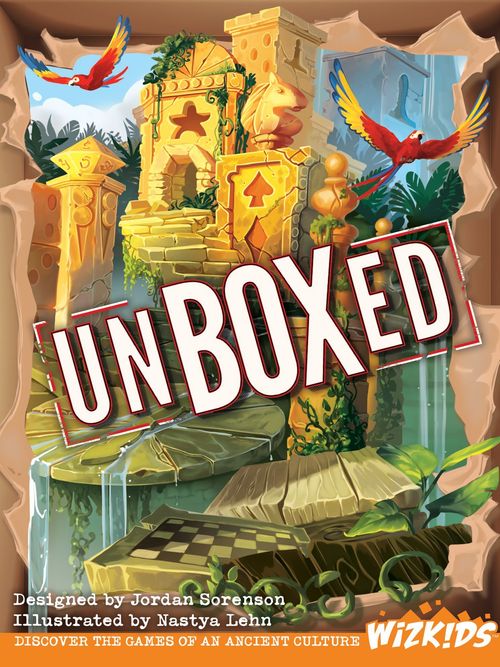
Unboxed
Unboxed Rulebook
Table of Contents
Table of Contents
Components
- 24 A-deck cards
- 36 B-deck cards
- 3 C-deck cards
- 12 D-deck cards
- 16 E-deck cards
- 7 Reference cards
- 32 Wooden discs
- 3 Relic tokens
- 5 Clue tokens
- 1 Dig Manual
- This Rules sheet
Introduction
Greetings! You must be my new intern archaeologists. I'm Dr. Ramos. It's nice to finally meet in person. I know unearthing ancient games isn't the most lucrative endeavor, but from your letters, it seems like you have the passion for games that this team requires, and the ability to peer into the minds of ancient designers. I think you're perfectly suited to peering into the minds of ancient designers and figuring out what made their games tick.
On this expedition, we have uncovered 10 different dig sites scattered across a series of ancient ruins. Each dig site contains a different ancient game our team must figure out how to play. Unfortunately, the ravages of time have disintegrated the rulebooks, so we must instead decipher the iconography of all the components present. I've already deduced that they are all competitive games for 2 to 4 players, but we have to work together to figure out those rules. And I've also come up with the title for each game: might help in your understanding of the game.
Beginning a New Dig
The top right corner of each dig depicts which components you have found for this dig only. For example, a card image with "A" means you use the "A" deck (marked on the bottom of the card backs). Any images of discs means using exactly that number and color of discs.
Then read the dig site name, introduction, and the questions out loud to your team. These help to give a little insight into the game's design, but it is the questions that should be your biggest focus: not only will they guide you in recreating the game but also assess your accuracy in comparison to my interpretation of how the game is to be played. Remember, you do not need to know every nuance of a game, just what the questions ask, as answering these correctly is what gives you points.
Feel free to examine and manipulate the components as you're trying to figure out how the game works. Be sure to test the game as you go.
Once you think you're comfortable answering all the questions, check the game's solution and see how you did!
Each question answered correctly is worth 3 points. If you've missed a key aspect or partially answered the question, it will be worth 2 points: don't judge yourselves too harshly but be fair in your self-assessment. Record your total score for each dig on page 27 of the dig manual. At the end of all 10 increasingly difficult dig sites, tally up the scores from all the digs and consult the chart for how you rate.
Clues and Relics
Each question comes with a numbered clue that you can look up to help you answer that question. It won't give you the answer, but it will guide you to one. Turn to the beginning of the dig manual to search for the right clue by cross-referencing each question's clue number. (Some clue numbers are empty on purpose.)
There is one clue for every single question in the game but using a clue will deduct a point from your dig score (take a token with my image as a reminder, and note these are limited). This is where Relics come in. Accompanying each dig are one to three Relics, depending on your chosen difficulty level. These Relics can be turned in to get a clue for free, that is it will not deduct from your score. However, Relics are limited and cannot be brought to another dig site. It should be noted that there are no game implications for your chosen difficulty level or number of Relics used. So, when it's only bragging rights that are on the line, choose what's most fun for your group.
Choose your difficulty level per dig and grab the following number of Relics:
- Beginner: 3 relics
- Normal: 2 relics
- Expert: 1 relic
Note: you can change the difficulty level in between digs.
Designer Variant
If you would rather not be beholden to the whims of a long-dead board game designer, you can disregard the scoring system altogether and instead try and assemble each dig's game to your group's unique specifications. Oftentimes some groups may come up with solutions that are more fun than what was originally intended!
And you can use your newfound design to give to another group to decipher, adding your own questions and clues.