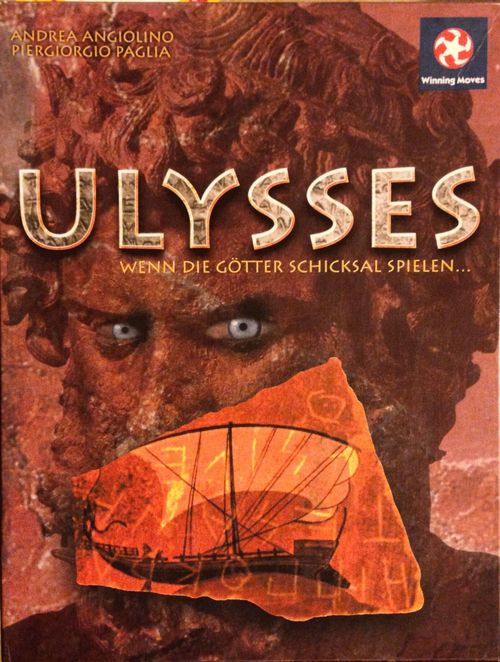
Ulysses
Ulysses Rulebook
Table of Contents
Table of Contents
Components
- 1 game board, showing the Mediterranean with the mythical islands and harbours that Odysseus visited, or may have visited. Each location has a colour (violet, green, red or blue) and shows the small symbol of the matching destination card.
- 36 destination cards showing these locations (the backs show the 4 colour groups of locations).
- 132 action cards, divided into:
- 50 objection cards (brown; used to object to destinations)
- 23 temple cards (yellow; used to build temples)
- 23 wind cards (orange; used to remain the active player)
- 16 plague cards (violet; used to place violet wooden discs)
- 11 Zeus cards (red; can be used as a wild card in place of any card)
- 9 Pandora cards (green; allow a player to draw two new action cards from the draw pile)
- Odysseus' ship
- 23 temples
- 9 wooden discs (1 blue, 1 red, 1 black and 6 violet)
- One rulebook
Setup
- Sort the destination cards by colour into 4 piles. Shuffle each pile separately and place them face down next to the game board. Each player draws one card face down from each pile, so that every player has one destination card of each colour.
- Place Odysseus' ship in Troy.
- Each player takes one temple and places it in front of them.
- Determine the starting player in any way. Play proceeds clockwise.
- Shuffle the action cards thoroughly. The starting player receives 5 cards, the second player (clockwise) 6, the third 7, and, if present, the fourth 8 and the fifth 9 cards. The remaining action cards are placed next to the board as a face-down draw pile.
Goal of the Game
Each player tries to pull Odysseus' ship to the 4 locations shown on their 4 destination cards. As soon as a player reaches their 4th destination, they have won and the game ends.
Course of Play
The starting player begins as the first active player with their turn. The turn of an active player consists of drawing action cards for all players, their own action phase, and the "Dispute of the Gods" over the new destination of Odysseus' ship. Afterwards the active player passes to the next player clockwise, unless they can and wish to play a wind card.
Drawing action cards: At the start of each new turn, each player, beginning with the active player and going around in turn, draws from the draw pile as many action cards as they have temples in front of them (so at the start of the 1st round, each player draws just one). If the draw pile runs out, the played cards from the discard pile are shuffled and used as a new face-down draw pile.
Action phase: The active player may carry out any number of the following actions in any order. Played action cards go onto the open discard pile:
- Draw more action cards: A player may play a Pandora card, or alternatively a Zeus card as a wild card for a Pandora. In doing so, they may take 2 new action cards from the draw pile. This can be done only once during the whole of the current turn.
- Place one or more plagues: For each plague card played, a player may place one plague (violet wooden disc) on any location on the game board. If all 6 violet wooden discs are already on the board, one of these discs must first be removed before a plague card can be played (see the next point).
- Remove one or more plagues: For each plague removed, a player must discard as many arbitrary action cards from their hand as they have temples in front of them.
- Exchange a destination card (allowed only once per turn): First, a player discards from their hand as many arbitrary action cards as they have temples. Then they place one of their own destination cards of their choice face down under the destination card pile of the same colour, and draw a new one from the top, face down, of any colour except the colour of the location where Odysseus' ship currently is. Through this exchange it is therefore also possible to hold several destination cards of the same colour.
- Build one or more temples: To build a temple, a player must discard, for each temple they already own, one temple card and one action card of their choice from their hand. That is, to build the second temple next to the one placed at the start of the game, a player must give up 1 temple card and 1 arbitrary card; to build the third temple, 2 temple cards and 2 arbitrary cards; to build a fourth temple, 3 temple cards and 3 arbitrary cards, and so on. Each temple is taken from the supply and placed in front of the player with their other temples. If there are no temples left in the supply, no new temple can be built.
Zeus cards: Zeus cards are wild cards that may be used in place of any other action card. If a Zeus card is used as a Pandora, the rule already mentioned still applies: two action cards may be drawn in this way only once per turn.
Propose a new destination: After completing their action phase, the active player proposes which location Odysseus' ship should be pulled to, and marks this location on the board with the blue wooden disc. The new destination must be connected to the old one by a line. A location with a plague (violet wooden disc) may not be chosen; if the active player wishes to move there, they must first remove the plague as part of their action phase.
The Dispute of the Gods: Going around clockwise, the players decide whether they agree with the new destination. If nobody objects, the blue wooden disc is removed and Odysseus' ship is placed on the new location. If a player does not agree with the choice of the new destination, the Dispute of the Gods begins.
The first player who decides to raise an objection (clockwise) plays at least one objection card and places the red wooden disc on another destination connected to the ship's current location. If the player wishes to choose a destination with a plague, they may remove the plague by discarding as many action cards from their hand as they have temples.
Going around in turn, the other players then decide whether they want to pass or play objection cards in support of the active player (blue wooden disc) or of the challenger (red wooden disc). A player who passes can no longer take part in the current dispute. All cards of one side are always counted together. At the end of the dispute, Odysseus' ship is pulled to the destination for which more objection cards have been played; in case of a tie, the blue destination takes precedence over the red. A player who wishes to support the red destination must play enough objection cards so that at least one more such card lies for the red destination than for the blue. Conversely, a player supporting the blue destination need only play at least as many objection cards that the cards played by both sides are level.
Cards continue to be played in turn. Each player must play at least one card, or as many cards as needed, until their side is ahead again, or they must pass. No one is forced to play their own objection cards; a player may also pass if they do not want to play any further. A dispute ends as soon as all players have passed. The played action cards go onto the open discard pile, and Odysseus' ship is pulled to the destination of the winning side. The wooden discs (blue and red) that marked the destinations are set aside again.
Example 1: Odysseus' ship is in Libya and Andreas places the blue wooden disc on Dido. Claudia challenges Andreas by playing an objection card and placing the red wooden disc on Zakynthos. Michael and Steffi pass. The dispute therefore takes place only between Andreas and Claudia: Andreas is the active player and needs to play only as many cards as Claudia in order to win the dispute. So Andreas also plays an objection card. Claudia plays another, likewise Andreas. Claudia places her third objection card and Andreas counters with a Zeus card (as a wild card for an objection card); Claudia plays her fourth objection card and Andreas has no objection cards left in his hand and must pass. Odysseus' ship moves to Zakynthos. Michael and Steffi are very pleased that Andreas and Claudia have got rid of so many objection cards.
Situations may also arise, as the next example shows, in which players are forced to play more than one objection card in order to stay in the dispute; either to exceed the number of objection cards of the defenders or to draw level with the number of objection cards of the challengers.
Example 2: Odysseus' ship is in Atlantis and Andreas places the blue wooden disc on Calypso; Claudia challenges Andreas with one objection card and places the red wooden disc on Lopadusa. Michael supports Claudia with a card. Steffi passes. To remain in the dispute, Andreas must now play 2 objection cards, because the challengers together already have 2 more than he has (none).
The following example is an even more complex dispute, involving four players:
Example 3: Odysseus' ship is in Minotaur and Andreas places the blue wooden disc on Melita. Claudia agrees, but Michael instead decides to challenge Andreas, plays an objection card and places the red wooden disc on Olympus. Steffi wishes to support Michael and plays an objection card for the challengers' side. Now it is Andreas's turn again and he wants to continue the dispute. He must now play 2 objection cards (to balance the 2 objection cards of Michael and Steffi together). He does so, and Claudia now decides to support Andreas, so she plays an objection card (she may do so, since she passed before the dispute began). Had she now passed, she would have left the ongoing dispute. Now it is Michael's turn again. To continue, he would have to play 2 cards (so that the challenger side again has one card more than the defenders). But he has only one objection card in his hand and no Zeus card. He must pass and is thus out of the rest of the current dispute: he may not play any further card. The dispute is not yet over, however. Steffi can continue and plays 2 objection cards indeed. Andreas counters with another card, Claudia passes, and Steffi plays another. Now the dispute takes place only between Andreas and Steffi. Andreas decides not to waste too many objection cards, so Odysseus' ship continues on to Olympus.
The black wooden disc: After a dispute between two sides has begun, a later player may, instead of passing or supporting a side, use a third option: they may place the black wooden disc (following the rules for the red one) on a third location. The dispute then takes place between three sides. To make the destination of the black wooden disc prevail, more objection cards must be played for this destination than for the blue and the red. In other words, if the blue side is level with the black, the blue side wins. If the red side is level, the red side wins. This means that to place the black disc, one needs at least two objection cards (in order to outbid the objection cards for the red destination).
If a player whose turn it is does not take the opportunity to place a red or black disc, they cannot make up for it later; they may, however, still join another player's dispute later (that is, a player who does not place a red disc may not later place a black one). If, however, they also do not take the opportunity to join a dispute, they can neither place a disc nor join in later.
Example 4: Odysseus' ship is in Sibyl and Andreas places the blue wooden disc on Pytusae; Claudia challenges Andreas by playing an objection card and placing the red wooden disc on Cyclopes. Michael passes and Steffi raises an objection against the destinations of Andreas and Claudia, places the black wooden disc on Elysium and plays 2 objection cards (one more than Claudia, which she must do in order to take the lead over her). Andreas passes (to remain in the dispute, he would have to play at least 2 objection cards in order to draw level with the highest bid, that for the black disc) and Claudia plays her second objection card. Steffi plays another and Claudia draws level with her third objection card. Steffi again one objection card, likewise Claudia. Then Steffi the next and Claudia again draws level. Steffi plays her 6th objection card and Claudia has neither objection nor Zeus cards in her hand to continue. She passes, whereby Steffi wins and Odysseus' ship moves to Elysium.
Remaining the active player: If the active player was not involved in a dispute, or won it, Odysseus' ship is pulled to the destination of the blue wooden disc. The active player may now remain the active player by playing a wind card. If they do so, the active player does not change, and the player on turn may now carry out their action phase again (that is, remove plagues, place plagues, build temples, exchange destination cards, play a Pandora card) and then determine a new destination for Odysseus' ship. This is not, however, a complete new turn, since the players do not draw action cards again, and a second destination card may not be exchanged, nor a second Pandora card (or Zeus card as a wild card for Pandora) played.
A player may remain the active player for as long as they are not defeated in a dispute and can keep playing wind cards. Otherwise, the active player passes clockwise and a new turn begins.
End of the Game
Each time Odysseus' ship reaches a location for which a player holds a matching destination card, that player must turn the card over and show it to everyone, even if they did not pull the ship there themselves. The player who is first to reveal all 4 of their destination cards wins the game.
Note: in the rules text, the term "player" ("Spieler") of course means both female and male players.