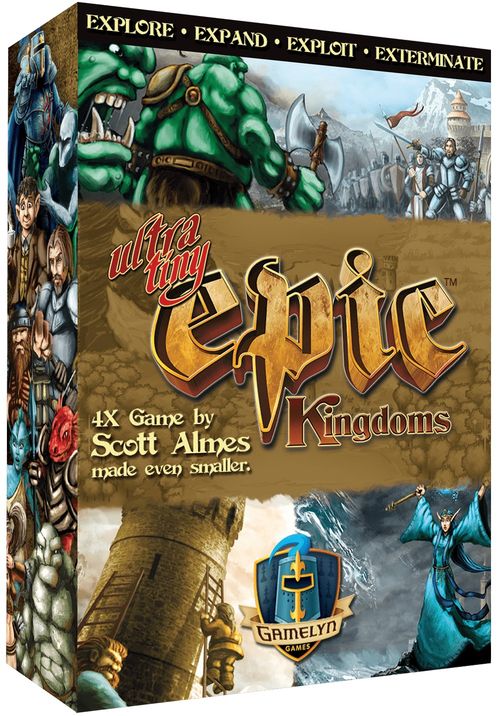
Ultra Tiny Epic Kingdoms
Ultra Tiny Epic Kingdoms Rulebook
Table of Contents
Table of Contents
Components
- 24 Cards:
- 16 Faction/Territory cards (double-sided)
- 1 Action Card
- 1 Tower Card
- 1 Compass Card (for Solo Game)
- 70 Cubes:
- 5 Gray Action Cubes
- 15 Resource Cubes (5 green "mana", 5 red "ore", 5 yellow "food")
- 50 Player Cubes (10 colored for each player)
- 1 Mini Tower
Card key: 1. Action Card, 2. Tower Card, 3. Faction Card, 4. Territory Card, 5. Resource Track, 6. Magic Level, 7. War Track.
Setup
Place the action card (1) and tower card (2) in the middle of the table. Then place the 5 gray action cubes next to the action card. Note: for modified rules for 1 player, see Solo Play Rules; for 2 players, see 2 Player Variant: The Lost Kingdom; for 5 players, see Playing with 5 Players.
Give each player to place in their area:
- 10 cubes in their chosen color
- 1 of each resource cube (mana, ore, & food)
- 1 faction card (3). Randomly draw, or chosen/drafted by each player.
- 1 territory card (4). Randomly draw from the faction cards not chosen. This is considered to be the player's home territory.
Each player should place:
- 3 resource cubes on their resource track (5) to represent a total of 6 resources. (For first time players, it is suggested they take: 1 ore, 2 mana, 3 food.) The 'zero' space is considered off the card.
- 1 player cube below the tower card, marking their tower level at 'zero' (2).
- 1 player cube below the magic levels on their faction card, marking their 'zero' level (6).
- 1 player cube near their war track (7).
- 2 player cubes (armies) on any one region on their home territory card (4). Place the remaining 5 cubes near their faction card.
Gameplay Overview
Players compete for the most victory points by expanding their armies, researching magic, and building towers. The game is played in a series of turns. Each turn, the active player selects an available action that all players will get a chance to perform. Then the active player token is passed to the next player clockwise and a new turn begins. Play continues like this until a player completes one of the end of game conditions. After which, players will add up their victory points and determine a winner.
On Your Turn
Every turn has five steps:
- If no more actions are available (i.e., if all 5 gray cubes have been placed), then clear the action card by removing all action cubes.
- Select an available action (one without a cube).
- Take the selected action (any player) or collect resources (non-active players only).
- Check for end-of-game conditions (see below).
- Pass the active player token (mini tower) clockwise.
Assign the Active Player Token
The player who most recently swung a sword is given the active player token (mini tower) and starts the game, or you may determine the first player randomly.
1. Clear the Action Card
If all 5 action cubes have been placed on the action card, take them all off and place them to the side of the card. You will now be able to select any action.
2. Select an Action
Place 1 of the action cubes on the action card. It must be placed on an action that doesn't already have an action cube on it. Announce which action you are selecting.
3. Take Action or Collect Resources
First, as the active player, you must either take the action you selected or choose to do nothing. Then in clockwise order, each other player must either take the same action you selected or collect resources (see Collect Resources). The active player cannot choose to collect resources.
Actions
There are 6 actions on the action card:
- Patrol - Regional army movement/Engage in war
- Quest - Territory army movement/Engage in war
- Build - Pay ore to construct tower (increase victory points)
- Research - Pay mana to learn magic (increase victory points)
- Expand - Pay food to grow army size (increase victory points)
- Trade - Exchange resources for other resources
Patrol
Move one of your player cubes (armies) into an adjacent region; that is, one that shares a common border with another region on the same territory card. You cannot patrol an army across or into water, including rivers, or crags (see Other Regions and Features).
The green arrows show legal patrolling. The red arrows show illegal patrolling because the river and crags are impassable.
Quest
Move one of your armies from one territory card to any other territory card. An army may only quest from and to a region that borders the edge of a territory card. You cannot quest across water, including rivers, or crags.
Movement Rules
- You cannot move an army into a region that already has 2 armies in it. At no point may more than 2 armies, of any colors, be in the same region.
- An army may never enter a region occupied by an opposing player's last army (i.e., the only army a player has in play), nor may you use your last army to enter a region occupied by an opponent.
Engaging in War
If you move an army into a region with another player's army, you must attack and start a war. You, the invading player, are the "attacker". The other player (whose army was already in the region) is the "defender."
- Set War Value – Both players, using their hand as cover, secretly set their war cube to a value on their war track indicating the total war cost they are willing to incur to fight the war (max value: 11). Players must have enough value in resources and ability bonuses when setting their war cube to pay their chosen war cost. OR, players may set their value to the white flag to offer a peaceful alliance; which requires no cost in resources.
- Reveal – Both players simultaneously reveal their value. The player with the highest war cost wins and takes control of the region. The other player, with the lowest war cost is the loser. If both players have selected the same war cost, the tie goes to the defender who then becomes the winner. If both players chose a white flag (0 war cost), a peaceful alliance is formed (see Forming an Alliance).
- Resolve – Win or lose, both players must pay their war cost. To pay your war cost, subtract any war cost abilities and then pay the remaining value with resources at the rate noted on the resource track: mana is worth 2, ore is worth 1, and food is worth zero. Then, the winner's army will remain in the warring region. The player who lost must retreat their army (see below) or remove it from play and return it to their supply.
Retreat
After war costs are paid, the losing player may pay food equal to the number of armies they currently have in play to move their army to an adjacent region. This movement however cannot result in another war. If there are no valid regions to move into, or the player does not have enough food, retreat is not an option, in which case you must remove the army from play and return it to the player's supply.
An Example of a War
Brittany starts a war with Mike. Brittany has a total of 1 mana, 2 ore and has a faction that offers a magic ability of -1 war cost. So, Brittany decides to set her war cube to the value of 5 even though she only has resources to pay a war cost of 4.
Mike wants to conserve his resources, and lets Brittany know he is willing to strike an alliance. He sets his war cube to the white flag to offer peace.
Mike and Brittany reveal their war values. Brittany's 5 beats Mike's zero, so she wins. Because of Brittany's faction ability, she only has to pay a war cost of 4 even though she set her war cube to a value of 5.
Mike chose peace and therefore pays no war cost. He must retreat or remove his army from play.
Forming an Alliance
If both players have offered the white flag of peace, their armies remain in the region, and both players will enjoy the benefits of that region. The two players are now considered to be in an alliance. Later, an allied player may patrol or quest their army out of an allied region without penalty. Then, if those players do not have any more allied regions together, they are no longer in an alliance.
Breaking an Alliance
If a player ever moves into a region, which starts a war with an ally, and doesn't offer peace, all allied regions they share are in jeopardy from this war. The war's winner will claim control of all the regions they share with the losing player. The player who lost must retreat all their armies in shared regions, paying the cost of retreat for each army, or remove them from play. The order in which these lost regions are resolved is chosen by the player who lost.
If breaking an alliance would result in a player losing their last army, then that player may retreat that army for free (no food paid) and must place that army in the nearest unoccupied region, even if there are no adjacent open regions and they must quest to a different territory card.
Build
Pay the number of ore necessary to reach the next level of the tower.
For example, the 1st level costs 1 ore, the 2nd level costs 2 ore, and so forth.
Starting with your cube off of the tower card, you advance your tower cube up by one level whenever you take the build action and pay the appropriate ore cost. You may only build 1 tower level per action. Tower cubes should be placed in the middle column of the card as they advance.
At the end of the game, you'll gain victory points equal to that listed on your tower level.
Research
Pay the number of mana necessary to reach the next level of the magic on the faction card.
For example, the 1st level costs 1 mana, the 2nd level costs 2 mana, and so forth.
Starting with your cube off of your faction card, you advance your magic research cube up by one level whenever you take the research action and pay the appropriate mana cost. You may only learn 1 magic level per action.
You immediately have access to the special ability granted by the new magic level and in addition to any already learned. These abilities are unique to each faction and may change how you interact with other players, and how you perform certain actions.
At the end of the game, you'll gain victory points equal to the number of mana cubes listed on your current magic level. Plus if you have achieved the highest magic level there is an opportunity to gain bonus victory points based on your faction.
Expand
Add a new army to a region you occupy, and pay food equal to the number of armies you now have in play (including the newest army).
For example, expanding for your 4th army costs 4 food.
The new army must be placed in the same region with another army of your color. Since there may never be more than 2 armies in any region, if you do not already have a solitary army, you may not expand.
At the end of the game, you'll gain 1 victory point for each of your armies in play, except for those in the ruins (see Other Regions and Features).
Trade
You may discard any number of 1 resource type and gain an equal number of 1 other resource type. You may only trade once per action.
For example, you may discard 3 food to gain 3 ore.
Collect Resources
Instead of taking the action selected by the active player, non-active players can collect resources from their occupied regions. For each region occupied by at least 1 of your armies, you collect one resource of that type. When you collect resources, you gain:
- Mana from forests
- Food from plains
- Ore from mountains
One Resource Only
Having more than 1 army on a region does not provide additional resources for that region; you still only collect 1.
Move Resource Cubes
Keep track of your resources using the resource track of your faction card, with the appropriate resource token showing how many of that resource you have.
Resource Maximum
9 is the maximum number of resources of each type that you can have (i.e., your resource cubes may never go past the end of your resource track).
"Last Army" Bonus Resource
In the rare event that you are reduced to 1 army in play, you may collect a bonus resource of your choice in addition to the 1 resource you gain from the region your single army occupies.
Other Regions and Features
Water, Rivers, and Crags
- These regions are impassable and cannot be occupied, unless stated otherwise by faction abilities.
- Rivers are treated like large bodies of water, and therefore impassable and regions divided by a river are not considered adjacent.
Capital Cities
- A capital city region is worth 2 victory points for the player who occupies it at the end of the game. If 2 allied players share a capital city, both allied players receive 1 victory point.
- A capital city region does not provide resources when collecting.
Ruins
Castle ruins and village rubble are rich in both resources and war stories. Armies that venture into these lands soon find themselves lost both physically and mentally.
- When collecting resources, for each ruins region you occupy, collect any 1 resource of your choice.
- You can only move an army out of the ruins as the active player (i.e., if you did not select the move action this turn, you cannot move an army out of the ruins).
- Armies in the ruins at the end of the game are considered lost and removed from play before scoring.
- Ruins are treated no differently than other regions regarding other movement rules, war and/or expanding.
4. Check for End-of-Game Conditions
Once every player has taken the selected action or collected resources, players should check to see if anybody has hit one of the following end-of-game conditions:
- A player has all 7 of their armies in play.
- A player has built the 6th level on the tower card.
- A player has researched all 5 levels of magic on their faction card.
If any one of these conditions has been met by any player, the end of the game is triggered. The trigger cannot be reversed by future actions. Play continues until the next time the action card is cleared. At that point the game ends immediately. Refer to the scoring section below to determine the winner.
5. Pass the Active Player Token
Pass the active player token clockwise, indicating who will select the next action. It is now their turn.
Scoring
After the game is over, each player gets victory points as follows:
- 1 victory point for each of your armies in play (except for those in the ruins)
- 1 victory point for each level of magic reached (plus bonus if the 5th magic level was reached)
- Victory points for the tower level reached
- Victory points for each capital city your armies occupy (2 for full control or 1 for allied control)
The player with the most victory points wins! In the event of a tie, check these tie-breaking conditions in this order:
- Most armies in play
- Highest tower level
- Highest magic level reached
- Highest total combined resources
If the tie remains, the game ends in a tie.
Solo Play Rules
Game Setup
Select a faction and a player color for you and a dummy player, this will be your opponent in solo play. For your opponent, some factions work better than others. Recommended factions to use for the dummy player are: Dark Elves, Dwarves, Orcs, Goblins, or Undead. (However, feel free to explore other factions.)
Select two Territory Cards. One belongs to you, and the other belongs to the dummy player. Place the Compass Card in the middle between the two territory cards with the Day Side facing up. The territory cards should be touching (or very near), the Compass Card.
Select any one forest and any one mountain region on the dummy player's territory and place one of their armies on each. The dummy player starts with three of each resource. If you wish to change the difficulty of your game, increase the number of resources the dummy player starts with.
Turn Structure
The dummy player and you will take turns just as in a normal game. When it is your turn to select an action, the dummy player must take the action if it can. If it cannot take the action you selected, it collects resources instead.
When it's the dummy player's turn to select an action, roll a twelve-sided die. The matching number on the Compass Card determines what action is selected. If that action has already been taken, continue around the Compass clockwise until you come to an action that has not been taken. The dummy player may always collect resources if they are unable to fulfill the action, even if they are the active player.
To play Ultra-Tiny Epic Kingdoms solo, you will need to supply your own twelve-sided die to roll to decide the dummy player's actions, or you can use the random number generator provided on the publisher's website.
The Compass Card
The Compass Card is used to help resolve actions for the dummy player.
Each time the Action Card is cleared, flip the Compass Card. This alternates the Compass between day and night, which affects war costs and how regions are selected. During the Day, the dummy player selects regions closer to the compass card. During the Night, the dummy player selects regions further from the Compass Card. In addition, when the card is flipped from Day to Night, the dummy player gains one resource of each type.
When the dummy player selects an action, use the same number rolled to determine any region selection, army selection, or movement required by that action. If the dummy player is taking the action you selected, roll their die once and use that number for their resolution.
Consider the Compass like a clock and the number rolled on the die determines the direction of a virtual 'hand'. This hand will point to the selection. If the hand does not intersect a region, imagine that it rotates one position clockwise and then continues to do so until a valid region is found.
For example, if an 11 is rolled: for Day, the mountain would be selected because it's closer to the compass; for Night, the forest is selected because it's further away.
Selecting an Army
If using a Patrol, Quest, or Expand action, roll the die to select the army. Always choose the first/closest one that is touched by the hand, and remember the Priority Selection (close/far) if it is Day or Night.
Roll the die:
- 12 - 1: Selects the Circle.
- 2 - 5: Selects the Hexagon.
- 6: Selects the Triangle.
- 7-11: Selects the Square, AND NOT the Star. During the Day, the Priority Selection is "close," so the square is closer. At Night, the Star would be selected because it is "far".
Moving an Army
To move an army for a Patrol action, imagine the Compass being superimposed on the army to determine the direction. After rolling the die, if the direction does not hit a region, continue clockwise until you hit a valid region to move into.
For example, if on a Patrol action an "8" is rolled, and that direction would not hit a region of a territory, the hand would rotate until "11" when it hits the forest.
Dummy Player Actions
Patrol – Use the Compass to select an army and to determine which region it will move to. A dummy army will not move into a region that already has one of its own armies, but will move into a region with an enemy.
Quest – Use the Compass to select the first army that can quest. Then, use the compass again to find a region for the army to move into. Ignore any invalid regions. A dummy army will not move into a region that already has one of its own armies, but will move into a region with an enemy.
War – When war starts, a war cost will need to be determined for the dummy player (see below). To win the war, you will need to pay a war cost equal to or higher than what is determined for the dummy player. If you cannot pay this cost or you choose not to, you lose the war.
The dummy player's war cost is determined based on whether the Compass Card is showing Day or Night. During the Day, the dummy player's war cost is twice the number of armies they have in play. At Night, the dummy player's war cost is equal to the number of armies they have in play. The dummy player never pays for war. If they can retreat they will, and they must pay to retreat. Use the Compass to determine the direction the army retreats.
Build – If the dummy player is able, they will discard the number of ore necessary to reach the next level of the tower. If using war towers, their war tower is placed in a region with an army selected using the compass.
Research – If the dummy player is able, they will discard the number of mana necessary to research the next magic level. The dummy player benefits from the abilities of its faction.
Expand – If the dummy player is able, they will discard the number of food necessary to create a new army. This army is not placed with an existing army, but rather in an open region adjacent to one of their armies. Use the compass to select a region where the new dummy army is placed.
Trade – The dummy player gains one of each resource type.
Collect Resources – The dummy player collects resources as normal as per its occupied regions.
Solo End Game and Scoring
Use the standard end game triggers and scoring methods.
2 Player Variant: The Lost Kingdom
To play with 2 players, a third territory card needs to be added to the game. This card is called the Lost Kingdom. Randomly place one of the unused territory cards in the middle of the table and place an army from an unused color on each occupiable region. These cubes are considered neutral armies.
During play, the players have the option of questing or patrolling into the Lost Kingdom. To do so, a player may have to enter into a war with a neutral army. To win against a neutral army, the player must pay a war cost at least equal to or higher than to the current number of neutral armies in play. By doing so, the player takes control of the region and captures the neutral army. Place the neutral army cube in your area, out of play. Players cannot enter into a region with a neutral army, starting a war, if they cannot pay the required war cost.
Once a player occupies a Lost Kingdom region, the other player may then patrol or quest into that region, starting a war, as usual, with that player. Players cannot form an alliance in a 2 player game, nor is it recommended to play with the Halfling faction.
At the end of the game, players gain 1 victory point for each region they occupy in the Lost Kingdom, plus 1 victory point for each neutral army they have captured.
Playing with 5 Players
The rules for a 5-player game are the same as 3-4 players, with the exception that the rest of the turn of the player who clears the action card gets skipped. No action is selected or taken this turn. The active player token is passed to the next player clockwise. This ensures that all players have an equal opportunity to make the first selection.