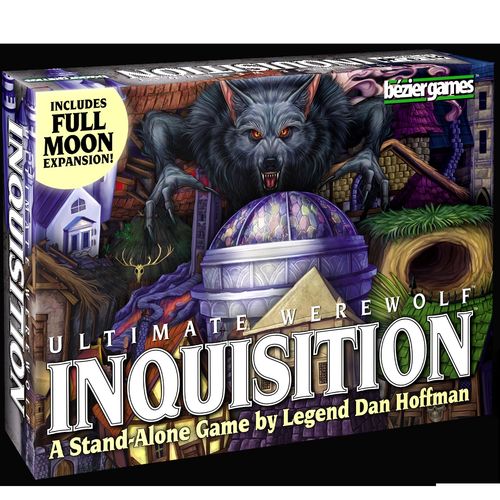
Ultimate Werewolf: Inquisition
Ultimate Werewolf: Inquisition Rulebook
Table of Contents
Table of Contents
Object of the Game
Help your team to either find the werewolves among the village residents or to hinder the investigative team's progress. Use the skills of the residents in the village to help you deduce who in the village is safe, and who you'll need to eliminate.
Two teams of players (Villagers and Werewolves) are investigating a village with the assistance of the residents. At the end of each day one of the residents is lynched by the players, and then the werewolf investigators eliminate another resident by eating him during the night. Dead residents and their corresponding huts are then removed from play.
Contents
- 12 Inquisitor cards (2 kinds)
- 19 Hut cards (14 kinds)
- 19 Resident cards (15 kinds)
- 1 Grand Inquisitor (standee)
- 50 Votes
Setup
Shuffle the Inquisition cards, using the table below to determine the card mix:
| Players | Villagers | Werewolves |
|---|---|---|
| 3 | 2 | 1 |
| 4 | 3 | 1 |
| 5 | 3 | 2 |
| 6 | 4 | 2 |
| 7 | 4 | 3 |
| 8 | 5 | 3 |
| 9 | 5 | 4 |
| 10 | 6 | 4 |
| 11 | 6 | 5 |
Deal out one face-down Inquisitor card to each player. The players view their card but keep it secret.
Place the votes in a pile. This is the supply. The supply is limited to the number of votes (50) in the game. It may happen that the supply runs out of votes; in this case players may not take votes from the supply for any purpose.
Each player gets 2 votes from the supply.
12 resident cards and their corresponding hut cards will be used in the game. Some of these residents are werewolves.
Choose a combination of residents where the numbers in the lower right of each card added together are as close to 0 as possible. See the Hut/Resident Combos section below for suggestions on which residents to use for your first game.
Shuffle and then place the resident cards face down in a grid, four cards across and three down. The cards should be positioned vertically, as shown in the rulebook diagram.
Place the huts to the side of the residents.
Give the Grand Inquisitor marker to a random player.
First Night
All players (including the Grand Inquisitor) close their eyes. The Grand Inquisitor (the player who has the Grand Inquisitor token) tells the werewolves to open their eyes so they can see who the other werewolves are. Then he tells the werewolves to close their eyes. The Grand Inquisitor tells everyone to open their eyes.
You can skip the First Night with 3 or 4 players, as there is only 1 werewolf in those games.
Each Day
Starting with the Grand Inquisitor and moving clockwise, each player must take a hut and do one of the following:
- Take the action for that hut, or
- Pass and take 2 votes from the supply.
If there are not enough huts for the players, the players who do not get to choose a hut instead take 2 votes from the supply.
After everyone has selected a hut, the voting begins. Beginning with the Grand Inquisitor, each player places a vote on one resident. If and only if a player has no votes, does he not place a vote on a resident.
The resident with the most votes is lynched. If more than one resident is tied for the most votes, the player with the Grand Inquisitor marker decides which of the tied residents with the most votes is lynched. Remove that card and its corresponding hut from the game.
If two columns have a single resident in them, they are combined (without changing their orientation).
The day is over, and it is now night.
Each Night
The Grand Inquisitor chooses any column of residents that has two or more cards in it, keeping them face down. Any votes on the cards in the selected column are removed and placed back in the supply.
The Grand Inquisitor tells the players to close their eyes, and then passes the cards to his left. Cards are passed around the table, with each player taking a few seconds before passing them again until the Grand Inquisitor receives the cards he originally passed.
Cards should always be passed face down. When passing, each player may open their eyes when they receive the cards, but must close them immediately after handing them to the player to their left. Only the werewolf players may look at the cards and change their order. Villagers may not view or change the order of the cards.
The passing of the cards is necessary for the werewolves to be able to choose a resident to kill. It is not intended to be a way for Villagers to figure out who is a Werewolf (if one player takes longer than expected to pass cards, or makes some sort of noise, for instance).
The cards are placed back in their column by the Grand Inquisitor starting at the very top row, but the bottom card is revealed and that resident is attacked by the werewolves. That resident card and its corresponding hut are removed from the game. All the remaining cards are placed back in vertical orientation.
If a werewolf is killed at night, all the vertical cards are picked up and shuffled and placed back in the spots where they were. Votes are removed from those cards.
A new day begins; the huts are placed back in the center of the table and the Grand Inquisitor marker is passed one player to the left. If two columns have a single resident in them, they are combined (without changing the orientation of each of the cards).
Game End
The game ends either when all the werewolf residents are dead (the Villagers win) or if there are more werewolf residents in the village than other residents at any time (the Werewolves win).
Huts and Residents
Each of the huts gives the player choosing it a special action. The Resident card orientation shown on the card only matters for viewing cards; it does not matter for placing/removing votes.
The term "Pay" means that in order to do the action, the player must pay votes in front of him to the supply. If he doesn't have enough votes, he may not do that action.
Balance numbers below (in parentheses) are printed in the lower right corner of each resident card, for use when building your own resident combination (see Hut/Resident Combos).
-
Apprentice Seer (+5): Pay 1 vote to the supply to secretly look at one of the vertical resident cards (without showing anyone else that card). After that resident card is viewed, it is placed back horizontally (width is longer than height).
-
Bodyguard (+2): Choose to protect one resident by removing all votes from a card (if any are there) and then placing the Bodyguard hut on the card. No more votes may be placed on this card during this round. The Bodyguard hut is removed from the card before the Grand Inquisitor chooses a column of cards to pass around at night.
-
Cursed (-1): Take 4 votes from the supply. If this hut's action was used by a player that day and the werewolves attack that card at night, it becomes a werewolf; that column's cards (including the Cursed) are shuffled and placed back in that column. It is now treated like a werewolf from this point forward in the game. It is possible for the werewolves to win the game by converting the Cursed to a werewolf, if that results in more werewolves than villagers.
-
Hunter (+1): Take 3 votes from the supply and place them on any single resident card.
-
Mason (+3): Pay 2 votes to look at the Inquisitor card of any player. You may not show the card, but you may say whatever you like about it. The Mason is not recommended for games with fewer than 5 players.
-
Mayor (+1): Give the Grand Inquisitor marker to any player (including yourself). The player who receives this will start the voting this round (and breaks ties) and also chooses the column of cards that is passed around the table at night. The Grand Inquisitor marker will be passed to the left at the beginning of the next day (so whoever receives it will pick a hut last the following day).
Hut/Resident Combos
When playing Inquisition for the first time, you might find it easiest to use the following set of huts and residents:
For 3-4 Players: 4 Werewolves, Apprentice Seer, Seer, Witch, Mayor, Hunter, Bodyguard, Minion, and Prince.
For 5+ Players: 4 Werewolves, Apprentice Seer, Seer, Witch, Mayor, Hunter, Sorcerer, 1 Villager, and Mason.
After your first game, you can choose any set of roles that you'd like, but try to keep the sum of the resident card numbers (in the lower right corner) close to zero to keep the game balanced.
With all players new to the game, you'll find that the werewolves have a hard time winning. As players get more experienced, they're more likely to use advanced techniques and strategies that will give them the edge.
If you find that the werewolves are winning too much, adjust the balance so that the sum is a larger number. If the werewolves aren't winning enough, adjust the balance so that the sum is a lower number.
Villager Strategy
Figuring out which of the inquisitors are werewolves is key to winning the game, as this will allow you to make more informed decisions when choosing special actions and voting for residents.
Later in the game, when there are fewer roles available, you might be able to prevent werewolves from using special powers by using the Mayor cleverly.
Werewolf Strategy
Keeping your identity a secret seems like it's the most important thing in the game, but actually, protecting the Werewolf residents is the most important thing.
If you can keep a werewolf alive one extra round by revealing yourself as a werewolf, that's likely to be more useful than letting that werewolf resident die while keeping your identity secret.