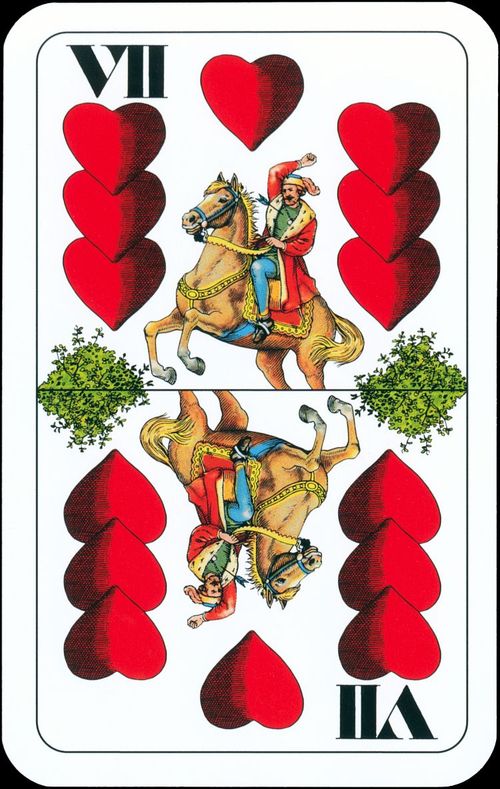
Ulti
Ulti Rulebook
Table of Contents
Table of Contents
Overview
Origin: The national game of Hungary, from ca 1800.
Deck and deal: Hungarian William Tell deck. Instructions here use a French 32 card deck 7 through Ace in four suits. (Ulti is traditionally played with a Hungarian William Tell deck in which the cards rank Ace, King, Over Knave (suit located at top), Under Jack (suit at bottom), 10, 9, 8, 7. The instructions here substitute Q for Over and Jack for Under and use English translations of the contracts.)
Players get 10 card hands.
For trump games cards rank: Ace, 10, King, Queen, Jack, 9, 8, 7.
For non-trump games cards rank: Ace, King, Queen, Jack, 10, 9, 8, 7.
Object: to earn the most points in contracts, by earning a majority of the tens and aces in tricks, declaring marriages, and achieving certain feats while taking those tricks.
Auction
Starts with dealer's right, who has to take talon, discard and bid. Thereafter, rotating counterclockwise, players may either
- Pass: move talon to next player.
- Bid: Take up talon, discard two cards face down. Then make a bid that is higher in points than the existing, or bid equal in points but with fewer components.
Players may re-enter after passing. Bidding continues anti-clockwise until three pass in a row. You can raise your own bid ("self robbing").
Card Play
Declarer names trump (if it hasn't been named as hearts or NT already) and then leads the first trick.
Trick following: F, T, R. In order of precedence: 1) must follow suit of card led foremost, and 2) must top the trick in that suit, if able, 3) must trump if void in suit, and 4) must top in doing so if able.
Example: If diamond 9 is led, and the second player has a diamond 8 and diamond 10, they must play the 10; but if they went third with the same two cards, and the second player trumped the 9, the third player must play either diamond (their choice, since neither will top the trick).
Example: In the previous case, if diamond 9 is led, and the second player plays a trump spade K, the third player (holding diamond 8 and diamond 10 and trump spade A), cannot play the Ace, since they are not void, and suit-following takes precedence over topping. They may play either diamond, since neither tops the trick.
Card Points
Card points captured in tricks are used to determine the winner of the hand.
| Card pts | |
|---|---|
| Aces and 10s | 10 |
| Last Trick | 10 |
| KQ of NT* | 20 |
| KQ of Trumps* | 40 |
*Marriages are King and Queen in the hand of the same suit. They get declared, without naming their suit, as one plays a card to the first trick. (But see the special case of 20-100, 40-100 below.)
Without marriages there are 90 trick points in the deck. Including marriages, there may be up to 190 card-pts in the deal.
Aces and Tens in the talon get scored for Defenders.
Contracts
- Simple (parti): Win more card points in tricks and marriages and last trick than opponents. Trump is named as one leads to the first trick. 1 cp
- 40-100: Win 100+ card pts, including 40 card pts from one trump marriage. (That is: 60 additional card-pts needed, which implies you can lose at most three Aces/10s/last.) No other marriages can be declared by either side. 4 cp
- 20-100: Win 100+ card pts, including 20 card pts from one non-trump marriage. (That is: 80 additional card-pts, which implies you can lose at most one Ace/10/or last.) No other marriages can be declared by either side. 8 cp
(One is permitted to "sacrifice" bid 20-100, 40-100 or ulti without the requisite marriages or 7, and one will necessarily lose that component. But that bid may still make sense in context to win a contract and for net points with additional contract components added on.)
- Slam (durchmars): Win every trick. Slam has two "ranks" in the auction: Slam and Open-Slam (teritett durchmars), both with either trump, hearts trump, or no-trump. Open slam is a commitment to win every trick with all three hands turned face up after the first trick is completed. A no-trump slam includes an additional NT Re-slam (redurchmars) option that is identical to a NT slam but for more points. (Its purpose is to mirror the hearts trump slam, and to lubricate the bidding.)
- Nullo (betli): Win no tricks at no-trump with natural rank order. Nullo comes in three "ranks": Plain Nullo, Re-Nullo (piros betli aka rebetli) and Open Nullo. The only difference between nullo and re-nullo is the latter is worth double the combo-points of the former (10 vs 5); akin to the "reslam", the two are identical otherwise. For Open Nullo, all three hands are turned face up after the first trick. Nullo games still follow standard Ulti trick-following rules to play a higher card to the trick if able. (Oddly, some sources call the Re-Null a "Hearts Nullo" (Piros Betli) despite the fact it is No-trump. To avoid confusion the author follows Lajos Widder and uses the term Rebetli, translated here as "Re-Nullo".)
- Hearts (piros): Playing with a trump suit of hearts. (All component-pts get doubled.)
- Ulti: Win last trick of a trump contract with the trump 7. If bid, that card must be held until the last trick if possible. (See below for oddities of ulti bids.) 4 cp
- Four Aces: Commitment by one player to take all four aces. 4 cp (See notes at end for some concerns with the Four Aces contract.)
Bids are announced by stating all the components sequentially, e.g. "40-100, in hearts, ulti." "Open Slam, notrump".
You can "mix and match" these contracts/components into your bid, providing they are higher than the previous bid and follow the constraints below.
The total value of the bid is the sum of the points of all the component points (CP).
As you go round the table, each next bid has to be higher in total CPs; or the same CP but less complex, i.e. with fewer components. (So betli at 5 beats ulti at 1+4.) However, many allow a hierarchy within the same CP and complexity, with Ulti taking precedence over Four Aces. (So a 4+4 "40-100 ulti" takes precedence and could be bid over a 4+4 "40-100 4-ace".)
The declarer is the player with the winning bid; the CP becomes the value of the hand. Total bids can range from 1 (simple) through 48 max (hearts ulti 20-100 open slam).
A declarer of a simple 1-game without hearts or ulti or four aces may concede prior to the first trick and lose double the normal amount to each player.
There are some restrictions on mixing components:
- A Simple can only be alone, or along with Hearts and/or Ulti and/or Four Aces.
- 20-100 can't combine with 40-100.
- Slams can't mix with Four Aces.
- Notrump bids (that is, NT Slams or NT Nullos) are always singular, and can't combine with anything else.
The easiest way to grasp the system is to use the following chart during bidding. In trump bids, any of the bids in the boxes (and only one per box) can be combined with any one bid in another box. Ulti and Hearts are able to be added to any of the trump bids. Hearts doubles all component values. The 1 pt for "Simple" game can be bid on its own (with or without hearts). But it also conjoins with Ulti and/or Four Aces implicitly if no other game is called. However, the simple isn't included for any of the higher bids. As shown in the chart, with Notrumps the bids are always alone without any components. (Note that "of Hearts" isn't itself a component adding complexity, it merely multiplies all the other components by 2.)
There is a "master chart" at the end of this document listing all 54 combinations you can consult if you feel you need to double-check a ranking or scoring.
Chart of Contract Components and their component point values
Trump bids (card order A-10-K-Q-J-9-8-7; doubling as a team):
- Simple: 1 (stands alone, or joins implicitly with Ulti and/or Four Aces if no other game is called)
- Ulti: 4 (may be added to any trump bid)
- Box A (only one from this box): Four Ace 4, or Slam 6, or Open Slam 12
- Box B (only one from this box): 40-100 4, or 20-100 8
- One bid from Box A may be combined with one from Box B, and with Ulti.
- Of Hearts: 2x (multiplies all components)
No-trump bids (card order A-K-Q-J-10-9-8-7; doubling individually), always alone:
- Nullo 5, or ReNullo 10, or Open Nullo 20
- Slam 6, or ReSlam 12, or Open Slam 24
Examples of component-points (CPs) used in ranking bids during the auction and for scoring the hand:
- Simple, Ulti (stated just as "Ulti"): 1+4 = 5 CPs.
- "Ulti, in Hearts" = 2*(1+4) = 2+8 = 10 CPs.
- "20-100, ulti" = 8+4 = 12 CPs
- "20-100, in hearts, ulti" = 2*(8+4) = 16+8 = 24 CPs.
- "40-100, slam" = 4+6 = 10 CPs
- "Open Slam in hearts, 20-100, with ulti" = 2*(12+8+4) = 48 CPs. (This is the very highest possible combo!)
- "Re-Slam" = 12.
Kontra, ReKontra (Doubles)
In addition to universal doubling that occurs with a Hearts trump, any individual component(s) of the declarer's bid can be selectively doubled 2x by either defender, and in turn redoubled 4x by declarer, and then re-doubled 8x, and so on to infinity. (In practice it rarely goes beyond redoubling.) Kontra should be stated when the defender plays to their first trick. A Redouble needs to happen before the start of the second trick. The specific components need to be identified, e.g. on a "40-100, ulti, 4 aces", a defender might say "Kontra the 4 Aces."
With a suit contract, either defender doubling affects both partners. With no-trump contracts, doubling is always individual and only affects the relative score of that defender and the declarer. Of course both defenders can join to individually double the same no-trump component.
Conceding a Simple
A declarer of a simple 1 game without ulti or four aces or hearts may concede prior to the first trick for a game value of 2 CP (double its normal value) to speed play and avoid incurring additional unbid ultis, 100s, etc.
Scoring
Base score: The value of a hand is the sum of the component points (CPs) for the contract, positive or negative depending on whether each part was achieved. Each component is scored individually, with positive points for achieving that component, and negative points for not achieving that component. You add in unbid silent bonuses too (see below).
For instance, say declarer bids "40-100, Ulti, with Four Aces" (4+4+4), and achieves the ulti but fails the 100 card points and fails the four aces. The cp value would be +4-4-4 = -4. This amounts to 4 game points paid by declarer to each defender.
Any aces or tens in the talon are scored by the defenders in trump games.
Points in Ulti are "hard scores" (usually money); what is won by one side is always paid by the other. If Declarer wins, each defender pays the CP amount to declarer. If lost, it is the reverse, and Declarer pays each Defender the CP amount.
As evidenced in the bidding charts, Hearts as trump doubles the points at stake for all components. Kontra by a Defender (and redoubling) doubles only the particular named component(s). Silent bonuses/penalties are also affected by a kontra.
Lost Ulti
If a declarer with an ulti contract fails to win the last trick with trump 7, a 4 cp extra penalty is enacted (8 for hearts) in addition to the 4 CP lost for the ulti (modified of course by any Hearts and Kontras). That is: for losing an ordinary ulti, declarer pays 8 total game points (to each defender), and for a heart ulti, 16 game pts. The additional penalty is not considered a "component" though, so the penalty is not doubled with kontra/rekontra. So, e.g., a failed heart ulti (8+2), where game and hearts had both been kontra'd (16+4), would have declarer give -20-8 = 28 pts to each defender. (The penalty 8 doesn't get doubled.) An ulti bid also, uniquely, incurs a "silent penalty" if any 7 is played and lost on the last trick by any player, even though not bid, and even if won by one's partner. (See below.)
Silent ("unbid") Bonuses
Silent bonuses are included in the scoring, garnering 2 cp points each (half of what those components would have made if declared). Either side can win silent bonuses (or, in the case of ulti, lose). As with regular failed ultis, kontras apply to all but the penalty part of the failed unbid ulti.
| Unbid | CPs | Hearts | Notes |
|---|---|---|---|
| Silent 100 | 2 | 4 | Either side winning 100 without a 100 contract. No limit on marriages included. Replaces the simple 1 (if it's there). |
| Silent four-aces | 2 | 4 | Scored by declarer or defenders. If by defenders, both score but it has to be achieved by one player. |
| Silent ulti | 2 | 4 | An unbid 7 trump played and won on the last trick by any player. If a defender wins it, both defenders score, against declarer. |
| Lost silent ulti* | -2-2 | -4-4 | If 7 trump unbid but played and lost on the last trick, by any player. Applies even if the defender's partner captures their 7. |
*The ulti is unique in that players can lose points even if no ulti was bid by either side.
Master Chart of All Contracts, Ranks, and Component Values
Columns: line number, rank, bid name, point value, total.
| Line | Rank | Bid Name | Pt value | Total |
|---|---|---|---|---|
| 1 | 1 | Simple | 1 | 1 |
| 2 | 2 | Simple in Hearts | 2 | 2 |
| 3 | 3 | 40/100 | 4 | 4 |
| 4 | 4 | 4 Ace | 4+1 | 5 |
| 5 | 5 | Ulti | 4+1 | 5 |
| 6 |
(Chart reproduced as printed in the source document, including the "16+25" value on line 53.)
Cheat Sheet (quick refresh once you know the game)
Summary turn order:
- 10 card hands.
- Dealer's right (forehand) starts the auction: must (take talon, discard, then) bid. Then, going counterclockwise, players either (a) Pass, moving talon to the next player; or (b) Take talon, discard two in their place, state bid, pass talon to the next player.
- After three consecutive passes, declarer leads to the trick. Players can re-enter, and they can bid over themselves.
- At the first trick: Marriages declared without naming suit. Last chance for defenders to kontra any component.
- Before the second trick is played: last chance to rekontra.
- Trick following is: FTR. Players must follow suit, must beat the highest card in the trick if they can, and play trumps if they are void of the led suit. In precedence: 1. Follow suit, first and foremost. 2. Top the trick if you can. 3. If you're void of the led suit, you must play a trump, in keeping with #2.
See the bidding chart for contracts, their pts, and card ranking.
- The CP in the chart is a hard score: declarer wins or loses that amount from each defender.
Reminders:
- Open contracts: all three hands turned up after the first trick.
- In 20-100 or 40-100, no other marriage can be declared by either party beyond that in the contract.
- The success of each component of the contract is evaluated separately to determine the value of the hand. Each defender pays that amount if declarer wins that component, each defender gets that much from declarer if that component of the contract fails. Each component can be doubled.
- Silent 100, Silent Ulti, and Silent 4-Ace are worth 2 pts if scored by either side, if unbid. Lost silent ulti is -4.
- Doubling affects both defenders in trump games, but is done individually in no trump games. Doubling doesn't affect the "lost ulti" extra 4 pt penalty.
- Card points don't matter with slams and nullos.
- You can bid components you're unable to fulfill, as a sacrifice bid.
Notes on Differences from Some Sources
- McCloud at Pagat doesn't rank multi-component bids of the same total as inferior, and simply has the first bid of equal value taking precedence. He thinks the system as outlined in these instructions leads to longer bidding and fosters "unscrupulous" bids by the defenders as they build their hands. According to the author's Hungarian sources he goes against how most Hungarians play.
- McCloud at Pagat omits the "four aces" contract saying it's too easy to earn. He notes some restrict it by stipulating you can't bid Four Aces with just a simple without combining with another contract. The (long gone) ultinet site counted only 3 pts for four ace but added a 9 pt "Four Ten" bid. Feel free to omit or restrict if you agree.
- McCloud at Pagat includes a stipulation that a suited Slam must always be combined with a 20-100 or 40-100. Here we follow what is found in the tournament rules and other sources where a slam can stand on its own. This is simpler and more straightforward.
- McCloud at Pagat has Open Durchmar score 24 (rather than 12) whether suited or in hearts. The tournament rules used here have the advantage that the hearts 2x rule is consistent without needing to remember exceptions.
- Biro, uniquely, has Slam earning 7 (rather than 6), and a simpler set of component restrictions. This makes fewer conflicting bids. However, he is an outlier being the only source of this scoring among all sources.
- Many sources include a Silent Unbid Slam, worth 3 cp (6 for hearts).
- The Ulti Tournament Association rules make a further hierarchy beyond Ulti > 4-ace so that Durch 40-100 and Durch Ulti can outbid Ulti of Hearts or 4 ace of Hearts, even though they are of equal pts and complexity. They do this to encourage those more exciting bids, at the price of lowering the elegance of the normal system.