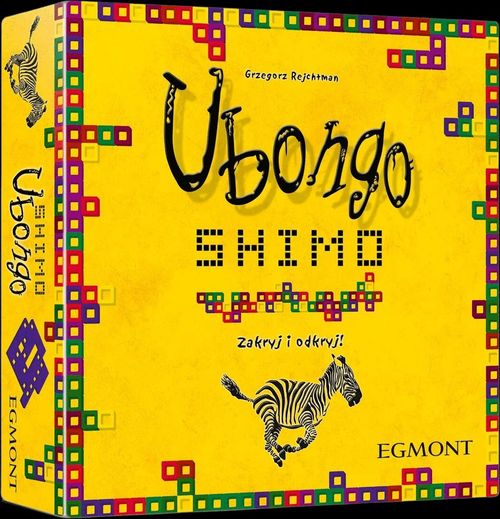
Ubongo Shimo
Ubongo Shimo Rulebook
Table of Contents
Table of Contents
Game Principle
Each player receives a set of 10 game pieces in one colour. At the start of each round, players reveal task cards and then must place the relevant pieces on the card so that all coloured fields are visible through the holes in the pieces. The player who places the pieces on their card first calls "Ubongo!", turns the hourglass, and the other players have one more minute to finish their tasks. For correct solutions, players gain gems and cards. The winner is the player who has collected the most points after 9 rounds, counted by the value of gems and cards.
Game Components
- 40 level 1 cards (green cards)
- 40 level 2 cards (blue cards)
- 40 level 3 cards (yellow cards)
- 40 level 4 cards (red cards)
- 40 coloured game pieces (10 for each player)
- 9 gems:
- 3 amber (yellow)
- 3 emeralds (green)
- 3 sapphires (blue)
- 1 hourglass
Task Cards
The assignments on both sides of each card have the same difficulty level. Difficulty levels are marked by different colours. There are 4 difficulty levels in the game. Level 1 is the easiest and level 4 is the hardest. The cards also show the numbers of the pieces you will need.
(Diagram: four example cards, one per level, with the difficulty colour strip, the tab marked with the task number, and a sidebar listing the numbers of the pieces needed.)
Game Pieces
- Each player receives a set of 10 pieces in their colour, numbered from 1 to 10.
- Each piece has two holes.
(Diagram: an example of one complete set of red pieces, numbered 1 to 10.)
Setup
- Choose a difficulty level and prepare the cards for it. We recommend starting with the first level (green cards). All players may play the same difficulty level, or you may choose different levels by agreement (for example, parents may choose harder tasks than children).
- Each player takes a set of pieces in the chosen colour and keeps it until the end of the game. If fewer than 4 players are playing, return the unused pieces to the box.
- Shuffle the cards of the chosen difficulty level and place them in the middle of the table as a draw pile. For different difficulty levels, create several piles.
- Place the hourglass in the middle of the table.
- Place the gems in the middle of the table.
Gameplay
- Each player takes one card from the top of the draw pile and places it in front of them.
- All players turn their cards over at the same time.
- The card determines which pieces the players must use for their task.
- Each player tries to place their pieces on the card as quickly as possible so that all coloured fields on the card are visible through the holes in the pieces. All pieces must remain inside the rectangular area of the card. No part of a piece may overlap another piece. Pieces may be freely rotated while you are placing them.
- The player who completes the task first calls "Ubongo!" and turns the hourglass. The other players have another 60 seconds to finish their tasks.
- The first player watches the hourglass and calls "Stop!" as soon as the time runs out. The round ends.
Scoring
- All players who solved their task keep their cards as victory points.
- The round winner takes one gem of the lowest value from the middle of the table. (In rounds 1–3 it is the yellow gem, in rounds 4–6 the green gem, and in rounds 7–9 the blue gem.)
- Players who did not solve their task in time must hand their cards to the winning player.
- If it cannot be determined who first called "Ubongo!" (for example, several players shouted at the same time), none of them receives a gem or cards from the other players. The gem for that round, and the cards of players who did not solve the puzzle, are returned to the box.
(Diagram: gem values. Amber gem = 1 point, emerald gem = 2 points, sapphire gem = 3 points.)
End of Game
- The game ends after 9 rounds, that is, at the moment when no gems remain in the middle of the table.
- Each player adds up the value of the points they have gained.
(Diagram: an example of a level 1 green card, labelled "1 point".)
- The winner is the player with the most points. If two or more players have the same number of points, the winner is the one with more cards. If that is still a tie, the players tied on points play one additional round. The winner of that round wins the whole game.
Variant: Different Way of Measuring Time
- As soon as a round begins, turn the hourglass. Turn it over each time the sand runs out, until someone completes the task and calls "Ubongo!". The current round ends when, after the last turn, the sand has run out.
Variant: For Advanced Players
- Place two piles of cards in the middle of the table: the level 3 and level 4 cards.
- In the first round, everyone takes a card from the level 4 pile and plays in the same way as in the basic game.
- In the second round, everyone takes a card from the level 3 pile and plays the round in the standard way.
- Until the end of the game, players alternate between level 4 and level 3 cards. It is important that all players play cards of the same level as the others.