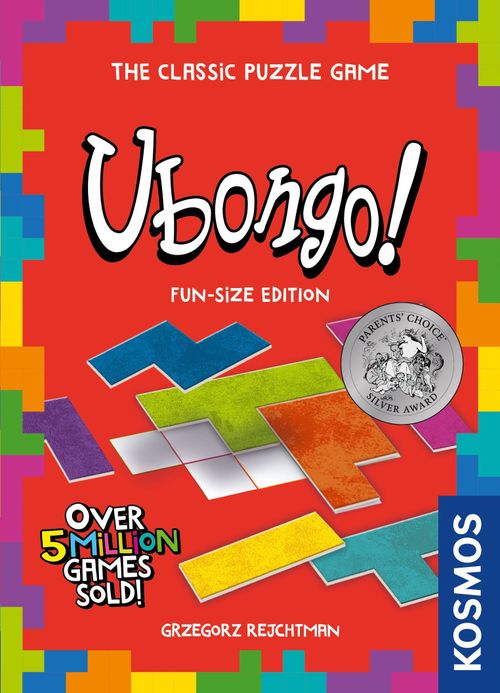
Ubongo! Fun-Size Edition
Ubongo! Fun-Size Edition Rulebook
Table of Contents
Table of Contents
Components
- 4 x 8 pieces
- 32 task cards with 64 different tasks
Setup
Before the first game, carefully push the pieces out of their frames.
Take the 32 task cards. Each task card has two sides with different difficulty levels:
- The A sides show the simpler tasks, for which you need 3 pieces each.
- The B sides show the harder tasks, for which you need 4 pieces each.
For your first game, we recommend using the simpler tasks. Turn all cards so the A side faces down, shuffle them, and place them as a stack in the middle of the table. The tasks you are about to play should lie face down at first.
- With 2 players, you need 16 cards.
- With 3 players, you need 24 cards.
- With 4 players, you need all 32 cards.
Return any surplus cards to the box without looking at them.
Each player receives a set of 8 different pieces. Pieces that are not needed go back into the box if there are fewer than 4 players. Each task needs only 3 or 4 pieces. Which pieces fit, you have to work out for yourselves.
Note: every task has at least three solutions, using different combinations of pieces.
Gameplay
The youngest player begins. Play proceeds clockwise and runs over 8 rounds.
Each round proceeds as follows:
- The starting player takes the top card from the stack and places it in front of them. The other players then each take one card in turn. Important: do not look at the underside of your card yet.
- Once everyone has a card in front of them, turn all of them over at the same time and start.
- Now everyone tries to cover the light building area on their board with their pieces as quickly as possible, exactly. This means the area must be fully covered, and nothing may protrude beyond the light building area at the sides. You may rotate and flip the pieces as you like.
- Whoever first manages to solve their own task calls out "Ubongo!" That player then counts aloud (but not too quickly) either to 20 (when playing with the A sides) or to 30 (when playing with the B sides). Before the game you may also agree on a different number.
- The player who solved their task first keeps their card as a victory point at the end of the round and places it in front of them.
- The other players keep working on their tasks while the counting goes on. Everyone who can also solve their task before the counting is finished may likewise keep their card as a victory point at the end of the round.
- When the counting is finished, everyone must stop. The player who finished first now additionally receives the cards of all players who could not solve their task, as victory points.
New round: This time, the player to the left of the player who solved their task first in the previous round begins. Take turns drawing a new card, and so on.
End of the Game
The game ends after 8 rounds, that is, when the stack in the middle is used up.
The player with the most cards as victory points in front of them wins. If several players have the highest score, they share the victory.
Solo Variant
If you want to play alone, you need a clock. Try to solve as many tasks as possible in 5 (or 10, or 20) minutes.
Another solo variant is to time how long you need to solve 5 (or 10, or 20) tasks.
If you get stuck on a task, you can set it aside and draw a new card. Write down your results and try to keep setting new records.
Increased Difficulty
If you want an even greater challenge, leave out the yellow straight piece. You then have only 7 pieces available to solve the tasks. Even then, all tasks remain solvable.
You can also use this variant so that, for example, less experienced players play with the yellow straight piece while advanced players must play without it.