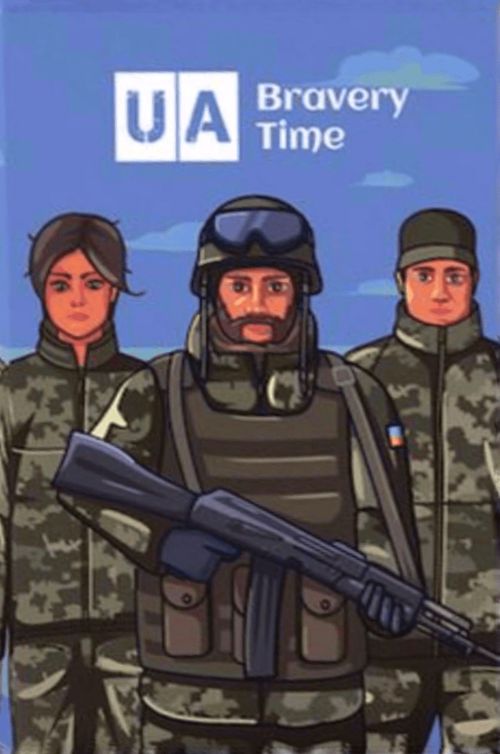
UA: Bravery Time
UA: Bravery Time Rulebook
Table of Contents
Table of Contents
Goal of the Game
In "UA: Bravery Time" for 1 to 7 players, you must defend the country together against an enemy attack.
To win at the end of the game, all territories must be liberated and all civilian needs that come up for the players during play must be resolved.
"UA: Bravery Time" is a cooperative game, so the players either win or lose together.
Contents
- 8 Territory cards
- 111 Player Action cards
- 24 Enemy Action cards
Setup
- Lay out the country map: place the four left-hand Ukraine territory cards with their "free" side up, and the four right-hand cards with their "occupied" side up.
- If there are 4 or fewer players, sort the Player Action deck and remove the cards marked with a "+" symbol, returning them to the box. If there are 5 to 7 players, use the full deck.
- Shuffle the prepared Player Action deck and place it in the centre of the table, within reach of every player.
- Shuffle the Enemy Action deck and place it at the upper left, above the country map.
- Deal each player 9 cards from the Player Action deck.
Game Overview
The game "UA: Bravery Time" lasts several rounds, during which you jointly strive to liberate all territories and help the people of the country.
Your cards in hand represent the opportunities and tasks available to you during the game. You may trade them freely with one another, unless the card's own ability expressly forbids it.
During a round you have the chance to help the people of the country, defend territories, attack the enemy to liberate a territory, and so on.
Game Round
One game round is one week of war. Each round consists of four stages, which follow one after another:
- Stage 1. Drawing Cards
- Stage 2. Planning Actions
- Stage 3. Enemy Actions
- Stage 4. Player Actions
Stage 1. Drawing Cards
Each player draws 3 cards from the Player Action deck and adds them to the cards in hand.
If at the end of the previous round a player still has unused urgent Civilian Needs (orange cards) in hand, that player draws 2 additional cards for each of them.
Stage 2. Planning Actions
All players simultaneously create their own plan for the week of war. From the cards in hand they form a set of cards which they will then be able to use during the Player Actions stage. The number of days each card requires to be completed is shown in the upper left corner of the card.
A week of war has 7 days, so the total days of all cards in one player's plan must be 7 days or fewer. Some cards require additional conditions to be met before they can be added to a plan.
Among the cards that players receive into their hands may be Enemy Action cards on your territory (Enemy Action cards that are in the Player Action deck). If you receive one or more such cards, you must immediately add them to the start of your plan.
Lay out your plan for the week in a row in front of you. The order of the cards is determined from left to right.
The leftmost card is the action for the first days of the week, and so on in order.
You do not know the enemy's plans in advance, so you must create your personal plan taking into account the plans of the other players and the fact that the enemy will also act. You may freely trade cards while forming a plan, unless the card's own ability expressly forbids it.
Stage 3. Enemy Actions
At this stage one card is revealed from the Enemy Action deck above the territory cards (one card if there are 4 or fewer players; two cards if there are 5 or more players).
If the last revealed card bears the "Additional Card" symbol (a red arrow), then one more card is immediately revealed from the deck. This continues until a card is revealed that does not bear the "Additional Card" symbol.
For each revealed "Enemy Offensive" card, the enemy begins a battle on the territory that has the fewest defense symbols among those that directly border the already captured (red) territories. If there are several such territories, you choose the territory the enemy attacks.
If there is no defense, the enemy wins and captures one territory without losses for each "Enemy Offensive" card.
If, however, any player's plan contains a "Defense" card, or the defense symbol is shown on the attacked territory itself, the players may begin to defend in a battle (see more in the "Battles" section).
Stage 4. Player Actions
Once the enemy's actions have been revealed and played, the players' actions begin to be carried out. At this stage it is forbidden to use cards from hand, so only the cards from the plan are played. It is advisable to play them in the following order:
- All players discard from their plan the red "Air Raid Alert" and "Information Attack" cards, the green "Almighty Volunteers" and "Cossack Drive" cards, and the corresponding number of yellow and orange Civilian Needs cards (see more in the "Card Types" section).
- Blue "Secret Operation" cards.
- Blue "Counteroffensive" cards. You may choose any territory bordering liberated territories yourself and begin a battle for it (see more in the "Battles" section).
- Blue "Reconnaissance" cards.
- Discard all unused cards, except "Coordination Headquarters" if any remain.
- Blue "Coordination Headquarters" cards. Carry out their properties, and the next round begins immediately.
Green "Konotop Witch" (Конотопська відьма) and "Fermar Squad" (Фермарський загін) cards are played when stated on the cards themselves, after which they are discarded together with the corresponding number of yellow and orange Civilian Needs cards (see more in the "Card Types" section).
After the actions are complete, the round ends and a new round begins.
Winning the Game
After the last card from the Enemy Action deck has been revealed, this round becomes the last round and the game ends. If all territories have been liberated by the players (cards turned to their green liberated side) and no yellow or orange Civilian Needs cards remain in any player's hand, the players win. If not all territories have been liberated, or if at least one player still has Civilian Needs cards in hand, all players lose together.
Card Types
-
Military Actions (blue): cards that allow you to defend and liberate territories, and that also have a number of other military capabilities.
-
Civilian Needs (yellow and orange): cards that must all be used by the end of the game in order to win. Civilian Needs come in two subtypes: regular (yellow) and urgent (orange). If at the end of a round a player still has unused urgent Civilian Needs in hand, that player draws 2 additional cards for each of them.
Civilian Needs cards add an amount of "Will" within the round. "Will" is an indicator of support from the people of the country, which allows the use of "People's Actions" cards. The Will symbol is shown as a raised fist.
-
People's Actions (green): cards that give additional bonuses to the players from the people of the country.
"People's Actions", unlike all other cards, do not take up time in a plan, but to be added to a plan they require the corresponding amount of "Will". The upper left corner of each card shows the amount of "Will" that card requires in order to be completed.
-
Enemy Actions (red): cards that subtract from the players' time in the plan and/or reduce the amount of "Will" within the round.
Battles
When the enemy attacks, or when you counteroffensive, a battle takes place. Several battles may occur within one round. In a battle one side is either attacking or defending, so only the cards of the corresponding type count in the battle. Cards bearing the defense symbol (a shield) add to defense strength, and cards bearing the attack symbol (a crosshair) add to attack strength.
The defense symbol is a shield in a hexagon; the attack symbol is a crosshair in a hexagon.
Winning a Battle
The attacking side wins if its strength is higher. Otherwise, the defending side wins.
When calculating strength, all the corresponding action cards from both sides are counted, along with the symbols on the territory where the battle takes place.
Battle Result
The result of each battle determines who owns the battle territory. If the attack wins, the territory passes to the other side; if the defense wins, control of the territory does not change. After the battle is over, the cards used are discarded.
Accordingly, if the enemy has more strength than needed to win, only as many cards are discarded as are sufficient for the victory.
Solo Play
For solo play you conditionally play as two players. You repeat the standard game setup in full, but at the start you take 18 cards. During the planning stage you build two different plans and may freely move cards between plans, ignoring the restriction on trading between players. In the "Drawing Cards" stage you draw 6 cards each time.