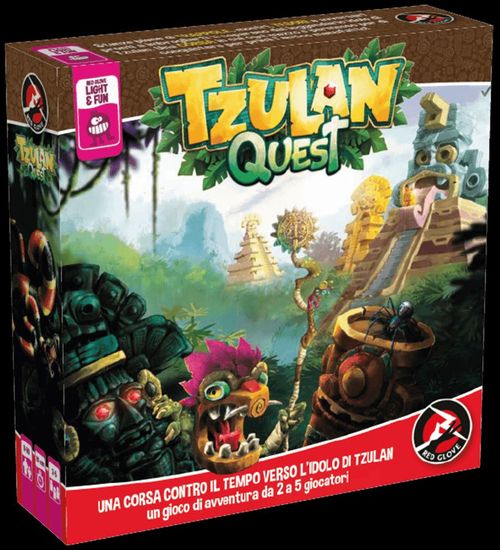
Tzulan Quest
Tzulan Quest Rulebook
Table of Contents
Table of Contents
Components
- 60 Action cards
- 12 Monster tokens
- 5 Trap tokens
- 12 Dark Rooms (Stanze Buie)
- 12 Mosaic Rooms (Stanze Mosaico)
- 12 Chasm Rooms (Stanze Baratro)
- 12 Infested Rooms (Stanze Infestate)
- 1 Altar Room tile
- 1 Idol
- 8 Adventurers with standups
- 20 Gems
Assembling the Standups
For the first game you must mount the figures on the standups; once done, you can leave them assembled in the box for later games. To mount the figures on the standups, hold the standup between the fingers of one hand: rest the index finger on one side and the middle finger on the other, pushing from below with the thumb. The standup will tend to open so that you can insert the figure.
Setup
- Take the Altar Room tile and place it in the centre of the table, face up. Place the Idol on it.
- Shuffle the Room tiles face down and deal 8 tiles to each player. Note: with 8 tiles the game is very fast. If you prefer longer games, you can decide to give more tiles to each player. Each player lays his tiles face down, in a row, without looking at them, on the table to form a path that ends with one side on the Altar Room. If you play on a small table, you can arrange them in another way, for example in an S shape, as long as it is clear which is the path and which tile comes after which. Put the remaining tiles back in the box: they will not be used in this game.
- Each player chooses the Adventurer he likes best (there are 8 Adventurers in the game to leave everyone wide freedom of choice), reveals the first tile of his path and places the chosen Adventurer on it. From now on the room in which your Adventurer is present will be called "active".
- Shuffle the Action deck and place it in the centre of the table so that everyone can reach it. Each player draws 3 cards without showing them to the opponents and keeps them in hand.
- Take all the Monster tokens and all the Trap tokens and place them on the table, in a spot easily reachable by all players.
- Take all the gems and place them on the table, in a spot easily reachable by all players. In the game there is no difference between red gems and green gems: you can freely mix them together.
You are ready to start playing!
How the Game Works
The goal of the game is to be the first to reach the Altar room with your Adventurer and take the precious Idol. During your turn you can play cards both to pass the rooms and their obstacles, and to hinder the opponents' race by playing monsters or traps on their paths. By defeating monsters and making trades with the other players you can earn gems to use to obtain bonuses in the game or as trading goods.
Turn Sequence
Starting from the first player and proceeding clockwise, each player takes his turn, following this order:
- DRAW PHASE: At the start of the turn, draw an Action card and add it to your hand.
- PLAY PHASE: In this phase you may play as many Action cards as you want (see PLAYING CARDS below), you may freely trade as many cards as you want with your opponents (see FREE MARKET below), and you may use the gems you earn during the game as trading goods or to perform special actions (see GEMS below). You may do one or more of these things, in any order you like.
- END OF TURN: When you cannot or no longer want to play Action cards, pass the turn to the next player and, if you are left with no cards in hand, draw 3.
Note: It may happen that you discard a card and are left with 0 cards outside your turn. In this case, you must immediately draw 3.
Note well: Trying to play all the cards you have in hand is an excellent strategy because it allows you to draw more cards and have more chances of getting the card you are looking for.
Playing Cards
In your turn you may play any number of Action cards from your hand. For each card played you must choose one of the two options offered: KEY or EFFECT, and apply it immediately. The used cards are then put in the "discard" pile, formed by all the Action cards played. When the Action deck runs out, the discard pile is reshuffled to form a new deck.
Note well: Normally it is possible to use only one of the two options of the card, KEY or EFFECT.
Action card layout:
- EFFECT: In the upper part of the card is described the effect you can use. The list of all card effects is found later in this manual.
- KEY: The lower part describes the key:
- Machete - passes an Infested room
- Tile piece (Tassello) - passes a Mosaic room
- Rope (Fune) - passes a Chasm room
- Torch (Torcia) - passes a Dark room
- Whip (Frusta) - eliminates a monster
Key
In the Action cards you will find objects shown in the foreground. Four of them serve to pass the rooms they are connected to (see the diagram to see the combinations). The Whip serves to defeat monsters.
You can play a key (Machete, Tile piece, Rope or Torch) and pass the active room only if the room is free of monsters. If there are monsters in the room you must first get rid of them (see below) and then play the card with the right key: you can thus proceed along your path, revealing the next room and moving your Adventurer onto it. During your turn you can pass as many rooms as you want, but each card allows you to pass only one room, even if the next room requires the same key. Your Adventurer can move only on your path: you cannot in any way go onto another player's path.
Example: (1) The active room of Banana Jones is an infested room. Fabio plays a Machete to open a passage. (2) He reveals the next room and moves Banana Jones onto it. Then he discards the card.
Getting Rid of Monsters in Your Active Room
Before you can pass the active room you must clear it of any monsters present. Doing so is very simple: just play a card with the Whip key. Remove the Monster token present in the active room and take, as written on the card, a gem. If there is more than one monster in the room and you have fewer Whips in hand than needed, you can play one whip in one turn and another whip later in the game; you do not have to eliminate them all together.
Example: (1) In Banana Jones's active room there is a monster. Fabio plays a Whip to get rid of it. (2) Then he discards the card and takes a gem, which he adds to his own. Now he is free to continue his race in the temple!
Effect
The Action cards contain various types of effects. When you play the Action card as an EFFECT, read and apply what is written on the card. Then put the card in the discard pile. At the end of this manual you will find all the effects described, in case you have doubts.
Free Market
The free market is the heart of the game: the more skilled you are at "bargaining" or "cheating" your opponents, the faster you will get the cards you need to pass the rooms. During your turn you can propose trades to the other players, offering cards from your hand in exchange for something else. You can propose more than one trade or receive proposals for more than one trade in the same turn. The only limit is that the trades in your turn must be made with you (e.g. in your turn, two other players cannot trade between themselves). Cards are always exchanged without being able to look first at what you receive, so you can bluff and give a different card from the one promised. It is up to you to decide how and when. You can accept trades as many times as you want in your turn, but only the first time you trade a card with a player, both of you receive 1 GEM. You will not receive further gems if you trade with the same player in the same turn. As true adventurers teach us, there is no limit to what you can ask for in a trade!
Example: You need a Machete to pass the infested room but you do not have that key among the action cards in your hand. You can ask aloud who is willing to give you that key, and the answers you receive may be quite bizarre. A player in search of riches might tell you "here is the Machete, but in exchange I want a card and a gem", another player might tell you "Yes, I will give you the Machete, but in exchange I want a Rope", and you might receive the Machete, if he is honest, or something else (or you might be the cunning one and give something else instead of the requested Rope). A lazy player might tell you "Yes, I will give you the Machete but afterwards you cook", while a threatening player might say "yes, but I want all your gems, and if you do not accept the trade I will play a monster in your room on my next turn!". These are only a few examples: there is no limit to imagination. Just remember that "what goes around comes around", and a player who cheats too often sooner or later loses the other players' consideration for future trades.
Gems
In your turn you may discard one or more gems to obtain bonuses. It is possible to obtain more than one bonus per turn and the same one several times, as you prefer. You can:
- discard 1 gem, to use both the EFFECT and the KEY of a card.
- discard 2 gems, to draw an Action card from the deck.
- discard 3 gems, to turn them into any key of your choice (you can pass any room or defeat a monster, but without receiving the gem).
There is no difference between red and green gems: you can use them interchangeably.
End of the Game
When a player passes the last room of his path and enters the Altar room, he can take the Idol of Tzulan and wave it in his opponents' faces: he was the fastest and shrewdest adventurer, for this time...
All the Effects of Tzulan Quest
Note: we recommend reading only the "Monster" and "Trap" effects and starting to play. All the effects in the game are intuitive and described on each card: consult the manual only if you have doubts.
Monster
In the recesses of the temple of Tzulan monsters of every kind lurk, besides the owners of the temple (and of the idol): the Brutti Musi! There are various types of monsters: Brutti Musi, Mummies, Carnivorous Plants, Giant Spiders, Badly-Dead Skeletons (Scheletri Morti Male), Shamans, Spectres and Studs. All monsters work in the same way.
When you play a Monster you can put a Monster token in the active Room of another player. That player will not be able to pass that Room until he gets rid of the Monster, using a Whip.
Warning: each Monster can be played only in its "Favourite Room" as described on the card (some Monsters have two Favourite Rooms to choose between). The symbol helps you identify the Room on the Tiles. You cannot use a Monster if there is no active Room corresponding to its Favourite Room.
If you play a Monster and there are no tokens available, take the token that remains furthest back on the various players' paths.
Each Room can contain more than 1 Monster.
Treasure (Tesoro)
The temple of Tzulan is rich in challenges, but it is also rich in treasures! Let us say that one can be found around every corner, you just have to stop and pick it up... If you are not too busy running toward the idol!
The treasure makes you draw 2 cards from the deck and add them to your hand. If the deck consists of only one card, draw the remaining card, shuffle the discards and draw the other.
Movable Room (Stanza Mobile)
Some rooms of the temple like to... move. Ancient forgotten mechanisms suddenly activate, making the temple's rooms slide away.
When you use the movable room, you can take your next room (the one immediately after the active room) and move it onto another player's path, as his next room (that is, after the active room). Trap or Monster tokens present on that room move together with it. Now your opponent will have one more room on his path and you one fewer! Your opponent draws a card.
Dead End (Vicolo Cieco)
It seemed the right way and instead the temple corridor collapsed before your eyes...
The unlucky player targeted by the Dead End moves his Adventurer from the Active Room to the previous Room. Any Trap or Monster tokens remain on the Room. That player draws a card.
Warning: you can play the Dead End on yourself too. For example, if your Active Room is full of monsters, you can use a Dead End to go back and then a Movable Room to give the Room full of Monsters to one of your opponents (maybe to whoever put the Monsters in your Room).
Theft (Furto)
Why use your own rope when you can always use someone else's?
Choose a player and look at his hand of cards. Choose one of his cards and take it, moving it to your hand. That player draws a card from the deck.
Talisman (Talismano)
Running through the temple corridors you might stumble upon magical Talismans of the Brutti Musi. As powerful as they are ugly and out of fashion.
This is the only effect to be played in an opponent's turn (discard it when you use it), when you are targeted by a negative effect (Monster, Movable Room, Dead End, Theft, Trap). You choose the new target of the effect: you may even decide to target whoever originally played the card. The new target can in turn decide to use a Talisman to bounce the Effect back, and so on. If an effect makes a card be drawn, it is always the player who suffered the Effect who draws it, not the one who played the Talisman.
If you decide to bounce a Monster, the targeted Active Room must be one of the Favourite Rooms for that Monster. If there are no other valid Active Rooms, you cannot use the Talisman against that Monster.
If you decide to bounce a Theft, you will not be the one stealing cards from another player: you simply decide which player will suffer the theft by the player who used the card. You cannot bounce the Theft onto the player who played it on you.
Escape (Fuga)
Sometimes you must resort to the last expedient handed down through generations of Adventurers: run and flee!
With Escape you can pass a Room even if it is crowded with Monsters. Together with the Escape card you must also play a card showing the Key needed to pass the Active Room. In this case, you will pass the Room normally but leave all the Monster Tokens in place: if another player plays a Dead End on you, you will find yourself in the middle of the monsters again!
Trap (Trappola)
The corridors of the temple of Tzulan are full of traps purposely placed by the Brutti Musi to keep intruders from entering the temple... Sometimes you even find a skeleton of a Brutto Muso there, but that is a detail: the Brutti Musi are not known for their intelligence.
When you play a Trap, take a Trap token and put it on another player's path, in the room immediately after his Active Room.
When a player enters the room of the Trap, he must decide whether to discard 2 among cards and gems to avoid it, or to fall into it and skip his next turn. In this case, the player takes the Trap card and puts it face up in front of him and his turn ends immediately. On his next turn, the player will discard the Trap card in front of him instead of playing. If a player cannot discard 2 among cards and gems because he does not have enough available, he can only choose to fall into the Trap. You cannot put more than one Trap per Room.
Lost Object (Oggetto Disperso)
Running through the corridors of the temple of Tzulan you may come across some object left earlier by another Adventurer, or the house keys lost by some absent-minded Brutto Muso...
When you play a Lost Object, take the discard pile in hand and look for a card with a key useful to you. Take this card and use it as a Key. Then discard both cards onto the discard pile. Needless to say, the Lost Object becomes stronger as the discard pile grows.
Quick Reference (Vademecum for the First Games)
TURN
- DRAW PHASE: Draw an Action card.
- PLAY PHASE: You may: play Action cards; trade with the other players; use Gems. You may play, trade and use gems in any order you like and several times in the same turn.
- END OF TURN: If you have no cards in hand, draw 3 Action cards.
GEMS
- (1 gem) Use both the Key and the Effect of a played Action card.
- (2 gems) Draw an Action card.
- (3 gems) Turn them into any key: you can pass any Room free of Monsters or defeat a monster (without taking the Gem).
Remember that there is no difference between green gems and red gems.