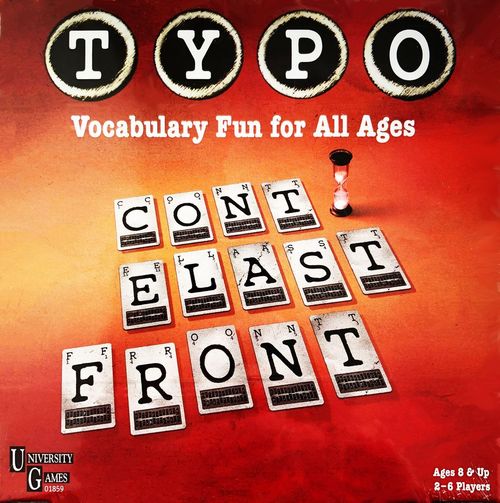
Typo
Typo Rulebook
Table of Contents
Table of Contents
Overview
Author: Corné van Moorsel Illustrations: Josine van Schijndel 2 to 6 players, ages 8 to 108 Duration: 30 minutes
You must try to connect the letters in your hand to the letter cards on the table, so as to form words that begin with the letters of the various rows.
Setup
- Shuffle the 64 cards. Each card shows a letter and a number indicating how many copies of that letter are in the deck.
- Place 4 cards at random on the table, starting 4 rows of cards (see illustration).
- Deal 12 cards to each player (only 10 cards each at 6 players). Every player must keep their cards secret.
- Set the remaining cards aside. They will not be used during the first half of the game.
- Give a pen and a sheet of paper to the player in charge of keeping score.
- If possible, get hold of a dictionary.
- Designate the "first" player, and give them the dictionary (or any other object).
First Half of the Game: Alphabetical
Each round, all players simultaneously choose one card from their hand. Once every player has chosen, the cards are revealed. Look among the letters played for the one that comes first in alphabetical order. The player who played it then adds that card to the left or right end of one of the four rows of letters on the table — rows that, at the start of the game, consist of only a single letter. The player who places a card this way must announce a word that begins with the letters of that row. Then it is the turn of the player whose letter comes next in alphabetical order to do the same, and so on. If two players played the same letter, the one earlier in turn order — starting with whoever holds the dictionary and going clockwise — places their letter first. Once every player has placed their card, the next round begins, with everyone choosing a card again, and so on.
Example
The four players have chosen their cards and reveal them. "F" is first in alphabetical order, so Ruud plays first, then Michael, Zinedine, and David.
Ruud places his "F" and says "front" (you must always read a row in its normal left-to-right direction — Ruud could not read it backwards, even supposing a word began that way). Michael says "elastic," and Zinedine says the same. David sees nothing he can do with his "V," so he plays it in place of the longest row instead, losing 6 points.
I Cannot Place This Letter
When you cannot start a word by adding your letter to any row, you remove and discard all the cards from the longest row and place your card there instead, so that it becomes the first letter of a new row. If several rows are the same length, you choose which one. You lose as many points as there were cards in the row you discarded — so your score goes negative. When you score negative points, you take the dictionary, meaning you place your card first if several players play the same letter in a later round.
This Word Does Not Exist
If you announce a word and half or more of the other players think that word does not exist, the player spells out the word, and the player holding the dictionary looks it up. (This is the only moment when the dictionary may be consulted!) If the word exists, you score 2 points (positive, this time). If the word does not exist, you remove the cards from the longest row and replace them with your letter — proceed as in "I Cannot Place This Letter" above. You then also lose 2 extra negative points for announcing a word that does not exist. If the players do not have a dictionary, decisions are made by majority vote, or settled by a player designated as judge.
Second Half of the Game: Anti-Alphabetical
When all the cards have been played, they are shuffled again, except for the cards forming the four rows. 12 cards are dealt again to each player (or fewer if there are not enough cards available — every player must receive the same number of cards). This second half of the game is played just like the first, except the cards are played in reverse alphabetical order, starting with "Z."
End of the Game
The player who has lost the fewest points wins.
Which Words Are Accepted?
Before starting the game, players must agree on which words will be accepted. The simplest rule is to accept only words that appear as such in the dictionary, to refuse proper nouns and abbreviations, and to accept plurals and conjugated verbs.
Variant Rule
- Goal: Be the first with 0 cards in your hand.
- Instead of writing minus points, you get cards from the discarded row into your hand of cards when you can't connect your letter.
- If the discarded row has 1 or 2 cards (this doesn't happen normally), then you take 1 card from the right side of the row into your hand of cards. The other card(s) of the row (left side) go out of the game.
- If the row had 3 or 4 cards, then you add the last 2 cards of that row to your hand.
- If the row had 5 or 6 cards, then you add the last 3 cards of that row to your hand.
- If the row had 7 or 8 cards, then you add the last 4 cards of that row to your hand.
- And so on. The first card(s) of the row (left side) go out of the game.
With this variant rule the number of cards in your hand will differ between players during the game. Fewer cards in your hand means that you are closer to victory but have fewer options. This variant is shorter than the normal game. At fairs it is used to let players learn the game in a shorter way.