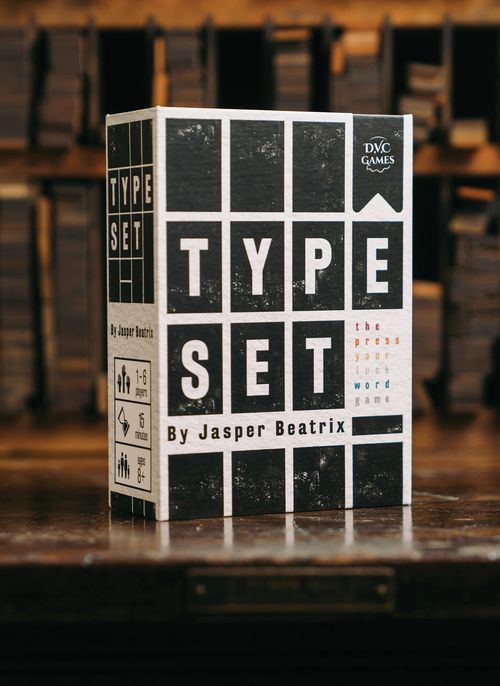
Typeset
Typeset Rulebook
Table of Contents
Table of Contents
Preparing to Play
- Lay out the game mat face-up on the play area (you can also choose to play without it - it is just for tracking which letters have been drawn).
- Each player selects a folding mat and marker.
- Shuffle the ability cards, choose one, and place it face-up for all players to see. Be sure to all agree on how it is used.
- Either shuffle the letter tokens in the box so they cannot be seen, or mix them face-down on the play area.
Overview & Goal
One letter is drawn for all players each turn. Each player adds the turn letter to their mat by writing it in the left-most open space of any row, crossing off and placing vowels as needed. The goal is to work towards longer words. After five letters are drawn, each player can choose to stop playing, or press their luck with five more letters. The highest score wins!
Components
- 25 ability cards
- 1 canvas game mat
- 6 player mats
- 6 dry-erase markers
- 45 letter tokens
- 1 rulesheet
Set-Up Example
An example ability card, Drop Cap, duplicates a placed letter in the same column.
Game Summary
Reveal
Reveal a letter tile at the start of each turn for all players. Move it to an empty space at the bottom of the mat for all to see.
Write
Place the turn letter by writing it on your mat. The letter may only go in the left-most empty space of any row. Each space can only have one letter. Every player does this during the same turn with the same letter. It cannot be saved for later.
You can start new words in empty rows or work on previous ones in any order you choose. You don't have to make complete words every turn.
FAQ
Vowels
You may add vowels at any time during a turn, before or after writing the turn letter. Cross off the vowel on your sheet, then place it like a turn letter—in the left-most available space of any row. You can do this multiple times per turn, as long as you still have vowels available to cross off. You only have so many vowels!
You can place vowels on their own in a row, even without any consonants.
Errors
Turn letters may be ignored up to five times. Any player may ignore or 'skip' a turn letter by circling a negative error number (i.e., the left-most available). If all five of your error numbers are circled, you must place all future turn letters (even if you are forced to form non-legal words!), until you stop playing after a round of five letters.
Rounds
Five turn letters constitute a round of play. To close out the round, move the five letters to matching letter spaces on the mat (to show which letter tokens have been revealed, and which ones are still available). Each player then chooses to either stop playing, or to play for another round. Players that stop can score their mat and wait for the other players to finish. Note that choosing to continue forces you to using five more letters, even if that causes errors or leads to unscorable words.
Players may use outside sources to check if a word is legal, or to verify its correct spelling. You can also ask each other!
Scoring
Scoring is based on the length of legal words. Players earn points for each complete, legal word; to determine how many points you've earned, compare each word's length to the scoring row at the top of the player sheet. Players receive a corresponding number of negative points for each incomplete or non-legal word. Players also receive negative points for all errors they circled (up to negative 4 points total).
Words that would typically just be names, such as people, places, or other proper nouns, are not legal words. If there are any blank spaces in a word (because of an ability), 'slide' the letters in that row to the left to fill the space. To find their score, each player adds up all their points and errors (which accumulate).
The player with the highest score wins, with ties broken by having the most longest words (normally seven letters), then most second-longest, and so on.
You may agree to play in one or more languages - be sure to agree on if additional words like slang or dialect spelling count before starting!
Wilds
You may earn wild letters. Wilds are bonus letters that can be the consonant or vowel of your choice. Wild letters must be used on the turn they are earned, or they are lost, and they are earned once each, through five methods:
- Cross off each of the vowels in a column (this can be done twice - two columns count).
- Have 3 of the 5 'challenge letters' (K, J, Q, X, Z).
- Have a letter in each of the four marked spaces.
- Use the special ability three times.
Once they are earned, wild letters can be used at any time during that same turn (i.e., before or after placing vowels or the turn letter), in the left-most available space of any row, or not placed at all.
Challenge letters are not available like vowels.
Example: Jerry uses the turn letter, and decides to place a U as well. This is the final letter needed to get a wild letter from using one of each vowel. The wild letter has to be used that turn, or it is lost. He uses it as a K, which is one of the 'challenge letters'. Since it is the third challenge letter, Jerry gets another wild letter to use this turn.
Abilities
Special abilities are opportunities to play differently. You don't have to play with one, but if you do, it can be used at any time, even multiple times on the same turn. Using the ability three times earns you a wild letter, and then you cannot use it any more. Be sure all players understand an ability before including it!
Playing solo? We call it a 'win' if you get at least 40 points AND use the ability all three times.