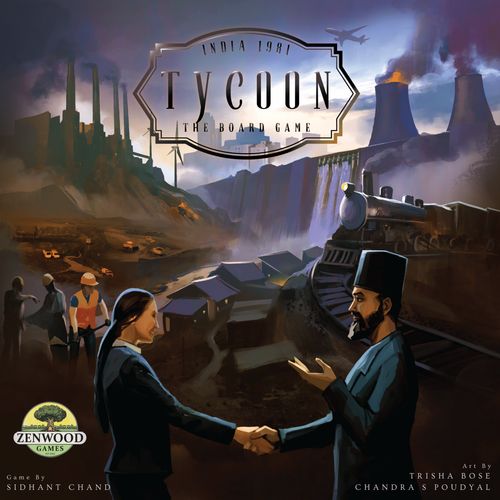
Tycoon: India 1981
Tycoon: India 1981 Rulebook
Table of Contents
Table of Contents
- Components
- Setup
- Game Overview and Concepts
- Gameplay - Phase 1: Activate a New Region
- Gameplay - Phase 2: Play Round Event/s
- Gameplay - Phase 3: Bid for Industries
- Industries, Tycoons and Players
- Gameplay - Phase 4: Take Actions
- End of Phase & End of Game
- Planning Commission & Corporate Agenda
- Endgame Scoring
- 2 Player Rules
- Solo Rules
- Headline Cards Variant
Components
- Map Board x1
- Sector Track Board x1
- Actions/Strategy Board x1
- Wooden discs, 4 colors x8 each
- Wooden plants, 4 colors x9 each
- Player Cards, 4 colors x1 each
- Player Shares, 4 colors x9 each
- Player Screens, 4 colors x1 each
- Action Tokens, 4 colors x2 each
- Age I Industry Cards x23
- Age II Industry Cards x25
- Age I Policy Cards x10
- Age II Policy Cards x12
- Promoter tokens: Value 1 x30, Value 3 x15
- Favor tokens: Value 1 x21, Value 3 x13
- +1 Action Token x10
- Conglomerate Bonuses x6
- Endgame Sector Favor x5
- Type A Planning Commission Cards x5
- Type B Planning Commission Cards x7
- Age I Headline Cards x7
- Age II Headline Cards x5
- Tycoon Round Pawn marker x1
- Money tokens of denominations 1, 5, 10, 20 and 50 Crores (in Indian Rupees) x100
- Merit Cards x30
- Promissory Notes x25
- AIPL Cards of 3 difficulty levels x52
Setup
For a 3-4 Player Game
- Layout the three game boards by unfolding and placing the 3 parts: Map Board, Sector Track Board & Actions/Strategy Board.
- Place the Round marker on round 0 (or Setup) of the round tracker on the bottom right of the Actions/Strategy board. Place the Tycoon pawn in the center of the Compass.
- Shuffle the Planning Commission cards A and B decks separately. Take 1 "A" and 2 "B" Planning Commission cards respectively. Display the 3 cards faceup in the slot on the Sector Track board.
- Shuffle the Policy cards Age I and II separately. Take 8 Age I Policy cards and all the 12 Age II Policy cards. Place Age I cards over II facedown, and form a Policy cards draw deck. Place the deck in the designated area of the Map Board.
- Shuffle the Industry cards Age I and II separately. Take 9 Age I cards and 18 Age II cards. Place Age I cards over Age II facedown, and form an Industry cards draw deck. Place the deck in the designated area of the Map Board, facedown.
- Shuffle all Merit cards and place them facedown on the designated area of the Map Board.
- Shuffle the 6 Conglomerate Bonuses tokens and pick 2 (for 3 player game) or 3 (for 4 player game) to place them faceup on the designated area of the Sector Track board.
- Shuffle the 5 EndGame Sector Favor tokens and pick 2 tokens to place them faceup on the designated area of the Sector Track board.
- Arrange and place the different Money tokens, Promoter tokens, Favor tokens, Promissory Notes, +1 Action tokens organized respectively near the board as a General Supply, within easy reach of all players.
- Give each player: 1 Player Card, 1 Player Screen, 8 wooden discs, 9 wooden plants, 9 Share tokens of values 30 to 70 - all of chosen player colour, and a Reference sheet, to form their personal supply. Share tokens are stacked in ascending order on the Player card, with share value '30' on top and '70' at bottom, respectively for each player.
- Decide a start player randomly. That player receives the Tycoon player marker along with the Tycoon action token and is the first player in turn order for that round. (Turn order always starts with Tycoon and goes clockwise).
- Each player collects their starting money tokens worth a total value of 150 Cr (Crores), with the exception of the Tycoon player who collects money worth 130 Cr instead.
Finally, display 2 Policy cards and 3 Industry cards in the designated slots on the Map Board. Move the round marker to round 1 of the tracker on the board. The game is now ready to begin.
Additional Rules for 2 player and solo game and Headline cards Variant are covered later, see 2 Player Rules, Solo Rules and Headline Cards Variant.
Game Overview and Concepts
Objective
You are a new Industrialist at the cusp of a new era of reforms in India, tasked at building the greatest Industrial empire in the country. Over a series of 7 rounds, you must bid against rivals for exclusive Industrial rights, acquire key Policies to gain bonuses, Build plants across key cities in India, take Loans (and sometimes Emergency Loans!), Muster your promoters to gain Strategic advantages, invest in other players' Shares, contribute to National Projects and gain Political advantages while re-building the Nation.
By carefully managing Money and Promoters, your eventual objective is to secure dominance in the two decisive parameters for a Tycoon: Wealth (or Asset Value) and Fame (or Influence). If you manage to do so, you win the game! However, if you manage to dominate only in one of the two parameters, then to win you also need to have the most government Favor to break ties.
Round Structure
Tycoon: India 1981 is played over a series of 7 rounds, tracked on the round tracker. Each round consists of 4 phases, in this order:
- Activate a new Region
- Play Round Event/s
- Bid for Industries
- Take Actions
A phase is resolved for all players (in turn order if needed), before moving on to the next phase, and so on. Once the fourth phase (Take Actions) is resolved, a round is complete; the round marker is moved to the next round and a new round begins with Phase 1 (Activate new Region).
The Era of the Tycoons
The game of Tycoon: India 1981 is played over a time period roughly spanning across 3 decades of India's economic history. During the 1960s to 1990s, the condition of Indian entrepreneurs and business tycoons was shaped by the economic and political climate of the time, often referred to as the era of "License Raj" or a tightly regulated and controlled economy, characterized by extensive government regulations, red tape, and a complex licensing system.
Many industries were protected from international competition through high import tariffs and strict controls on foreign investment. This created opportunities for established business houses, few of which emerged as dominant players in the Indian business landscape.
Limited competition and protectionist policies restricted new entrants. However, despite the challenges, some individuals and companies managed to succeed. The period ended with liberalization reforms in the 1990s, bringing significant changes and opening up new opportunities for entrepreneurs.
Game Base Concepts
Asset Value represents the total wealth of a player, and is one of the 2 major ways to win the game. You gain Asset Value by building more Industries, buying Shares of the right players, moving up on Finance & Transport track, and having Merit cards that provide Asset Value.
Influence represents your renown, popularity and brand equity. Having the most Influence is one of the 2 major ways to win the game, apart from Asset Value! You gain Influence by a vast multitude of ways; most of the actions/bonuses in the game give you Influence either in-game or at the end of game.
Favor is a tricky parameter - and in a way, the third way to win the game! Favor represents the support, backing and friendliness with the Indian government. You gain Favor through Policies, taking the 'Politics' action, investing in National Projects, fulfiling Corporate Agendas etc.
During the game, Asset Value is tracked indirectly via the values on the Industry cards or on certain areas of the board. In-game Influence is tracked on the Influence tracker around the Map Board. Favor is tracked via Favor tokens that players keep with them.
Each of these 3 parameters is additionally tracked and scored in the endgame, as per certain conditions.
Money is a vital resource in the game majorly spent on bidding for Industries, building plants and buying opponent Shares! You gain Money via Revenue from Industries, Share Dividends, Loans, Sales Strategy actions etc.
Promoters are the other main resource of the game that collectively represent key stakeholders allied to your company - Managers, Lobbyists and Workforce and so on. You may gain Promoters by taking the Politics Action, building Plants in the East region, moving up on the Minerals Production Track, etc. You spend them majorly in 2 ways - bidding for Policies and Mustering them in the Strategy Pool for taking various Strategy Actions.
Gameplay - Phase 1: Activate a New Region
Gain bonuses for every plant you've built in that region.
At the beginning of a round, the Tycoon player chooses 1 of the 3 available regions (or 4 in the first round of the game) and moves the pawn from the current region to the new region on the Compass to activate it. From round 2 onwards, the pawn MUST move and can't stay in the same region.
Once the pawn is placed and a region is activated, all players who have an existing plant built in any city in that region, gain the Region Bonus. They gain it as many times as they have plants of their color in that Region. The four region bonuses are mentioned on the compass illustration on the Map Board. At the beginning of the game, nobody gains any bonus as nobody would've built any plants yet!
Example - Tycoon activates the East Region. The pawn is placed in the East Region on the Compass. East Region Bonus is +1 Promoter. Green player has 2 plants in the East, and would gain 2 Promoters. Red player has 3 plants in the East, and therefore would gain 3 Promoters. Other players do not have plants in East and hence do not receive any bonus.
The Map Board
The Map Board represents the physical subcontinent of India, and cities of economic and industrial importance back in the 1980s.
- The Map is divided into 4 regions (North, East, South, West) demarcated by colored lines. Each region has 8 distinct cities.
- Cities are connected across the map via a single, cross-country road (represented by the thick golden line) that circuits around the map. This golden road will be useful to calculate distances for the purpose of Power and Transport costs as part of the Build Action, which is explained later.
- Each of the 4 regions has 1 "Regional Metro" city from which all distances are to be calculated. There is 1 metro in each of the 4 regions: Bombay, New Delhi, Calcutta and Madras.
- Each of the 4 Regions is associated with a small passive bonus that players gain anytime they build a plant in that region, AND anytime that region is activated at the beginning of a round.
- Each City is also associated with a one-time bonus that players get when they build a plant in that city.
Example: Margao gives "Move up 1 step on the Power Sector Production Track" when a plant is built there.
Gameplay - Phase 2: Play Round Event/s
Bid for Policy, Gain Revenue and Dividends and/or Invest in National Projects.
Depending on the round and what's printed on the round tracker, all players participate in the Round events, in order of their appearance on the tracker. There are 3 types of Round Events.
Event - Bid for Policy
During a Policy bid, all players take part in a closed Bid using Promoters. As per setup, there will always be 2 open Policies.
- Each player secretly chooses any number of Promoters from their own supply, conceals those Promoter tokens in their hand, closing to form a fist. They may also choose 0 promoters.
- Once every player has concealed promoters secretly, they all extend their fists and reveal their bids together.
- The player who has bid the highest number of Promoters wins the Policy Bid (in case of a tie, the tied player who's ahead in the Influence track, wins the Bid).
- The bid winner then pays their entire bid promoters to the Tycoon of that round. In case the winner is the Tycoon themselves, they instead pay their entire bid promoters to the general supply.
- All the remaining players MUST transfer all of their bid promoters to their own Strategy Pool for free.
- The bid winner then decides to pick any 1 of the 2 open Policies and add it to their play area face-up. They own the Policy and its bonuses for the rest of the game.
- If the picked Policy card had any promoter tokens on top of it, it goes to the bid winner's personal supply as well.
- The other Policy that wasn't chosen, accumulates a Promoter token from the general supply on top of it.
- A new Policy card is then revealed from the Policy draw deck, and the row is reset to 2 open Policy cards.
Ties for determining the Policy Bid winner are always broken by Influence track, i.e., the tied player ahead on the Influence Track, wins the bid. In case more than one player occupies the same number on the influence track, then the player who is higher up on the top of the stack, has more influence, and therefore breaks the tie.
Example - 4 Player Policy Bidding: All 4 players take part in the Policy Bid Event. Players reveal their chosen bid promoters simultaneously. Yellow player bids 0, Red player bids 2, Green player bids 1, Blue player bids 2. Both Red and Blue have bid the highest number of promoters, so there is a tie. On the Influence track, Blue is higher up than Red (higher on the stack of discs), and therefore is the final bid winner.
- Blue is the winner of the current Policy Bid event.
- They pay the winning bid (2 promoters) to the current Tycoon, i.e., Green.
- After that, Blue chooses the Policy "Institutes of Technology Act" and gains it, keeping it faceup near their player area. They also get to keep the free promoter on top of that Policy card.
- All remaining players (Green, Red) who did not win, transfer their bid promoters to their designated Strategy Pool.
- Yellow does not transfer anything as they bid 0 promoters.
The unchosen Policy then accumulates 1 promoter from general supply, and a new Policy card is drawn from the top of the Policy draw deck.
Policy Cards
These are powerful cards representing key government policies that were introduced in India during the 1960-90s. Players can gain Policy cards through an event called Policy Bidding, as well as via Strategy action.
There are 3 types of Policies: Industrial Policies (Age I) provide an endgame Influence bonus, Economic Policies (Age I) provide an ongoing passive benefit to the player throughout the game, while Liberal Policies (Age II) provide a one-time benefit immediately once a player gains the policy.
Additionally, every Policy also strengthens your Politics action, and is worth Favor at endgame.
Policies that shaped INDIA: Policies aimed to foster industrial growth by promoting import substitution and self-reliance. However, the closed economy approach limited competition, innovation, and access to international markets. Subsequent policy reforms were initiated to address these challenges in the following decades.
Industrialists heavily relied on favorable policies for their success. Access to resources, licenses, permits, taxation rates, and subsidies were all influenced by policies. The ability to understand, leverage, and influence the evolving policy landscape played a pivotal role in determining the fortunes of industrialists during this era.
In the game Tycoon: India 1981, each Policy is unique, and each contains a block of information around its history and significance.
Event: Gain Revenue and Dividends
This event is simultaneous. All players first gain Revenue and then gain Dividends on their opponent shares, if any.
- Add up the total Revenue value from all your Built Industry cards and gain that much money from the general supply.
- Then, gain Dividends of a total of 15 Cr per Opponent Share token you currently hold; 10 Cr from the Share owner (i.e, from the player with the same color as the Share) and 5 Cr from the general supply.
- In case a player is unable to pay Dividends, they MUST take an emergency loan to be able to do so.
Concepts of Industries and Shares are explained under Industries, Tycoons and Players.
Example - Red player takes Revenue and Dividends phase, and:
- Gains 20 + 15 = 35 Cr Revenue from their built Industries.
- Gains 30 Cr Dividends from opponent shares; 10 Cr each from the Blue and Green player respectively, and bonus 5x2=10 Cr from the general supply.
- Pays a dividend of 10 Cr to the yellow player for the Red share they hold.
Event: Invest in National Projects
This event takes place in turn order. Starting with the Tycoon player, and going clockwise, all players may optionally spend a mix of their Money and/or Promoters to gain Influence and Favor.
- You can choose how you want to spend in any combination of money and promoters, to gain the bonus that many times.
- You have only one chance in that round to pay and gain from National Projects, during your turn in the turn order.
- The cost changes from Round 3 to 6.
- You may skip this entirely in your turn if you do not wish to invest in National Projects.
Example of National Projects event in Round 3: Red spends 45 crores in total, and gains 9 Influence and 3 Favor tokens. Green spends 3 promoters and 15 crores in total, and gains 6 Influence and 2 Favor tokens, respectively. Blue and Yellow skip this event entirely.
Gameplay - Phase 3: Bid for Industries
In this phase, all players can take part in an open bidding with money, to acquire new Industry cards.
- As per setup, there will always be 3 open Industries.
- The bidding goes clockwise around the table, exactly 2 times! It starts with the Tycoon player and ends with the player seated right to the Tycoon.
- Players' current bids are tracked using player discs on the Industry Bidding tracker.
- The minimum bid amount to start bidding is equal to the minimum of the "Asset Value" of the 3 open Industry cards.
- Once a player announces their bid, the next player has two options: either to increase the previous bid OR pass.
- The minimum increment to the previous bid should be of 5 crores.
- All bids should be a multiple of 5.
- A player may also pass in their first, or second chance of bidding (including the Tycoon player). If a player passes on their first chance, then they do not get to bid in the second round.
Once the bidding goes twice around the table, the bidding ends. Check for the top two players in the bidding activity - these two players are the bid winners and only they will have a chance to choose new Industry cards.
- Both bid winners MUST first pay their bid amount in money, to the general supply.
- In the order of the bids, the highest bidder picks any 1 of the 3 open Industries and adds it to their play area.
- The second highest bidder then picks 1 of the remaining 2 Industry cards and adds it to their play area similarly.
- Upon picking an Industry card, players must immediately place an available plant from their supply ON the Industry card just acquired - This Industry card is now UNBUILT. Players do not gain any bonuses yet. They will now be able to build this plant on the map, in a later Actions phase to gain any bonuses.
- The unpicked Industry card/s from the 3 open Industry cards, accumulate a Promoter token from the general supply.
- Then, two new Industry cards are drawn and placed, resetting back to 3 total open Industry cards.
- All the remaining players that did not gain an Industry card this phase, do not pay any money. Irrespective of whether they took part in the bid or not, they each gain 3 free promoters in their Strategy Pool, from the general supply.
The highest Industry bidder gets to become the TYCOON player for the next round!
In case only one player put the bid and everyone passes in the first chance, only that player gets to pick an Industry card and everyone else gains 3 free promoters on the strategy pool.
If everyone passes in the first chance, nobody gets any Industry and everyone gains 3 promoters in their Strategy pool.
If a player does not have an available plant in their supply, they cannot take part in the bidding and must pass.
Example: It's a 3 player game. Red is the Tycoon. Minimum Bid is 30 Crores.
- Red bids 40 Cr
- Blue bids 45 Cr
- Green bids 55 Cr
- Red passes
- Blue bids 65 Cr
- Green passes
At the end of the bidding, as per the track, Blue is the highest bidder at 65 Cr, and Green is actually the 2nd highest bidder at 55 Crores (even though they passed). Blue and Green pay 65 and 55 Crores money, respectively. Blue being the highest bidder will be the TYCOON player for the NEXT round. Both of them pick Industry cards in order, place them faceup in their play area, and place a plant of their color from their supply onto their acquired Industry cards, marking it Unbuilt. Red doesn't pay anything, and instead gains 3 free promoters in their Strategy Pool.
Industries, Tycoons and Players
Industry Cards
Industries are the heart of Tycoon: India 1981. They represent many of the major industries that helped revive the Indian Economy in the 60s-90s. Not only do they improve both Asset Value & Influence, but also increase Industrial Sector Production and gives Revenue. Each Industry belongs to one of the 6 types of Industrial Sectors in the game: Finance, Minerals, Agro, Fuel, Power, Transport.
Industry Sector Tracks
Each of the sectors has its own track where players track their sector production levels using their player discs. Tracks are numbered from 1 to 7, and each sector has unique bonuses for moving up on the tracks! As players move up on the various sector tracks, they gain each bonus as they pass AND/OR land on them. (Except, if there is an Asset Value bonus printed, they would add that only in the end game scoring.)
The top position (7) of each production track can only be occupied by the first player who claims it. The rest of the players can reach up to level 6 if level 7 is occupied already. Beyond that, if you still gain sector production track progress, then it goes to waste and you don't gain anything.
New Wave of Industrialisation
Several key industrial sectors played a pivotal role in shaping the country's economy and development. Industries like automobiles, steel, chemicals, pharmaceuticals, etc. contributed significantly to the industrialization of India. The government emphasized agricultural development and introduced policies to improve productivity and infrastructure. Power sector focused on generating electricity and meeting the growing energy demands of the nation. Roadways and railways made way for high speed mobility across the nation.
In the Liberal era, industrialists could express their interest in acquiring specific public sector industries and participate in competitive bidding processes. The government evaluated the bids based on various factors, including financial viability, management expertise, and the proposed plans for the industry.
The Tycoons of India!
Each powerful industrialist employed diverse strategies to seize the largest market share and become the top Tycoon! These strategies encompassed multiple dimensions, such as aggressive expansion through acquisitions and mergers, diversification into new sectors, and capitalizing on emerging opportunities. Industrialists leveraged their entrepreneurial acumen to identify untapped markets, develop innovative products, and establish robust distribution networks. Additionally, strategic alliances, technological advancements, and astute marketing tactics played pivotal roles in their quest for dominance. The pursuit of tycoon status spurred intense competition and fueled an era of remarkable economic growth and transformation in India.
Tycoon Player Marker
The Tycoon player plays like a regular player, but has certain powers - they decide the active region, start the turn order etc. They also lead that round; they make sure all transactions are being done correctly, and all rules are followed for bidding, actions etc.
They also get to take an additional Action as compared to the other players, in the 4th Phase - Take Actions.
Player Cards
The Player card is used to represent your player color, store all your share tokens in ascending order from 30 to 70 in a stack, as well as store opponent player shares in the space below.
It makes it easy to calculate shareholding dividends during the specific event.
Players in this game play one of the four fictional industrial houses: Cyrus Corporation, Gopalan Group Inc, Angelo Associates, and Satnam Services Pvt. Ltd.
Gameplay - Phase 4: Take Actions
In this phase, players take up to 2 (or 3 if Tycoon) different actions, one at a time.
- Starting with the Tycoon player and going clockwise, each player must take an action among the 6 types, or Pass.
- You cannot take the same action more than once in the same Actions phase. Opponent action tokens do not restrict you from taking that action, however.
- When you take an Action, you must mark it on the action space on the board with an action token of your color, as a reminder that it cannot be repeated by you again.
- After you've completed your chosen action, the turn then goes to the next player in clockwise order, who takes 1 action and so on, till all players have used up their action tokens and/or have passed.
- If you are the Tycoon player, you have an additional Tycoon action token which you can use to take a 3rd 'different' action.
- Additionally, you might also have one or more +1 Action token/s that you could have gained beforehand. This +1 Action token can be used to take ANY action you want to, irrespective of if you already had taken that action earlier! The +1 Action token is a one-time benefit and must be discarded immediately after its use. You must still take only 1 Action in a turn.
- Once all players have taken their desired actions turn by turn, and have passed, the Action Phase ends.
The 6 Actions are explained as follows:
Action: Build
Build an Industrial plant on any city on the Map. Pay the building costs to the leaders, and gain 4 bonuses.
- Decide an empty city on the Map, where you want to build the linked plant. Each city can accommodate only a single plant of any player.
- Calculate the costs of building your plant in the city, as mentioned on the Industry card:
- Check the Industrial sector icon/s present at the bottom of the Industry card you're building.
- These are the resources you need to buy from the sector leaders, to build your plant - by paying money.
- For each sector icon, calculate the relevant resource cost and pay the cost to that sector's current leader.
- The SECTOR LEADER is the player currently at the highest position on that specific Industrial sector production track.
- In case more than 1 player is at the highest position of a track, the leader is the one whose disc is at the top of the stack, i.e, who became the leader most recently.
- If there is no player disc on a sector, we assume that a neutral 'Government' player is the sector leader occupying level 1 of that sector. In such a case, the cost payment goes to the general supply.
- If the player who is building the plant is also the sector leader of a sector they need to buy as resource, they do not pay anything!
- The cost to be paid depends on which sector it is.
- For Minerals, Fuel, and Agro, the cost to be paid is 2 Crores per level the Sector leader is currently at.
- For Power and Transport, the cost is 1 Crore per city distance from the Regional Metro city. When calculating distance, both the Metro and destination cities are included.
- Pay the money resource costs to the respective leader/s: Once the cost is figured out and money is paid to the respective leaders, the player places their plant on the city chosen.
- Gain bonuses from the Industry card, region, and city:
- From the Industry card: 1 or 2 steps up an Industry Sector, and Influence (move up on Influence track).
Reminder: Regional Metro is the metro city in the region where the Pawn is currently present. (Bombay, New Delhi, Calcutta & Madras.)
You may only build 1 single plant in 1 Build action.
Example - Red player takes a Build Action:
- Red has decided to build the "Refinery" plant in Nashik.
- The resources needed to build Refinery are Minerals & Power.
- The leader in Minerals is Green. The cost for Minerals is 3 (level) x 2 Crore = 6 Crores.
- The leader in Power is Blue. The cost for Power is 2 (distance from Bombay, the regional Metro) x 1 Crore = 2 Crores.
- Red pays 6 Crores to Green and 2 Crores to Blue, and places the plant in Nashik.
After building the 'Refinery' plant in Nashik, Red immediately gains: 2 steps on Fuel Sector track (Industry card), 4 steps on Influence track (Industry card), 1 step on Agro Sector track (bonus from Nashik), 5 Crores from Region bonus (West region bonus).
Action: Share
Buy a Share of any one opponent directly. Be eligible for Dividends and improve your endgame Asset Value.
- Decide which player's share you want to buy. While it is not a formal rule, there is nothing stopping others from pitching their share to you.
- Check the lowest-valued share token of that player.
- Pay money as per the value mentioned on the cheapest share token, directly to the opponent player. Pick that share token, flip it to the non-value side, and keep it on your Player card.
- Move up on the Influence track at 2 influence per opponent share token that you currently have (including the share you currently bought).
- Opponents CANNOT deny selling you their share as long as you pay the required money to them and buy their cheapest share token.
Player Share Tokens: Shares represent publicly available company shares that are available for others to buy. Every player starts with 9 shares of their own color. Each share has its purchase value written on top of it, and hence the shares are arranged in ascending order from 30 Crores to 70 Crores.
You can buy opponent shares using the Share action. You must always buy the cheapest available share from that player. During the Revenue event, all shareholders gain dividend income from respective share-owners as well as from the general supply.
But majorly, opponent shares are worth Asset Value in the end game. Your own colored shares DO NOT count towards dividends or even asset value scoring for yourself!
Example: Red takes a Share action and buys a Blue Share. Red pays 45 Crores money directly to Blue, and Blue gives their (cheapest) 45 Crores valued Blue Share token to Red. Red also scores 6 Influence immediately, as now they have 3 opponent shares in total. Red is now a shareholder of Blue (2 Blue Shares).
Action: Muster
Add promoters from your hand to your own Strategy Pool, in order to take powerful Strategy actions in later turns. Then, gain a Merit card.
- Transfer from 1 up to 6 promoters from your own supply to your strategy pool (of your color).
- Finally, gain exactly 1 Merit card.
- You must at least transfer 1 Promoter to the Strategy Pool, to be able to take this Action.
Merit Cards: Merit cards are one-time bonus cards that can be taken during a specified time in the game, as mentioned on the cards themselves. Players gaining Merit cards must keep them secret from others and may feel free to use one or more of them at appropriate times during the game. There are various types of bonuses that one can find in Merit cards! Merit cards mention the bonuses as well as the time/phase when this card can be played during the game. There is no limit of unused Merit cards that you may own. Once played, Merit cards are discarded to the bottom of the Merit Card deck.
Action: Strategy
Discard a number of Promoters to gain any 1 bonus printed on one of the available Strategy Actions spaces.
There are two kinds of Strategy Action Spaces:
- Administration: These Strategy actions are always available to all players. To take one of these actions, remove 2 Promoters from Strategy Pool. The specific bonuses are explained below.
- Non-Administration: Apart from Administration, every other Strategy action requires players to follow these specific steps:
- Decide which Strategy Action you want to take. Only the ones visible (which are not covered already) are available to choose from.
- Remove as many Promoters from your Strategy Pool as mentioned in the cost for gaining the chosen Strategy Action bonus. You can't take a Strategy Action if you do not have the required amount of promoters in your pool.
- Take your (own player color) cheapest Share token, flip it to the non-value side, and cover the Strategy Action space that you chose.
- Gain the bonus that you just covered.
Strategy Actions indirectly increase your current Share price!
Strategy Actions List
Administration Strategy Actions:
- Gain +1 Action token: Discard 2 Promoters from your pool to take a +1 Action Token. You can either use this Action token to repeat an action this round or save it for a later round!
- Buy an Industry card: Discard 2 Promoters from your pool, and directly buy an available Industry card (from the 3 open industries available). You need to pay 2 times the Asset Value of the Industry card you want to buy! Then, gain a small bonus of either 10 Crores money OR 2 Influence. Add an available plant to your newly bought Industry card as usual, marking it as UNBUILT, just like you would do after winning an Industry bid. Reset back to 3 open Industry cards in the display.
- Sales: Discard 3 or 4 Promoters to gain specified Money from the general supply.
Non-Administration Strategy Actions:
- Lobby: Discard 5 Promoters to gain any 1 open Policy card (from 2) of your choice, and place it near your player area. You own this Policy and all its bonuses/effects from now on. Gain any promoters on the Policy card if any. Reset back to 2 open Policy cards.
- Office: Discard 5 Promoters to add an unused available plant of your player color, to any empty city of your choice. Gain the Region and City bonus immediately. This plant acts as a regular plant on the map for all other purposes henceforth.
- Advertising: Discard 4 or 6 Promoters to gain specified Influence. Move up on the Influence track.
- Export: Discard 4 Promoters to move up 1 step on any Industry sector track, OR discard 7 Promoters to move up 2 steps on any 1 industry sector track OR 1 step on any 2 industry sector tracks.
Action: Politics
Gain all the "Politics" bonuses printed on each of your Policies. Then, gain a Favor token.
- Check all the bonuses printed on the "Politics" space of ALL the Policy cards you own, currently.
- Add up all the bonuses of various types, and gain all of them from the general supply (Promoters, Money, Merit Cards) or track on the board (Influence).
- Finally, gain a 1 Favor token from the general supply.
Example: A player owns 3 Policy cards. They take the Politics action. As per the action, they check all bonuses printed above the "Politics" icon on all their policy cards. They gain 2 Influence on the influence track + 2 Promoters & 5 Crores from the general supply, immediately. Finally, they also gain 1 Favor token from the general supply.
Action: Loan
Gain money from the supply as per your Loan intake level. Collect a Promissory Note and move up 1 step on the Finance Sector Track.
- Check your current loan intake level, as per your position on the Finance track.
- Gain the loan amount in money from the govt supply, as per current loan level, and also collect 1 Promissory Note. Keep the Promissory Note visible at all times.
- Finally, move 1 step up the Finance track.
Example: Green's loan level is 40 Crores as per the Finance production track. When they take a LOAN action, they will gain 40 Crores and collect a Promissory Note. After that, they move up 1 space on the Finance track. Next time they take a loan, it would be an intake of 45 Crores!
Even if you've not started on the Finance production track, the Default Loan Intake level for everyone is 30 Crores, starting from the beginning of the game.
Free Action: Emergency Loan
You can always take a free emergency loan, anytime during the game. The intake is capped at 25 Crores money (irrespective of where you stand on the Finance track).
You do not spend any Action token. Finally, you MUST collect 1 Promissory Note. Keep it visible at all times.
Promissory Notes
Anytime you take a Loan Action OR an Emergency Loan, you gain a Promissory Note. Every Promissory Note Card is the exact same: it reminds players of their debt, and instructs them to pay back the loan amount at a fixed rate of 50 crores in money, per Note.
- Players must keep their Promissory Notes open and visible at all times.
- Promissory Notes can ONLY be paid back after all 7 rounds are over, i.e, during the End of Game round, and never before that.
If a player is unable to pay back one or more Promissory Note, they must keep it with them. It will attract negative Asset Value of -50 Crores, as well as -7 Influence during the specific endgame scoring!
Each player can have a maximum of 10 Promissory Notes in the game.
End of Phase & End of Game
End of Phase
Once all the players have taken their actions & passed, the Round ends and a new round begins.
- The Round tracker moves 1 space ahead.
- Each player collects back their 2 player action tokens each, respectively.
- The player who bid the highest in the last Industry Bidding phase becomes the NEW Tycoon player of the next round and collects the Tycoon marker and the Tycoon Action token, respectively.
Other Features
Conglomerate Bonuses: Any time a player places their 6th player disc on the Sector production track, i.e, they have a player disc on all of the 6 Industry Sector production tracks, they are a Conglomerate! They immediately pick any 1 available Conglomerate Bonus token and gain the bonuses instantly. Once gained, discard the Conglomerate bonus token. These bonuses are not reset back!
Endgame Sector Favor: This represents the two Favorable Industrial sectors that are randomly chosen during setup. These two sectors additionally provide endgame Favor for improving sector production level in these specific Industry production tracks.
+1 Action Tokens: During the Actions Phase, if you have a +1 Action token, you may spend it to take ANY of the 6 actions, irrespective of your previous actions. These are one-time use action tokens. Once you take the action, these tokens are immediately discarded to the general supply. You can also save them for later rounds!
End of Game
When the Round tracker reaches the 'END' slot, the game proceeds to the end game phase. The steps to carry out are as follows:
- A final Revenue and Dividends event is triggered, and players carry out the steps as usual.
- Starting with the new Tycoon player, each player may pay back their Promissory Notes, at a fixed payback of 50 Crores per Promissory Note. Discard Promissory Notes as you pay for them.
- Once done, players then proceed to endgame scoring.
Planning Commission & Corporate Agenda
Planning Commission Cards
Every game will have 3 randomly selected Planning Commission cards, (1 Type A + 2 Type B) that give conditions for scoring additional Influence at the end of the game. These are open to all players. Some of these are competitive, while others let every player score for Influence.
Corporate Agenda Cards
Every player gets to keep one secret Corporate Agenda card, that only they can score for Favor at the end of the game.
Corporate Agenda example - "Industrialization": build a lot of plants on the map. You only score Favor for the best possible tier that you have achieved, i.e, it is NOT cumulative. For example, in the example Corporate Agenda, if you ended up with building 8 plants of your color, you would score additional "7 Favor" from Corporate Agenda, during the End Game Favor Scoring.
A Dynamic Economic Landscape
Established in 1950, the Planning Commission served as a key advisory body to the Indian government. It focused on implementing the Five-Year Plans, which aimed at achieving self-sustained growth and equitable development. The Commission emphasized sectors such as agriculture, industry, infrastructure, and social welfare. It also aimed to reduce poverty, promote employment, and enhance education and healthcare.
In the 1980s, tycoons in India had diverse corporate agendas driven by their respective industries and business interests. While some focussed on rapid expansion, backward integration, and leveraging government policies, others targetted innovation, product development, and international partnerships.
The liberal reforms of the 1980s aimed at encouraging private investment, allowing for the growth of corporate shareholding. The government introduced policies to attract investment, promote entrepreneurship, and encourage the participation of private investors in various sectors, leading to an expansion of corporate shareholding in the country.
Aligning with the Planning Commission cards ensures you a boost of Influence at the end game scoring, while meticulously following your pre-decided Corporate Agenda could turn the game into your "favor".
Asset Value & Influence: The 2 Sides
Becoming a Tycoon is no simple task. It requires meticulous attention to your financial foundation, including industry performance, shareholding, and your relationship with the bank. Additionally, as the owner of a vast corporation, your success is intertwined with public opinion and brand awareness, both of which hold immense significance.
In essence, you must diligently focus on building substantial asset value while simultaneously expanding your influence among customers, the general public, and the media.
Favor - The 3rd Side of the Coin
During 1980s India, political favor was vital for industrialists. Favorable relations with influential politicians facilitated access to resources, permits, and licenses. It streamlined bureaucratic processes and offered protection against interference and competition. Connections allowed industrialists to secure advantageous positions, favorable policies, subsidies, and incentives. They also gained representation power to voice concerns, influence policy decisions, and shape regulations. In essence, political favor played a pivotal role in providing opportunities, protection, and the ability to shape the business landscape for industrialists in India.
Endgame Scoring
Scoring is carried out in the following steps, elaborated later. Use the scoring sheet provided.
- Calculate total Asset Values for each player and determine the winner in Asset Value.
- Calculate total Influence for each player and determine the winner in Influence.
- If both winners are the SAME player, that player wins the game immediately.
- If they are two different players, then they proceed to step 3.
- Calculate total Favor for ONLY the Asset Value and Influence winners. The player with the highest Favor among them wins the game!
1. Asset Value Scoring
Industries: Add up the Asset Value numbers from all Industries that a player has BUILT.
Opponent Shares:
- Based on the relative rankings of the Industry Asset Value numbers, players get a rank.
- The player with the highest Industry Asset Value (from the previous row) gets assigned a unit share value of 60 Crores per share of their color. The next highest player has their unit share value as 40 Crores, then the third has 20 Crores and fourth (if any) has 20 Crores respectively.
- Mention the unit share values (60 Crore, 40 Crores etc) for each player color at the top of the scoring sheet for more straightforward calculation.
- Calculate the total Asset Value from Opponent Shares for every player, by adding up individual values of all the opponent colored shares they hold.
Finance & Transport Production Tracks: If players have reached certain levels in the Finance and Transport production tracks, they gain Asset Value as per their current position on these tracks.
Merit Cards: If players have unused Merit cards that specifically add Asset Value, they add those.
Finally, if a player has Unpaid Promissory Note/s left with them, they deduct 50 Crores per unpaid Promissory Note.
If there are ties in:
- Industry Asset Value (for the purpose of Shares and otherwise): Check the current Influence track. The tied player who is higher up the Influence track breaks the tie.
- Total Asset Value: Tied player with the higher Industry Asset Value, breaks the tie.
Any leftover shares of your player color are useless to you in the endgame Asset Value scoring - you DO NOT score it for yourself!
Example: Red scores their Asset Value:
- Industries: 60+40+30+100+40 = 270 Crores.
- Assuming Blue has highest Industry Asset Value at 400 Cr, followed by Red at 270 Cr and then Green at 250 Cr. Therefore, unit Share values: Blue(60), Red(40), Green(20).
- Opponent Shares' Final Values: 2 Blue Shares = 120 Cr & 1 Green share = 20 Cr.
- Sector Tracks: 40 Crores from Finance Track + 30 Crores from Transport Track = 70 Crores.
- Merit Cards: 2 Merit cards worth 40 Crores.
- Total Asset Value for Red: 270 + 120 + 20 + 70 + 40 = 520 Crores.
2. Influence Scoring
Influence Track: Write the current Influence levels of each player as per their position on the Influence track.
Planning Commission:
- Score each of the 3 Planning Commission cards in play. Some are scored independently for each player, while others are competitive and award Influence only to those who achieved the highest and second highest condition.
- In case of tie in such cases, add the points for the tied positions and distribute evenly.
Industrial Policies: Add Influence for players who have Industrial Policies, if any, and have met conditions mentioned to score those Policy cards.
Finally, if a player has Unpaid Promissory Note/s left with them, they deduct 7 Influence per unpaid Promissory Note.
If there are ties in total Influence, the tied player who was higher up on the Influence track (prior to the end-game bonuses), breaks the tie.
Check who are the players with the highest Total Asset Value and highest Total Influence, respectively.
- If they're the same player, that player is the Ultimate Tycoon and wins the game!
- If they're two different players, they are the contenders to be the Ultimate Tycoon. The total Favor of ONLY these two players is evaluated.
Example: Red scores their Influence:
- Influence Track: 71 Influence.
- Planning Commission: Assuming Red has 4 plants connected in series (12 Inf), Lowest Production level at 1 (3 Inf.), tied with Blue for highest number of opponent Shares (18/2 = 9 Inf.). Total = 12 + 3 + 9 Influence.
- Industrial Policies: Red has only one Industrial policy that scores 6 Influence (assuming Red has built 6 plants on the map.)
- Total Influence for Red: 101 (highest is of Green at 112, so we will check Favor of both!)
3. Favor Scoring
Favor tokens: Add the Favor values from the Favor tokens gained throughout the game.
Endgame Sector: Add favor from each of the two chosen Endgame Industrial Sector Favor tracks for each player, depending on players' individual sector levels respectively. 1 level = 1 Favor.
Policies: Add up the total favor from each of the Policy card players own.
Corporate Agenda: Players reveal their Corporate Agenda. Add Favor from the agenda basis how well players have met the conditions mentioned on the Corporate Agenda card.
Total the Favor of both the contender players. The contender player with the highest Favor wins the game! In case of Favor tie, players share their victory.
Example: Red scores their Favor:
- Favor Tokens: Assume a total value of 7 Favor.
- Endgame Sectors: 5 Favor from Finance Track, 7 Favor from Fuel Track. Total 12 Favor.
- Policies Worth: Total 5 Favor from 2 Policies.
- Corporate Agenda: 0 Favor, as Red was left with more than 3 Shares with them.
- Total Favor for Red: 7+12+5+0 = 24 (as compared to 21 Total Favor for Green).
Red wins the game with highest Asset Value, and highest Favor!
2 Player Rules
Tycoon: India 1981 is an interactive game, designed to be played with a minimum of 3 players. In order to play a solo (or 2 player) game, we need to introduce 2 (or 1) AI players, that would mimic actions of a regular player and tie-in the experience of actually playing a 3 player game!
The information printed on the front and backs of the cards dictate what the AI player does in their turn, in each phase of the round.
The game Tycoon: India 1981 comes with 52 AIPL (or AI Player) cards, each belonging to a difficulty level of 1, 2 or 3. These AIPL cards are utilised to create both solo and 2 player experiences. The difficulty levels of the AI player/s can also be customised!
AIPL difficulty level is denoted by the number of gears on the back bottom corner of the AIPL cards. More number of gears = more difficulty. There should be:
- 18x Difficulty Level 1 cards
- 18x Difficulty Level 2 cards
- 16x Difficulty Level 3 cards
AIPL - Automaton India Private Limited: In Tycoon: India 1981, AIPL is one of the government regulated public sector entities that is also competing side by side with the Industrialists for wealth, influence and favor!
Setup
-
Separate all the 52 AIPL cards into 3 separate decks as per their difficulty type.
-
Shuffle each of the 3 decks separately.
-
Then, create a custom AIPL deck for your game by taking a combination of randomly drawn cards from each of the three AIPL decks, as per your preferred choice of overall AI player difficulty. You can refer to some pre-set mix options as per the table below (Number of AIPL Cards to pick from each deck, Level 1 / Level 2 / Level 3):
- Microenterprise: 18 / 18 / 0
- Small Business: 18 / 10 / 8
- Corporation: 12 / 12 / 12
- Industry Giant: 4 / 8 / 14
The total number of cards in any difficulty level should always be 36.
-
Remove the 3 Planning Commission "B" Cards from play: Total unused promoters in hand, Total unused promoters in strategy pool, and Total unused cash in hand.
-
Assign a player color and a table position to the AI player, and set up their starting resources: 1 Player card, 8 player discs, 9 wooden plants, 9 share tokens of values 30-70 - all of chosen player colour.
-
Place the customised AIPL deck near the player area. This belongs to the AI player.
For example, in a 2 player game if you prefer a 3rd AI player of difficulty level "Small Business", then first, create the AIPL deck by randomly picking from the level 1, 2, 3 decks set aside: 18 cards from AIPL difficulty level 1, 10 cards from AIPL difficulty level 2, and 8 cards from AIPL difficulty level 3, then shuffle all the cards well together facedown to form the customised AIPL deck for this game. Setup the game like a 3 player game, with the following rule changes.
When AI decision is required during Setup, please follow these rules:
- Start Player: The AI player cannot start the game as a Tycoon player. It has to be a human player.
- Starting Influence & Promoters: The AI player will always choose the position with the most influence possible as per their turn. The AI player does not receive any promoters.
- Starting Policy: The AI player always collects the Policy that gives it the most Influence in the Politics action. If tied for choices, pick the leftmost tied Policy card in the row.
- Corporate Agenda: The AI player randomly draws a Corporate Agenda and keeps it hidden throughout the game.
The game is now ready to begin, and be played like a 3-player Tycoon game! Before we go into the gameplay, let's understand some key changes when playing with the AI player.
AIPL Concepts
- Basics: The AI player plays a lot like a regular player, taking part in all phases of a round - bidding, taking actions etc. For in-game decisions dictated by the AIPL cards, the human players must volunteer to do the operations, cleanup etc. on behalf of AI player.
- Gaining Money/Promoters: Resources are infinite - AI never runs out of Money or Promoters. AI player never stores any resource. However, if it has to gain money from a human player, then that player must instead pay it to the general supply.
- Spending Money/Promoters: AI player does not need to spend money or promoters in general. It can (mostly) always bid for Industries, buy opponent shares, and can always pay for building costs. Also, it can always bid for Policies, always take Strategy actions, etc. However, if it has to pay to a human player, then the player collects it from the general supply instead.
- Gaining Promoters in Strategy Pool: AI player neither adds nor spends promoters in its Strategy Pool - it is able to take any Strategy action as instructed.
- Gaining Merit Cards: Anytime AI gains a Merit card, it keeps it facedown under its Player card. AI player never plays or uses a Merit Card. Each stored Merit card is worth 10 Cr Asset Value during the endgame scoring.
- Gaining Influence (in-game): AI player gains influence just like a human player, and moves up on the influence track as normal.
- Gaining Favor (in-game): AI player gains Favor tokens throughout the game whenever it has to, and adds it to its own player area, like a human player.
- Picking Industries: Anytime AI has to choose between multiple Industry cards, it always picks the one with the most Asset Value. In case of a tie, it goes for the leftmost tied Industry card.
Gameplay: Like a 3 player game, human players play the game over 7 rounds as they would. When it is the turn of the AI player in any phase (except the Actions phase), then the top card of the AIPL deck is flipped faceup and kept beside the AIPL deck, and the specific step related to that phase is carried out.
Whenever the AI player is supposed to take a decision, flip the top card to reveal a new faceup AIPL card, and do the step on behalf of the AI player depending on the phase you are currently in. This starts to form two AIPL decks - a facedown draw deck and a faceup used or discard pile. Each AIPL card has decision instruction with respect to each of the 4 phases, and is mentioned in order.
If there are no more AIPL cards to flip, shuffle the faceup discard pile and create a new draw deck, and then continue.
Every time the AI player needs to take a decision for phases 1, 2 or 3, flip the top card and take the decision as per the information on the new flipped faceup card - such as which Region to Activate, how much to bid for Policies, how much to invest in National Projects, how much to increase the bid for Industries in this round of bidding, which actions to take and in what order.
AIPL Phases
Phase 1: Activate a Region
If AI player is the Tycoon player of this round: Flip the top AIPL card and move the Pawn to the region as instructed on the card.
If a human player is the Tycoon, then do not interact with the AIPL deck in this phase.
Phase 1 Decision Examples: "Move pawn to the next region in clockwise order"; "Move pawn to the nearest region in anticlockwise order, that has the most AI player's plants".
Phase 2: Round Events
- Policy Bid: Flip the top AIPL card once everyone has revealed their bids. The AI player bids the number of promoters mentioned on the card.
- Revenue and Dividends: AI player just receives and pays dividends, if any.
- National Projects: If it is the round 3 National Project, do not flip any card. Instead, draw the top AIPL card and keep it aside to be referred to later. If it is the round 6 National Project, do not flip. Instead, draw the top AIPL card. Now, compare this card with the card kept aside in round 3 National Project phase, faceup. Check which card has the higher Influence + Favor bonus. The AI gains that immediately. Discard both cards to the faceup AIPL deck.
Phase 2 Decision Examples: "AI player bids 2 Promoters for the Policy Bid"; "AI player would gain 9 Influence and 3 Favor (if this card had the higher Influence + Favor among the two)".
Phase 3: Industry Bidding
In this phase, when it is the AI player's turn to bid, flip the top AIPL card. The AI player bids as per the new card, following the increment rule:
- Bid Increment Rule: The bid value on the AIPL card for this phase represents how much the AI player would increase its bid from the previous bid. It is NOT the absolute bid value!
- If AI player is the Tycoon and is starting the bid, it bids by adding up the AIPL bid value to the lowest Industry Asset Value among the 3 Industries. This becomes the starting bid.
- The AI player will always increment and bid, except the following cases:
- If the flipped AIPL card bid value is 0, and it is NOT the starting bid, AI passes.
- If the previous player's bid is more than the max threshold limit printed on the flipped AIPL card, AI passes.
AI player always flips the card in round 1 of the bidding. If the AI player passes in the first round, it does not bid in the second round, and hence no new AIPL card is flipped.
At the end of bidding, if the AI player is one of the top two bidders, it would gain an Industry card as per the rules mentioned for picking Industry Cards.
Phase 3 - Bid Decision Examples: "AI player adds 20 Crores to the previous bid value, and bids"; "AI player adds 10 Crores to the previous bid amount, ONLY IF the previous bid value is 80 crores or less. Else, AI player passes."
Phase 4: Actions
No AIPL cards are flipped in this phase! The AI player takes one action at a time just like a human player. In its turn, it takes the leftmost action if it is able to do so, or skips an action till it is able to take an action, from left to right, in the order how they appear in the current faceup AIPL card.
Like the Human players, the AI player also takes only one action at a time. It places its action token on the action space of the AIPL card itself, denoting that it has taken that action.
Overall, the AI player takes as many actions as it has action tokens in that round. This includes player action tokens, Tycoon action token and +1 action tokens, respectively.
In case AI player needs to take more actions than is denoted on the card, it takes all its remaining action/s as Politics actions, EVEN if it would mean repeating it. Politics is the only action that is allowed to be repeated by the AI player (After all, it is a government controlled entity!)
Phase 4 - Action Decision Examples: "The AI must take the BUILD action if it can. If the AI player DOES NOT have an unbuilt Industry Card, then it instead skips to the next one - Share action - as its first action, and so on." If the AI had 4 Action tokens (2 player, 1 Tycoon and a +1 Action), and was able to take the Share and Strategy Action in its first 2 turns, it takes all its remaining 2 actions as Politics actions, respectively. It is possible that an AI player is unable to take any of the 3 printed actions, and must take all Politics actions, one turn after another this round.
Phase 4 Actions - Icon reference examples:
- BUILD: AI builds a plant in the Metro city in the region where the pawn is currently at. If unavailable, AI builds a plant in the first empty city that comes when moving clockwise from the Metro city. (A variant instruction: AI keeps moving anti-clockwise from the Regional Metro City where the pawn is currently at. Then, it builds a plant in the first empty city in West Region, when moving clockwise.)
- SHARE: AI buys the cheapest available Share of the player that has the lowest influence among all opponent players. (Variants: buys the cheapest available Share of the player that has the highest number of built Industries among all opponent players, tied opponent player with lower influence breaks ties; or buys the cheapest available Share of the player that currently has the highest valued share among all opponent players, tied opponent player with lower influence breaks ties.)
- STRATEGY: AI picks an open Industry Card among the 3, with the highest Influence (or Asset Value, as mentioned on the card itself). Ties broken from left to right. AI blocks it with one of its available plants. AI does not gain the other bonus (e.g. 10 Cr OR 2 Inf.). (Variant: AI cover the leftmost available Strategy space in "Sales" with its cheapest share. AI does not gain anything.)
- POLICY: AI covers the leftmost available Strategy space in "Policy". Then it picks an open Policy card among the 2, (as per the AI rules of picking a Policy).
- OFFICE: AI covers the leftmost available Strategy space in "Office". AI places an available AI player plant in an empty city; the city is decided by the 'Build' action instruction on the same card.
- ADVERTISING: AI covers the leftmost available Strategy space in "Advertising". AI gains the specified Influence as well.
- EXPORT: AI covers the leftmost available Strategy space in "Export". AI moves up a wild sector production track as per AI player rules.
The AI player never takes Muster or Loan Actions!
Policy Benefits: The AI player gains immediate, passive and endgame benefits from acquired Policies, if it can, as per the AIPL rules. If it has to take a decision, it will be as per AIPL rules. If it has to choose an opponent player for any decision, it always picks the opponent player with the most Asset Value. If tied, then tied player with the higher influence breaks the tie.
Solo Rules
If you want to play solo, there would be two AI players playing as your opponents, each using the same AI player ruleset as designed for the 2-player mode!
Setup the game like a regular 3 player game. Decide the player colors for AI player A and AI player B.
Create 2 unique custom AIPL decks for each of the 2 AI players, as per required difficulty level. In a solo game, each of the two AIPL decks will only have 18 cards.
You can refer to some pre-set mix options for how to set the AIPL deck A and AIPL deck B, as per the table below (Number of AIPL Cards to pick from each deck, AIPL Deck A configuration Level 1/2/3, AIPL Deck B configuration Level 1/2/3):
- Entrepreneur: A: 18/0/0, B: 18/0/0
- Magnate: A: 12/6/0, B: 12/6/0
- Tycoon: A: 6/12/0, B: 6/12/0
- Balanced Twin: A: 6/6/6, B: 6/6/6
- Legendary: A: 3/7/8, B: 3/7/8
Play the game as you would, while managing both the AI player operations during their respective turns.
Both AI players A and B may also interact with each other. If referring to "opponent" player, each AI is an opponent of each other as well as of you.
Headline Cards Variant
Tycoon: India 1981 comes with 12 Headline cards that mimic the Indian License Raj Bureaucracy and Red Tapism, and the eventual Liberal Era economic opportunities - in a simple yet interesting manner.
Headline cards represent any of the key turning points during the 3 decade time period of the game, which can either be beneficial/detrimental to some or all players, depending on the card. Headline cards replace one of the Planning Commission slots on the board, and are dynamic, i.e, they keep changing every round!
They also make the Politics action slightly more beneficial by providing a small influence boost additionally.
Key Changes in the Game
Setup:
- Shuffle the Planning Commission cards A and B decks separately. Take 1 "A" and 1 "B" Planning Commission cards. Display both these cards in the 2 leftmost slots.
- Shuffle the Headline cards Age I and II separately. Take 4 Age I Headline cards and all 3 Age II Headline cards. Place Age I cards over II facedown, and form a Headline cards draw deck of 7 cards. Place the entire deck in the rightmost slot of the Planning Commission card slot. The slot is marked with an asterisk (*).
Gameplay: At the beginning of every round, before activating a new region, the Tycoon player flips the top card of the Headline draw deck and places it faceup on the same deck, reading aloud the Headline and its effect for the current round.
Headline cards get triggered at various times during a round. They can be of the following types:
- Start of Round: Players must carry out additional steps at the start of the round, i.e, before region is activated.
- End of Round: Players must carry out additional steps at the end of the round, i.e, after phase 4 "take actions" is over.
- Entire Round/Actions: Players must follow a rule change for the entire round, or when taking a specific Action during this round.
- Round Event: Players must carry out additional steps when resolving the Round Event (Phase 2) of that round.
Each Headline card is active only for the current round. Once the effects have been resolved, at the end of a round (end of the Actions phase), the Tycoon player discards the active Headline card and removes it from the game.
Modifications for a Solo/2 player game: AI players are unaffected by Headline cards completely, both in bonuses or penalties.
Icons Glossary
- Influence: Gain Influence, worth Influence in the endgame, etc.
- Asset Value: Worth Asset Value in the endgame.
- Promoters: Gain/spend Promoters, add Promoters to pool, etc.
- Money: Gain Money, cost to spend in Money, etc.
- Favor: Worth Favor in the end.
- Check Loan Level: Gain money as per current Loan Level.
- (Gain) Favor Token/s.
- Opponent Shares: Buy Shares, worth in endgame, etc.
- (Gain) Extra Action Token.
- Plant: Build a plant, linked to construction of a plant, etc.
- Policy: Policy Bidding event, linked to Policy cards, etc.
- Strategy Pool: Add Promoters in Strategy Pool, etc.
- (Gain a) Policy card.
- National Projects (Event).