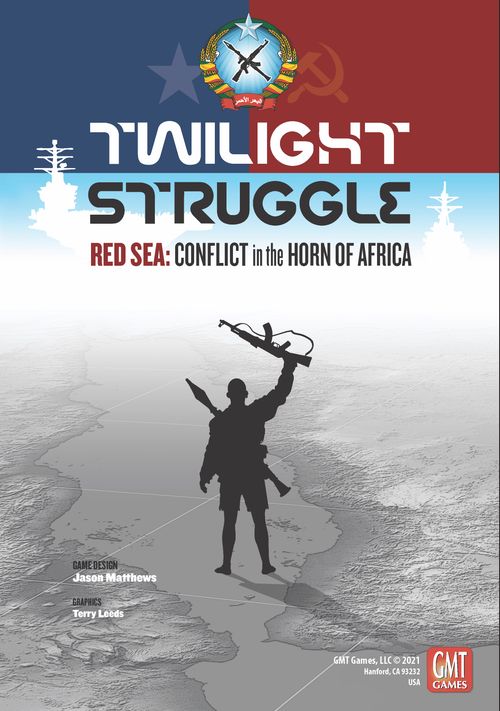
Twilight Struggle: Red Sea – Conflict in the Horn of Africa
Twilight Struggle: Red Sea – Conflict in the Horn of Africa Rulebook
Table of Contents
Table of Contents
- Quick Start Rules for Experienced Twilight Struggle Players
- 1.0 Introduction
- 2.0 Components
- 3.0 Game Setup
- 4.0 Game Sequence
- 5.0 Card Play
- 6.0 Operations
- 7.0 Events
- 8.0 DEFCON Status and Military Operations
- 9.0 Romanian Autonomy
- 10.0 Scoring and Victory
- 11.0 Tournament Play
- 12.0 Optional Integrated Variants
Quick Start Rules for Experienced Twilight Struggle Players
The rules are almost exactly the same as those in Twilight Struggle. Here's what TS players need to know to play:
The game takes place in two Regions: reduced portions of both Africa and the Middle East. In this game, Kenya is a Battleground country, though it is not in base Twilight Struggle.
The basic game consists of two turns: one considered Mid War and one considered Late War, with Late War cards being shuffled into the draw pile at the end of Turn 1. Final Scoring occurs at the end of Turn 2.
Flashpoint rule for Ethiopia and Somalia: As the Ogaden War is central to Twilight Struggle: Red Sea, Ethiopia and Somalia work differently than in Twilight Struggle. First, both countries have a red lightning bolt icon which indicates that they are Flashpoints, as distinct from "Battlegrounds" (see 2.1.5 and 10.4.1).
When a Coup occurs in a Flashpoint, a card is turned over from the draw deck. If it is a Scoring card, a 1 Op or a 2 Op, decrease DEFCON 1 level, then discard the card. This may trigger game-ending global thermonuclear war. Additionally, when a Scoring card is turned over, resolve it immediately BEFORE the Coup is resolved. However, if the card is a 3 Op or 4 Op, place it on the bottom of the draw deck available for reshuffle.
Scoring is the same as Twilight Struggle, but when the Africa Scoring card is played, if one player Controls Ethiopia and Somalia (both Flashpoints), and Controls more African countries than their opponent, that player wins automatically. Automatic Victory also occurs at 10 VPs (in contrast to 20 in the original game).
DEFCON prevents you from making Coups or Realignments in the Middle East when DEFCON is 3 or lower. Egypt, which is part of both Africa and the Middle East, IS subject to this restriction (see 2.1.1).
The Romanian Autonomy card works exactly like the China Card, but it is not as strong: it's a 2 Ops card with a +1 bonus if your opponent has more VPs. If you finish the game with the Romanian Autonomy card, you get a 1 VP award (see 9.0).
There is a space called "Strategic Sea Lanes." It is not in either Region, and is not considered a country. It has a Stability Number of 4. No Realignments or Coups are allowed; you can only place Influence there normally (no adjacency required), or use one of the Events that affects the space. If you Control the Strategic Sea Lanes space, you double the points you receive when you score a Region. If you lead in Influence without Controlling, you get +1 point when scoring a Region. In Final Scoring, you get 2 VPs for Control of Strategic Sea Lanes, and 1 VP if you have more Influence in Strategic Sea Lanes than your opponent (see 10.2).
DEFCON starts at level 4, not 5. DEFCON level adjustment terms have been revised (see 8.1.2 and 8.1.7). To increase the DEFCON level is now to "improve" it, to reflect the lessening of tensions in the area. Correspondingly, to decrease the DEFCON level the player will "degrade" it. Original Twilight Struggle players will find this clarification does not redefine the meaning of the action.
1.0 Introduction
"Under Lenin the Soviet Union was like a religious revival, under Stalin like a prison, under Khrushchev like a circus, and under Brezhnev like the U.S. Post Office." —Zbigniew Brzezinski
Twilight Struggle: Red Sea is a two-player game simulating the sudden escalation of the Horn of Africa from a stable diplomatic backwater, to a central front in the Cold War between the United States and the Soviet Union.
Twilight Struggle: Red Sea builds upon the card-driven system of the original Twilight Struggle. However, it is a stand-alone game, neither requiring a copy of Twilight Struggle to play, nor previous experience with the system to master. This game is part of the GMT Lunchtime Series, and thus is a quick-playing, low-complexity game in that tradition. It also is an excellent way to introduce the Twilight Struggle system to novice players.
Event cards cover a variety of historical happenings during this era of the Cold War, from the creation of CENTCOM, to the Ogaden War, to the Eritrean rebels and other issues that made the Horn of Africa the focus of policy makers in Washington and Moscow. Subsystems capture the Space Race, and the importance of Strategic Sea Lanes as well as nuclear tensions, with the possibility of nuclear war ending the game.
These rules are organized into numbered sections and subsections (for example, 2.1 and 2.2). In a number of places, you will see references made to rule sections and subsections that are related to the one you are reading.
Additionally, terms such as "Influence" or "Battleground" are capitalized to allude to their specialized meaning within the rules.
2.0 Components
A complete game of Twilight Struggle: Red Sea includes the following:
- One 20" × 14" map board
- One sheet of markers
- Four Player Aid Cards
- 51 cards
- Two custom 6-sided dice
- A combined solo rule book/background booklet
- This rule book
2.1 The Game Map
"But when I was President during the Cold War, every nation in the world, even the most tiny nations like Burkina Faso and Liberia and Mali, obviously Ethiopia and larger countries, were looked upon as a testing ground in the competition between democracy as we see it and Communism espoused by the Soviet Union." —President Jimmy Carter
2.1.1 The map is divided into two Regions: Africa, and the Middle East. A Region is a group of geopolitically connected nations, normally in close geographic proximity. The countries within a Region share a map color. Egypt counts as being in both Africa and the Middle East and is colored accordingly.
DESIGN NOTE: Egypt was and remains to this day a central country in Middle Eastern politics, but in the context of the Horn of Africa also plays an important role in the regional balance of power with the Suez Canal, the Aswan High Dam and the historical rivalry with Ethiopia.
2.1.2 Any Event, rule, action, or card that refers to "Middle East" or "Africa" applies to Egypt.
2.1.3 Each map space represents a country. Each country has a Stability Number representing the country's overall stability, independence and power.
2.1.4 Battleground Countries. Most country names are shown with their Regional background color. Battleground country names have a purple banner. They work the same way as normal countries, but have special rules for Scoring (see 10.1) and Coup attempts (see 6.3).
2.1.5 Flashpoint Countries. Ethiopia and Somalia are Flashpoint countries. The country space shows a lightning bolt symbol at the bottom. They follow the same rules as normal countries, but have special rules for Coup attempts (see 6.3.6) and DEFCON impacts (see 8.0) and Scoring (see 10.4.1). They are distinct from Battleground Countries.
2.1.6 Countries are connected via the brown and red lines on the map. Brown lines connect countries within a Region. Red dashed lines connect countries in different Regions. A country is considered adjacent to all other countries to which it is connected.
DESIGN NOTE: Adjacency is not entirely a reflection of geography. Several countries that share physical boundaries are not connected in the game. This is not a map error but is part of the mechanics of the game and the political situation of the times.
2.1.7 Strategic Sea Lanes. This space on the board does not represent a physical location. It is not a country and is not connected to countries. It has special rules for Influence Placement (see 6.1) and Scoring (see 10.1). Players may never conduct Coup attempts (see 6.3) or Realignments (see 6.2) on this space.
2.1.8 Controlling Countries: Each country on the map is considered either Controlled by one of the players, or uncontrolled. A country is considered Controlled by a player if:
- The player's Influence in the country is greater than or equal to the country's Stability Number, and,
- The player's Influence in the country exceeds their opponent's Influence in that country by at least the country's Stability Number.
EXAMPLE: To Control Saudi Arabia (Stability Number 3), a player must have at least 3 Influence in Saudi Arabia, and at least 3 more Influence in Saudi Arabia than their opponent.
2.1.9 Some countries, such as South Yemen or Ethiopia, have small US or Soviet symbols in them. These symbols indicate a "1" Influence marker placed in that country at setup.
2.2 Cards
2.2.1 The game uses 51 cards. Except for Scoring cards, all cards have an Operations value, an Event title and an Event description. Scoring cards are labeled scoring and must be played during the turn they are drawn.
2.2.2 Each card shows which superpower is associated with its Event:
- Cards with a red star: associated with the USSR
- Cards with a white star: associated with the US
- Cards with a split red/white star: associated with both sides
See 5.2 for the effect of playing cards with Events that are associated with your opponent's superpower.
2.2.3 Cards may be played as either Events or Operations.
2.2.4 Some cards have an asterisk (*) following their Event title. When these cards are played as Events, they are removed permanently from the game.
2.2.5 Cards that have their Event title underlined are displayed face-up beside the game board until they are canceled (or the game ends).
PLAY NOTE: Players may also use the numbered card reminder markers to show that underlined Events have been played.
2.2.6 Cards that are discarded (not permanently removed from the game) are placed face-up beside the draw pile.
2.3 Markers
The game includes various markers to assist play.
3.0 Game Setup
3.1 Shuffle the Mid War cards and deal each player 9 cards. Place Romanian Autonomy face-up in front of the US player.
3.2 The Soviet player places 2 Influence: 1 in Somalia, 1 in South Yemen. The US player places 2 Influence: 1 in Ethiopia, 1 in Saudi Arabia.
3.3 Place the following:
- US and USSR Space Race markers in the Start Box of the Space Race track.
- Military Operations markers on space 0 of the Military Operations track.
- Turn marker on the first space of the Turn Record track.
- DEFCON marker on Level 4 of the DEFCON track.
- VP marker on space 0 of the Victory Point track.
4.0 Game Sequence
4.1 The standard game of Twilight Struggle: Red Sea has two turns. Each turn represents approximately 4 years, in which each player will make 7 normal card plays (called Action Rounds). At the beginning of the game, each player receives 9 cards from the Mid War deck. At the beginning of the second turn, the remaining Mid War cards in the draw pile are shuffled with the Late War cards and players are dealt cards until they have 9 cards.
4.2 The Phasing Player is the player whose Action Round is underway.
4.3 Event cards with an asterisk (*) are permanently removed from the game when they are played, and are not shuffled into the new draw deck.
4.4 When moving from Mid War to Late War, do not add the discard pile to the deck. Instead, add the Mid War or Late War cards (as appropriate) to the existing deck and reshuffle.
4.5 A turn in Twilight Struggle: Red Sea has this structure:
- A. Improve DEFCON Status
- B. Deal Cards
- C. Headline Phase
- D. Action Rounds
- E. Check Military Operations Status
- F. Reveal Held Card (tournament only)
- G. Flip Romanian Autonomy
- H. Advance Turn Marker
- I. Final Scoring (after Turn 2)
A. Improve DEFCON Status: [Skip this phase on the first turn.] If the DEFCON level is lower than 5, improve the DEFCON status by 1 step toward Peace.
B. Deal Cards: Players should be dealt enough cards to bring their hand size to 9. The Romanian Autonomy card is never included in this total.
C. Headline Phase: Each player secretly selects a card from their hand. Once both players have made their choice, they reveal their cards to each other simultaneously. These are called Headline cards and their Events occur in this phase (if the Event title has an asterisk, remove it from the game). The card with the higher Operations value occurs first. In the event of a tie, the US player's Event occurs first.
- Scoring cards may be played during the Headline Phase. However, they are considered to have an Operations value of 0 and always occur second. If both players select a Scoring card as their Headline card, the US player's Scoring card occurs first.
- Players must play a Headline Event, regardless whether the Event helps them or their opponent.
NOTE: If you play your opponent's Event during the Headline phase, your opponent implements the Event as if they had played the card themselves. However, the player of the Headline card is considered the Phasing Player for DEFCON status purposes (see 8.1.4).
- Romanian Autonomy may not be played during the Headline Phase.
- Unless the Headline Event specifically mentions Operations points, neither player receives Operations points from cards played during the headline phase.
D. Action Rounds: There are 7 Action Rounds. Players take turns playing cards, one per Action Round. The USSR player plays first subject to Events. Actions required by a card must be resolved before the next player starts their Action Round by playing a card. The player whose Action Round is underway is called the Phasing Player.
- Ordinarily, a player will have a card left over after all Action Rounds are completed. This card is considered "held" and may be played in subsequent rounds. Scoring cards may never be held.
- If a player has insufficient cards to complete the remaining Action Rounds, they must sit out of the remaining Action Rounds while their opponent completes the turn.
E. Check Military Operations Phase: Each player determines if they are penalized Victory Points for failing to perform enough Military Operations during the turn (see 8.2). Each player then resets their Military Operations markers back to 0.
F. Reveal Held Card: During tournament or competitive play, both players reveal the bottom edge of any held cards to their opponent to ensure that they aren't holding Scoring cards. Since this detracts from secrecy, this rule is not necessary in non-competitive play.
G. Flip Romanian Autonomy Card: If Romanian Autonomy was passed face-down during the turn, flip it face-up now.
H. Advance Turn Marker: Move the Turn marker to the next turn. At the end of Turn 1, shuffle the Late War cards into the draw deck.
I. Final Scoring: At the end of Turn 2, perform Final Scoring (see 10.4.2).
5.0 Card Play
5.1 Cards may be played as either Events or Operations. Ordinarily, players will hold one card in their hand at the end of the turn. Players may not forgo their turn by declining to play a card or discarding a card from their hand.
5.2 Events Associated With Your Opponent: If you play a card for Operations, and its Event is associated only with your opponent, the Event still occurs (after which, if the Event title has an asterisk, it is removed).
NOTE: When playing a card for Operations and it triggers your opponent's Event, your opponent implements the Event text as if they had played the card themselves.
- The Phasing Player always decides whether the Event occurs before or after the Operations are conducted.
- If a card play triggers an opponent's Event but that Event cannot occur because a prerequisite card has not been played, a condition of the Event has not been met, or play of that Event has been prohibited by a superseding Event card, the Event does not occur. In this instance, Events marked with an asterisk are returned to the discard pile and not removed from the game as usual.
- If a card play triggers an opponent's Event, but the Event results in no effect, the Event is still considered played, and would still be removed if it has an asterisk.
EXAMPLE 1: The US player plays the Mengistu Haile Mariam card before the The Lion Falters card has been played. The US player receives 3 Operations points, but Mengistu Haile Mariam does not occur. The Mengistu Haile Mariam card is placed in the discard pile.
EXAMPLE 2: The USSR player plays Ogaden War for 2 Operations. However, during their previous Action Round, they played F-5Es Delivered, which prohibits play of Ogaden War as an Event. The USSR player would still receive 2 Operations points, but the Event does not occur and the card is not removed from the game.
EXAMPLE 3: The USSR player plays Eritrean Popular Liberation Front. However, the USSR player does not Control Ethiopia. Therefore the USSR conducts Operations without triggering the Event.
EXAMPLE 4: The USSR Player plays Victorious Leader. However the USSR does not currently Control any countries on the board. The Event is implemented to no effect, and since it has an asterisk, it is removed from the game.
5.3 When an Event requires a card of a specific value to be played or discarded, a higher valued card will always satisfy the requirement.
5.4 When an Event forces a player to discard a card, the Event on the discarded card does not occur. This also applies to Scoring cards.
5.5 Except as noted in Rule 10.1.5, card text overrides the written rules.
6.0 Operations
Operations can be used to place Influence markers, make Realignment rolls, attempt Coups, or advance in the Space Race. When a card is played for Operations points, the player must use all of the Operations points on one of these options.
6.1 Placing Influence Markers
"Our aim is to gain control of the two great treasure houses on which the West depends: The energy treasure house of the Persian Gulf and the minerals treasure house of Central and Southern Africa." —Leonid Brezhnev
6.1.1 Influence markers are placed one at a time.
When placing Influence in a country, Influence must be added to, or placed adjacent to, friendly markers that were in place at the start of the Phasing Player's Action Round. Exception: markers placed when required by an Event are not subject to this restriction, unless specifically stated otherwise on the card. If the Influence is sufficient to gain Control of the country, place the marker on its darker side.
6.1.2 It costs 1 Operations point to place an Influence marker in a country that you Control or that is uncontrolled. It costs 2 Operations points to place an Influence marker in an enemy-Controlled country. If a country's Control status changes while placing Influence markers, additional markers placed during that Action Round are placed at the lower cost.
EXAMPLE 1: The US player has 2 Influence markers in Egypt and the USSR player has none. Therefore, the US Controls Egypt. The USSR player uses a 4 Operations point card to place Influence markers. The USSR has existing Influence in Sudan. The first Influence marker costs 2 Operations points. However, after the first marker is placed, the US no longer exceeds USSR Influence in Egypt by the Stability Number of 2. Thus, additional Soviet Influence markers would only cost 1 Operations point each. If the US player started with only 1 Influence marker in Egypt, the US player would not Control Egypt. Therefore, Soviet Influence markers would only cost 1 Operations point each.
EXAMPLE 2: The US player Controls Somalia and Kenya and the USSR player Controls Madagascar and Ethiopia. Neither player Controls Djibouti.
6.1.3 Influence markers may be placed in multiple Regions and multiple countries or on the Strategic Sea Lanes up to the number of Operations points on the card played.
EXAMPLE 3: The US player has Influence markers in South Yemen, Djibouti, and Kenya. The US player uses a 3 Operations card to place more Influence. The US player may place Influence markers in any of Madagascar, Somalia, Ethiopia, and Saudi Arabia. However, they cannot place Influence markers in Yemen and Sudan. They could also use any remaining Operations points to strengthen Kenya, Djibouti, or South Yemen.
6.1.4 Strategic Sea Lanes. Influence may be placed here without a connection to existing Influence or adjacent Influence. Strategic Sea Lanes do not provide adjacency to any countries on the board.
6.1.5 Influence markers are treated like cash. Players may break a large denomination into smaller denominations at any time. Additionally, the number of Influence markers included in the game is not an absolute limit. Small poker chips, coins or wooden blocks can be used in the event of a marker shortage.
6.1.6 If a player has 2 or more markers in a country, place the larger denomination on top. Influence markers are open to inspection at all times.
6.2 Realignment Rolls
6.2.1 Realignment rolls are used to reduce enemy Influence in a country. To attempt a Realignment roll, you need not have any Influence in the target country or in an adjacent country, although this improves the chance of success greatly. However, your opponent must have Influence markers in the target country. When using a card for Realignment rolls, the player may complete each roll before declaring the next target. Countries may be targeted for Realignment more than once per Action Round.
6.2.2 It costs 1 Operations point to make a Realignment roll. Each player rolls a die and the high roller may remove the difference between the results from their opponent's Influence in the target country. Ties are considered a draw, and no markers are removed. Each player modifies their die roll:
- +1 for each adjacent Controlled country
- +1 if they have more Influence in the target country than their opponent
EXAMPLE: The US player targets Ethiopia for Realignment. The USSR has 3 Influence points in Ethiopia, while the US player has none. The US player has no modifiers—they do not Control any adjacent countries and have less Influence in Ethiopia then the Soviets. The USSR player has +1 because Sudan is adjacent to Ethiopia and the USSR Controls it and +1 for having more Influence in Ethiopia than the US. The US player gets lucky and rolls a 5, while the USSR player rolls a 2 (modified to 4). The USSR player must remove one Influence point from Ethiopia.
6.2.3 No Influence is ever added to a country as a result of a Realignment roll.
6.2.4 Realignment rolls can never be conducted against the Strategic Sea Lanes space.
6.2.5 Realignment rolls against Flashpoint countries are conducted normally.
6.2.6 Events that give a player a free Realignment Roll(s) in a particular Region may ignore the geographic restrictions of the current DEFCON level (see 8.1.7).
6.3 Coup Attempts
6.3.1 A Coup represents operations short of full-scale war to change the composition of a target country's government. To attempt a Coup, you need not have any Influence in the target country or in an adjacent country. However, your opponent must have Influence markers in the target country.
6.3.2 To resolve a Coup attempt, roll a die and add the Operations points on the card to the die result. If this modified die roll is greater than the Stability Number of the target country × 2, the Coup is successful; otherwise it fails. After a successful Coup, remove opposing Influence markers equal to the difference between the modified die roll and Stability Number from the target country. If there are insufficient opposing Influence markers to remove, add your own Influence markers to make up the difference.
6.3.3 Move your Military Operations track marker the number of spaces equal to the Operations value of the card played.
EXAMPLE: The US player plays a 3 Operations card to conduct a Coup attempt in Kenya. The US player has no Influence in Kenya; the USSR player has 2 Influence. First, the US player adjusts their marker on the Military Operations track to show that they spent 3 points on Military Operations this turn (see 8.2). Then they roll a 4 and add their Operations number (3) for a total of 7. They now subtract twice the value of Kenya's Stability Number (2 × 2 = 4) from this result to get a final total of 3. This is the number of Influence markers they may remove from/add to Kenya. The US removes the 2 Soviet Influence markers, then places 1 US Influence marker. Note: Since Kenya is a Battleground country in Twilight Struggle, Red Sea the DEFCON level should degrade 1 after this Coup attempt.
6.3.4 Any Coup attempt in a Battleground country degrades the DEFCON status 1 level (towards Nuclear War).
6.3.5 Cards that give a player a free Coup attempt in a particular Region may ignore the geographic restrictions of the current DEFCON level (see 8.1.7). However, a free Coup attempt used in a Battleground country still degrades the DEFCON level (see 6.3.4).
6.3.6 Flashpoint Countries. Ethiopia and Somalia are Flashpoint countries. Coup attempts against Flashpoint countries are conducted slightly differently. These spaces have a red lightning bolt icon in their country banner to remind players of their special status.
6.3.6.1 When a Coup attempt is made against a Flashpoint country, a card is turned over from the draw deck. If it is a Scoring card, a 1 Op or a 2 Op, decrease DEFCON 1 level; then discard the card. This may trigger game-ending global thermonuclear war. Additionally, when a Scoring card is turned over, resolve it immediately BEFORE the Coup is resolved. However, if the card is a 3 or 4, place it on the bottom of the draw deck available for reshuffle.
EXAMPLE: The USSR player plays a 2 Operations card to conduct a Coup attempt in Somalia. Before the Coup attempt is resolved a card is drawn from the top of the draw deck and revealed. It is a 1 Op card and decreases DEFCON from 3 to 2. Had the DEFCON level already been at 2, the USSR player would have caused nuclear war and lost the game. The 1 Op card is now discarded into the Discard Pile. If the card had been a 3 or 4 Op card, it would have been placed at the bottom of the draw deck.
6.4 The Space Race
"We have succeeded. Everything is excellent. Soyuz and Apollo are shaking hands now." —Astronaut Thomas P. Stafford, Apollo-Soyuz mission.
6.4.1 The Space Race track has a marker for each superpower. Operations points may be used to move to the next box on the track. To do so, discard a card with an Operations value equal to or greater than the number shown on the box into which you are attempting to advance. Roll the die. If the number falls within the range listed below the target box, move your marker to the new box.
6.4.2 A player may only discard 1 card per turn in an attempt to advance in the Space Race.
6.4.3 Advancing on the Space Race track results in Victory Points, a special ability, or both. One box on the Space Race track is marked with two numbers separated by a slash (2/1). The left-hand number indicates the number of Victory Points awarded to the first player to reach that box; the right-hand number indicates the number of Victory Points awarded to the second player to reach that box. Victory Points are awarded immediately and are cumulative.
6.4.4 Special abilities are granted only to the first player to reach the space. Any ongoing special ability is immediately canceled when the second player reaches that box.
- Upon reaching Box 1 (First Mission to Leave the Solar System) remove an Influence from 1 country after the next or current Headline Phase.
- Upon reaching Box 3 (First Reusable Manned Orbital Spacecraft) draw an additional card and score 3 VPs.
EXAMPLE: The USSR player reaches Box 3. They claim an additional card and score 1 VP. If the USSR player reaches Box 1 before the US player reaches Box 1, the USSR player may also remove 1 Influence from 1 country immediately after the Headline Phase. If the US player has already reached Box 1, this impact is cancelled.
6.4.5 When a card is used for the Space Race, the Event does not occur and the card is placed in the discard pile.
DESIGN NOTE: The Space Race is your safety valve. If you want to at least temporarily get rid of an Event that is good for your opponent, dump it on the Space Race (provided it has a sufficient Operations value to qualify for an attempt to move forward).
6.4.6 If a player reaches the final box in the Space Race, they cannot play any more cards in the Space Race for the remainder of the game.
7.0 Events
"Under Lenin the Soviet Union was like a religious revival, under Stalin like a prison, under Khrushchev like a circus, and under Brezhnev like the U.S. Post Office." —Zbigniew Brzezinski
7.1 A player may play a card as an Event instead of Operations. If an Event is associated with the player's own superpower, or with both superpowers, it occurs as directed by the card's text.
7.2 Permanent Events: Some Event titles are underlined, e.g. The Derg, This indicates that the effects of these Events last for the duration of the game. When these cards are played as Events, place them beside the map, or their markers on the Turn track or elsewhere on the board, as a reminder of their ongoing effects.
7.3 Some Event cards modify the Operations value of cards that follow. These modifiers are cumulative and can modify Romanian Autonomy.
EXAMPLE: The US player plays the Albano-Stalinist Economics card as an Event during the Headline phase. Ordinarily, 1 Operations point would be subtracted from all USSR Influence points played in Africa. However, the USSR played T62s and Kalashnikovs for their Headline card, which adds 1 to all Soviet Operations up to a total of 3. For their first Action Round, the USSR chooses Romanian Autonomy. The Soviet player is behind on the Victory Point track, so the Operations value of the card is 3. The Albano-Stalinist Economics card deducts 1 point, but the T62s and Kalashnikovs card adds 1 point. They cancel each other out and the USSR plays 3 Operations points.
7.3.1 Events modifying the Operations value of subsequently played cards do so for all purposes.
EXAMPLE 1: If the Soviet player uses T62s and Kalashnikovs and later used a 2 Operations card for a Coup, the USSR player adds 3 to their Coup roll and receives 3 Required Military Operations points.
EXAMPLE 2: If the US player Headlines Albano-Stalinist Economics, and the Soviets use a 3 Operations card to place Influence, if the Soviets elect to place Influence in Djibouti, the card's Operations value is reduced to 2 and only one more Influence may be placed.
EXAMPLE 3: If the USSR player uses T62s and Kalashnikovs, they could then play Stagflation and conduct 3 Operations if the US player's hand contained a Scoring card.
7.3.2 If an Event specifies that a player may "conduct Operations, place Influence or attempt Realignments as if" they played a card of a certain Operations value, those additional Operations are treated as if a card had been played for its Operations point value. Therefore, those Operations are subject to Rule 6.0 and other Events limiting their placement or value.
7.4 If an Event is canceled or restricted by another Event, the unplayable Event card may still be used for Operations.
7.5 War Events: The deck contains 1 War Event: Ogaden War. A player does not need Influence markers in either the attacking or defending countries to play this Event. If no Influence is at risk, the player still receives Required Military Operations and, if successful, Victory Points (see 8.2.4).
8.0 DEFCON Status and Military Operations
"We thought that the proletariat would eventually run the world. But it is the Americans who have assumed that position... The American people have changed." —Mengistu Haile Mariam, President of Ethiopia
8.1 The DEFCON Track
8.1.1 DEFCON measures nuclear tension in the game. The DEFCON track begins the game with a degree of existing tension at level "4" and will degrade or improve due to Events and player actions.
8.1.2 Improve & Degrade. When rules or cards say to "improve" the DEFCON status, move the DEFCON marker to a higher number. When they say "degrade", move the DEFCON marker to a lower number.
8.1.3 Maximum DEFCON is 5. Any Event that would improve DEFCON above 5 has no effect on DEFCON.
8.1.4 If DEFCON reaches 1, nuclear war breaks out and the game ends immediately. The Phasing Player is responsible and loses the game.
EXAMPLE: The US player is on their last Action Round and has only one card to play Mr. Nyet with the DEFCON status at 2. The USSR implements the effects of the card. DEFCON decreases to 1, and nuclear war is triggered. The US player, as the Phasing Player, loses.
8.1.5 Any Coup attempt in a Battleground country degrades DEFCON by 1.
8.1.6 Any Coup in a Flashpoint country MAY degrade DEFCON by 1 (see 6.3.6.1).
8.1.7 DEFCON status consequences are as follows:
| Status | Consequence |
|---|---|
| DEFCON 5 | No effect. |
| DEFCON 4 | No effect. |
| DEFCON 3 | No Coup or Realignment rolls in the Middle East. |
| DEFCON 2 | No Coup or Realignment rolls in the Middle East. |
| DEFCON 1 | Game over. The Phasing Player loses the game. |
(Degrading moves down this table toward DEFCON 1; improving moves up toward DEFCON 5.)
PLAY NOTE: Players may place a DEFCON Restriction marker in the Middle East at DEFCON 3 or lower as a reminder that no Realignment rolls or Coups are permitted there.
8.1.8 Improve DEFCON Status Phase. If DEFCON is below 5 at the beginning of a turn, improve it by 1.
8.2 Required Military Operations
"Every night, whisper 'peace' in your husband's ear." —Andrei Gromyko, Soviet Minister of Foreign Affairs to First Lady, Nancy Reagan
8.2.1 Players must carry out a certain number of Military Operations each turn or be penalized Victory Points. The number of Required Military Operations is equal to the current DEFCON status. If you carry out insufficient Military Operations, your opponent gains 1 VP per unplayed Military Operations point. If both players are penalized Victory Points, the net total should be implemented on the Victory Points track.
EXAMPLE: The US player carries out two points in Military Operations in a turn. DEFCON is at 4. The USSR player gains 2 Victory Points.
8.2.2 Coup attempts and War Events count as Military Operations. Realignment rolls and free Coup rolls through Events do not.
8.2.3 When Operations points are used in a Coup attempt, the Phasing Player moves their Military Operations marker by the number of spaces equal to the Operations value of the card. When Ogaden War is played as an Event the US player moves their marker the number of spaces instructed by the Event.
8.2.4 If the Soviet player uses Ogaden War for Operations, the US player moves their Military Operations marker as instructed by the Event.
9.0 Romanian Autonomy
9.1 By the close of the Cold War, Romania under Nicolae Ceaușescu had become the member of the Warsaw Pact that most aggressively courted the West. Combining nationalism and authoritarianism, Romania became an unpredictable Soviet ally seeking to chart its own course in foreign policy. The pattern repeated itself during the Ogaden War, when Romania remained allied to Somalia though the Soviet Union and the rest of the Warsaw Pact transferred their support to Ethiopia. These shifting allegiances are represented by the Romanian Autonomy. Either player may use Romanian Autonomy as part of their regular hand. This card does not count towards the hand limit.
9.2 Playing Romanian Autonomy counts as an Action Round. As a result, players may have more held cards than usual, if Romanian Autonomy is played.
9.3 When you play Romanian Autonomy, immediately hand it to your opponent face-down. Your opponent cannot play it this turn as long as it is face-down. Next turn, your opponent may flip it face-up and ready for play.
9.4 If Romanian Autonomy changes hands through an Event, give it to your opponent as instructed by the Event.
9.5 Romanian Autonomy may not be played:
- during the Headline Phase;
- if it prevents the play of a Scoring card;
- as a discard required by an Event.
9.6 To receive the bonus +1 Operations point the player must be behind on the Victory Point chart at the start of the Action Round.
9.7 The Operations value of Romanian Autonomy may be modified by Events.
9.8 Play of Romanian Autonomy can never be forced by Events or a card shortage.
10.0 Scoring and Victory
The object of the game is to score Victory Points (VPs). You can earn Victory Points by Controlling countries or playing certain Events. Each Region has its own Scoring card, which earns players Victory Points depending on how much Influence they have in the Region when it is played.
PLAY NOTE: Playing Scoring cards when you have peak Influence in a Region is often key to winning the game.
10.1 Scoring
10.1.1 The following terms are used during Regional Scoring:
Presence: A superpower has Presence in a Region if it Controls at least 1 country in that Region.
Domination: A superpower achieves Domination of a Region if it Controls more non-Battleground countries and Battleground countries in a Region than the opponent (and at least 1 of each).
Control: A superpower has Control of a Region if it Controls more countries in a Region than its opponent, and Controls all of the Battleground countries in the Region.
10.1.2 Players can earn additional points during Regional Scoring, as follows:
- Strategic Sea Lanes (see 10.2);
- +1 VP per Controlled Battleground country in the Region;
- Adjust the Victory Point track by the difference between the players' scores.
EXAMPLE: The USSR plays the Africa Scoring card. The USSR Controls Ethiopia, Madagascar and Djibouti. The US Controls Egypt, and has 1 point of Influence in Kenya. The US player has 1 Influence in Strategic Sea Lanes and the USSR has zero. The USSR therefore has Presence (1 VP) in Africa for its Control of 3 countries (1 VP). The US also has Presence (1 VP) and 1 VP for a Battleground, due to their Control of Egypt (which counts in both Africa and the Middle East). However, the US does not score Domination as they Control fewer countries and no non-Battlegrounds. The 1 US Influence in Kenya is insufficient to Control the country and therefore does not impact scoring. The US also scores 1 VP for having more Influence in Strategic Sea Lanes than their opponent. The difference between the two scores (3 VPs and 1 VP) is 2. Move the scoring markers 2 spaces in the US player's favor.
10.1.3 Certain Events may award Victory Points.
10.1.4 You may earn Victory Points if your opponent fails to perform the number of Required Military Operations in a turn (see 8.2).
10.1.5 Events cannot force players to hold Scoring cards.
10.2 Strategic Sea Lanes
10.2.1 Strategic Sea Lanes are scored along with Scoring cards and can have a major impact on the resolution of Scoring cards.
10.2.2 Control of the Strategic Sea Lanes is analogous to Control of a country. You must have Influence equal to the Strategic Sea Lanes Stability Number of 4, and at least 4 more Influence than you opponent has in Strategic Sea Lanes.
10.2.3 A player Controlling the Strategic Sea Lanes space doubles the points they receive when resolving a Scoring card. This total is then adjusted by their opponent's points and the VP marker is moved a number of spaces equal to the difference between the scores.
EXAMPLE: The US player Dominates the Middle East with Control of Saudi Arabia, Oman and Yemen. The Soviet player scores presence in the Middle East for Control of South Yemen. If the US player also Controlled the Strategic Sea Lanes when the Middle East Scoring card was played, the US would score 5 for Middle East Domination +1 for Control of the Saudi Arabia Battleground country, for a total of 6. With Control of Strategic Sea Lanes, this would be modified to 12 VPs. The USSR would then score 3 VPs for Presence in the Middle East, and the net result would be 9 VPs for the US.
10.2.4 A player who has more Influence than their opponent in the Strategic Sea Lanes space, but does not Control the space, receives 1 VP when a Scoring card is played.
10.2.5 Control of the Strategic Sea Lanes space does not double the Regional Scoring during End Game Victory (see 10.4.2), only during the play of Scoring cards. However, a player receives 2 VP for Control of the Strategic Sea Lanes or 1 VP if they have more Influence in Strategic Sea Lanes during End Game Victory.
10.3 The Victory Point Track
10.3.1 The Victory Point track goes from zero to 10. The VP marker begins in the Start box (zero), or total equilibrium between the two sides. Count this box as a space when adjusting players' scores. The VP marker is double-sided and should be flipped to indicate which superpower currently has the advantage in VP.
EXAMPLE: The scoring marker is on the 1 box on its USSR side when the US player scores 2 VPs. Move the marker to the zero space, flip it to its US side, then move it back to the 1 box.
10.3.2 If a card states that a player "gains" a Victory Point, move the VP marker one space in that player's favor.
EXAMPLE: If the marker is on the 9 box on its US side, and the USSR player gains 2 VPs, move the marker to the 7 box.
10.3.3 If a card awards each player Victory Points, move the VP marker the difference between the scores.
10.4 Victory
10.4.1 Automatic Victory. Automatic Victory is achieved when:
- A player reaches 10 VPs. The game ends immediately and that player wins. NOTE: Score both players' VP awards for an Event or Scoring card before determining Automatic Victory.
- EXCEPTION: If a player reaches 10 VPs during the Check Military Operations Status phase, reveal any held cards before declaring that player the winner. If the player who reached 10 VPs is holding a Scoring card, they lose.
- The Africa Scoring card is played and a player Controls more countries in Africa and Controls both Flashpoint countries (see 2.1.5).
- Nuclear War: A player may also declare Automatic Victory if DEFCON reaches 1 while their opponent is the Phasing Player.
10.4.2 End Game Victory. At the end of Turn 2, both Regions are scored: add these VPs to the current score. Egypt is scored in both the Middle East and Africa. Score both Regions before determining who has the most points and is victorious. Reaching 10 VPs does not result in Automatic Victory during scoring at the end of Turn 2. If the VP marker is on 0, the game ends in a draw.
11.0 Tournament Play
These rules are optional and not required for friendly play. They are simply offered as guidelines for playing Twilight Struggle: Red Sea as a competitive tournament game.
11.1 During the Reveal Held Card phase, each player exposes the bottom edges of their cards to their opponent to show that they are not Scoring cards. This prevents Scoring cards from being accidentally or deliberately held.
11.2 Any player found holding a Scoring card has started an accidental nuclear war and loses immediately.
11.3 The Soviet player receives the first card of every deal. Dealing alternates between players until they have received their full hand size. A player may receive consecutive cards in a deal if they require more cards than their opponent.
11.4 Bidding may be used to determine sides. Each player should secretly write the name of a side and a number on a piece of paper. The two bids are then revealed. If the bids show different sides, each player takes the side they wrote down, and play begins. If the bids show the same side, the player who wrote the higher number takes that side. Their opponent then receives Influence equal to the higher number; to be allocated during setup after all other Influence is placed. If the numbers are equal, sides are determined randomly; the player taking the side that did not appear on either bid then receives the additional Influence.
11.4.1 Additional Influence received in this way can only be placed in countries where the player has existing Influence at setup (as of the end of the regular setup phase) and may not exceed 2 more than what is needed for Control of the country.
EXAMPLE: Setup is complete and the US player is placing additional Influence from bidding. The US has 3 Influence in Saudi Arabia. Since 3 Influence are needed for Control, the US cannot have more than 5 (3+2) Influence in that country when play begins.
12.0 Optional Integrated Variants
These variant rules allow players to utilize cards from the original Twilight Struggle game to create a slightly longer Twilight Struggle: Red Sea experience. Furthermore, using the same basic mechanism, designated cards from Twilight Struggle: Red Sea can be added to the original game.
12.1 Red Sea Third Turn
The third turn of the game is a Late War turn. Conduct the Late War turn shuffle normally (see 4.4).
12.1.1 After setup, the US player chooses cards first, then reveals the chosen cards to the Soviet player. Then the Soviet player chooses and reveals their cards to the US. All cards chosen are then shuffled into the corresponding Mid War or Late War decks.
12.1.2 Both players may choose cards with a total value of 9 Operations points or less. Any unused points are wasted.
12.2 Card Options. Each player, both the US and the USSR, may add up to 9 Operations points to their deck from the Twilight Struggle core game. Eligible cards are listed below.
| Neutral Mid War | US Ops | USSR Ops |
|---|---|---|
| 36 Brush War | 3 | 3 |
| 39 Arms Race | 3 | 3 |
| 43 SALT Negotiations | 3 | 3 |
| 45 Summit | 1 | 1 |
| 49 Missile Envy | 2 | 2 |
| Mid War | US Ops | USSR Ops |
|---|---|---|
| 44 Bear Trap | 3 | – |
| 63 Colonial Rear Guards | 2 | – |
| 66 Puppet Governments | 2 | – |
| 72 Sadat Expels Soviets | 1 | – |
| 74 The Voice of America | 2 | – |
| 108 Our Man in Tehran | 2 | – |
| 51 Brezhnev Doctrine | – | 3 |
| 56 Muslim Revolution | – | 4 |
| 61 OPEC |
| Neutral Late War | US Ops | USSR Ops |
|---|---|---|
| 92 Terrorism | 2 | 2 |
| 100 Wargames | 4 | 4 |
| Late War | US Ops | USSR Ops |
|---|---|---|
| 86 North Sea Oil | 3 | – |
| 110 AWACS Sale to Saudis | 3 | – |
| 98 Aldrich Ames Remix | – | 3 |
| 109 Yuri and Samantha | – | 2 |
12.3 Adding Twilight Struggle: Red Sea Cards to the Original Game
12.3.1 After setup, the US player chooses cards first, then reveals the chosen cards to the Soviet player. The Soviet player then chooses and reveals their cards to the US. All chosen cards are shuffled into the corresponding Mid War or Late War decks.
12.3.2 Both players may choose cards with a total value of 9 Operations points or less. Any unused points are wasted.
| Neutral Mid War | US Ops | USSR Ops |
|---|---|---|
| RS42 Separatists | 2 | 2 |
| RS44 Apollo-Soyuz Test Project | 2 | 2 |
| RS51 Water Wars | 2 | 2 |
| Mid War | US Ops | USSR Ops |
|---|---|---|
| RS1 Peace Corps | 2 | – |
| RS3 Ogaden War | 2 | – |
| RS4 USAID | 2 | – |
| RS6 Victorious Leader | 3 | – |
| RS7 Eritrean Popular Liberation Front | 1 | – |
| RS14 Hero of the Crossing | 3 | – |
| RS15 Israeli Periphery Doctrine | 2 | – |
| RS16 The Strongman of Sudan | 1 | – |
| RS19 Soviets Airlift Cubans |
| Late War | US Ops | USSR Ops |
|---|---|---|
| RS2 Zbig | 3 | – |
| RS5 Albano-Stalinist Economics | 1 | – |
| RS8 CENTCOM | 3 | – |
| RS9 Carter Doctrine | 4 | – |
| RS10 Kenya Joins Rapid Deployment Force | 1 | – |
| RS11 Voice of America in Amharic | 2 | – |
| RS17 Afghanistan Invaded | 4 | – |
| RS18 Daniel Arap Moi | 2 | – |
| RS46 We Are the World |