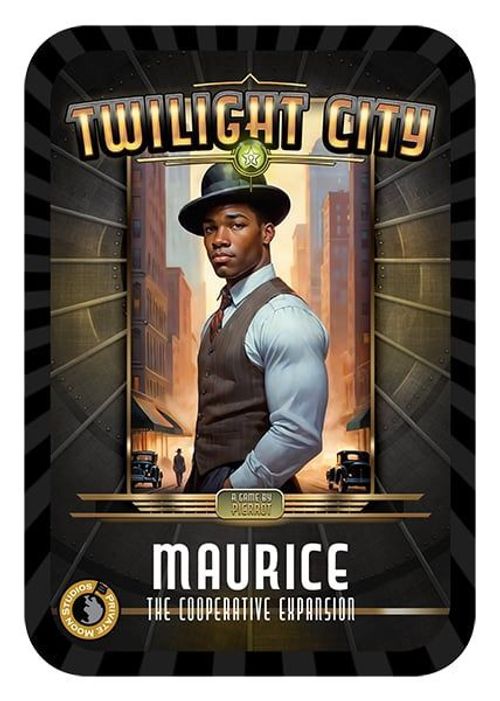
Twilight City: Maurice – The Cooperative Expansion
Official rulebook: Private Moon Studios · PDF
Twilight City: Maurice – The Cooperative Expansion Rulebook
Table of Contents
Table of Contents
Expansion Components
The Maurice game box contains the following additional components:
1. Personal Mission Cards
The box contains 16 large personal mission cards. We recommend them for every player count in the traditional, competitive setup, primarily for the first few game sessions.
At the start of the game, during setup, each of you draws 1 personal mission card at random and keeps it secret from the other players until the end of the game. Fulfilling the conditions of the card is not mandatory, but if you succeed, you receive the bonus points on it at the final evaluation. (The scoring pad has no such box, so add the points to some other value.)
2. Maurice Game Figure
Maurice has a specific role in the cooperative mode: as an extra character, on a white base ring, he must be brought into play according to the rules below. In the competitive (original) mode, however, he may also be chosen as your own figure; in that case, attach the base ring matching your colour to his base.
3. Avatar Tokens
The expansion contains 6 new avatars. Four of these (two discs, showing both sides) display alternative faces of the earlier figures; 2 belong to Maurice.
If Maurice will be your own character in the competitive mode, choose the matching disc and the side you prefer, then place the disc in the recess provided on the right side of your personal board.
4. Cooperative Task Cards
The expansion contains 24 cooperative task cards with an M on the back. These, naturally, are card types that can only be used in cooperative mode.
The difficulty of a task is shown by the number of stars in the upper right corner of the card. The easiest tasks are marked with 1 star, the medium ones with 2 stars, and the hardest with 3 stars. These represent the leaked information that Maurice hands over to you when you meet him in secret.
5. Black and White Cube Markers
Each of these is a component of the cooperative mode. The rule below explains their use.
Cooperative Mode Setup
Set up everything as the Twilight City base game rules prescribe (for the current number of players). Then decide whether you want to play the cooperative version on easy, medium, or hard difficulty.
Next, sort the task cards by difficulty (the number of stars) and shuffle each of the three decks separately. After shuffling, draw cards from the top of the face-down decks according to the chosen difficulty level (see the table below) and keep them face down. Shuffle the 5 cards you have drawn and place them face down next to the game board. Return the remaining task cards to the game box without looking at them.
| Difficulty level | 1 star | 2 stars | 3 stars |
|---|---|---|---|
| Easy | 3 | 1 | 1 |
| Medium | 1 | 3 | 1 |
| Hard | 1 | 1 | 3 |
Also place the black and white cubes near the cards.
Attach the white ring to Maurice's base, and place him on the third card column of the Acquisition Board (above the board or between the two cards, as you prefer).
Gameplay
If a player takes one of the cards from the third column of the Acquisition Board (paying 1 coin and 1 resource of any colour for it), Maurice automatically appears at the location shown by the other card in that column. Place his figure at the location indicated by the other card, then discard that other card (it does not move the Police Airship). Because of this, both location cards in the column must be refreshed on the Acquisition Board at the end of the player's turn.
(Of course, if Maurice is already on the City Board, nothing of the sort happens.)
Maurice's appearance in the city is not affected by anything (for a certain time, Tim can block the signal of his bracelet toward the Police Airship), so it is no problem if he appears next to an agent, or in one of the districts controlled by the Airship.
From this moment on, Maurice waits for one of you to meet him. If one of you moves onto the space where he is, he hands you an important piece of information. Then turn over the top card of the task cards placed next to the board during setup, and put it, now face up, next to the deck.
Attention: from now on, this task affects the outcome of the game. Depending on the type of task, if you manage to accomplish it during play, place 2 white cube markers on the card. If you definitely fail the task during play, place 2 black cube markers on it.
After the meeting, Maurice immediately returns to his hiding place, that is, the last card column of the Acquisition Board, so that he can reappear when someone calls him again in the manner described above, by taking a card.
Maurice can be called onto the City Board in this way a total of 5 times, and each time he has you turn over one more task card. After the fifth card is turned over, he no longer returns to the Acquisition Board; put his figure back into the game box.
End of the Game (Evaluation)
The game ends in a similar way to the traditional competitive mode, that is, when one of you fulfils one of the end-of-game conditions. The shared victory, the success of toppling the government, is decided only afterwards, once you have carried out the final task set.
To do this, empty the draw bag, then put into it as many black cubes as you started with: 4, 6, or 8, depending on the number of players.
Then evaluate the task cards. Place 2 white cube markers on each task card you completed. Place 2 black cube markers on each task card you did not complete. Place 2 black cube markers on each card that remained face down. Put the 10 cube markers gathered this way into the draw bag, alongside the black cubes already in it.
Then each player draws 3 cubes from the bag. (Drawn cubes are not returned to the bag.)
If together you have drawn more white cubes than black, you have achieved the great goal: the Governor's power is shattered, and the countdown to Twilight City's regime change has begun.
(Unfortunately, a draw is not enough in such a delicate situation.)