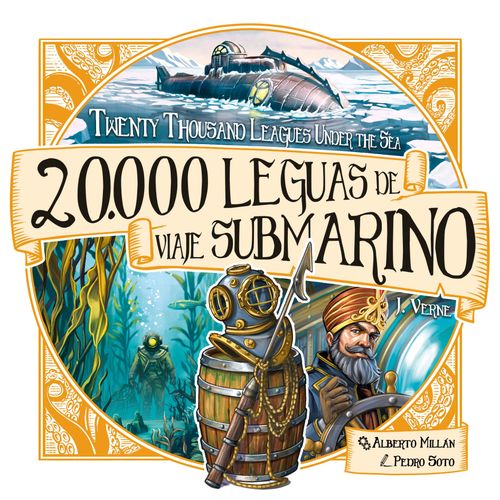
Twenty Thousand Leagues under the Sea
Twenty Thousand Leagues under the Sea Rulebook
Table of Contents
Table of Contents
Components
- 1 double-sided pad (surface map and depth map).
- 5 Nautilus tokens.
- 1 turn marker.
- 55 cards:
- 18 Surface discoveries
- 18 Depth discoveries
- 1 Conseil (with turn summary)
- 7 "Verne Deck" cards for solo and two-player mode (see Solo and Two-Player Mode)
- 8 Dangers
- 3 Characters (with different bonuses on each side): Captain Nemo, Professor Aronnax, and Ned Land
Game Objective
The game is played over 16 full turns, with all players acting simultaneously. Study the 6 discovery cards that are paired in the center of the table and choose a pair of them to draw on the surface map and the depth map.
However, you'll need to consider the interests of others, because if you select the same pair as another player, you will suffer the dangers of the sea.
Move the Nautilus, surfacing and diving to avoid obstacles and score points for various elements, such as hunted cetaceans, sighted islands, sunken ships, found treasures, seaweed forests, or even visit the lost continent of Atlantis.
Setup
- Take 2 sheets from the pad and use one for the surface side and one for the depth side. (You may flip the sheets to reuse the blank sides in a future game.)
- Assign the values "1", "2", "3", and "4" to the four crew members on your surface sheet in any order you choose. Avoid using the same combination as other players, if possible.
- Receive a Nautilus and place it in the central space ("19") of your surface sheet.
- Select a letter from "A" to "E." In the space with that letter on the surface map, draw a ship; and in the space with that letter on the depth map, draw a trident (symbol of Atlantis).
- The player with the least experience in board games receives the Conseil card, the faithful assistant to Aronnax, which makes them immune to danger and provides a turn summary.
- Create a 9-card matrix in the center of the table by following these steps:
- A) Randomly place the 3 character cards (Nemo, Aronnax, and Land) in the first vertical column. Each character has a different bonus on each side (see "Characters"). Choose the side you want to use for each character before placing them.
- B) Shuffle the surface discovery deck and place it under the second column. The back of these cards shows an arrow indicating that the cards move up through this column.
- C) Draw 3 surface discovery cards to fill the column.
- D) Shuffle the depth discovery deck and place it above the third column. The back of these cards shows an arrow indicating that the cards move down through this column.
- E) Draw 3 depth discovery cards to fill the column.
- Shuffle the 8 danger cards and place them face down in a horizontal row visible to all players. Reveal the first 2 cards, and place the turn marker on the left space of the first card. This row of cards represents the 16 turns of the game and the dangers associated with each turn.
The sheet shows: scoring from islands (all turns); scoring from islands and sunk ships (turns 4, 8, 12, and 16); sunk ships; captured cetaceans; the 16 game turns; crew; visits to Atlantis; treasures obtained; scoring from character bonuses; scoring from seaweed forests; damage taken; total score. Each side of the table has a discard pile for surface discoveries and for depth discoveries.
Game Turn
The game lasts 16 turns in which everyone plays simultaneously. In each turn, you must complete these phases in strict order:
- Select a character.
- Face danger.
- Move the Nautilus.
- Draw discoveries.
- Score islands and sunken ships.
1. Select a Character
Choose which of the 3 card rows you are more interested in and secretly write (covering with your hand) the initial of the character ("N", "A", or "L") in the box for the corresponding turn. When everyone has done so, reveal simultaneously.
2. Face Danger
Players with the same written initial suffer the danger shown by the turn marker, except the player holding the Conseil card, who is immune.
After this, the player with the Conseil card passes it to the nearest player clockwise who has suffered the danger. If no one has suffered it, the player to their left receives the Conseil card.
Example: In a 5 player game, two players have chosen Ned Land, two players the Captain Nemo, and one player the professor Aronnax. Only the player who chose Aronnax is safe from danger. The player with the Conseil card is also safe, which is passed clockwise to the nearest player who has suffered danger granting them immunity for the next turn.
Dangers
- Ice. "However, during the day of March 16, these tracts of ice completely barred our path." Your Nautilus takes a bow hit (see "Impacts"). Additionally, it cannot surface or dive this turn (see "3. Move the Nautilus"), so it can only move within the map it is currently on.
- Maelstrom. "Was the Nautilus being dragged into this whirlpool just as the skiff was about to detach from its plating?" Your Nautilus takes a hit on the bridge (see "Impacts"). Also, the underwater current forces it to immediately surface or dive. This movement does not spend points (see "3. Move the Nautilus") but as usual, if your Nautilus ends in a space with an obstacle, it suffers a hit on the bow.
- Giant squid. "It was a squid of colossal dimensions, fully eight meters long. It was traveling backward with tremendous speed in the same direction as the Nautilus." Your Nautilus takes a hit on the propellers (see "Impacts").
- Sharks. "I understood his fear. A gigantic shadow appeared above the poor diver. It was a shark of huge size, moving in diagonally, eyes ablaze, jaws wide open!" The crew member indicated on the card is seriously injured. Cross out the points they would have given you at the end of the game.
Impacts
The Nautilus has 3 impact zones. Each time you suffer an impact, mark an "X" in the impacted zone. Each impact has a different negative point value (-1, -3, or -5) depending on the zone.
- Bow (-1 coin / -1 point). You receive an impact whenever your Nautilus moves to a space with a drawn discovery (crossed out or not) and also when suffering the "Ice" danger.
- Bridge (-2 coins / -3 points). You receive an impact when suffering the "Maelstrom" danger.
- Propellers (-3 coins / -5 points). You receive an impact when suffering the "Giant Squid" danger.
You can avoid marking the impact if, at the moment you receive it, you cross out as many coins as the indicated value in the impact zone.
3. Move the Nautilus
Move your Nautilus as many spaces as submarine icons present in the selected row of 3 cards, following these movement rules:
- You must use all movement points.
- During a movement, you cannot revisit a space on the same sheet.
- Moving to an adjacent space costs one movement point.
- Surfacing or diving costs one movement point and allows you to place your Nautilus on the same space of the other map.
If during the movement, your Nautilus enters a space with any drawn discovery, you suffer a bow impact (see "Impacts"). The only exception is when passing through ships (see "Discoveries").
Example: You have 4 movement points and want to end adjacent to Atlantis. To avoid damage from surrounding seaweed, you decide to surface (1), move 2 spaces (2 and 3), and dive again (4). You pass through a ship without taking damage and earn points for sinking it.
4. Draw Discoveries
Draw each discovery in a free space within the exploration area of the Nautilus. The surface discovery must be drawn on the surface map and the depth discovery on the depth map.
The exploration area always consists of the 6 spaces surrounding the submarine on the current map and the 7 spaces (the 6 surrounding and the one directly above or below) on the other map.
Note: If after your movement there are no free spaces to draw one of your discoveries, you do not draw it.
After drawing them, check the spaces adjacent to your Nautilus to see if you interact with any discoveries drawn this turn or earlier.
Islands and ships give you points at the end of the turn, seaweed gives you points at the end of the game, but cetaceans, treasures, and Atlantis activate only if you end your movement adjacent to them (see "Discoveries").
5. Score Islands and Sunken Ships
If your Nautilus ends its movement on the surface map, you gain one point for each island you can see. To sight an island, there must be a clear line of sight between the edges of the hexagons without interruptions (nothing drawn in between) from the Nautilus to it. Crossed-out discoveries still count as obstacles for the lines of sight.
Additionally, in turns 4, 8, 12, and 16, you score the number of sunken ships regardless of which map your Nautilus is on. Add one point per sunken ship to your island score. The ship points are cumulative throughout the game.
Example: You are on turn 8 and score 3 points for the 3 visible islands (one island is not visible because there is no direct line between the edges of the hexagons, and another is blocked by a ship). Additionally, since it is turn 8, you add 3 points for the ships you have sunk so far, for a total of 6 points this turn.
Discoveries
Surface Discoveries
- Islands. "The Nautilus was sailing amidst a peculiar archipelago, composed of floating islands—gigantic masses of vegetation drifting slowly over the sea." At the end of each turn, score the islands you have drawn if they are within the Nautilus's line of sight (see "5. Score Islands and Sunken Ships").
- Ships. "A hideous collision occurred, and thrown over the rail with no time to catch hold of it, I was hurled into the sea." Ships are the only discoveries that can be crossed out without taking damage. If you enter a ship's space, cross it out and mark an "X" in the sunk ships section. A ship that has already been sunk becomes an obstacle like any other discovery and will damage the Nautilus if you enter its space.
- Cetaceans. "While I was observing this phenomenal creature, two jets of steam and water sprang from its blowholes and rose to an altitude of forty meters." If you end your movement next to a cetacean, cross it out and mark as many "X"s in the hunted cetaceans section as indicated by its value. Surface mammals include dugongs worth 1 point and narwhals worth 2 points. (Note: While dugongs are technically sirenians, not cetaceans, they are included in this category for game simplicity.)
Depth Discoveries
- Atlantis. "Just then the moon appeared for an instant through the watery mass, casting a few pale rays over this submerged continent." Whenever you end your movement next to Atlantis, you may draw a line on the map marking the edge of the hexagon that touches your Nautilus. The player with the most marked sides will score more points at the end of the game (see "End of Game").
- Seaweed. "None of the grasses carpeting the ground, nor any of the branches that bristled the shrubs, curved or spread out horizontally. All grew upward toward the ocean surface... That was the kingdom of verticality." Seaweed provides points at the end of the game based on the size of the seaweed forests formed (see "End of Game"). A seaweed forest is made up of several adjacent seaweed spaces.
- Cetaceans. These work just like surface cetaceans, but at depth they include narwhals and southern right whales, worth 2 and 3 points respectively.
- Treasure. "From the boxes and barrels escaped ingots of gold and silver, cascades of coins and jewels. The seabed was strewn with these treasures." If you end your movement next to a treasure, cross it out and draw 1 or 2 circles in the treasure section, according to the value indicated.
End of Turn
After drawing the discoveries and scoring any islands and/or ships, the turn ends by following these two steps in order:
- Discard the top card from the surface column and the bottom card from the depth column. Move the 2 surface cards up and the 2 depth cards down. Then, refill the empty space with the top card of each deck.
- Move the turn marker one space to the right. If it enters the first space of the last visible card, flip the next card. Always keep 2 danger cards visible so players can anticipate upcoming threats.
Note on drawing: Simpler drawings are suggested on the rulebook page for the discoveries, so you can simplify them yourself.
End of Game
After the island and ship scoring of turn 16, the game ends, and final scoring is carried out:
- Total islands and ships: Sum the scores from each of the 16 turns.
- Captured cetaceans: Gain 1 point for each mark.
- Crew: Gain as many points as indicated for each crew member not eliminated.
- Seaweed forests: Score the seaweed forests according to their size. A seaweed forest consists of several adjacent seaweed spaces. In a forest with more than five seaweed spaces, each additional seaweed from the sixth onward gives you 2 extra points. Example: with a forest of 6 spaces (17 points) and another of 2 spaces (3 points), you achieve a total of 20 points.
- Impacts: Subtract the points indicated for each "X" in the impact zones of the Nautilus. Each zone has a different value. Example: Tough journey for your Nautilus! You subtract 10 points (-5, -3, -1, and -1).
- Atlantis: Compare the number of sides drawn around your Atlantis with the others. The top 3 players score according to their position (1st: 15, 2nd: 7, 3rd: 3). In case of a tie, sum the positions and divide the total (rounding down). If a player has not visited Atlantis at least once, they cannot score any points. In the example, two players have the most marked sides (5) and share the sum of the first two positions equally: (15 + 7 = 22 ÷ 2 = 11 points each); the others score 3 points and 0 points.
- Characters: At the end of the game, count how many times you have written each of the following letters: "N", "A", and "L". For each letter, the player who has written it the most times receives the bonus shown on that character's card (see "Characters"). In case of a tie, all tied players receive the bonus.
The player with the most points wins! In the case of a tie, the tied player with the most unused coins wins. If the tie remains, the tied players share the victory.
Characters
- Captain Nemo. A man of broad culture and vast scientific knowledge, who loves freedom and keeps his past a secret. His rejection of the world of surface men has made him a strong and authoritative leader.
- Bonus 1: Gain 2 points for each treasure discovery drawn on the depth map (regardless of its value or whether it has been crossed out).
- Bonus 2: Choose the map where you have the most discoveries drawn on the corners. Gain 2 points for each of these corner discoveries.
- Professor Aronnax. A prestigious French naturalist and biologist, very curious and intelligent. Although fascinated by the underwater world, his strong morality causes him inner conflict regarding Captain Nemo's actions.
- Bonus 1: Gain 2 points for each marked side of Atlantis.
- Bonus 2: Gain 2 points for each piece of seaweed in the longest straight line within a seaweed forest.
- Ned Land. A skilled Canadian harpooner and expert cetacean hunter. Energetic and impulsive, his constant desire for freedom drives him to always seek a way to escape the Nautilus.
- Bonus 1: Gain 2 points for each island drawn.
- Bonus 2: Gain 2 points for each cetacean drawn on the surface map (regardless of its value or whether it has been crossed out).
Solo and Two-Player Mode
To play solo or with two players, use the special 7-card deck called Verne, which simulates the decisions of another player.
Setup
- Prepare the game as usual.
- Shuffle the Verne deck.
- In solo games, the Conseil card is not used, and you must cross out the scores for second and third place for Atlantis.
Game Turn
After selecting and revealing letters, draw the top card from the Verne deck. If the letter matches one of yours, you suffer the danger, except for the player holding the Conseil card (which is not used in solo play).
The Atlantis card is special:
- It counts as all 3 letters at once, so you will certainly suffer the danger (except in two-player games, the player with the Conseil card is still immune).
- Draw a side of Atlantis on the dashed hexagon located next to the scoring area on the depth map of one of your sheets. It doesn't matter which side you choose; it's just a reminder to keep track of how many times Verne has visited the lost continent.
- After this, shuffle the discarded cards with the deck to make it whole again for the next turn.
Optionally, you may include the Verne deck in 3- or 4-player games for an added challenge, with dangers arising more frequently during your voyage.
Scoring
A two-player game is scored the same as a game with more players. For Atlantis scoring, Verne counts as a third player.
In solo play, there is only one scoring position for Atlantis. If you win, you earn 15 points; if you lose, 0. In case of a tie with Verne, following the normal tiebreaker rules, you will score 7 points (15 + 0 divided by 2, rounded down).
Also, in solo mode, you only score the bonus of the character you used the most times (if there is a tie between characters, choose which one to score).
Once you have your solo score, compare it with this table to see your level of success:
| Score | Level |
|---|---|
| 0-69 | Amateur Diver |
| 70-79 | Diver |
| 80-84 | Abyssal Explorer |
| 85-89 | Professor of Ichthyology |
| 90-94 | Ocean Biologist |
| 95-99 | Science Officer |
| 100+ | Vernian Disciple |