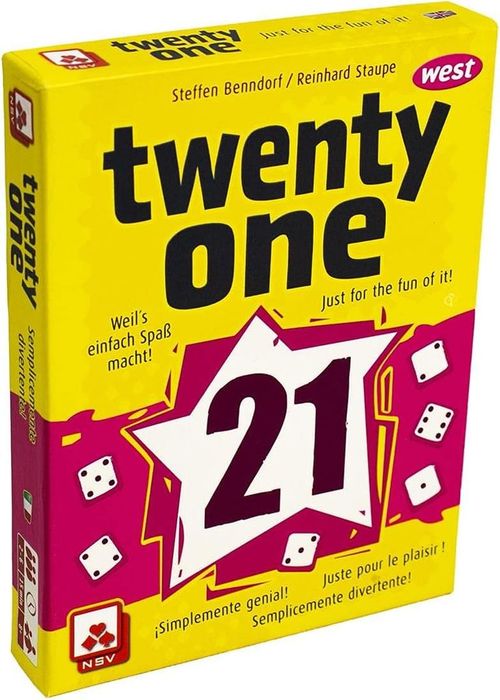
Twenty One
Twenty One Rulebook
Table of Contents
Table of Contents
Game idea and setup
Each player receives a different sheet of paper (there are 6 different sheets) and a pen. Note: Use a felt pen or a ballpoint pen if possible to make it easier to see the numbers that you have written down.
On each sheet of paper there are 5 horizontal rows. The numbers are identical on each sheet of paper. The arrangement of colors, however, is different. The rows must be completed one after the other from top to bottom. That means, each player has to first fill in the first row completely and count up the score, then fill in the second row completely and count score, etc. It is entirely possible that each player will compete the rows at a different pace and therefore be on a different row at the same time. Once a player has completely filled in all 5 rows and added up his score (finishing with the last row), the game is over.
Note: Each player is allowed to see the other players' sheets at all times.
Each sheet has 5 rows, and each row has 6 colored dice-symbol fields (red, yellow, green, blue, white, black) followed by a score box. Each colored field shows a die face with a number of pips. The small letter in the bottom corner (A-F) makes it easy to identify the different sheets.
How to play
Draw to see who goes first. On your turn, roll all six dice. If you're satisfied with your roll, you don't have to roll the dice again. If you're not satisfied with your roll, you get one opportunity to roll the dice a second time. When making a second attempt, you must roll all the dice again, except for any dice that you rolled a 1 with. Any dice that you rolled a 1 with may not be rolled again.
Example: It is Tim's turn. He rolls a 6, 4, 3, 3, 1 and 1. He would like to make a second attempt. The two dice with which he rolled a 1 he has to keep. The other four he rolls again.
Once you have finished rolling the dice (max. of 2 attempts), every player must write down at least one number in his current row (or cross out a number, see below). If anyone would like to (and is able to), he can write down more than one number, and theoretically even all six, which seldom ever happens. A number that has been rolled may be recorded in the matching colored field of the row that you are currently on, if the number is lower or the same as the number depicted in the die symbol.
Attention, an exact hit! If the number rolled is exactly the same as the number in the colored field, it is an exact hit that you indicate with a small x. An exact hit is good because it gives you bonus points once the row has been completely filled in and scored. Each player gets to decide for himself which numbers he wants to fill in, or not. Note: You should always write down exact hits because you will never get a better number for that field.
Example: Sarah writes down the black 1 in the black field with the number 1 in it. That is an exact hit, which she immediately indicates with a small x! The blue 3 is also an exact hit that she also indicates with a small x. Sarah writes down the rolled number 4 in the yellow field. Sarah could record the red 1 and the green 2, but she decides not to. She cannot record the white 4 because the number rolled is higher than the number in the colored field.
Crossing out a field: If you can't or don't want to record any numbers in your current row, you have to cross out an empty field in this row, and it has to be the field furthest to the left. Note: It is never possible to cross out a field when you also enter a number. You have to either enter a number or cross out a field. Nor is it ever possible to cross out more than one field per round.
Example: Emma has already filled in four fields in previous rounds. In the current round she can't enter anything because both the green 5 as well as the white 6 are greater than the number in the respective colored field. Emma has to cross out the field with the white 5.
After every player has entered numbers (or crossed out fields) in his current row, it is the next player's turn in a clockwise direction to roll the dice. Play then continues as described above with each player taking turns in a clockwise direction.
Full row (evaluating your score)
If a player has completed a full row by recording numbers (or crossing out fields) in his current row, this row is scored as follows:
- Add up the numbers that were entered into the fields of the row (crossed out fields are worth 0).
- There are also bonus points according to the table for the total number of exact hits in a row.
- Add the bonus points to the numbers that you have recorded in the row.
The bonus-point table (hits / points) is:
| Exact hits | 1 | 2 | 3 | 4 | 5 | 6 |
|---|---|---|---|---|---|---|
| Bonus points | 1 | 3 | 6 | 10 | 15 | 21 |
Example: Emma has completed her first row and adds up her score. She gets 14 points for the numbers that she wrote down in her row (5+0+4+2+2+1). For her three exact hits she receives 6 bonus points according to the table. Emma records her results (14+6=20) in the points box on the right.
In the next round continue on with the next row. Note: It is never allowed to enter numbers into multiple rows in the same round.
End of game
Once a player has completely filled in all five of his rows and added up his score, the game is over. All other players are allowed to add up their score for the row that they are currently on, even if it is not completely filled in. Then, all players count up the point totals from all their rows. The player with the most points wins.
Example: Linus has completed his fifth and therefore his last row (= end of game). He counts up his score for the row and then adds up his total for all five rows. His final score is: 88 points.