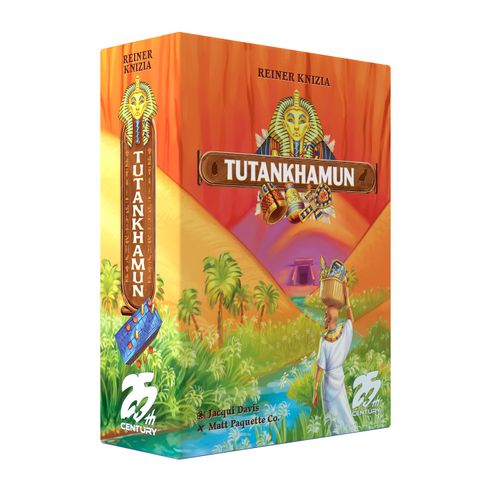
Tutankhamun
Tutankhamun Rulebook
Table of Contents
Table of Contents
Components
- 1 Rulebook
- 1 Underworld Board
- 1 King Tut Sarcophagus
- 2 Guardian Statues
- 6 Canopic Jar Scoring Markers
- 6 Boat Player Markers
- 10 God Idol Tiles
- 6 God Idol Reference Cards
- 70 Artifact Tiles
- 1 Game Box (the box bottom is the Tomb, and the Spirit Track is along its upper edge)
Note: The black corner spaces are buffers to prevent crowding. You can skip these spaces when moving your score markers.
Setup
-
Place the Tut Sarcophagus in the middle of the box bottom (the Tomb), then set the Tomb at one end of the play area.
-
Shuffle all of the Artifact and God Idol tiles together, then (selecting them randomly) arrange them face up in a long winding path from one end of the play area to the other. This path represents the Nile River, starting at its source and flowing all the way down to Tutankhamun's Tomb. Once the final tile is placed, move the Tomb so that the Tomb's door meets the open side of that final tile.
While all the tiles together represent the Nile, each individual tile also represents a God Idol or Artifact that can be found along the river.
-
Place the Underworld Mat and the two Guardian Statues at the other end of the play area from the Tomb, near the start of the Nile River.
-
Each player chooses a color, then takes the Canopic Jar and Boat marker of that color, plus a God Idol reference card.
-
The object of the game is to be the first to completely cleanse your spirit (indicated by reducing your points to zero). Each player starts with the same number of points; the more players there are, the fewer points each player starts with.
PLAYERS 2 3 4 5 6 POINTS 30 28 24 20 18
Artifact Sets
Note that the 70 Artifact tiles are divided into 13 sets — 12 normal sets and a set of Scarab Rings. One of your primary goals is to collect more tiles of a set than anyone else. There are three sets of 8 identical tiles, three sets of 6 identical tiles, three sets of 4 identical tiles, three sets of 2 identical tiles, and one set of 10 scarab ring tiles. (A tile from each set is illustrated on the back cover of this booklet.)
For the 12 normal sets, the value of each of these normal sets is the same as the number of tiles in the set: 8-tile sets are worth 8 points, and so forth.
The 10 Scarab Ring tiles will have a different style of scoring with the tiles worth 1 point each plus a set bonus. See "Tile Scoring" for more details on how to score a Scarab Ring tile.
On Your Turn
-
Sail your Boat (Choose One)
- Sail your Boat forward on the Nile to any tile ahead of you. OR
- Sail your Boat backward to the nearest tile behind you. (You may never sail beyond the nearest tile when sailing backward.)
In either case, remove this tile from the river and leave your Boat marker in its place.
-
Resolve the tile. Resolve the tile you have sailed to. If it is an Artifact tile, place it face up in front of you with the other tiles that you currently have collected. If it is a God Idol tile, resolve it immediately.
- If it's an Artifact tile and there are more tiles of this Artifact set still in the Nile, simply place it face up in front of you with the other tiles you currently have collected.
- If it's an Artifact tile and there are no more tiles of this Artifact set still in the Nile, score the Artifact set (see "Tile Scoring").
- God Idol tiles give special advantages to players who select them from the river. If the tile is a God Idol, resolve the tile immediately and then place the tile in the Tomb. (See "God Idol Tiles" for more details.)
-
Resolve any trailing tiles. If your Boat is the furthest back on the Nile, you will often sail past tiles as your boat moves forward, leaving tiles behind that everyone else has also sailed past. After you've sailed to a tile and resolved it, check to see if there are any tiles in the Nile behind your Boat that all Boats have passed. If so, move those tiles to the Underworld Mat, one tile at a time, beginning with the tile furthest back and continuing forward until one of the Boat markers is reached.
For each trailing Artifact tile that is removed, check to see if there are any other tiles of its set still in the Nile. If there aren't, score the set. Any God Idol tiles that all Boats have sailed past are also placed in the Underworld, without resolving their ability.
Tile Scoring
Normal Sets
The number on each tile of a normal set of Artifacts gives both the number of tiles in the set and the value of the set.
The player who collected the most tiles of the set scores points by moving their Canopic Jar marker down on the Spirit Track by the number listed on the tile. The player who collected the second most tiles of the set moves their Canopic Jar marker down on the Spirit Track by the number of points equal to half the set's value (1, 2, 3, or 4).
If only one player has collected tiles from that set, no second-place points are deducted.
If there is a tie for first place, the tied player whose Boat marker is further back on the Nile River earns first place with the other player taking second. If there is a tie for second, the tied player further back wins the tiebreaker and the other player(s) do not score any points.
Scarab Rings
There are 10 Scarab Ring tiles in the game (1-point tiles). These are scored differently. When you collect a Scarab Ring tile from the Nile, you immediately reduce your score by 1 on the Spirit Track. Keep the tile with the other Artifact tiles you currently have collected. Once the final Scarab Ring has been removed from the Nile, the player with the most Scarab Ring tiles is awarded a 5-point bonus. If there is a tie in who holds the most Scarab Ring tiles, the tied player whose Boat is further back on the Nile is awarded the bonus points.
Once a set is scored, collect all of the Artifact Tiles in that set from all players and the Underworld, and place them into the Tomb.
In all cases, scoring points means that you move your Canopic Jar marker toward zero. You never increase the number of points that you have.
God Idol Tiles
There are five different types of Egyptian God Idol tiles, with two tiles of each type. During setup, these are mixed in with the Artifact tiles and distributed randomly in the Nile. Idols do not score you points, but instead earn you favor from the Gods to help you on your journey.
A tile's ability is resolved immediately when a Boat lands on it, and then it is placed into the Tomb. (Note: if you land on a God Idol tile, its ability is resolved before any trailing tiles are resolved.)
If a God Idol itself is a trailing tile, it is placed into the Underworld just like a trailing Artifact tile. Its ability is not resolved when it is placed into the Underworld. The abilities are as follows:
OSIRIS — Collect any tile from the Underworld. If this is a God Idol, resolve it immediately, then discard both tiles in the Tomb. If it is an Artifact tile, keep it with the other Artifact tiles that you currently have collected. If it is a Scarab Ring, score a point, as usual, when you collect it.
ISIS — Swap a Scarab Ring you have collected with any tile in the Nile. Resolve the newly collected tile as usual. The point you scored when you originally collected the Scarab Ring remains scored. If anyone (including you) collects the Scarab Ring you returned to the Nile, that person scores yet another point when collecting it.
RA — Remove a tile from anywhere in the Nile and place it in the Underworld. If it is a God Idol tile, you do NOT get to resolve its ability. If it's the last tile of a set in the Nile, immediately score the set.
THOTH — Swap the locations of two tiles anywhere in the Nile as long as both are in front of your Boat.
HORUS — Collect any one tile in the Nile that is behind your Boat. Score if this completes a set; immediately resolve if it is a God Idol tile. OR move your Boat marker to the back of the Nile behind all other Boat markers and tiles. (Note: this cancels the removal of any trailing tiles, since they are no longer trailing.)
Two-Player Changes
When playing a two-player game, the Underworld is used as though it were another player when you determine whether or not you have enough tiles in a set to score first or second place. Should the Underworld and a player tie for the same quantity of tiles, then the player wins the tie and is awarded the points.
For example, the Senet Game set of 8 tiles is being scored. Player A has 4 tiles, the Underworld has 3 tiles, and Player B has 1 tile, Player A scores first place as usual, but Player B doesn't score second because the Underworld has more tiles than Player B.
In another example, for the same Senet Game set of 8 tiles: Player A has 3 tiles, the Underworld has 3 tiles, and Player B has 2 tiles. Player A and the Underworld are tied so the player wins the tie and takes first place. The Underworld would take second place with Player B receiving no points.
Ending the Game
The game ends at the conclusion of a player's turn when any player reaches zero on the Spirit Track. (You cannot go below zero; any excess points are ignored.) Once at least one player reaches zero, complete the current player's turn, but no one takes any more turns. If there is only one player with zero points, that player is the winner. If more than one player has reached zero on the Spirit Track, the tie is broken, as always, by whichever tied player's Boat marker is furthest back on the Nile.
If no one reaches zero before all tiles are gone from the Nile, then the player with the fewest remaining points wins, with a tie broken as usual.
Artifact Set Reference
The back cover of the rulebook illustrates one tile from each of the 13 Artifact sets:
- Scarab Ring ×10
- Ankh ×2
- Dagger ×2
- Crook & Flail ×2
- Pottery ×4
- Bracelet ×4
- Lotus Lamp ×4
- Sarcophagus ×6
- Standing Statues ×6
- Seated Statue ×6
- Senet Game ×8
- Throne ×8
- Cartouche ×8