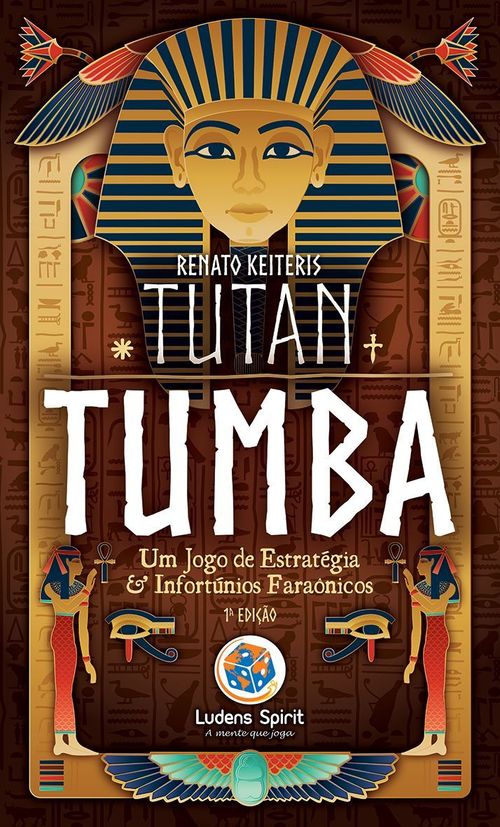
Tutan Tumba
Tutan Tumba Rulebook
Table of Contents
Table of Contents
- Components
- Setup
- How to Play
- First Action: Positioning Your Mummies [Mandatory]
- Placing Mummies on the Board
- Special Actions of the Priest
- Maat's Rest & Osiris Maneuver
- Second Action: Incinerating Enemies [Optional]
- Entering the Pharaoh's Tomb and Winning the Game
- The Vital Elements
- Advanced Game Mode: The Pharaoh's Wrath
Components
- 24 modular pieces: 22 Burial Chambers and 2 Secret Passages
- 84 Skulls: 14 Skulls in each of the 6 player colors
- 1 Central Board (the Tutan Tumba)
- 1 First Player token (round, the Pharaoh Tutankhamun)
- 6 Player Aid cards (the printed text on the aid cards is not legible in the source scan and is not transcribed; the rules they summarize are covered in this rulebook)
- 3 six-sided dice
- 1 Rulebook
Setup
-
Each player chooses a color of Skulls and places all of them in front of them on the table. This area is called the House of the Dead. They represent the player's army of mummies that will try to enter the Tutan Tumba.
-
Place the board in the center of the table. It represents the Tomb where the Pharaoh Tutankhamun is buried.
-
Separate the 22 Burial Chambers and the 2 Secret Passages. The chambers must be positioned on the sides of the main tomb so as to form the shape of a pyramid. Therefore, at the base of the tomb, in front of each of the numbers 1, 2, 3 and 4, place 3 Burial Chambers, projecting from the side out of the tomb.
We will call this horizontal formation of Burial Chambers Lines. In front of each of the numbers 5, 6, 7 and 8, place 2 Burial Chambers in the same manner as before. In the positions 9 and 10, place only 1 Chamber in each position. And finally, in front of the numbers 11 and 12, place the Secret Passage pieces.
See the picture below for the appearance of the Burial Chambers and the assembled Central Board.
-
Define the First Player. Suggestions for this choice: who saw a mummy most recently and gave it a kiss? Who traveled to Egypt most recently and broke the rest of the nose of the Sphinx?
How to Play
Starting with the first player, each player has up to two actions on their turn. The first action is mandatory and the second action is optional, and they must be carried out in that order.
First Action: Positioning Your Mummies [Mandatory]
On their turn, the player must take the three dice and roll them. From the result obtained, they make their choice of placement of their mummies in the Burial Chambers.
- The player may place 1 to 3 Mummies in the chambers in each action, according to the result of the dice.
- The numbers on the dice represent the numbers of the Lines of Burial Chambers on the Main Board.
- The player may place 1 Mummy for each number that appears on the dice, or combine them in any way they wish.
- All 3 dice must be used in every action.
Example: a roll with the result 2, 3 and 5 has the following placement possibilities:
The source prints the placement options as a table of dice icons, each with a lettered marker and a line of text. Each text line is printed above the icon row it describes. The dice combinations are shown only as icons in the source and are not described in words.
- A (dice 2, 3 and 5): Place a Mummy in each of the Lines 2, 3 and 5.
- B: Place a Mummy in Line 2 and one in Line 8.
- C: Place a Mummy in Line 3 and one in Line 7.
- D: Place two Mummies in Line 5.
- E: Place a Mummy in Line 10.
Transcriber's note: the reading of the table above (text printed above each letter's icon row) is the transcriber's reading of the page layout; the icon-to-option matching is not spelled out in the text and is given in printed order.
Placing Mummies on the Board
Mummies must always be placed in the outermost chamber to the tomb, that is, from outside to inside of the board. Each Burial Chamber can be occupied by only one Mummy at a time.
If the outermost chamber is occupied, the player must move the Mummy that was already occupying that chamber to the chamber in front of it (in the direction of the tomb) in the same line, if possible, and occupy the outermost chamber with their own Mummy.
- It is not possible to add a Mummy to a line that already has Mummies in all of its chambers.
- It is not possible to "push" a Mummy from a Burial Chamber into the Tutan Tumba by adding a Mummy in a line.
If, with the result of the dice, it is not possible to make a play using all 3 dice, the player must roll the dice again until they show a possible play, even if it is no longer the most favorable one for the player.
(Source diagram: a board with Entrance of the Chamber, Full Chambers, the Tutan Tumba and a dotted path showing a Mummy moving forward in a line.)
Special Actions of the Priest
Pharaoh's Golden Triple Power
When rolling the dice, if the player obtains 3 equal numbers as the result, the player may use the power of the Pharaoh's Golden Triple. The player may place a Mummy directly inside the Tutan Tumba.
In addition, if the player chooses to use the power, the player may remove a Mummy from inside the tomb of the opponent with more Mummies there. If there is no Mummy in the tomb yet, the player may choose to remove a Mummy from the player with the greatest number of Mummies on the whole board.
When using this power, the player may then roll the three dice again and proceed with their play with the values shown normally. If by chance the player rolls 3 equal dice again, they may benefit from the Pharaoh's Golden Triple power once more. But they may not roll the dice a third time.
The player may choose not to use the Pharaoh's Golden Triple power and carry out their play normally with the 3 equal numbers. However, they will not receive the benefit of the new dice roll.
Anubis Double Power
When rolling the dice, if the result shows 2 equal numbers, the gods favor you with the power of Anubis, and you may choose any enemy mummy to remove from any Burial Chamber (never from inside the Tutan Tumba). When choosing to use the power of the Anubis Double, the player must place a Mummy on the line whose number appears on the third die rolled. If the player cannot do so for any reason, the player cannot use the power of the Anubis Double and must therefore carry out their play normally.
Example: The Red Priest rolled the dice with the numbers 2, 2 and 3. They may use their double 2 to attack an opponent. They resolve by removing a mummy of the Blue Priest. Then, they take one of their own mummies and place it on the line numbered 3. If it is not possible to place a mummy on Line 3, the Red Priest cannot use the power of the Anubis Double to eliminate an opponent, but may use the result of the dice (2, 2 and 3) for a normal play.
Secret Passage & Ammit's Attack
When rolling the dice, if the player obtains a sum of 11 or 12 points, they may place a mummy in the passage and automatically enter the king's tomb. In addition, when incinerating (we will see more about "Incineration" below) an enemy skull, if its movement ends in the Secret Passage, your mummy also enters the tomb. This maneuver is called Ammit's Attack.
Example: The Red Priest rolled the dice and obtained a result of 6, 6 and 3. They choose to use the sum of the dice 6 and 6 to place a mummy in the Secret Passage and enter the tomb automatically. Then, they place one more mummy on the line numbered 3, mandatorily.
The Priest, in this case, could also have used the double result, 6 and 6, to make use of the power of the Anubis Double, removing an opponent's mummy and placing one more of their own on line 3. The choice of the combination and of the play is up to the player.
Maat's Rest & Osiris Maneuver
To perform Maat's Rest, at the start of your turn, the player checks whether they have completed a round with 1 mummy in the chambers of number 9 or 10, or 2 mummies in the chambers of the lines 5, 6 and/or 7, 8. In this way, one mummy may enter the tomb automatically. The other mummies on the line of the same number must be removed and returned to the player's House of the Dead.
(Source diagram: "After 1 Complete Round" and "Immediately" panels showing skulls in chambers of lines 9/10 and 5-8 entering the tomb.)
Osiris watches over his faithful followers, helping them to enter the pharaoh's tomb. In the Osiris Maneuver, on lines 1 to 4, when completing 3 mummies of a single player in a single line, the third and last mummy may enter the tomb automatically. The other two mummies of the line are removed and return to the player, since they have already fulfilled their role by helping the entry of the third mummy. The Osiris Maneuver may be carried out as many times as possible, and by any player.
(Source diagram: a single-chamber triple on a line entering the tomb.)
Second Action: Incinerating Enemies [Optional]
As a Mummy, you have the power to incinerate your enemies as you find them along your path, to save the soul of the pharaoh. To make an attack you only need to be in a chamber adjacent to your enemy and for there to be a free chamber in a straight line where you will finish your attack. That free chamber may be the pharaoh's own tomb. Only one mummy per player turn may carry out the attack action. It is not possible to incinerate your own mummies.
When incinerating an enemy mummy you must pass over it and end your movement in an empty adjacent chamber in a straight line. The attack may be made from any chamber adjacent to the enemy, and must be in a straight line — horizontal, vertical or diagonal — from outside to inside or parallel to the main board, but never backwards (except in the Advanced Game Mode).
(Source diagram: an attack from an adjacent chamber over an enemy mummy into an empty chamber in a straight line.)
It is possible to carry out multiple incinerations with one single mummy in the same play, as long as the attack rules explained above are obeyed, that is: after each incineration there must be an empty chamber, and the movement must be kept from outside to inside or parallel to the main board. In this case, after each incineration, it is possible to change direction, as in the example below.
(Source diagram: a chain of incinerations by one mummy changing direction between attacks.)
If an attack ends on the Secret Passage piece, that mummy immediately uses the passage and enters the Tutan Tumba (Ammit's Attack).
Mummies incinerated by enemies return to their players and may be used again on their respective turns.
Entering the Pharaoh's Tomb and Winning the Game
To win the game, each player must bring 8 Mummies with the Vital Elements into the pharaoh's tomb. There are 5 ways to enter the Tutan Tumba:
01 – Incinerating an Enemy: The player incinerates an enemy and the free chamber used for the maneuver is the Tutan Tumba itself.
02 – Using the Secret Passage: If on rolling the dice any combination of the numbers results in 11 or 12, the player may place their mummy in the Secret Passage and automatically enter the tomb. It is also possible to use the Secret Passage when incinerating an enemy (Ammit's Attack).
03 – Maat's Rest: At the start of their turn, the player checks whether they have completed a round with one of the lines from 5 to 10 filled with their mummies. If so, one of them may enter the tomb.
04 – Osiris' Maneuver: When completing a line of three chambers with mummies of only one player, that player carries out the Osiris Maneuver to enter the Tutan Tumba. When placing the third mummy in the third chamber of the line, they may place it directly inside the tomb. The other mummies that made up the line return to the House of the Dead in front of the player.
05 – Power of the Pharaoh's Golden Triple: On rolling the dice, if the result shows 3 equal numbers, the player may use the power of the Pharaoh's Golden Triple. The player may place a mummy directly inside the Tutan Tumba. In addition, if the player chooses to use the power, they may remove a mummy from inside the tomb of the opponent with more mummies there. If there is no mummy in the tomb yet, the player may choose to remove a mummy from the player with the greatest number on the whole board.
The first Priest with 8 Mummies in the Tomb of Tutankhamun saves the soul of the pharaoh, becomes the High Priest (Sumo Sacerdote) and wins the game!
The Vital Elements
(Flavour text from the source page, transcribed in full.)
For the ancient Egyptians the human, natural and divine worlds were considered one single thing, without barriers between them. The worlds of the dead and of the living could influence one another. For there to be life after death it was necessary to preserve the physical and the immaterial aspects of the dead. The physical aspects to be preserved were the physical body, which should be mummified, called Khet. Their name, Ren, which had to be protected, and their shadow, Shut, which gave protection under the sun of Egypt. But the immaterial aspects also had to receive offerings so that they would remain with the dead, such as Ib, their metaphysical heart, Ba, which would be their personality or soul, Ka, the vital force that sustains them, and Akh, which is their own being, the junction of Ba and Ka, or the transfigured dead who transits through different dimensions, visible and invisible. Not forgetting the Book of the Dead from the New Kingdom period. Its texts were produced on rolls of papyrus, which were wrapped in pieces of the material from which the mummies were made. The most sophisticated versions were composed of rich typographic ornaments, known as vignettes.
Advanced Game Mode: The Pharaoh's Wrath
The following is the official advanced-mode manual ("Manual da Modalidade de Jogo Avançada – A Ira do Faraó", Portuguese, version 24.01.24), transcribed in English from the Portuguese original as a separate section. It is an additional mode; the base rules above apply unless it says otherwise.
Advanced Preparation
Good! Now you have played some games of Tutan Tumba and want to take one step further towards eternity. Let us begin with a setup different from the Board:
- The first player takes all the modular pieces and distributes them to all the players, starting with the player to their left. All the pieces must be distributed, even if it is not possible to distribute them equally.
- Starting with the first player, each player, in clockwise order, must position their Burial Chambers on the sides outside the main tomb, one by one. The chambers must be placed in alignment with the numbers from 1 to 12 on the sides of the tomb and must be placed at random. The chambers must form lines from the board, which must have a minimum of 1 and a maximum of 3 Burial Chambers.
There is no distinction of chambers between the players; when placing them, they do not belong to any particular player.
Attention: The last chamber placed must necessarily be in one of the lines between the numbers 7 and 12.
- As soon as the last Burial Chamber is positioned, the player who placed it must remove all chambers in the chosen line, including the newly placed one, and replace them all with the Secret Passage piece (in this mode we use only 1 Secret Passage), which must remain connected directly to the main board and must occupy its line alone. The removed pieces, if any, must be redistributed to other lines and repositioned, following the same premise of a minimum of 1 and a maximum of 3 Burial Chambers per line.
Excitement ahead! In Tutan Tumba the game has already started in the setup! Besides all the moves you have learned, what about using some Advanced Optional Moves to make your games even more interesting?
Advanced Turn Moves
Advanced Regular Turn Move
In the Advanced Game Mode 1 – The Pharaoh's Wrath, all normal turn moves allow each of the priests to choose one of the dice to make their re-roll. Simply roll the three dice normally, then indicate the die to be re-rolled, make the new roll, and position your mummies normally in their respective Burial Chambers according to the results obtained.
After carrying out this re-roll, the player may attack their opponents normally. Priests are entitled to make only one die re-roll per turn.
Seth's Trick
Seth's Trick is a special movement that makes it possible to relocate pieces of Burial Chambers. Before the player even rolls their dice, they choose Seth's Trick and sacrifice their roll – in this round – to move a piece from the entrance or the exit of the Tutan Tumba, with or without mummies, to any place on the board, in the opposite way to its original position. The player must always respect the same rule of keeping a minimum of 1 and a maximum of 3 Burial Chambers per line on each number of the main board.
If Burial Chambers remain there that are left over, they will be distant from the main board; they must necessarily be repositioned close to it, as must all the others.
Example: The Green Priest, before rolling their dice, chooses Seth's Trick. They do not roll the dice as a penalty, thus paying their offering to the god Seth for their advanced-level play. They choose to move the piece at the entrance of the tomb on line 6, carrying it to the exit of line 10 (always in the opposite way, as the rule says), with one of their mummies inside this chamber.
After carrying out Seth's Trick, the player may attack their opponents normally.
(Source diagram: board showing the Seth's Trick example with the chamber moved from line 6 to line 10 and the Chamber Entrance marked.)
Toth's Inversion
If, on rolling the dice, the player manages to make a sequence of low numbers (the result of the dice in simultaneous sequence: 1, 2 and 3 / 2, 3 and 4, or 3, 4 and 5), in the same play, they may benefit from Toth's Inversion. Toth, as the God Scribe, holds the power of inverting the incineration of mummies! Like the God Scribe, he may invert the rules, granting the power to the player to incinerate the opposing mummies in the opposite direction (backwards) to that which the game allows.
Example: The Blue Priest, on rolling their dice, has as a result the numeric sequence 3, 4 and 5. They must position their mummies normally and may only use Toth's Inversion if they succeed in this positioning.
Right after, they carry out the attack against their opponents, but this time they may do it in the opposite direction to the Tutan Tumba, that is, backwards.
Mummies that have been incinerated must return to the House of the Dead of the player of that colour, so that they start the whole journey again.
Tutan's Wrath
If, on rolling the dice, the player obtains a sequence of the highest numbers (the result of the dice in simultaneous sequence: 4, 5 and 6), in their current play, they may benefit from Tutan's Wrath! This special maneuver holds the power to move the Main Board in the vertical direction (Top X Bottom), making it possible to change the configuration of the current game. The player may only use Tutan's Wrath if they succeed in the anticipated positioning of their mummies according to the result obtained on the dice (4, 5 and 6).
Example: as soon as the Yellow Priest achieves, as the result of rolling the dice, the sequence of the highest numbers (4, 5 and 6), they will have the possibility of moving the Main Board in any direction (Top X Bottom), only one line up, or only one line down.
First, they position their mummies in chambers 4, 5 and 6, then they move the Main Board in the desired direction. The Burial Chambers that are left loose after the movement of the board must be relocated by this player, obligatorily, to the entrance positions of the lines of the main board that are left without Burial Chambers (above or below). This must occur with or without mummies – theirs or their opponents' – on top of the chambers.
This positioning must always respect the rule of keeping a minimum of 1 and a maximum of 3 Burial Chambers per line at each number of the main board. After carrying out Tutan's Wrath, the player may still carry out the attack against their opponents.
(Source diagram: the board after a vertical shift of the Main Board, with the loose chambers relocated to the entrances.)
Receiving Eternal Life
(Lore section printed on the source page, transcribed in full.)
Receiving eternal life was possible for the ancient Egyptians, but it was not easy. It was necessary to cross 21 Pylons, pass through 15 Gateways and cross 7 Halls to reach the Hall of the Two Truths, where your heart Ib would be weighed. Supervised by Anubis and other gods, the heart was placed on a scale and weighed against an ostrich feather, symbol of the goddess Maat.
If the Egyptian had lived a life obeying the principles of universal order, justice and harmony designated by the goddess Maat, the heart would balance with the feather. If the heart were heavier, it would be devoured by the monster Ammit, thus ending the possibility of resurrection, and the dead one would then be expelled from creation.
Winning the Game: The Pharaoh's Wrath
The first player who positions 8 Mummies inside the Tutan Tumba wins the game, making Pharaoh Tutankhamun rest for ever!
As an even more complex alternative game, the players – by common agreement – may choose to position 10 Mummies (instead of 8) inside the Tutan Tumba for the final victory condition. In this way, it may happen that one or more players are left without mummies to play before the end of the game. When this occurs, the player without mummies skips their current turn until they receive mummies back that were incinerated by opponents (in subsequent turns). As soon as they receive back at least 1 mummy, they may continue their game normally in their next turns, making the best possible positioning with the current number of mummies in their House of the Dead.