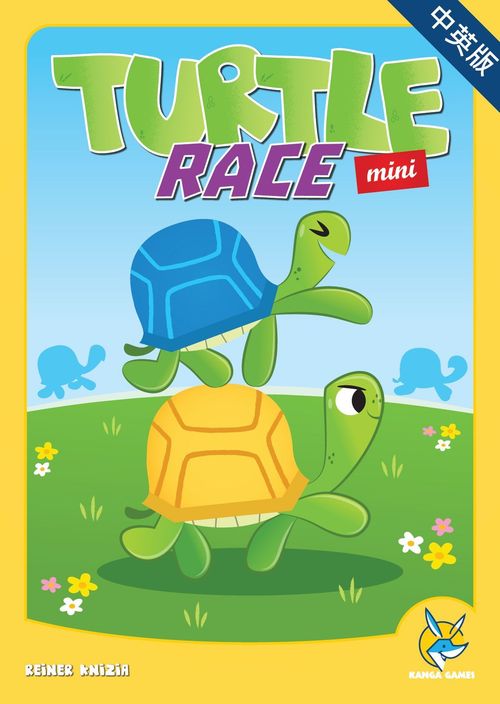
Turtle Race Mini
Turtle Race Mini Rulebook
Table of Contents
Table of Contents
Components of the Game
- 5 color cards in the five turtle colors
- 12 turtle tiles, 2 of each turtle color and two neutral
- 50 movement cards consisting of:
- 20 cards in the five turtle colors: +++ (1), ++ (2) and - - (1) in each color,
- 21 multicolored cards: ++ (6), + (6), - (3), - - (4), - - - (2),
- 6 shaking cards, and
- 3 lettuce cards.
Purpose of the Game
Players try to get a turtle in their color first to the end of the race. Throughout the game, the turtle colors are secret, however, and turtles belonging to other players can also be moved.
Game Setup
- Shuffle all the turtle tiles and place them randomly face up in a row.
- Shuffle the color cards and deal one to each player. Put unused color cards back in the box. Players check their color, but do not reveal it to the other players.
- Shuffle the movement cards and deal five to each player. Players keep their cards secret. Place the other movement cards face down in a stack on the table.
- If you receive a lettuce card in the initial hand, you shuffle it back into the deck and draw another card.
Game Flow
The youngest player starts, and the turns continue clockwise. On your turn, you perform two actions:
- Play a movement card from your hand and perform the assigned action. Place the played cards face up in a discard pile.
- Draw one movement card from the deck so that you have five cards in your hand.
Movement Cards
The + and - cards allow you to move the selected turtle in the card's color by 1, 2 or 3 places. + means move forward and - backward.
Multicolored cards are wild cards (jokers) and allow you to move a turtle in any color. Black turtles (neutral) can also be moved with these cards.
When a turtle ends its movement in the same place as another turtle, a stack of turtles is formed. The order of the turtles is from the bottom up.
Example: The player has played a green +2 card and moves the green turtle on top of the blue turtle two places ahead. Any empty spaces are filled in by bringing the turtles together.
The moving turtle carries all the turtles above it. The turtles below stay in place.
Example: The player played a blue +3 card. The blue turtle is part of a stack with (from the bottom) green, blue, yellow, and red. The blue turtle moves with the yellow and red turtle 3 places ahead. The green turtle stays in place.
You can play a + card for the first turtle or a - card for the last turtle, but then those turtles do not move.
There are blanks behind the last and before the first turtle. When the turtle reaches the first or last position, it stops moving (any excess movement points are lost).
Shaking
The player chooses the turtle at the bottom of a stack. This turtle shakes all the turtles off its back. Place them in a row behind the turtle at the bottom in the same order as they were in the stack, with the lower ones first.
Example: The player plays a shaking card on a stack with a blue turtle at the bottom, then a black, and a red on top. The black is placed behind the blue, and the red behind the black.
Lettuce
If you draw a salad card, you show it to the other players and place it face up on the table in front of the turtles. Then you draw another card.
End of the Game
The game ends as soon as the third lettuce appears on the table. Players reveal the colors of their turtles. The player with the turtle in first place wins. When several turtles in the stack are in first place, the lowest position wins. Turtles in colors that no one is playing do not count.
Example: The player who has the purple turtle wins. If no player has the purple turtle, the player with the yellow turtle wins, and so on.
Advanced Variant
In this variant, the game can last several rounds. The players keep their color secret until the end of the last round. The game is played according to the same rules as the basic game with the differences described below.
At the end of each round (three salads on the table), the first two turtles are taken out of the game and are said to have finished. The remaining turtles take part in the next race. Black (neutral) turtles always run in the next race, and the next non-black turtle is taken out instead.
Example: At the end of the first round, purple is first, black is second and yellow is third. The purple and yellow turtle finish the race. The other turtles start the next round.
A New Round
Separate the turtles in the stacks by placing them in a row behind the turtle at the bottom in the same order as they were in the stack, with the lower ones first. The players keep their cards from the previous round and play continues in turn order.
End of the Game (Advanced Variant)
The game ends when two turtles of the same color have finished the race. This can happen after the first round or after playing several games. When this happens, the players reveal their colors. The winner is the player whose both turtles have finished the race. In the event of a tie (both turtles of two players have finished the race) or both winning turtles do not belong to either player, only the last race counts, and the winner is the player whose turtle took the position farthest in front.
Example: In the first race, purple and yellow finished. In the second race, green was first, followed by yellow, and red. Green and yellow now finish the race, and the game ends after the second race, since two yellow turtles have finished. The yellow player wins. If there is no yellow player, green wins. If there is no green, red wins, and so on.