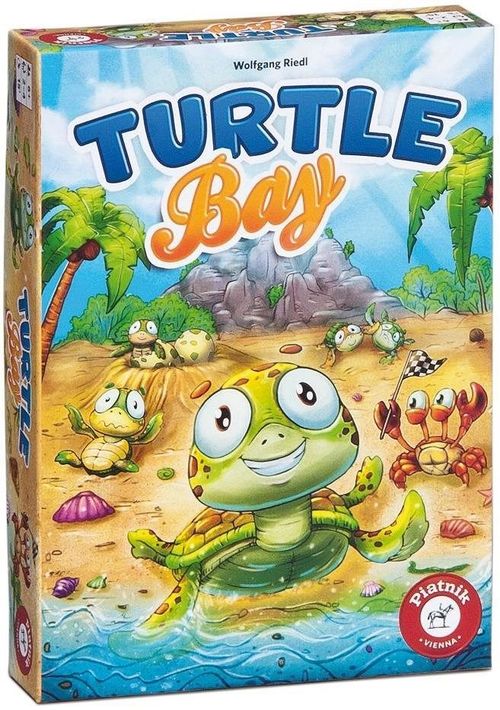
Turtle Bay
Turtle Bay Rulebook
Table of Contents
Table of Contents
Contents
- 1 board
- 20 turtles, 5 each in four different colours
- 3 dice
- 1 seaweed marker
- 1 game manual
For 2 to 4 players, aged 6 or over. Game lasts about 15 minutes.
Aim of the Game
The aim is to be the first player to get all your turtles to the ocean – with a few lucky throws.
Preparation
- Place the board in the centre of the table.
- Choose a colour, take the five turtles in that colour and place one on the start square. Place the other four turtles in a line behind it, beside the board.
- Put the three dice and the marker next to the board.
Rules
The youngest player starts. Players then take turns clockwise.
In turn, each player:
- rolls the dice
- positions the marker (optional)
- moves and turns over a turtle or turtles
1. Rolling the Dice
If all your turtles are on the start square, you only roll one die. As the game progresses, how many dice you can roll in each turn depends on how many of your turtles on the board are lying on their backs:
- 1 die if there are 0 - 1 turtles on their backs
- 2 dice if there are 2 turtles on their backs
- 3 dice if there are 3 - 4 turtles on their backs
Find out how your turtles end up shell-side-down in step 3: "Moving and turning over turtles".
Important: Even if you roll several dice, only the die with the highest number counts for that turn.
2. Positioning the Marker (Optional)
Before you start, place the marker beside the square with the turtle you want to move. This helps you remember which square your turtle started from and which turtle(s) you therefore need to turn over after moving. More on this in step 3: "Moving and turning over turtles". N.B.: You may not need to use the marker at the start of the game, but you will need it once you have multiple turtles on the move.
3. Moving and Turning Over Turtles
You now move any one of your turtles forwards by the highest number you have rolled. Important:
a. You can only move one of your turtles in any one turn. You can never split the number you have rolled between turtles.
b. Once you have moved one turtle off the start field, you immediately move the next one up in its place (if there are still turtles waiting). You decide when to move a turtle from the start square. However, you must move a turtle from the start if you cannot move any of the others.
c. You can move your turtle to the finish by rolling exactly the right number or a higher number than required. If you have rolled a higher number, the difference cannot be transferred to another of your turtles.
Turning over turtles:
Once you have moved your turtle forwards, you need to turn over all the turtles – your own or others' – that you have passed, starting from the square where you started. Use the marker to help you remember. If a turtle then is on its back, it cannot move. It must wait until another turtle passes it again and turns it the right way up before continuing on its way to the water.
Please remember: If a turtle lands on a field where there are already one or more turtles, all the turtles remain as they are. When one of the turtles is moved on from that square, the turtles remaining on the square are turned over.
Remember: The number of your turtles that are on their backs decides how many dice you can roll when it's your turn.
You should always carefully follow everyone else's moves to make sure that:
- all turtles that have been overtaken are always turned right way up again
- that a turtle on its back is not accidentally moved
Now it's the next player's turn.
The End of the Game
The game can end in one of two ways:
a. One of you manages to get all five of their turtles to the water. That player is the winner. N.B.: For a quicker game, you can play until someone gets just three of their turtles to the ocean. You still play with all five turtles in this version.
b. The player whose turn it is cannot move any of their turtles because they are either on their backs or have already reached the water. In this case, the winner is the player who has got the most turtles to the water by this point. In the event of a tie or if no one has got a turtle to the water yet, the person whose turtle is closest to the ocean wins, even if it is on its back. If this still results in a tie, you check whose second turtle is closest to the water, etc.
Tips for a Tactical Approach to Turtle Bay
- It can sometimes be an advantage to have two or more of your turtles on their backs. This means you can roll more dice and are more likely to roll a high number, and can move a turtle further. Be careful, however, that you don't end up with all your turtles on their backs, as that means the game is over.
- Keep an eye on the other players' turtles to try and prevent someone else ending the game early if this would mean you would lose.
- Be careful not to leave any of your turtles too far behind. A turtle left behind risks getting stuck.
Example: If your turtle is the second last and is overtaken by the last turtle, which overturns it, there will be no more passing turtles to right it.