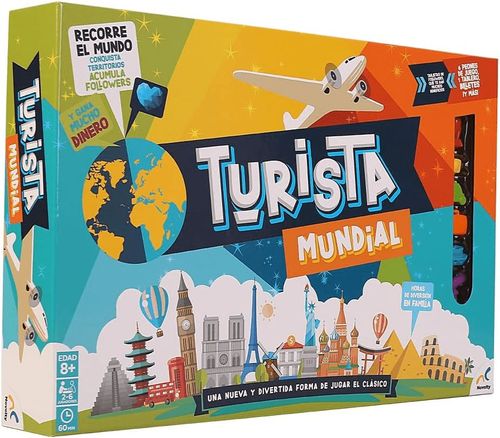
Turista Mundial
Turista Mundial Rulebook
Table of Contents
Table of Contents
- Object of the Game
- Components
- Setup
- Starting the Game
- Properties
- Rent
- Restaurants and Hotels
- Airlines, Embassy, and Consulate
- E-mail and SMS (Text Messages)
- Customs (Fiscal Traffic Light)
- Passing the Start Space
- Deported to Greenland
- Oceania
- Important Note
- Negotiations
- Mortgages
- Returns to the Bank
- Bankruptcy
- How to Win
Object of the Game
Through the purchase and tourist development of properties, increase your capital and either bankrupt your opponents, or be the player with the greatest amount of capital in properties and cash within a set time limit, to win.
Components
- Turista board
- 200 bills
- 15 SMS cards
- 15 E-mail cards
- 30 Property titles
- 36 Restaurants
- 12 Hotels
- 6 Airplanes
- 2 Dice
Players: 2 to 6. Age: 7 to 99.
Setup
- Each player is given $1,500 in cash as follows: six $5 bills, five $10 bills, six $20 bills, two $50 bills, two $100 bills, and two $500 bills. The rest of the money stays with the Bank.
- Detach the E-mail and SMS cards and place them in the indicated place on the board.
- The Property titles, the remaining money, and the Hotels and Restaurants remain with the "Bank."
- Choose one person to run the Bank. This person may or may not take part in the game.
- To determine who starts and which airplane each player chooses, each player rolls one die. The other turns follow from right to left of the winner.
Starting the Game
- Place the airplanes on the Start space.
- Roll the 2 dice and move to the right as many spaces as the dice show.
Properties
- When a player's roll brings them to a space bearing the name of a country, airline, embassy, or consulate, they may buy it for the value shown on the space, paying the Bank.
- When a property is bought, the player receives its Property title from the Bank.
- A player should try to obtain all three properties of the same set or color, since only then may they begin to build Hotels and Restaurants.
Rent
- If a player lands on a property owned by another player, they pay the rent shown on that property's Property title.
- If the owner holds the complete set, the rent is double.
- If the property has Restaurants or a Hotel, the player pays the amount shown on the Property title for what is built on the property.
Restaurants and Hotels
- Only the Bank may sell and buy Hotels and Restaurants.
- When a player holds all three properties of the same color (set), they may begin building.
- Up to 4 Restaurants may be built on each property. The next step is to place a Hotel, returning that property's Restaurants to the Bank.
- The purchase price of a Restaurant is shown on the respective Property title. The cost of a Hotel is paid as the equivalent of buying 5 Restaurants.
- Example: If a player already has four Restaurants on a property and wants a Hotel, they pay only the value of one more Restaurant to make the exchange, and the four Restaurants they had are returned to the Bank.
Airlines, Embassy, and Consulate
- These are properties, just like the countries, with the difference that they cannot be built upon.
- They collect rent according to the number of similar properties the owner holds.
E-mail and SMS (Text Messages)
- When a player lands on a space marked SMS (Text Message) or E-mail, they take the top card from the board and carry out the instruction on it (collect, pay, etc.).
- The card is then returned to the bottom of the pile.
Customs (Fiscal Traffic Light)
- When a player lands on this space, they must roll a 6, 7, or 8 with the dice to pass inspection. Otherwise, they must pay $100 to the Bank.
Passing the Start Space
- During the game, players will pass the Start space several times. Each time a player arrives at or passes the Start space, whether by rolling the dice or by the instruction of an SMS or E-mail card, the Bank pays them $200 as travel allowance.
- This payment must be claimed immediately. If it is not claimed on the player's turn, it is not paid.
Deported to Greenland
- A player who lands on the "Deported" space goes to Greenland. Once there, they must pay a fine of $50 to leave. Otherwise, they must stay for three turns as punishment.
- To leave Greenland, a player may:
- Pay $50.
- Hold an SMS or E-mail card obtained earlier that reads "Claim for leaving Greenland without paying the fine."
- Lose three turns as punishment, after which they must leave.
- It is important to note that if a player arrives exactly at Greenland by rolling the dice, it counts only as a pass-through space.
Oceania
- When a player lands on this space, they automatically lose three turns. They may leave only if, on their next turn, they roll doubles.
Important Note
- A player who is in Greenland or on the Oceania space may still collect rent and make negotiations with other players.
Negotiations
- When all Property titles have been sold, and no player holds a complete set (three properties of the same color) to build on, players may make transactions with each other on their own turn to sell, exchange, or buy properties among themselves.
Mortgages
- When a player runs out of money and has properties with nothing built on them, they may mortgage them exclusively to the Bank for the amount printed on the back of the Property title, and receive that money.
- When a property is mortgaged, the player turns its card face down to show that it is mortgaged. While it remains unpaid, no rent is collected for it.
Returns to the Bank
- Restaurants and Hotels may be sold only to the Bank. If a player needs money to settle a debt, the Bank will buy them back for only half of the price at which they were sold.
- The Bank pays the full value of a Property title, as long as it is not mortgaged. If it is mortgaged, only half of its price is paid.
Bankruptcy
- A player is declared bankrupt when they run out of money and the value of their properties is not enough to cover the debt to another player. In that case, the player may settle the debt by giving their properties to the creditor.
- Bankruptcy, or a voluntary withdrawal, removes a player from the game, but the remaining players may continue playing.
- Note: The Bank never goes bankrupt. If the Bank runs out of money, it is enough to write the amount needed on ordinary paper and convert it into money.
How to Win
- The game ends by time limit, and the richest player wins. Alternatively, the game ends when one player takes everything and bankrupts all the others.