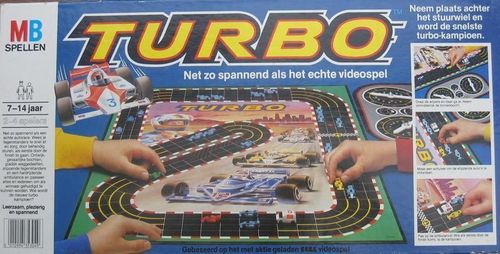
Turbo
Turbo Rulebook
Table of Contents
Table of Contents
Goal of the Game
Be the first to cross the finish line.
Contents of the Box
- 1 circuit
- 20 racing cars (1 red, 1 blue, 1 yellow, 1 green and 16 pale blue)
- 1 ambulance
- 1 double counter (each counter in two parts)
Game Preparation
- Assemble each of the two counters as shown in Diagram 1.
Diagram 1
-
Place a pale blue car on each of the 16 blue dots found on the circuit. (These cars are there to hinder the race and do not move during the game.)
-
Each player chooses the car they will drive and turns one of the counters. The player who obtains the highest number places their vehicle in the starting position, on the inside rail (inside lane), behind the Start (and Finish) line. The player to their left places their vehicle in the second lane, and the other players follow in the same direction, each placing their car in a lane. The ambulance is placed on the square marked with a red cross. (See Diagram 2.)
Track Layout (Diagram 2)
The track diagram labels the following features: the ice patch (La Nappe de Verglas), the hairpin bend (Virage en Épingle à Cheveux), the point where the ambulance starts (L'ambulance commence ici), the starting position (Position de Départ) and the 2nd, 3rd and 4th positions (2ème, 3ème, 4ème Position) on the grid, the start/finish line (Ligne de Départ / d'Arrivée), the red-hatched portion (Portion hachurée en rouge) of the chicane (La Chicane), the curves (Virage), and the yellow lines (Lignes jaunes).
The Game
-
The player whose vehicle is in the starting position on the inside lane plays first. Players play in clockwise order.
-
On your turn, turn both counters and act as follows:
a. First, move your car around the circuit a number of squares equal to the number shown on one of the counters, of your choice. Always play the full total shown.
b. Second, move the ambulance or an opponent's car a number of squares equal to the number shown on the other counter.
-
Note: If your vehicle is in a position such that you cannot play the full total shown on either counter, your points are lost. However, you must still move the ambulance or an opponent's car a number of squares equal to the number shown on one or the other counter.
Translator's note: the printed French says "vos points sont perdus" ("your points are lost"); "points" here refers to the movement total of the turn, as the rule text makes clear in the preceding paragraph.
-
How to move vehicles (your own, your opponents', or the ambulance):
a. Vehicles may move straight ahead, or change lane by moving forward diagonally to the left or to the right (see Diagram 3). Vehicles may not move sideways or in reverse (see Diagrams 4a and 4b).
Legal Moves (Diagram 3)
Diagram 3, titled Déplacements légaux ("Legal moves"), shows a car moving one square straight ahead, or one square forward diagonally to the left or to the right.
Illegal Moves (Diagrams 4a and 4b)
Diagram 4a (Illegal moves): A sideways or reverse move, as shown by the arrows, is illegal.
Diagram 4b (Illegal move): This move in a curve is illegal, because the destination square is not in the diagonal extension of the vehicle's starting square.
Exceptions:
a. Vehicles may move in any direction when they are on the ice patch (see rule 8).
b. Vehicles may not occupy a square already occupied by another vehicle.
c. "Obstacle" cars (the pale blue cars) do not move at all during the game.
5. Overtaking
A vehicle may change lane in order to overtake and gain ground, but it is forbidden to slip between two other vehicles (see Diagrams 5a and 5b).
Diagram 5a (Illegal overtaking).
Diagram 5b (Legal overtaking).
6. Changing Lane in a Curve
Note that at every curve there are yellow lines separating the lanes.
Vehicles may cross one of these yellow lines only if they move from the inside toward the outside of the curve (see Diagrams 6a and 6b).
Diagram 6a: A vehicle may cross a yellow line to change lane and move toward the outside of the curve.
Diagram 6b: This move is legal. The vehicle does not cross the yellow line.
Strategy tip: As in a curve the distance is always shorter if you take the rail, try to manoeuvre your vehicle so that it is on the inside lane before entering a curve.
Diagram 6c (Illegal move in a curve): Do not cross a yellow line if you move toward the inside of the curve.
Diagram 6d (Illegal move): This move is illegal because the vehicle crosses a yellow line and moves toward the inside of the hairpin bend. See Diagram 2 to locate it.
7. The Chicane
The chicane is the part of the circuit where the track narrows and forms only a single lane (see Diagram 2).
Vehicles may neither cross nor occupy a red-hatched square.
Strategy tip: The chicane is a good place for a traffic jam. Try to place your vehicle, or an opponent's, on the available lane in such a way that no other vehicle can pass. This will create a traffic jam that slows your opponents' race. The ambulance may also be used to create a traffic jam.
8. The Ice Patch
The icy part of the road is shown by wavy blue lines. It is the most dangerous spot on the circuit (see Diagram 2).
How to move a vehicle on the ice patch: A vehicle may move on the ice patch in any direction: backward, forward and sideways. When you move it backward, do not take it off the ice patch. During a single move, a vehicle may change direction or land on the same square one or more times.
Strategy tip: You and your opponents try to place your vehicles in an advantageous position on the ice patch. It is therefore in your interest to advance your vehicle so that it can leave the icy area on your next turn. Meanwhile, to prevent your exit, your opponents will try to push your vehicle backward. It is your turn: the player following you is ready to leave the icy area. You must try to prevent this by moving their vehicle backward.
9. The Ambulance
When the ambulance crosses the finish line, its race is over and it must be removed from the circuit.
The Winner
The player whose vehicle first crosses the finish line is the winner.
Car Championship
Schedule a series of races. For each race, the winner earns 4 points, the second-place car 3 points, the third-place car 2 points and the fourth-place car 1 point. The player who totals the most points at the end of the series is the grand winner of the Car Championship.
Alternative Way to Play
Instead of placing the 16 pale blue cars on the spaces marked with blue dots, you may choose their positions yourself at the start of each game.