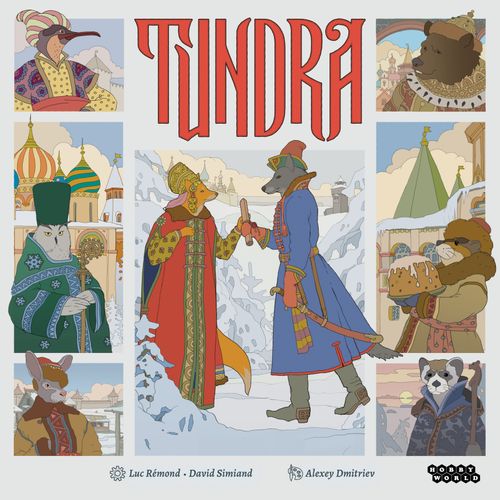
Tundra
Tundra Rulebook
Table of Contents
Table of Contents
About the game
"Tundra" is a competitive strategy game with worker distribution and resource gathering. You become a representative of one of the estates in the kingdom of Tundra and develop lands to earn the favor of the society and the Tsar.
The game is played over four rounds. In each round, the actions of all players are determined by the values of the dice rolled by the first player. Players take turns using the dice to perform a variety of actions: send workers to gather resources, build towers and hire advisors at the market, fulfill common and personal goals, and so on. During the course of the game, you can earn victory points in various ways. The player with the most victory points after four rounds wins and is named Viceroy of Tundra.
Contents
- 4 different colored sets for each player, each set contains:
- 1 double-sided player board
- 4 order boards
- 1 double-sided settlement tile
- 7 dice
- 4 tower pieces
- 6 worker pieces
- 4 markers
- 1 VP counter
- 1 acorn token (for counting VP)
- 1 game board
- 24 glade tiles
- 16 starter enhancement cards
- 40 city cards
- 9 common goal cards
- 11 personal goal cards
- 6 special title cards
- 1 white die for the "Wisdom" title
- 8 reference cards
- 1 first player token
- 1 round counter token
- This rulebook
Setup
-
Each player chooses which character they want to play as and takes a set of one color. Return all extra sets to the box.
There are four characters in the game: Duchess Elisabeth — is a representative of a noble family, Governor Polkan — is the people's guardian and protector, Abbess Sophia — is the spiritual guide of Tundra, and Merchant Hammy — is a tradesman known throughout the Tundra.
-
Each player places their dice next to their player board — this is their dice supply.
-
Each player places 4 order boards next to their player board. Place them so that the board's icon (shown on the rulebook page) is visible.
-
Place the game board at the center of the table.
-
Count out glade tiles according to the number of players:
- 2 players — all tiles without the two marker icons (three small circles each), 12 tiles in total;
- 3 players — all tiles without the one marker icon (three small circles), 18 tiles in total;
- 4 players — all 24 tiles.
Return all extra glade tiles to the box. Shuffle the glade tiles and place them face up onto the board according to the layout below, depending on the number of players. See alternate board layouts for 3–4 players on page 18.
-
Each player places their settlement tile, on the settlement space closest to them (marked red on the layout) and opens the 2 glade tiles next to their settlement (marked yellow on the layout).
-
Each player then places one worker piece on each of the starting glade tiles. The remaining worker pieces and all tower pieces are placed next to the player board — this is the player's supply.
-
Each player places 4 markers on their player board as depicted in the illustration — each marker must be placed onto one of the four tracks on the starting value marked with a darker shade. This is the set of berries and resources you possess at the start of the game.
You are ready to play.
The main concepts of the game
Glade tiles
The resource that can be collected on this tile is indicated at the top of the tile. If no resource is indicated, no resource can be obtained from this glade tile. A space for a tower piece and the tower bonus are indicated on the tile as well. Dots on the tiles indicate the number of players, as described in setup.
Note: you do not receive resources from the glade tiles you place your workers onto during setup (step 7).
Order boards
The name of each board is indicated at the top of the board. On the right side of the board there are slots, which you can place dice to use actions. The actions are separated by frames — for example, in the illustration, one action corresponds to slots 6 and 5, while the other action corresponds to slots 4, 3, 2 and 1. The price of upgrading a board is listed at the bottom of the board. Upgrading an order board allows for more beneficial actions as well as grants VP.
Player board
The player board features a portrait of your character, and their basic title listed below it. The title is the character's ability, the starting and maximum number of dice along with the maximum number of advisor cards you can hold, and the cost of free actions. The right side of the board is occupied by a berry track and three resource tracks.
There are three types of resources in the game: firewood, stone or peat. Berries are not considered a resource, so their track is a different color. When you gain resources and/or berries, immediately move the marker on the corresponding track on your board up by as many spaces as the number of resources or berries you have gained. When you spend them, move the marker down following the same logic. You can't gain more than 10 resources of each type and more than 20 berries, and the number of resources or berries cannot be negative.
Any resource — this refers to firewood, stone or peat depending on which you choose. A resource with an "equal" sign requires you to gain or spend the specified number of resources of the same type of your choice.
Victory points
A victory point track runs along the sides of the game board. In the game victory points (VP) are indicated with an acorn symbol. When you receive VP, immediately move your VP counter along the track by the required number of spaces. When your VP counter reaches the end of the track, place the acorn token on your player board and continue moving your VP counter from the first space on the track. At the end of the game, add 50 to the value on the space your VP counter occupies.
Movement and receiving resources
During the game you will be able to use movement points, which are indicated by a boot symbol. When you gain 1 movement point, move one of your workers to an adjacent glade tile or settlement tile and immediately receive 1 resource from this tile, if there is one. A tile that has a common side with the tile a worker is standing on is considered adjacent. If the tile you moved the worker to is unopened, open it.
When you gain several movement points, you can choose:
- move the corresponding number of workers to adjacent glade tiles;
- move one worker over the respective number of tiles;
- distribute the movement points among the workers.
For example, for 3 movement points you can move one worker over two glade tiles and one worker over one tile.
A single glade tile can be occupied by however many workers of different players. You get a resource from each glade tile that your worker steps on during movement.
Note: a worker can only visit each glade tile once per action, including the tile from which they start moving.
Gameplay
The game lasts 4 rounds. Each round consists of four phases:
- Start of round.
- Dice roll.
- Dice placement.
- End of round.
1. Start of round
All players simultaneously place 4 dice from their supply onto their player board during round I or II, and 5 dice during round III or IV. The ship on the round track reminds you of the additional die used in the second half of the game: time is running out, and all classes are working harder, getting an extra turn to achieve their goals.
Each player takes turns, starting with the first player, performing the following steps in order:
-
Use a title (in its entirety or in part, if desired). In a game with no special titles each player has the same basic title on their player boards:
Humble — You are taking your first steps in the Tundra and anticipating a new experience. At the beginning of every round: gain 1 movement point and gain any 1 resource of choice.
For example, Duchess Elisabeth uses her basic title "Humble" at the beginning of the game: for 1 movement point she moves her worker to an adjacent glade tile, opens it, and gains 1 stone. Then she gains a resource of her choice — she chooses peat. Elisabeth has one upgraded board and gets 1 VP for it. Elisabeth also has one tower on the board: it gives her 1 VP and 1 peat.
-
Then, at the start of the round, each player also:
- gains 1 movement point or any 1 resource of choice, as shown by the title (see above);
- receives 1 VP for each upgraded order board, if they have any;
- gains the bonuses of their towers that are placed on the board. Tower bonuses are indicated next to the tower icon on the glade tiles.
2. Dice roll
The first player rolls the dice on their player board and announces the results of the roll. All other players turn their dice to the same values as the first player's and keep them on their player boards.
3. Dice placement
During this phase, you will use dice to activate actions on the order boards.
To activate means to place your die on an empty (not occupied by another die) slot with the same value as on the die, and to take the action corresponding to that slot. You can either activate an action on one of your order boards or a common goal card on the board. The die you used to activate an action or goal card is considered used.
Starting with the first player and going clockwise, each player takes a turn: taking any one of their dice on their player board and activating an action on any of their order boards (see pp. 10–12) or activating a goal card (see p. 10).
After using one die, a player passes the turn to the next player, and everyone continues to take turns until all players run out of dice. Players without dice skip their turn. When everyone runs out of dice, the round ends.
For example, Merchant Hammy activates action 3 on his travel order board and gains 1 movement point.
Free actions
Before or after using a die, each player can spend berries to:
a) Reroll any unused die for 1 berry.
b) Change the value of any unused die by +1 or -1 for 2 berries. The values are not looped — a six and a one cannot turn into each other.
c) Buy a die from the supply for 6 berries, immediately roll it and place it on your player board. Purchased dice are returned to the supply at the end of the round. You can buy as many dice as you want per turn as long as you have enough in your supply and as long as you have enough berries. You cannot buy a die after you have run out of dice on your board and ended your turn.
Free dice actions can be performed as many times as you like per turn. A modified or purchased die can be used in the same turn if you have not used another die yet.
Example of buying dice. It is the first round. Governor Polkan has used three dice in his previous turns. Before using the fourth, he spends 6 berries to buy an extra die from the supply. Polkan rolls it immediately — it rolls a 2. He can use it now, since he hasn't used a die yet, or save it for his next turn. Due to the purchased die, Polkan will have one more turn this round.
Activating goal cards
- Condition for gaining VP.
- Die slot.
- The die values required for activation.
- Indication of the number of players for setup.
A goal card can only be activated by a die of a value indicated in white on the card. Place a die on an empty slot and gain VP according to one of the conditions: this goal card is now unavailable to the other players until the end of the round. One player can activate however many goal cards. See page 14 for more information on goal cards.
Note: If the condition for gaining VP on a goal card is the number of berries or resources, VP are awarded based on the number of required resources or berries you possess at the time of activation. You do not spend resources or berries to gain VP from such a goal card.
Activating actions using enhancement cards
Enhancement cards add new actions to the actions on order boards. As with boards, different actions on the cards are separated by frames. The frames on the cards and the board may not match up. You can perform actions on a board and cards in any order, but you cannot break one action into parts. You do not have to perform all actions or perform one in its entirety.
For example, Abbess Sophia activates action 3 on a trade board enhanced with two cards. She can take a total of three actions: one from a board (gain 2 berries and upgrade up to 4 order boards), one from a starting enhancement card (gain 1 peat), and one from an enhancement card from the row (gain 1 movement point). She can perform these actions in any order: for example, gain peat first, then move, then gain berries and/or upgrade the boards. However, she cannot gain peat or moves between gaining berries and upgrading boards.
How actions work
Architecture
Spend 2 of the same resource and remove one worker from a glade tile to your supply to build one tower on that same glade tile.
This action can be performed up to two times (up to four times on an upgraded architecture board), spending two resources of the same type each time (see an example at the end of the section). Only one tower of any player can occupy one glade tile. After completing an action, immediately gain the tower bonus indicated on the glade tile. You will also gain it at the beginning of each round. The tiles containing towers can still hold however many worker pieces of any player. You get the bonuses of all towers built in one action only after that action is completed.
Note: when you gain a worker via a tower bonus, place it on the same glade tile from which you received the bonus.
Spend 2 of the same resource and 1 berry to place one of your workers on the game board.
You can perform this action up to two times (up to three times on an upgraded architecture board), spending two resources of the same type each time (see example at the end of the section). You must place a worker either on your settlement tile or on a glade tile containing your tower. In one action you may place however many workers you want on your settlement tile, and only one worker on each glade tile with your towers (other workers, both yours and of other players, may be on the same tile).
The upgraded architecture board adds a new action:
Spend 2 of the same resource to gain 1 VP. This action can be performed as many times as the number of your towers on the board, spending two resources of the same type each time (see example below).
For example, Duchess Elisabeth has 3 firewood, 2 peat and 1 stone, and 3 of her towers on the board. Elisabeth spends 2 firewood and gains 1 VP, then spends 2 peat and gains 1 more VP. She has 2 resources left, but they are different, so Elisabeth cannot perform the action a third time. In total, she gets 2 VP for one action.
Travel
The general rules of movement are described on page 8.
- Gain 2 movement points.
- Gain 1 movement point.
The upgraded travel board contains three actions with an increased number of movement points:
- Gain 4 movement points.
- Gain 3 movement points.
- Gain 2 movement points.
Gathering
Gain up to 4, 3, or 2 resources for each of your pieces on a glade tile.
Each piece receives 1 resource from the glade on which it stands. You can choose which pieces receive resources.
For example, Duchess Elisabeth has a tower on a stone glade tile, two workers on a peat tile, and one worker on a firewood tile. Elisabeth activates action 4 on her gathering board and can gain up to 3 resources. She may choose 1 stone and 2 peat, OR 1 firewood and 2 peat, OR 1 stone, 1 peat and 1 firewood.
The upgraded gathering board gives you the ability to gain 4 of any resource (regardless of the position of your pieces) when activating actions 6 and 5, and increases the number of resources for the other actions:
- Actions 6 and 5: gain 4 of any resource (regardless of the position of your pieces).
- Actions 4 and 3: gain up to 6 resources for each of your pieces on a glade tile.
- Actions 2 and 1: gain up to 4 resources for each of your pieces on a glade tile.
Trade
Take one city card of your choice from the market and gain 1 berry.
If you take a card from the market, do not fill the empty space with a new card. If the city card deck has run out, shuffle the respective discard pile and form a new deck. See more about city cards on the right.
Gain 2 berries and upgrade up to 4 order boards.
To upgrade your boards, spend the resources indicated at the bottom of the board and flip it over to the other side. Immediately gain 1 VP — you will also gain them at the beginning of each round. Now you can use upgraded actions. If there were dice on the board, place them in the same slots on the upgraded side without activating actions. If there were enhancement cards underneath the board, they remain in place.
The upgraded trade board increases the number of berries and also gives you the ability to renew the city card market: discard all cards from the market and place new ones from the top of the deck depending on the number of players during setup.
Note: if you've upgraded your trade board before receiving berries from the same action, you still receive 2 berries, not 6.
City cards
There are two types of city cards in the game:
-
Advisor cards. Each advisor gives you a free action that you may activate during your turn before or after you use a die. After that, turn the advisor card on its side — its action becomes unavailable until the next round.
The maximum number of advisor cards is indicated on your title. If you take an advisor card in excess of the specified maximum number, you must discard one of the ones you have (you can discard a card turned on its side).
-
Enhancement cards. Place an enhancement card underneath one of your order boards. A maximum of two enhancement cards may be placed underneath one order board, one starter card and one purchased from the market. You may discard an enhancement card purchased from the market and replace it with another one.
Note: an action from an enhancement card can be activated immediately after purchasing and placing it — to do this, place the card underneath the trade board and perform the action from the card corresponding to the row on your board that was activated during this turn.
End of round
If the fourth round just passed, the game is over — proceed to scoring. If not, end the round following the directions below and begin a new round.
All players return their dice from their order boards and goal cards at the same time and return them to their respective supplies. First player discards all cards from the city market and replaces them with new cards from the top of the deck according to the number of players:
- 2 players — 4 cards;
- 3 players — 5 cards;
- 4 players — 6 cards.
Players who used an advisor card action in this round turn them back — this action will be available again in the new round. The first player moves the round counter token to the next space and passes the first player token to the player on the left.
Scoring and Victory
Get as many VP as indicated on the square below your VP counter on the VP track. If you have an acorn token with a value of 50+ on your player board, add 50 VP to the value on the square. The player with the most VP wins. In case of a tie, the challenger with more resources on their player board wins. If there is still a tie, the participant with more berries wins. If it's also a tie, then for the first time in the history of Tundra, the Tsar will have several worthy viceroys at once!
Game with personal goals and special titles
You can customize the game with special titles and personal goal cards. During setup, randomly deal one special title and personal goal card to each player. Consider the dots on the cards: in a two-player game, take the cards without the marker icon; in a three- or four-player game, take all the cards.
The special title card is your ability. Place it on your player board so that it completely covers the basic title. You can choose a side with a male or female title depending on your character. Note that some titles do not apply at the beginning of each round, but at other points in the game. Other values may also be different on a title: the maximum number of advisor cards, the starting and maximum number of dice, and the cost of free actions. If the values are highlighted on a card with a patterned border, it means they are different from the basic title on the player's board.
For example, the basic title limits you at three advisor cards. Yet the "Provident" title allows you to hold up to 4 advisor cards — this value is highlighted with a border.
Your personal goal card is your secret goal. Keep it facing down in front of you and try to complete it by the end of the game. When scoring, flip your personal goal card so that everyone can see it and check to see if the goal has been accomplished. If so, add the VP scored from the goal card to the value underneath your marker on the VP track.
See page 15 for explanations of title cards, and page 16 for personal goal cards.
Common goal cards index
The die values shown on each card are card artwork and are not reproduced here; the goal conditions are transcribed as printed.
- Get 2, 4 or 6 VP for 3, 5 or 7 of your city cards respectively. Both advisor cards and enhancement cards taken from the market under all of your order boards count. Starter enhancement cards do not count.
- Gain 2, 4 or 6 VP if you have 2, 3 or 4 upgraded order boards respectively.
- Get 2, 4 or 6 VP for 10, 15 or 20 berries accumulated respectively. Berries are not spent to gain VP.
- Get 2, 4 or 6 VP for 2, 3 or 4 of your towers on the board respectively.
- Get 2, 4 or 6 VP for 2, 4 or 6 of your workers on the board respectively.
- Get 2, 4, or 6 VP for 2, 3, or 4 glade tiles with the specified resource that have at least one of your pieces on them, respectively. If more than one of your pieces is on the same token, the token still only counts once. (Printed on three separate cards, one for each resource: stone, peat and firewood.)
- Get 2, 4 or 6 VP for 6, 12 or 18 of your resources respectively. The total of all resource types is counted. No resources are spent to gain VP.
Titles index
Each title card is placed on the player board to cover the basic title "Humble" (see Game with personal goals and special titles above).
Provident — Word of your wealth is bringing in help: at the beginning of each round, take a free advisor or enhancement card from the market, not replenishing it. Your maximum number of advisor cards increases to 4. You can afford it. Card values: starting dice 4, maximum dice 7, maximum advisor cards 4.
Wise — You're always thinking ahead: at the beginning of the game, take a white die and place it in your supply — this is your extra die, which stays with you until the end of the game. This title card increases your maximum number of dice to 8. Your renown wisdom attracts new manpower: buying an additional die will cost you 5 berries.
Eloquent — Inspired by your example, the workers enthusiastically come to help: during step 7 of setup additionally place 2 of your workers on your settlement tile.
Spirited — You are determined to win and you work hard at it: at the start of rounds I and II you have 5 dice on your board, at the start of rounds III and IV you have 6 dice. If you are the first player, you roll your dice as normal first, and then roll your additional die just for your own use. Your workers eat for two: buying an extra die will cost you 9 berries.
Hardworking — You yourself don't mind rolling up your sleeves and working hard for the good of the people you can have a maximum of three enhancement cards under each order board — one starter card and two from the market. You work so much that you don't have time for clever thinking: you can hold a maximum of 2 advisor cards.
Generous — Your generosity is returned to you a hundredfold: gain 3 berries at the beginning of each round. Workers are always willing to go out of their way to help you: changing the result of a die roll costs you 1 berry.
Personal goals index
Each personal goal card is kept secret until scoring. The goal conditions are transcribed as printed.
- Tight-knit team — Gain 2, 5 or 9 VP for 2, 3 or 4 of your towers in the longest chain of your adjacent towers, respectively. You can only get VP for one such group of towers.
- Day off — Gain 4, 10, or 17 VP for 2, 4, or 6 workers in your reserve, respectively. Workers in your reserve at the time of scoring are taken into account, even if they were previously on the board and then returned to the reserve.
- Distant borders — Gain 4, 10 or 17 VP for 6, 8 or 10 of your pieces on the edge glade tiles respectively. The glade tiles closest to the perimeter of the board are considered to be the edge tiles.
- Business acumen — Gain 2, 5, or 9 VP for 4, 7, or 11 (total) of your city cards and upgraded order boards, respectively. Advisor cards and enhancement cards taken from the market count, but not starter enhancement cards.
- Good word — Gain 4, 8, or 10 VP for 2, 3 or 4 types of glade tiles with a total of two or more of your pieces on them, respectively. There are 5 types of glade tiles in the game: settlement tiles, glade tiles with stone, peat, firewood and glade tiles without resources. Pieces can stand on different tiles of the same type.
- Curfew — Gain 2, 5, or 9 VP for 2, 4, or 6 of your workers that stand on glade tiles along with your towers, respectively. One glade tile with a tower can have as many of your workers on it as you want and they all count.
- Frugality — Gain 4, 10, or 17 VP for 2, 3, or 4 towers in your reserve, respectively. This goal requires you to build as few or no towers as possible, depending on the number of VP you want.
- Firewood deposits — Gain 4, 8, or 11 VP for 3, 4, or 5 glade tiles with the specified resource on which the number of your pieces exceeds the number of each opponent's pieces, respectively. If the number of pieces is equal, the tile does not count. Tiles with only your pieces on them count.
For example, the number of pieces of Duchess Elisabeth exceeds the number of other player's pieces on the tile with peat, and the number of pieces of Governor Polkan exceeds the number of other player's pieces on the tile with firewood.
The three deposit cards (firewood, peat and rock) each apply to glade tiles with the named resource.
Alternate board layouts for 3–4 players
The layouts for 3 and 4 players show the placement of workers as per step 7 of setup. The printed diagrams are not reproduced here; see the setup instructions above for the placement rules.
Round flow
1. Beginning of round
- Place 4 dice (during round I or II) or 5 dice (during round III or IV) onto your player board.
- Use titles with "At the beginning of each round".
- Receive 1 VP for each of your upgraded order boards.
- Receive tower bonuses.
2. Dice roll
- The first player rolls the dice from their player board, all players copy the results of the roll on their dice.
3. Die placement
- Players take turns activating actions or common goal cards, using one die from their player board per turn until they run out of dice. In addition, players may take as many free actions as they wish during their turn.
4. End of round
- Return the dice to your supply.
- Replenish the city card market.
- Turn your advisor cards back on the right side.
- Move the round counter token and pass the first player token to the next player.