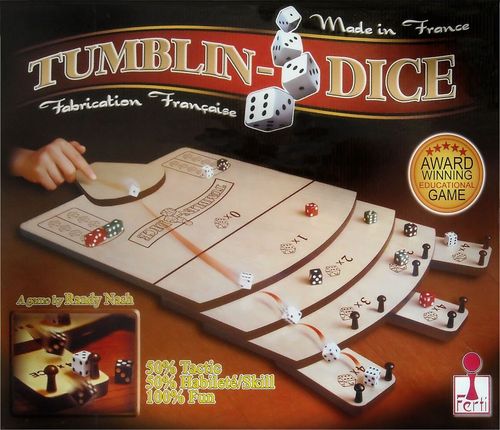
Tumblin' Dice
Tumblin' Dice Rulebook
Table of Contents
Table of Contents
Object
Be the player to score the most points in four rounds of play. If any players are tied after four rounds, then those players will play an extra round or rounds until a winner is determined.
Setup
To assemble the game board, place the smaller section with the 2x, 3x, and 4x levels on a flat surface. Now line up the wooden dowels on the bottom of the larger section with the -1x and 1x levels over the holes on the smaller section. Press firmly together. Each player chooses a colored set of dice. To determine the order of play, each player rolls one die. The highest roll goes first, followed by the next highest going next, and so on. Use a paper sheet to record your scores.
How to play?
The landing disc is the raised area between the scoreboards. The first player slides, rolls, or flicks one die off the landing disc towards the scoring zones. The die must always make contact with the landing disc first. At this point the first player's die is now resting on one of the scoring levels, or has tumbled off of the board and is no longer in play. The next player slides his die off of the landing disc with the option of advancing his own die into a scoring position, or bumping an opponent's die from the board.
A player may bump more than one die, or may bump his own die down into a better scoring position.
Play continues with each player alternating turns until all four of your dice have been used. This is the end of a round. At this point the scores are tallied.
Totally your scores: multiply the value of the die times the level on which the die has come to rest.
Example: a die which shows a 4, resting on scoring level 3 (3 x dice) would equal 12. All of the dice remaining on the board are multiplied and added in the same manner.
A die on the level -1 scores negative points. The total is your score for the round. Record your scores on the paper sheet.
You are now ready to start the second round. The player with the highest total score at the end of the previous round goes first, and the next highest second, and so on. If two or more players have the same score, then the order of play reverts back to the prior round.
Play continues until four rounds have been completed. The final score is tallied and the highest score is the winner. If two or more players are tied at the end of four rounds, then an over-time round (involving the tied players only) is played to determine the winner.
Other playing options
Instead of playing four rounds, the game can be played until a predetermined score is reached (ie. 301 or 501 points). If more than one player reaches the predetermined score, then the player with the highest score wins.
Instead of playing as individuals, play as teams. Red and green dice vs. black and white dice. Determine who will shoot first and second on each team. Play alternates just like the original game. Team mates never shoot back to back.
Younger players who have not yet learned how to multiply can play by adding the die value to the level value (instead of multiplying). For example: a die rolled lands on a four, and it comes to rest on level 3, then the score would equal 7 (4+3) instead of 12 as in regular play. This is great for children learning to add.
Additional Official Rules (translated from the French section of the same rules sheet)
The Ferti rules sheet prints its rules in several languages side by side. The English column above stops after "Other playing options"; the French column of the very same official sheet also carries the component list, the 2-player rules, the team rules and a set of variants. Those sections are reproduced below in faithful translation from the French original.
Components
- One game board in three parts
- 10 wooden dowels
- 18 dice in 4 colors (5+5+4+4)
Aim of the game
Be the first player, or the first team, to reach 301 points by flicking your dice each round.
Assembly
To assemble the board, place the "2x", "3x", and "4x" elements on the playing surface. Then fit the "1x" element in so as to obtain the same game board as shown on the box. Finally, push the wooden dowels into each hole of the board.
The raised part of the game board, projecting slightly at the back of the board, is the launching ramp (from which the dice will be propelled with a flick of the finger).
Each player then chooses a color of dice (for the distribution of the dice, refer to the following sections), then each rolls one die to determine their position in the turn order.
You are advised to have a sheet of paper and a pencil to hand in order to record the scores of each round.
Rules for individual play with 3 or 4 players
On his turn, a player places one of his dice wherever he likes on the launching ramp, then propels it with a flick of the finger towards the front of the board, in the hope that it stops on one of the numbered zones "1x", "2x", "3x", or better still "4x". The further a die stops up the game board, the more points it can potentially bring in at the end of the game.
Any die which leaves the board scores no points. Once a die has been flicked, it is not touched again (whether it scores points or not): it will always be an obstacle or an objective for the opposing players.
The players then each flick one of their dice in turn.
It is possible to knock one or more dice off the board by hitting them: all it takes is good aim. In the same way, it is sometimes wise to push your own dice, or to protect them by placing a die in line with them. As well as being a game of dexterity, Tumblin-Dice is also a tactical game.
Once the dice of all the players have been flicked, each player counts his points:
- each die located in the "-1x" part scores as many negative points as its value (example: -1 x 3 = -3 points);
- each die located in the "1x" part scores as many points as its value (example: 1 x 5 = 5 points);
- each die located in the "2x" part scores as many points as its value multiplied by 2 (example: 2 x 4 = 8 points);
- and so on with the "3x" and "4x" parts.
Note: 24 is the maximum number of points that can be scored with one die (4 x 6 = 24 points).
You play as many rounds as necessary until the sum of the points won by a player reaches or passes 301 points. If several players (or teams) reach or pass 301 points at the same time, the one or those with the most points win.
Rules for 2 players
You can play in three different ways:
- each player takes five dice of the same color;
- each player takes five dice of the same color and one bonus die of another color. The points scored by this die count double. Each player decides when he wants to flick his bonus die;
- finally, it is possible to use two colors of dice per player (that is, nine dice per player).
Team rules (4 or 6 players)
With 4 players, you form two teams of two players, each taking 4 dice of the same color. The points scored by the two colors of a single team are added together.
With 6 players, you form two teams of three players, each team having 9 dice (5 of one color and 4 of another color). Each player of a team takes three dice in hand. The points scored by the players of a single team are added together.
Variants
For the youngest players
Instead of multiplying the values of the dice by the multiplier coefficients (1x, 2x, 3x and 4x), add 1, 2, 3 and 4 respectively to the values of the dice. Example: instead of 4 x 5 = 20 points, you now calculate 4 + 5 = 9 points.
For the older players
-
Dice ejected from the board score negative points for their owner and are deducted from the total. You therefore have every interest in ejecting your opponents' dice.
-
For the team game, play to 501 points (and no longer 301) for longer games.
-
Instead of playing to 301 points, play X winning rounds (we advise you 4 winning rounds for a suitable playing time).
-
It is possible to award a bonus of points to a player if all of his dice are on the board at the end of the round. This bonus is left to the players' convenience: +10 points, +20 points, doubled points...
Being ridiculous never killed anyone...
You can play with special dice (with 8, 10, 12 or 20 faces) to spice up the games.
With other colors of dice, it is possible to play with even more players, but the games will be longer...
By playing with 1 die per person, up to 16 players can take part, forming 4 teams of 4 players. It is no doubt a bit long... but it is possible!
For the Tumblin Dice Grand Modèle only, 2 additional dice expansions are available from Ferti!