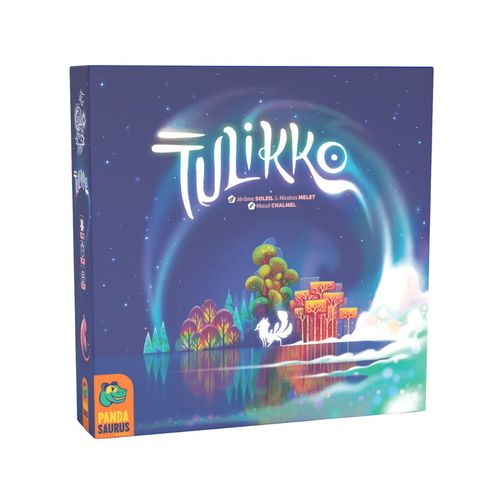
Tulikko
Tulikko Rulebook
Table of Contents
Table of Contents
Overview
Add forest tiles to your wilderness map as you explore a mystical forest. Choose tiles wisely to complete objectives and place tokens. To win, be the first to place all your tokens.
Components
- 1 central board
- 8 aurora tiles
- 12 neutral forest tiles (3 of each color)
- 4 symbol cards
- 29 landscape cards (three types with different backs: 8 river cards, 12 color cards, 9 shape cards)
For each player:
- 1 wilderness map
- 12 animal tokens
- 6 river tokens
- 12 forest tiles (3 of each color) with the player's animal on the back of the tiles
NOTE: Wilderness maps have a grid with each of the four symbols showing five times (one symbol per space, twenty spaces total). The order of the symbols is different on each wilderness map.
Setup
- Each player chooses a wilderness map and places it in front of them. Players put their 12 animal tokens (same animal as wilderness map) and 6 river tokens next to their wilderness map. This is their entire supply of tokens for the game.
- Next, players take the 12 forest tiles with the back that matches their wilderness map's animal. These tiles should be shuffled and placed face-down next to their wilderness map.
- Place the central board in the middle of the table where everyone can reach it.
- Shuffle the three types of landscape cards separately and randomly draw one of each type. Place these three cards face-up next to the central board and put the other landscape cards back in the box (they will not be used).
NOTE: For your first few games, we recommend removing the landscape cards that have this icon. You can use these cards once you are familiar with the game.
- Place the 4 symbol cards next to the landscape cards.
- Place the 8 aurora tiles in four piles by color. For each color, place both tiles active side up, with the "3" tile on top of the "4" tile.
- Take the 12 neutral forest tiles. Randomly choose five and slide them into the central board from the sides, forming a cross. The middle tile will be hidden at the center of the board. Next, each player randomly chooses one tile from the remaining neutral forest tiles and places it on any space of their wilderness map. Put the remaining neutral forest tiles back in the box without looking at them.
- The youngest player will go first.
You are ready to play!
WARNING: If a tile is sticking out, it might prevent other tiles from sliding into the central board easily. If sliding is difficult, check that all tiles are correctly aligned with the central board. If a tile gets stuck in the middle of the central board, there is a hole in the back of the central board to help move it.
Goal
To win the game, be the first to place all your animal and river tokens.
Turns
Starting with the first player, each player takes a turn, proceeding clockwise around the table.
On your turn, complete all the following actions in this order:
- Eject a forest tile from the central board.
- Place the forest tile on your wilderness map.
- Check for completed objectives.
WARNING: If you do not have any empty spaces with the correct symbol on your wilderness map, you must discard the forest tile instead of placing it.
1. Eject a forest tile from the central board
A. Turn over the first forest tile from your personal pile.
B. Slide this tile into the central board from one of the four sides, far enough so another tile is pushed out the opposite side. Take the tile that was pushed out.
2. Place the forest tile on your wilderness map
A. Place the forest tile you ejected from the central board onto your wilderness map. You must place it in an empty space with the same symbol as the side of the central board the forest tile came out of.
B. If the forest tile you just placed is adjacent to another tile, put a token from your supply between the two:
- 1 river token if the two forest tiles are different.
- 1 animal token if the two forest tiles are the same.
It is possible to place multiple tokens on the same turn. Do not place any tokens if your tile is not adjacent to other tiles or you do not have any of the required token type.
EXAMPLE: Flora places a tile next to three others, one of which is the same. She places one animal token and two river tokens.
You may also choose not to place a token between two tiles in order to complete one of the objectives shown in the Landscape Card Descriptions section. However, you may not change your mind and place the token later.
EXAMPLE: Natasha places a green forest tile which allows her to place one river token and one animal token. She completes two objectives at once! The river card and the color card. She places two animal tokens on the river card, which already has two of Flora's animal tokens. However, Natasha completed the color card objective on a previous turn, so she cannot place any additional tokens on it.
3. Check for completed objectives
After placing a forest tile, check to see if you have met the requirements for any landscape card, symbol card, or aurora tile.
If you complete multiple objectives on the same turn, apply all their effects.
A. Landscape cards
3 landscape cards are randomly chosen at the start of each game: 1 river card, 1 color card, 1 shape card.
Each landscape card shows a specific tile arrangement you need on your wilderness map in order to complete the objective. The tile arrangement is still valid if rotated, but cannot be flipped.
EXAMPLE: To complete this objective, the following four tile arrangements are valid. However, this arrangement is not valid, as it has been flipped.
If you are able to complete a tile arrangement on your wilderness map, you fulfill that objective and immediately place two of your animal tokens (or just one, if it's your last) on the corresponding landscape card, on the space with your animal.
All players can fulfill each landscape card objective once. See Landscape Card Descriptions below for details.
B. Symbol cards
The four symbol cards are used in every game, and represent the four symbols on the wilderness maps.
If you are the first to cover all five spaces with the same symbol on your wilderness map, you complete the corresponding symbol card objective. Immediately place up to two animal tokens on this card.
Unlike landscape cards, each symbol card objective can only be completed by one player.
EXAMPLE: Flora places a tile on her wilderness map, covering her last visible symbol. As the first player with no remaining symbols, Flora places two animal tokens on the corresponding symbol card. This objective is no longer available to other players.
C. Aurora tiles
There are 8 aurora tiles, 2 for each color of forest.
For each color, the first player with three forest tiles of that color on their wilderness map takes the "3" aurora tile.
When a different player places four forest tiles of that color, they take the "4" aurora tile.
IMPORTANT! A player cannot have two aurora tiles of the same color. If a player has a "3" aurora tile, they may not take the "4" aurora tile of the same color. It will go to the next player to place their fourth tile of that color.
When you earn an aurora tile, place it next to your wilderness map. You can use your aurora tiles at any time during your turn. Each aurora tile may only be used once per game. After use, flip it to the inactive side.
The effects of aurora tiles are listed in the Aurora Tile Effects section below.
EXAMPLE: Flora places her fourth orange forest tile. She already has the orange "3" aurora tile, so nothing happens. On Natasha's turn, she also places her fourth orange forest tile. Natasha takes the orange "4" aurora tile, which she can use later in the game.
End of the Game
There are two ways to end the game:
- A player places all their animal tokens and river tokens. Finish the round, so all players have played the same number of turns.
- After twelve turns, players have no remaining forest tiles in their personal piles.
If only one player successfully places all their tokens, they win the game.
If the twelfth turn finishes and all players still have tokens, count points as follows: 2 points for each unplaced animal token and 1 point for each unplaced river token. The player with the lowest score wins.
EXAMPLE: After twelve turns, everyone still has unplaced tokens. Players count points to see who wins. Flora has two unplaced animal tokens (4 points) and one unplaced river token (1 point) for a total of 5 points. Natasha has one unplaced animal token (2 points) and two unplaced river tokens (2 points), for a total of 4 points. Natasha wins!
In case of a tie, the player with the largest uninterrupted zone of one color wins. If there is still a tie, the players share the victory.
EXAMPLE: After placing a tile, Flora places her last tokens, triggering the end of the game. Flora was the first player. The others finish the round, so everyone gets the same number of turns. On her turn, Natasha also places the last of her tokens! To break the tie, they check who has the largest uninterrupted zone of one color. Flora has a zone of five tiles, whereas Natasha has a zone of only four tiles. Flora wins!
Landscape Card Descriptions
When players complete a landscape card objective they place two animal tokens on the card, on the space showing their animal. There are three types of landscape cards, with different backs: shape, river, color.
Shape cards
These landscape cards require a certain pattern of forest tiles on your wilderness map. The color of these tiles does not matter.
NOTE: Although most forms can be rotated as needed on your wilderness map and remain valid, some, given their dimensions, only have one valid orientation.
- Make this shape by placing forest tiles on your wilderness map. Their color does not matter. A rotation of this shape is also valid.
- Place a forest tile on each of the four corners of your wilderness map.
- Make a square containing forest tiles of all four different colors.
- Make this shape with forest tiles on your wilderness map. Tiles separated by a ≠ symbol must be different colors. A rotation of this shape is also valid.
- Make a line of four forest tiles, each a different color. A column is also valid.
River cards
These landscape cards require river tokens to be placed in certain patterns on your wilderness map. Rotated patterns are also valid.
- Make this shape using river tokens. A rotation is also valid.
- Join two adjacent edges of your wilderness map with a continuous stretch of at least four river tokens.
- Join two opposite edges of your wilderness map with a continuous stretch of at least four river tokens.
- Place a continuous stretch of six river tokens, in any shape.
Color cards
These landscape cards require a square of four forest tiles on your wilderness map with a specific layout of colors.
Rotations are also valid, but not flips.
- Make a square of forest tiles with the correct color pattern.
Aurora Tile Effects
Each color has two aurora tiles (labeled "3" and "4") that give a bonus. The first player to place three forest tiles of the same color takes the "3" aurora tile of that color. When a different player places four forest tiles of that color, they take the "4" aurora tile.
You can use your aurora tiles at any time during your turn. After use, flip the tile over to the inactive side. Each tile can only be used once per game.
- Place two animal tokens on a landscape card that does not already have your animal tokens and fulfill this objective, even if you do not meet the requirements.
- Place your forest tile from the central board on any empty space on your wilderness map, ignoring the symbol requirement.
- After taking the forest tile that you ejected from the central board, you may slide it back into the central board from any side to push out a different tile.
- Choose a forest tile on your wilderness map. Return all tokens along its edges to your token supply. Then move the tile to an empty space. Place tokens based on its new position.
NOTE: With this aurora tile you can retrieve the forest tile you had at the start of your turn or the forest tile hidden in the middle of the central board.
NOTE: Moving a forest tile does not undo any objectives completed beforehand, even if the movement causes the player to no longer meet the requirements.
EXAMPLE: Natasha decides to use an aurora tile to move a forest tile on her wilderness map. She removes all tokens from the forest tile's edges (two river tokens). She then moves the tile to a new position. She then places tokens based on the new location (2 animal tokens and 1 river token).